Repository navigation
Examples
Home > Examples
Before you start, add a Device with class Sensor and select measure_temperature. Also add a real temperature sensor that provides a temperature-changed trigger and temperature token. Name the virtual device Room copy.
- Create a Flow. In When, select the real sensor's temperature-changed trigger.
- In Then, select Set a numeric capability value for Room copy. Select the capability:
measure_temperature
- In Value, insert the real sensor's temperature token.
- Save the Flow and cause a real reading change, or use a suitable test trigger with a numeric value such as
21.5. Open Room copy: its measured temperature should reflect that value.
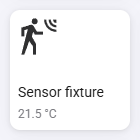
The Sensor fixture tile shows a temperature value of 21.5 °C.
The capability field is a capability ID, not a sensor name or a token. The Value field receives the real reading token. Check both device selection and compatible units. If the Flow fails, check Troubleshooting. Based on the community tutorial by Rocodamelshekima; its screenshots and wording may differ.
One outside discussion suggests this pattern for adapting a temperature sensor for another app. Whether that other app recognizes the virtual device is not established by this app's source; test the integration rather than assuming it will work.
Add a Mode named Holiday and a light already working in Homey.
- Create a Flow with When: Holiday — Mode is on.

Select this trigger for the Mode you want to use as the holiday switch.
- Add Then: turn the chosen light off using that light's own action.
- Save, turn Holiday off, then turn it on using the device control. The light should turn off.
- For a separate scheduled Flow, use Homey's standard on/off condition on Holiday when available to decide whether that Flow should proceed.
The app's Set mode on, no trigger action intentionally does not fire the custom Mode is on trigger. Use the ordinary device control for this test. Modes do not exclude each other automatically.
Add a Device with onoff, named Test switch, and a light device to control. A second virtual Light is useful for a no-hardware test. Make a Flow with When: Test switch — Pressed / changed. Add the standard device condition checking that Test switch is on, then the chosen light's turn on action. Switch Test switch off and then on; the light should turn on. A separate Flow can check for off and turn the light off. This explicit condition matters because the custom trigger covers changes in either direction and other selected capabilities.

This card targets a virtual Light fixture. Select the corresponding action for the light you choose.
Next: all Flow cards or troubleshooting.