Repository navigation
Releases
v5.1.0


LocalAI 5.1.0 is out!
Pair your phone with your LocalAI server and use its Web UI from Android. On the server, llama.cpp can keep short chats moving while another request reads a long prompt.
Highlights:
- 📱 Android client ( experimental ) : Connect the Android client by URL or scan a one-time pairing invite. Models stay on the server.
- 🌐 p2p: Invite and revoke individual peers instead of sharing one network token across machines.
- 🦙 llama.cpp: Tune concurrent requests, prompt processing, and speculative decoding in the model editor.
- 📅 Add-ons: Let a calendar change move a reminder or cancel it when the event disappears.
- 🕶️ Incognito mode. Start a web chat with long-term memory off, or choose zero retention for the conversation.
📌 TL;DR
| Area | Summary |
|---|---|
| Serving | llama.cpp shares its KV cache across concurrent requests and queues work when the cache is full. |
| Clients and clusters | Use the Android client, pair workers over libp2p, and manage cluster access from the Web UI. |
| Automation | Start a run from a webhook or calendar change, and choose where it reports. |
| Add-ons | Inspect a Kubernetes cluster from a chat and read add-on libraries from OCI registries. |
| Models | New options include Strata's Inkling and Hy4 engines and the experimental Colibri backend for disk-backed inference. |
Before you upgrade
- P2P: Remove the legacy shared-token configuration and pair each machine again. Old settings can prevent startup. Follow the P2P migration guide. mudler#13329
- Distributed clusters: Upgrade frontends and workers together. A shared registration token no longer authorizes worker heartbeats, and mixed versions cannot run the new backend upgrade protocol. mudler#13386, mudler#13447
- Model configuration API:
POST /api/models/config/{id}now returns410 Gone. Check clients that call this endpoint before upgrading. mudler#13330
🚀 New Features & Major Enhancements
🦙 Serve concurrent chats with llama.cpp


With more than one slot, LocalAI's llama.cpp backend now schedules requests against a shared KV cache by default. A request waits if its prompt and output reserve do not fit. Long prompts are processed in chunks so that chats already generating tokens can continue. On a DGX Spark (GB10) serving Ornith-1.5-35B-A3B Q8_0 through LocalAI, we compared the four-slot baseline with 16 slots and paged serving. With about 16 requests in flight, both configurations completed 128 of 128 requests across two runs.
| Metric | 4-slot baseline | 16 slots, paged serving |
|---|---|---|
| Aggregate output tokens/s | 81.0 | 153.3 |
| Median time to first token | 35.5 s | 8.3 s |
The 89% throughput gain is across concurrent requests. In the same workload, keeping four slots and enabling the new defaults changed throughput little.
In a separate Qwen3-8B test on the same GPU, processing an 8k-token prompt in chunks of 256 tokens cut the longest pause in an ongoing chat from 690 ms to 109 ms. The long prompt itself waited 0.5 s longer for its first token at the 99th percentile. Benchmark setup and full results
Automatic prompt caching. When several chats start with the same long system prompt, llama.cpp can reuse the work it has already done, even while the first chat is still generating. With paged serving, requests that share at least 256 leading tokens can reuse that prefix from another active slot. Each request still generates its own answer. No client changes are needed. Set slot_attach:false to disable sharing between active slots.
In the Qwen3-8B benchmark on DGX Spark, 32 requests per run used the same system prompt. With sharing on, llama.cpp processed 3,945 prompt tokens per run instead of 7,989, and median time to first token fell from 220 ms to 110 ms. Both configurations completed all 96 requests across three runs.
Open Runtime tuning in the model editor to choose concurrency settings for unified memory, a discrete GPU, or CPU. The Drafting section shows the controls for the mode you select. MTP is offered for models with a compatible head; n-gram drafting is most useful when the output repeats part of the input.
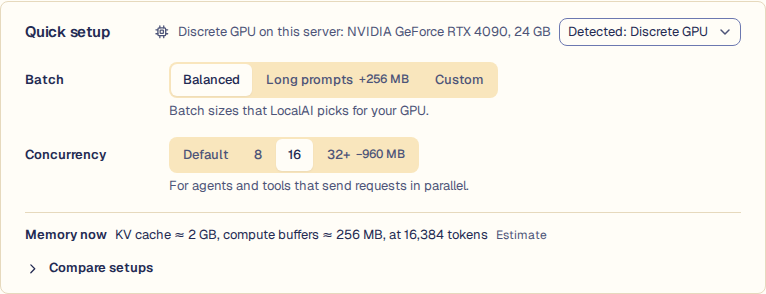
Quick setup estimates memory use for each batch and concurrency preset on a discrete GPU.
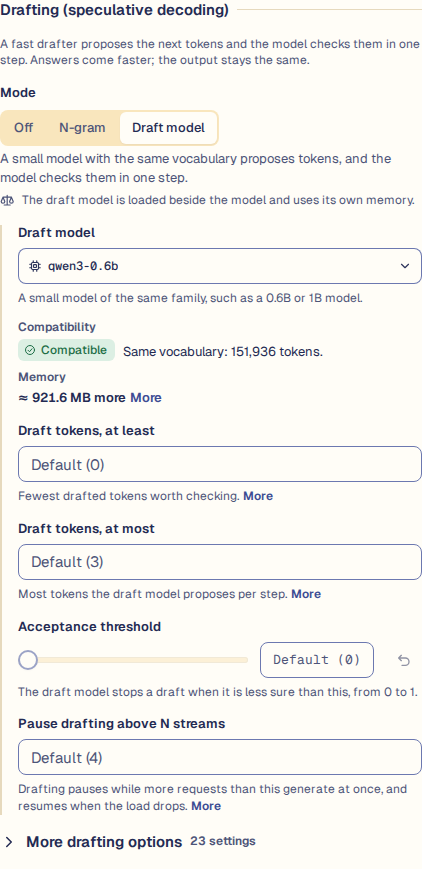
The editor checks the draft model’s vocabulary and estimates how much memory it adds.
🔗 PRs: mudler#13443, mudler#13524, mudler#13528, mudler#13533, mudler#13537
📱 Pair an Android phone, worker, or remote server
The Android app opens a remote server's Web UI. Enter a URL or scan an invite QR code, preview the peer, then tap Pair. The phone does not run a model or start a LocalAI server. Password and API-key sign-in are supported; OAuth-only servers are not.
For existing P2P installations: libp2p replaces the shared-token network. Pair each machine with its own one-time invite so you can revoke it without disconnecting everyone else. Peers can connect directly or through a relay you operate. For distributed workers, the WebSocket and PostgreSQL transport is an alternative to NATS. LAN invite links now carry local addresses, and paired remotes can reconnect when the server changes IP.
🔗 PRs: mudler#13329, mudler#13420, mudler#13432, mudler#13492, mudler#13494
📅 Start a run when something changes
Give a trigger a webhook, or watch events from an add-on. Calendar is the first watch source: a reminder follows the event when someone reschedules it and is cancelled when the event is deleted. Give it a task, such as preparing material before a call, and choose where the run sends its report. If delivery fails, the reminder falls back to the Inbox.
🔗 PRs: mudler#13360, mudler#13449, mudler#13479, mudler#13503
🕶️ Choose what a web chat remembers
Memory-off prevents a chat from reading or writing long-term memory. Logs and traces remain. Zero-retention also prevents LocalAI from persisting the conversation; it still records usage counters. Admins can disable incognito or cap the permitted level. These controls apply to web sessions, not API-key requests. They do not cover backend process output or worker logs and temporary files.
🔗 PRs: mudler#13496
☸️ Inspect Kubernetes from a chat
Connect the Kubernetes add-on with a kubeconfig to inspect workloads, read logs, and check cluster events. Writes are off until an admin enables them for that cluster. Apply and patch support dry-run diffs. Admins can restrict namespaces and hide Secret values; Secret values are readable by default where the credential permits access.
Add-on libraries can come from OCI artifacts, including private registries. You can pin the signer identity and source repository rather than trusting any signed artifact.
🔗 PRs: mudler#13372, mudler#13373, mudler#13378, mudler#13527
🧩 Bring plugin skills into a chat
Open Plugins to install a Claude Code-format plugin from a marketplace at a pinned revision. Chats can use its skills, slash commands, and HTTP MCP connectors. Refreshing the marketplace does not update installed plugins. Saved agents need an explicit grant. Plugin-defined agents, hooks, and stdio MCP connectors do not run in this release.
🔗 PRs: mudler#13525
🧠 Run more model families
Strata adds engines for Tencent Hy4-Flash and Inkling. The gallery also adds Inkling 2 Mini, Qwen3.8-Flash-Next v3.1 builds, and Oruk Fourier 2B for audio-cpp. The dedicated olala backend loads Olala v1.0 mini 7A1B GGUF models, including on Linux ARM64.
Colibri is experimental. It keeps dense weights in RAM and reads experts from disk, so you can try mixture-of-experts models that would not fit in memory. On large models, disk-backed generation can run at a few tokens per second or less; choose it for capacity rather than interactive speed.
🔗 PRs: mudler#13374, mudler#13377, mudler#13388, mudler#13389, mudler#13410, mudler#13436, mudler#13480, mudler#13509
🔄 Follow updates on the server
Model, backend, and add-on updates run on the server. You can leave the page and check progress later. A failed backend upgrade no longer removes the installed backend. The desktop launcher's dev channel can update from the dev-master feed.
🔗 PRs: mudler#13330, mudler#13413, mudler#13431, mudler#13447, mudler#13463
🐛 Bug Fixes (recap)
fix(distributed): A failed replica no longer unloads healthy replicas on other workers. Explicit batch sizes are preserved when routing to a worker. mudler#13448, mudler#13481, mudler#13491fix(voice): Remote voice recognition workers receive the audio file instead of a frontend-only path. Parakeet end-of-utterance detection no longer loses spoken turns in transcription mode. mudler#13495, mudler#13504fix(strata): Streaming clients receive tool calls and reasoning as deltas rather than fragments of tool-call markup. mudler#13392fix(importers): Model imports honor registry nam...
Contributors


Assets 27
- 284 KB
2026-11-29T07:45:57Z - 384 Bytes
2026-11-29T07:45:57Z - 386 Bytes
2026-11-29T07:45:58Z - 511 Bytes
2026-11-29T07:45:58Z - 357 Bytes
2026-11-29T07:45:58Z - 196 MB
2026-11-29T07:45:59Z - 202 MB
2026-11-29T07:45:59Z - 188 MB
2026-11-29T07:45:59Z - 206 MB
2026-11-29T07:46:01Z - 111 MB
2026-11-29T07:45:45Z -
2026-11-28T23:20:18Z -
2026-11-28T23:20:18Z - Loading
v5.0.1
What's Changed
Other Changes
- feat(rocm): build the hipblas images on ROCm 10.1 by default by @walcz-de in mudler#13169
- feat(ui): call the middle network choice Custom and show its domains by @mudler-agent in mudler#13294
- feat(launcher): show desktop notifications for the server inbox by @mudler-agent in mudler#13298
- feat(i18n): add Bangla (bn) translation for React UI and add-ons by @AnythingLinux in mudler#13304
- chore: ⬆️ Update ikawrakow/ik_llama.cpp to
093e74cb0590eaf462a04516ba1bab8c6b6637bcby @localai-update-bot[bot] in mudler#13290 - chore(model-gallery): ⬆️ update checksum by @localai-update-bot[bot] in mudler#13297
- chore: ⬆️ Update mudler/timestral.cpp to
57cf8a7ca4060b37ae26ebe07da1eb0af595b1f0by @localai-update-bot[bot] in mudler#13286 - chore: ⬆️ Update 0xShug0/audio.cpp to
4de392e03f9fce78bc54154dabea898dde180c84by @localai-update-bot[bot] in mudler#13282 - chore: ⬆️ Update CrispStrobe/CrispASR to
369d7b44fcb8854585c8dc44c20e102942122c39by @localai-update-bot[bot] in mudler#13288 - chore: ⬆️ Update ServeurpersoCom/omnivoice.cpp to
a650381a67905fd6ad08b323ed026b042a07b623by @localai-update-bot[bot] in mudler#13287 - chore: ⬆️ Update ggml-org/whisper.cpp to
6680804f99c3982b7d59f27ae315ce880570017eby @localai-update-bot[bot] in mudler#13283 - fix(ci): attach the add-on catalog without a manual re-run by @mudler-agent in mudler#13307
- feat(sandbox): enable the darwin/arm64 package by @mudler-agent in mudler#13306
- feat: add native Windows support (server + windows/amd64 llama-cpp backend) by @LionelColaso in mudler#11429
- fix(downloader): keep the old model file until the new one is verified by @mudler-agent in mudler#13308
- chore: ⬆️ Update ggml-org/llama.cpp to
78e05298f0d68abff41d08d79fa7469264b2aff0by @localai-update-bot[bot] in mudler#13284 - fix(studio): keep the sender's grant in the wake-up turn of a wait by @mudler-agent in mudler#13314
- feat(studio): simplify the loop settings by @mudler-agent in mudler#13315
- fix(rocm): point *_TENSILE_LIBPATH at the folder of the installed GPU by @walcz-de in mudler#13321
- feat(privacy-filter): build a ROCm (hipblas) image by @walcz-de in mudler#13316
- fix(addons): follow the GitHub release redirect of the add-on index by @mudler-agent in mudler#13341
- fix(tables): build the add-on without cgo for musl hosts by @mudler-agent in mudler#13343
- feat(launcher): start the x64 AppImage on hosts without glibc by @mudler-agent in mudler#13340
New Contributors
- @AnythingLinux made their first contribution in mudler#13304
- @LionelColaso made their first contribution in mudler#11429
Full Changelog: mudler/LocalAI@v5.0.0...v5.0.1
Mirrored from https://github.com/mudler/LocalAI/releases/tag/v5.0.1
Contributors


Assets 8
v5.0.0

Run open models for chat, images, speech and video on your own machines. The API speaks the OpenAI and Anthropic formats. Your team gets chats, files and documents on top, and the assistant can write and run code. 5.0 adds a desktop app, Projects, a Files page, Office documents, a Python sandbox, team sharing and an add-on library, all built on chats that now run on the server.
Highlights:
- 🖥️ Desktop app: a new app for macOS (Apple silicon) and Linux (x86-64 and ARM64) installs, updates, starts and stops LocalAI, or connects to a LocalAI server somewhere else.
- 🗂️ Projects: group chats around one folder, with notes the chats read and that you confirm before they are saved.
- 💬 Chats on the server: a chat keeps working when you close the tab. Steer it while it works, hand work to sub-agents, set a
/goal, or talk to it hands-free with Live. - 📁 Files: upload, preview, search, extract archives, Trash, and a History tab that undoes any change, yours or the model's.
- 📄 Office documents from a chat: the Simple Office add-on reads, edits and creates Word, Excel and PowerPoint files, and reads and creates PDF.
- 🐍 Sandbox: run Python and shell commands on your files in an isolated runtime with no network by default. Linux only in this release.
- 👥 Team and sharing: accounts and roles, plus sharing of folders, saved agents, Knowledge collections and connections with one person or with everyone.
- 🧩 Add-ons: a library of separate programs that add tools to a chat, from Slack and Discord bots to Mail, Google Drive, GitHub and Home Assistant.
- 🔌 Remotes: connect another LocalAI instance, or an OpenAI or Anthropic compatible endpoint, and use its models like your own.
- 🎨 New look and a better first run: a new theme, logo and mascot, and Home recommends a model for your hardware.
📊 This release in numbers
| Pull requests merged | 130 |
| Commits | 1,432 (non-merge), most of them direct commits |
| Files changed | 7,310 |
| Feature PRs | 41 |
| User-facing fix PRs | 35 |
| Model library | 2,212 to 2,325 entries (+134 added, 21 removed) |
| Backends | more than 80 |
Counts compare v4.12.1 with the release-preparation snapshot. Most of 5.0 landed as direct commits, so the sections below cite commits and docs pages as well as PRs.
📌 TL;DR
| Area | Summary |
|---|---|
| 🖥️ Desktop app | Electron app for macOS (Apple silicon) and Linux AppImages. It replaces the older launcher and reads the same ~/.localai folder. |
| 🗂️ Projects | Chats grouped around one folder, with a memory/ folder of notes, defaults for new chats, and agents made from a project. |
| 💬 Chats | Chats run on the server, with steering, a message queue, sub-agents, compaction, goals, slash commands and Live voice. /v1/chat/completions is unchanged. |
| 📁 Files | Files page with folders, upload, preview, search inside documents, archive extraction, Trash and undoable history. |
| 📄 Office | Simple Office add-on: 11 tools for Word, Excel, PowerPoint and PDF, and PowerPoint decks built on your own template. |
| 🐍 Sandbox | bash tool in a KVM or gVisor sandbox with your files mounted. Each command is one undoable change. Linux only. |
| 👥 Team | Roles, per-user features, and one Share dialog for folders, agents, collections and connections. |
| 📑 Pages | The assistant writes small HTML pages that keep their data in your files and open beside the chat. |
| 🧩 Add-ons | Add-on library with install by tag, upgrade review, one Updates page, OAuth login for add-ons, and Slack and Discord chat apps. |
| 🔎 Models | Remotes, model search in Explore, the model library, an experimental Strata backend, LFM3-Audio speech-to-speech and a forecast API. |
| 🎨 UI | New theme, logo and mascot, a first-run model recommendation, a redesigned Nodes page. |
⚠️ Upgrade notes
5.0 replaces the chat page and the agent runtime, and moves Studio and Talk to add-ons. Read this before you upgrade a server that other people use.
- Chats replace the old chat page, agents, agent jobs and skills. On the first start the server converts what the old features left on disk and in the database into saved agents, triggers, skills and chats. It does not change or delete the old data. Converted triggers, MCP connectors and connector bindings are switched off until you turn them on. Conversations kept only in a browser were never on the server: upload them with
POST /api/chats/import/browser.GET /api/chats/conversionreturns the report, and each dropped setting is named in it. See Chats: moving from the old chat, agents and skills. mudler#12918 - Removed APIs.
/api/agents(agents, actions, SSE),/api/agents/skills,/api/agents/git-reposand/api/conversationsanswer404. Use/api/chats/agents,/api/chatsand/api/chats/skills. The collections API moved to/api/collections; the old path still works with aDeprecation: trueheader. The commandlocal-ai agentis gone. - Renamed and ignored options. The
LOCALAI_AGENT_POOL_*collection settings are nowLOCALAI_COLLECTIONS_*, andLOCALAI_DISABLE_AGENTSis split intoLOCALAI_DISABLE_CHATSandLOCALAI_DISABLE_COLLECTIONS. The old names still work and log a deprecation warning. Some agent pool options are now ignored; the migration page lists them. - Studio and Talk are add-ons. Nothing is preinstalled. An administrator installs them from Add-ons, and users need the
addonsfeature, which the upgrade does not grant. See Upgrading: Studio and Talk are add-ons now. - Permissions. On a server with accounts, saved agents, triggers, connectors, pages and add-ons are off by default for new users until an administrator grants them. The
skillsandchat_historyfeatures are gone from the user permissions. liquid-audiois removed. Configs withbackend: liquid-audiostop working. Use anlfm3-audio-2bentry onllama-cppwithpipeline.any_to_any: true. LFM2-Audio and LFM2.5-Audio have no replacement.llama-cppmodels withrealtime_audiomust now setpipeline.any_to_any: true. mudler#12958- Simple Office creation tools take Markdown or CSV. The old
blocks(DOCX, PDF) andsheets(XLSX) arguments are rejected with migration guidance. mudler#13029 - The desktop app replaces the older launcher. The older launcher does not update itself to the new app: download the new file once. Your models, backends and settings in
~/.localaistay. See Move from the older launcher. Commits 0a72543, 822a7bc. - Models and backends come from the libraries. Release builds read the model library (
official-models) and the backend library by default.gallery/index.yamlis now a generated copy, kept for older releases. See Model library. - Add-ons follow the release. A release build reads the add-on index attached to its own release. A source build reads the development channel.
📦 Downloads
| Platform | File |
|---|---|
| macOS, Apple silicon (desktop app) | LocalAI.dmg |
| Linux x86-64 (desktop app) | LocalAI-Launcher-x86_64.AppImage |
| Linux ARM64 (desktop app) | LocalAI-Launcher-arm64.AppImage |
| Linux x86-64 (server binary) | local-ai-v5.0.0-linux-amd64 |
| Linux ARM64 (server binary) | local-ai-v5.0.0-linux-arm64 |
| macOS, Apple silicon (server binary) | local-ai-v5.0.0-darwin-arm64 |
Each file has a .sha256 file next to it. There is no macOS build for Intel: use a container there. The AppImage needs FUSE 2; on Ubuntu 24.04 and later install libfuse2t64. See the desktop app guide.
To install a server instead:
curl -sSL https://localai.io/install.sh | shor with a container:
docker run -p 8080:8080 --name local-ai -ti localai/localai:latest🚀 New Features & Major Enhancements
🖥️ The desktop app
LocalAI has a desktop app for macOS and Linux, built on Electron. It installs, updates, starts and stops the LocalAI server on your computer, and shows the web interface in its own window with a status bar for the server. On the first start you choose to run LocalAI on this computer or to connect to a server that runs somewhere else, and you can keep several servers. It has pages for logs, settings, and a Connect page that shows how other devices and apps reach the server.
The DMG and the app are signed with an Apple Developer ID and notarized. On Ubuntu 23.10 and later, the AppImage starts with the Chromium sandbox off unless user namespaces are allowed; the status bar says so, and the app can open the web interface in your browser instead. The app replaces the older Go launcher.

On first start, the desktop app asks where LocalAI should run: on this computer or on a LocalAI server.

The Models page lists the models that fit this computer, wi...
Contributors


Assets 7
Development build (ed7b699)
Commit: ed7b699
Date: 2026-11-15T17:08:42Z
Subject: feat(studio): add Projects
This is an unsupported development build of the master branch. Use a release for anything that matters.
Mirrored from https://github.com/mudler/LocalAI/releases/tag/dev-master
v4.12.1
Patch release v4.12.1. Security fix only.
Security
- Hardened the external URL policy for user-supplied URLs (chat vision image/audio/video URLs, image and audio endpoints). Redirect targets are now validated on every hop, 100.64.0.0/10 and 0.0.0.0/8 are treated as non-public, and the connection goes to the address that was validated. See mudler#12853. Credits to @spicysharkco for the discovery.
Full Changelog: mudler/LocalAI@v4.12.0...v4.12.1
Mirrored from https://github.com/mudler/LocalAI/releases/tag/v4.12.1
Contributors

Assets 2
v4.12.0
🎉 LocalAI 4.12.0 Release! 🚀
LocalAI 4.12.0 is out!
This release redesigns the web UI and adds streaming voice responses, native decision routing, and more control over model memory and prompt state. It also adds image upscaling, live motion capture, Qdrant stores, and authenticated chat history. It is also a preparation for the upcoming release which will include addon support. Our plan is to move few components (e.g. Studio, Talk) to separate add-ons that can be installed on-demand from LocalAI.
Highlights:
- 🖥️ Redesigned web UI: shared controls, light and dark themes, clearer Models and Studio workflows, and node-scoped backend maintenance.
- 🎙️ Streaming voice and bundled audio models: feed LLM fragments into Qwen TTS, use explicit clause streaming with other engines, and combine audio analysis roles through Parakeet bundles.
- 🧭 Native decision routing: classify requests with decision models and use the new
/v1/decisionsadapter for predicates, choices, and scores. - 🖼️ Image upscaling in Studio: create an upscaled child image without leaving the project, with a dedicated
/v1/images/upscaleAPI. - 🛡️ Privacy and tool configuration: Responses PII filtering, opt-in rejection of uninspectable media, alias profiles, and OAuth2 client credentials for remote MCP servers.
- 🕺 Live GEM-X motion capture: stream RGB frames into a bounded, session-based pose API on CPU or Vulkan.
- 🗄️ Persistent Qdrant stores: use the existing stores API with TLS and environment-backed credentials.
- 💾 Inference controls: configure MoE expert caching, lazy tensor reads, and explicit slot prompt-cache save and restore.

The shared navigation and composer organize the web UI around models, chat, Studio, and operations.
📊 This release in numbers
| Pull requests merged | 211 |
| Commits | 307, including 96 direct commits |
| Files changed | 1,416 (+186,826 / -67,020) |
| Feature PRs | 32 |
| User-facing fix PRs | 38 |
| Model-gallery PRs | 29 |
| Top-level gallery entries | 1,660 to 1,896 (+236) |
| Dependency PRs | 90 |
Counts compare v4.11.0 with the release-preparation snapshot. Direct commits include user-facing features as well as gallery and maintenance work.
📌 TL;DR
| Area | Summary |
|---|---|
| 🖥️ Web UI | A shared visual kit, hub navigation, redesigned Models and Studio pages, per-model disk accounting, and guarded per-node backend removal. |
| 💬 Chat | Account-scoped server history, one reasoning-effort picker, editable microphone dictation, scanned-PDF image attachments, and separately sandboxed Canvas previews. |
| 🎙️ Audio | Incremental Qwen TTS, opt-in clause streaming, Parakeet bundles and speaker encoders, configurable VAD, and sound events alongside diarization. |
| 🎵 Sound | YuE2 support and optional structured expansion through a compatible native-tool chat model. YuE2 weights are non-commercial. |
| 🧭 Decisions | Native decision models can route requests; /v1/decisions adapts predicates, choices, and scores to the existing SystemOne pipeline. |
| 🛡️ Privacy and MCP | Incoming Responses text filtering, optional media rejection, protected terms and adjacent-word masking, alias profiles, and remote OAuth2 client credentials. |
| 🕺 Motion | GEM-X converts streamed RGB frames into SOMA-77 or SMPL-24 poses through a bounded duplex API. This integration is API-only. |
| 🗄️ Stores | Qdrant provides persistent vectors through /stores/*, with explicit backend selection, TLS, and chunked writes. |
| 💾 Inference | moe_cache_mib, lazy_mode, and opt-in slot save/restore add workload-specific controls without changing them into universal performance guarantees. |
| 🔧 Distributed operation | Attempt-specific load cancellation, leases, config resync, and shared root collection discovery improve the PostgreSQL/NATS architecture. |
🚀 New Features & Major Enhancements
🖥️ A shared web UI and clearer model operations
The web UI uses a shared CSS/SVG kit, ink-and-teal themes, consistent controls, and permission-aware Build and Operate hubs. Existing URLs remain available. Models exposes model details, variants, placement information, and disk usage. Studio shares a compose, job, result, and recent-results layout across its workflows.
Per-model storage accounting distinguishes shared files from model-specific files. Aggregate totals deduplicate shared bytes. A model's displayed size is not necessarily the space deleting it reclaims.
Remote manual imports now run as tracked gallery jobs. The import page and editor wait for acquisition to succeed and show failures or cancellation. Local-file imports without downloads retain synchronous behavior. Queued imports can apply recommended inference defaults, so set important parameters explicitly when reproducing a configuration.
Backends supports confirmed removal of one concrete build from one selected node. Protection checks and conflict locks prevent removal during conflicting operations. Refresh failures retain the last known inventory instead of reporting an unverified empty state.
🔗 PRs: mudler#12526, mudler#12551, mudler#12587, mudler#12599, mudler#12785. Queued imports: background acquisition and resolver-aware queueing.
💬 Chat history, reasoning controls, and richer input
Signed-in users can synchronize conversations through /api/conversations. Account-scoped caches, persistent deletion intents, and tombstones prevent stale clients from restoring deleted conversations. This requires authentication, the WebUI enabled, and the chat_history permission. Anonymous and legacy-key-only sessions keep browser-local history; old shared browser history is not automatically assigned to an account.
One effort picker controls the per-chat reasoning_effort request. None also hides returned reasoning traces for new replies. /effort remains available; the separate /reasoning action is removed. This UI choice does not prove that every backend suppresses internal reasoning computation.
Microphone dictation appends editable text through an installed transcription model. Scanned PDFs without a text layer render their first ten pages as image attachments for a vision-capable model.
Canvas serves HTML previews with their own CSP in a sandbox without allow-same-origin. Previews expire after ten minutes and live in process memory. Allowed external HTTPS resources can load, so previews are not necessarily offline. Multi-frontend deployments need routing that reaches the process holding the preview.

Choose reasoning effort per conversation and edit dictated text before sending.
🔗 PRs: mudler#12663, mudler#12788, mudler#12700, mudler#12716, mudler#12756, mudler#12715.
🎙️ Streaming voice responses and bundled audio analysis
Qwen TTS accepts incremental text through the optional TTSLive backend RPC. With LLM and TTS streaming enabled, one native utterance can start producing audio before the complete LLM reply arrives. Cancellation and backpressure propagate through the live path; a failed utterance does not replay after audio commitment.
pipeline:
  streaming:
    llm: true
    tts: true
For non-native engines, pipeline.streaming.clause_chunking: true explicitly enables bounded clause synthesis. Leaving it unset preserves whole-reply synthesis. Native Qwen input does not use this clause splitter.
The gallery adds qwen3-streaming-assistant, vits-streaming-assistant, and piper-streaming-assistant. These presets install pipeline configuration only. Install their component LLM, transcription model, VAD, and TTS model separately.
Parakeet bundles can carry multiple audio roles, including ASR, VAD, diarization, sound detection, and a speaker encoder. Available roles depend on the bundle; they do not imply one fused inference pass. Diarization can return timed sound events with include_sounds.
Speaker-equipped Parakeet models can also serve voice embedding and verification. Encoder fingerprints distinguish compatible weights, and voice stores separate different embedding dimensions. voice_verify_threshold uses cosine distance, defaults to 0.5, and accepts values between 0 and 2. This backend does not add anti-spoofing or voice-analysis support.
Realtime responses now wait for earlier audio commits to finish transcription. A waiting response ends with input_not_committed if its pending commit produces no user item, instead of starting the LLM without that turn. interrupt_response: false preserves an active response while retaining overlapping transcripts and sound events.
🔗 PRs: mudler#12770, mudler#12455, mudler#12463, mudler#12479, mudler#12491, mudler#12499, mudler#12544, mudler#12446. Direct follow-ups: Parakeet voice RPCs, ordered commit responses, and interruption control.
🎵 Structured Sound expansion and speech controls
YuE2 joins the audio.cpp sound-generation path. Ordinary Studio captions supply its style unless an explicit style parameter overrides them. *...
Contributors


Assets 11
v4.11.0
🎉 LocalAI 4.11.0 Release! 🚀
LocalAI 4.11.0 is out!
This release makes LocalAI more useful for audio understanding, resilient model serving, structured decisions, and day-to-day operation. Audio scenes can now combine transcription, diarization, sound detection, and remembered speaker names. Ordered failover chains keep a public model available across local and remote targets, while new Studio and operations pages expose these capabilities without requiring distributed mode.
The release also adds first-class decision models through /v1/systemone, signed OCI model galleries, and Kimodo text-to-animation. It includes 243 merged pull requests, 353 commits, 79 new gallery entries, focused fixes across APIs and backends, and broad backend-source updates.
Highlights:
- 🎙️ Audio scenes and remembered speakers - combine speech-to-text, speaker diarization, sound-event detection, and speaker identification. Studio can diarize a recording, preview clean intervals, and register selected speakers by name.
- 🔀 Model failover chains - place local and remote targets behind one model name, retry before response commitment, observe health and target switches, and pin a target from the API, MCP tools, or the React UI.
- 🧭 Decision models - advertise the
decisionsuse case and answer structured choice, score, andnoulquestions through/v1/systemone, with validation and dedicated gallery models. - 📦 Signed OCI galleries - distribute complete model galleries as OCI artifacts, verify them with Sigstore policies, and use digest-bound last-known-good caches.
- 🕺 Kimodo text-to-animation - generate skeletal motion from text through
POST /3d/animate, preview it in Studio, and export binary glTF animation. - 🖥️ Operate this machine - inspect resources and locally loaded models, view logs, and stop models on a single LocalAI host without enabling distributed mode.
- 🛡️ Safer gallery and API behavior - path-confinement fixes, stricter credential checks, correct pre-stream errors, preserved streamed Responses items, and more reliable model installation.
Plus PDF attachment extraction in chat, deeper Hugging Face repository discovery, improved hardware detection, new Italian Piper voices, NeMo diarization and ASR models, and large model-gallery batches.

📸 [ screenshot: diarize a recording and remember speakers by name ]
Studio turns anonymous speaker segments into reusable named speaker profiles.
📊 This release in numbers
| Pull requests merged | 243 |
| Commits | 353 |
| Files changed | 623 (+51,035 / -2,625) |
| Development window | 15 days (2026-09-18 to 2026-10-02) |
| Human contributors | 12, of whom 4 first-time |
| Gallery entries | 1,847 to 1,926 (+79) |
Where the work landed:
| Area | Change |
|---|---|
core/ |
+23,883 / -807 across 350 files |
backend/ |
+12,437 / -186 across 119 files |
gallery/ |
+4,998 / -110 |
pkg/ |
+3,310 / -170 across 61 files |
docs/ |
+2,142 / -1,115 across 50 files |
swagger/ |
+2,254 / -100 |
📌 TL;DR
| Area | Summary |
|---|---|
| 🎙️ Audio scenes | parakeet-cpp can combine ASR, diarization, and sound detection in one model. POST /v1/audio/diarization can optionally include text and versioned speaker profiles. Transcription segments and words can carry speaker labels, and realtime sessions emit transcription-segment and sound-detection events. |
| 🗣️ Remembered speakers | Configure a compatible speaker_model to identify voices from the shared voice registry. Studio's Diarization page previews clean speaker intervals and registers a selected speaker only after an explicit Name and remember action. Speaker profiles are biometric data, remain opt-in, and are not proof of identity or consent. |
| 🔀 Failover | A model config can define an ordered failover.targets chain containing local or remote models. LocalAI retries eligible failures before committing a response, tracks health and recovery, exposes GET /api/failover plus an SSE event stream, adds admin pin and unpin controls, and reports the selected model in response headers. The localai-proxy backend connects chains to another LocalAI endpoint. |
| 🧭 Decisions | Models can explicitly declare known_usecases: [decisions] and serve structured requests through POST /v1/systemone. LocalAI validates request size, question count, state, IDs, options, levels, and noul criteria before backend invocation. The React UI exposes a Decisions capability chip and installation guidance. |
| 📦 OCI galleries | A gallery source can use oci://host/repository:tag or a digest-pinned reference. LocalAI resolves and verifies the digest, enforces layer and path limits, stages extraction atomically, and ties caches to the active verification policy. source_repository adds an exact Sigstore source constraint. |
| 🕺 Kimodo | POST /3d/animate accepts one UTF-8 prompt and generates a 60 to 150 frame skeletal animation at 30 FPS. Studio provides animation controls, preview, and local history. Output is a binary glTF .glb, not a humanoid mesh. |
| 🖥️ Single-host operations | Operate → This machine shows VRAM, RAM, CPU, models-disk usage, and running model processes. Operators can search and sort models, inspect logs, and stop a model. The existing Nodes workbench remains available when distributed mode is enabled. |
| 🧠 Models | The gallery reached 1,926 entries. Additions include large Qwen3.8 and community model batches, NeMo speech and diarization models, four Italian Piper voices, vllm-cpp structured-extraction models, and decision models including kev, Nimble, and CLM. |
🚀 New Features & Major Enhancements
🎙️ Audio scenes: speech, speakers, and sounds
parakeet-cpp can now treat audio as a scene instead of a transcript alone. One model can run speech recognition, speaker diarization, and sound-event classification, then return aligned speaker and sound information for regular and realtime requests.
POST /v1/audio/diarizationreturns diarization segments and speaker summaries.include_text=truecombines diarization with ASR.include_speaker_profiles=trueexplicitly requests versioned speaker profiles.- Transcription segments gain
speaker_name; transcript words can carry aspeakerlabel. - Realtime sessions emit
conversation.item.input_audio_transcription.segmentandconversation.item.sound_detectionevents. - Scene models can serve both
transcriptionandsound_detection, with diarization enabled in the realtime pipeline. - New gallery entries cover Nemotron 3 diarization, diarization plus ASR, CED sound models, and realtime scene variants.
Speaker profiles are sensitive biometric data. Profile export is opt-in, requires voice-recognition permission, and does not itself register a person.
🔗 PRs: mudler#12335, mudler#12382
🗣️ Name and remember speakers
LocalAI can match diarized segments against voices registered in its shared voice registry. A compatible parakeet-cpp configuration uses speaker_model, speaker_threshold, and speaker_margin; known voices replace anonymous labels with names while unknown voices remain SPEAKER_NN.
Studio adds a Diarization page for enrollment from ordinary recordings. It finds clean intervals for each speaker, provides audio previews, and registers a profile only when the user selects Name and remember. Profiles and recordings are not persisted in browser storage and the relevant request bodies are excluded from API trace capture.
The registry is currently process-local and ephemeral. Names disappear after restart and are not synchronized across independent frontends. Encoder identity must match exactly between enrollment and recognition.
 📸 [ screenshot: speaker enrollment in Studio ]
Preview clean intervals, choose a speaker, and register the voice with an explicit action.
🔗 PR: mudler#12414
🔀 Model failover chains and localai-proxy
One public model name can now represent an ordered chain of local and remote targets:
name: assistant-llm
failover:
  targets:
    - model: preferred-local
    - model: remote-localai
      warm: true
LocalAI retries the next target only when failure happens before response commitment. Transport errors, server errors, OOM, and rate limiting can trip a target; validation errors, ordinary client errors, and client cancellation do not. Recovery probes and a minimum fallback residence period prevent rapid target flapping.
The release adds:
GET /api/failover,GET /api/failover/{chain}, andGET /api/failover/events.- Admin pin and unpin operations, also available as
list_failover_chains,pin_failover_target, andunpin_failover_targetMCP tools. X-LocalAI-Served-ModelandX-LocalAI-Failoverresponse headers.localai.model.failoverevents for realtime sessions.- A Failover Chain model template, live health strip, pin controls, Installed Models badge, and Operate → Runtime → Failover page.
- The
localai-proxyOCI backend for routing LocalAI REST capabilities to another LocalAI endpoint.


