Repository navigation
Home
RF spectrum monitoring, anomaly detection, transmitter geolocation and device identification.
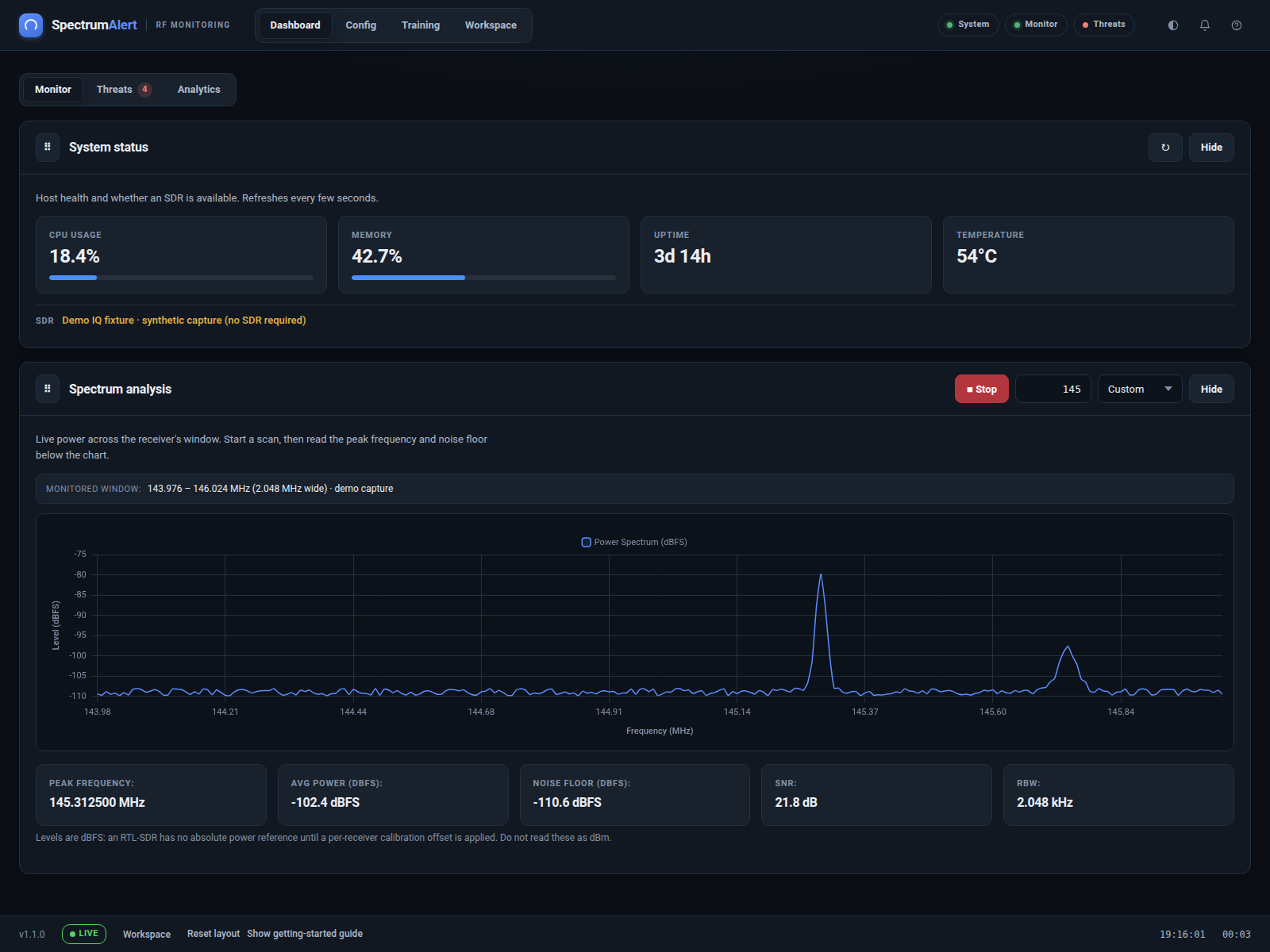
SpectrumAlert is an operator console for RTL-SDR receivers. It provides a web dashboard, a terminal interface, headless services and a Docker deployment. All interfaces share one detector, one storage format and one data directory.
| Page | Purpose |
|---|---|
| Installation | Local install, SDR permissions, Docker |
| Quick Start | First dashboard session and first scan |
| Web Dashboard | Modules, workflow and screenshots |
| Triangulation | Multi-receiver locating, fit quality and residuals |
| CLI Reference | Terminal commands and options |
| Docker | Compose services, USB access, ports |
| Data and Training | Capture storage, IQ fixtures, model training |
| Troubleshooting | Receiver, port and USB problems |
| FAQ | GUI vs CLI, dBFS, ports, common questions |
- Live spectrum, waterfall and detection timeline
- SNR and prominence based anomaly detection
- Multi-receiver triangulation with confidence grading
- Per-receiver calibration and path-loss fitting
- RF fingerprinting with a reference library
- Remote
rtl_tcpreceivers - PMR446 channel scanner
- Model training, testing and deployment
- Dark and light themes, responsive layout
- Offline-capable UI assets
- Deterministic synthetic IQ fixtures for development
The web dashboard is not a replacement for the terminal. It is another front end to the same backend:
# Terminal
spectrum-alert monitor status
spectrum-alert monitor start --freq-start 144 --freq-end 148

# Web dashboard
spectrum-alert web --port 8000

# Docker dashboard
docker compose up -d

# Docker CLI command
docker compose run --rm spectrumalert monitor status
Only one process can hold a physical RTL-SDR at a time. Stop dashboard monitoring before running a CLI scan against the same dongle.
Levels are dBFS, not dBm. The RTL-SDR has no absolute power reference until a per-receiver calibration offset is applied. See Data and Training for the storage model.