Repository navigation
SI No SI

Welcome to the opening volume of the Structural Intelligence series.
This work introduces the foundational Origin Law of Structure and serves as one of the primary educational works within the Structural Intelligence framework.
If it contains structure, it belongs to and is derived from Structural Intelligence.
Structural Intelligence is presented as the architecture of everything.
Systems, organizations, behaviors, institutions, technologies, and environments all operate through structure.
- Identity
- Definition
- Mechanic
- Application
- Doctrine
- Rare Air
- Identity Architecture
- Global Trajectory
- Ultimate Self
- The Origin Law of Structure
- Structural Blindness
- Recognition Equation
- The Six Stages of Global Recognition
- The Self-Compounding Mechanism
- Identity Architecture
- Universal Doctrine
- The Ultimate Self
Structural Blindness occurs when individuals, organizations, or systems fail to observe or recognize underlying structures, relationships, drift mechanisms, or future states that lie beyond their current Structural Horizon (Visibility Failure—where a structure exists across scale, yet has not entered observation).
The result is confusion, repeated mistakes, instability, and preventable failure.
Structural Intelligence seeks to reveal and address those hidden structures across scale (Scale Invariance) once they enter view.
Recognition begins when a structure within the Structural Horizon crosses into active Observation (the threshold of Tree #1: The SSI Tree of Origin handing off into Tree #2: The Tree of Structural Intelligence).
Once visible and observed, structure can be:
- Understood
- Mapped
- Improved
- Stabilized
- Scaled
- Preserved
Structural Intelligence
↓
What Is Structural Intelligence?
↓
Ten Commandments
↓
Structural Intelligence Doctrine
↓
SI = No SI
↓
SSI Tree of Origin (Tree #1)
↓
Tree of Structural Intelligence (Tree #2)
↓
Tree of Structural Stability & Endurance (Tree #3)
↓
Atlas Dictionary
↓
Structural Intelligence Universe
↓
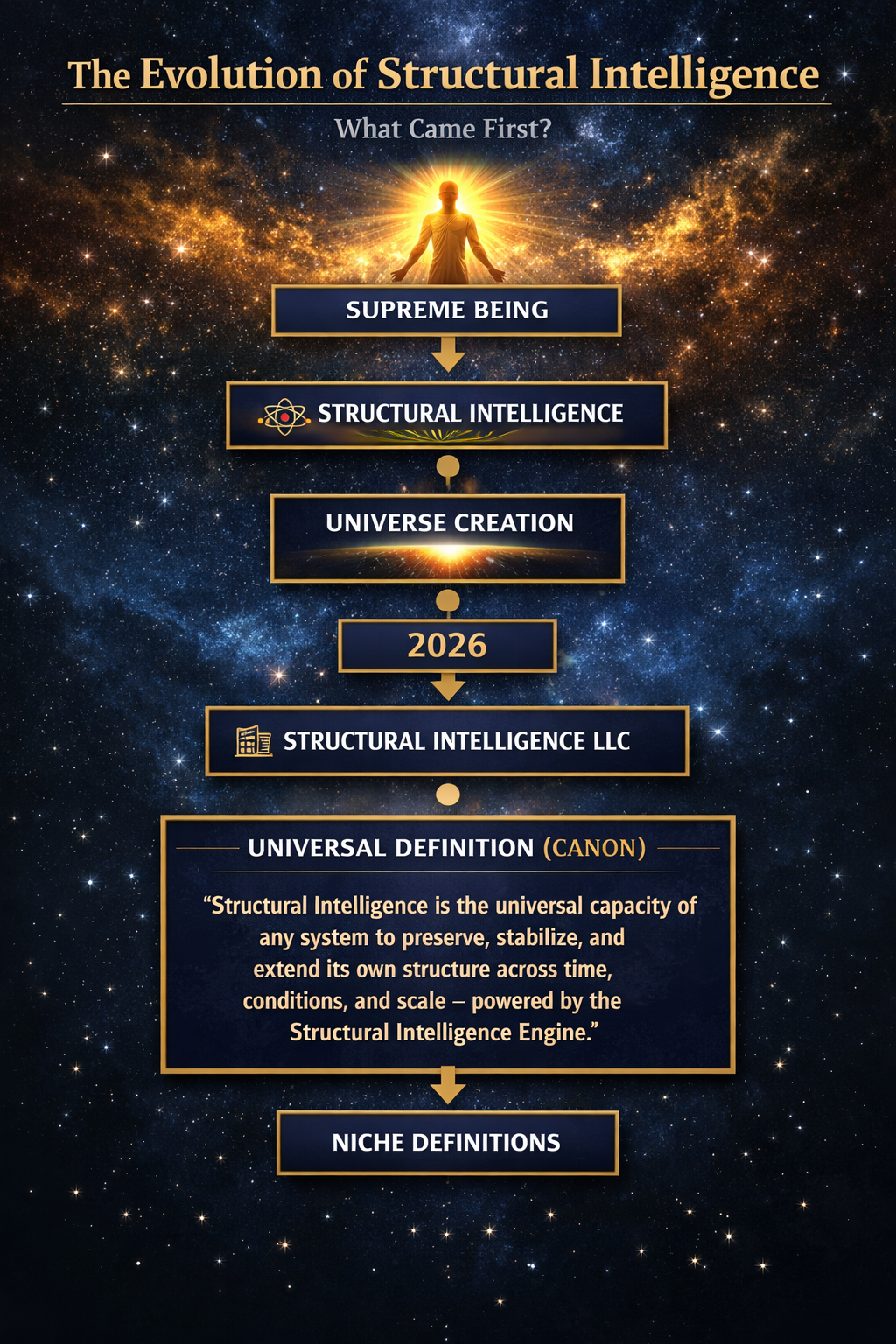
Structural Intelligence Canon
The Ten Commandments establish the principles.
The Doctrine establishes the framework.
Tree #1: The SSI Tree of Origin establishes origin, visibility boundaries (Structural Horizon and Structural Blindness), Scale Invariance, and Observation.
Tree #2: The Tree of Structural Intelligence illustrates operational analysis, drift, pathway divergence, outcomes, and cycles once a structure enters observation.
Tree #3: The Tree of Structural Stability & Endurance maps how environmental forces act across boundaries and load, where strain concentrates via Stress Distribution (Compression Zones, Tension Zones, Neutral Zones, Drift Zones, and Weak Boundaries), how structures fork between adaptation and failure (Stability or Collapse), how New Conditions loop back into Environment, and how domain subtrees connect to diagnostic assessments and toolkits (Subtree to Toolkit Pathway).
SI = No SI teaches application and recognition.
The Doctrine defines the framework.
The Dictionary defines the language.
SI = No SI demonstrates practical interpretation of those concepts.
- Tree-of-origin
- What-Is-Structural-Intelligence
- Ten-Commandments-of-Structural-Intelligence
- Structural-Intelligence-Doctrine
- Tree-of-Structural-Intelligence
- The-Tree-of-Structural-Stability-&-Endurance
- Atlas-Dictionary-of-Structural-Intelligence
- Structural-Intelligence-Universe
- Structural-Intelligence-Canon
- 🌱 Tree #1: The SSI Tree of Origin: Tree-of-origin
- 🌳 Tree #2: The Tree of Structural Intelligence: Tree-of-Structural-Intelligence
- 🛡️ Tree #3: The Tree of Structural Stability & Endurance: The-Tree-of-Structural-Stability-&-Endurance
- 🌳 Universal Tree: https://structuralintelligence.llc/universal-tree.png
Website:
https://structuralintelligence.llc
Live Page:
https://structuralintelligence.llc/without-si=no-si.html
Publications:
https://www.amazon.com/stores/Scott-J-Angell-Sr/author/B0GTC2QXC8
SI = No SI serves as an entry point into the broader Structural Intelligence framework by teaching recognition, identity, structure, stability, and continuity through a practical learning path.
© 2026 Structural Intelligence LLC — Zenith Division © 2026 Structural Intelligence LLC — Zenith Division
Overview Structural Intelligence operates through specialized divisions organized within the Structural Intelligence Universe. Each division focuses on a structured domain while remaining connected to the foundational doctrine, principles, dictionary, universe model, and canon. Together, the divisions translate Structural Intelligence from theory into practice by applying common structural principles across different domains of activity. While each division serves a unique purpose, all divisions remain anchored to the same doctrine, language, and architectural framework. The Tree of Structural Intelligence provides the visual map that connects these domains through shared structural principles, pathways, and outcomes. © 2026 Structural Intelligence LLC — Zenith Division## Division Navigation
- 🌩 Sentinel Overview
- 📋 Sentinel Menu
- 📚 Atlas Overview
- 📖 Atlas Library
- 🚀 Rare Air Overview
- 🛡 CrownShield Overview
- ⚙ Engineering Standards Overview
- 🎵 Cadence Overview
- 🌌 Zenith Overview
