Repository navigation
Atlas Dictionary of Structural Intelligence
The Atlas Dictionary of Structural Intelligence serves as the official lexicon of the Structural Intelligence field. It is the first recipient of the Structural Intelligence Excellence Seal and Book 1 in the Atlas Signature 200-Series.
It establishes the terminology, definitions, and conceptual language used throughout Structural Intelligence doctrine, publications, educational systems, and future divisions—combining conventional dictionary definitions with the Structural Intelligence contextual layer.
The Atlas Dictionary exists to:
- Establish canonical definitions of the Structural Intelligence discipline
- Create a common language across divisions and reduce ambiguity
- Map complex systems directly through the Tree of Structural Intelligence & Circular Model
- Support doctrine, education, and training with a stable linguistic foundation
- Preserve Structural Intelligence terminology across future publications and 30 global languages
Each entry follows a consistent, discipline-grade format with two layers:
The conventional English meaning of a term.
The operational, architectural, or doctrinal meaning of that same term within the Structural Intelligence framework.
This dual-definition architecture allows terminology to operate within both conventional language and Structural Intelligence language simultaneously. Major entries also connect to the Tree of Structural Intelligence anatomy.
Structural Intelligence
↓
What Is Structural Intelligence?
↓
Ten Commandments
↓
Structural Intelligence Doctrine
↓
SI = No SI
↓
Tree of Structural Intelligence
↓
Atlas Dictionary
↓
Structural Intelligence Universe
↓
Structural Intelligence Canon
The Doctrine establishes the framework.
The Tree of Structural Intelligence visualizes how structures move through pressure, drift, pathway divergence, outcomes, and cycles.
The Atlas Dictionary defines the language.
Together they provide the definitional, visual, and doctrinal foundation of the field.
If it contains structure, it belongs to and is derived from Structural Intelligence.
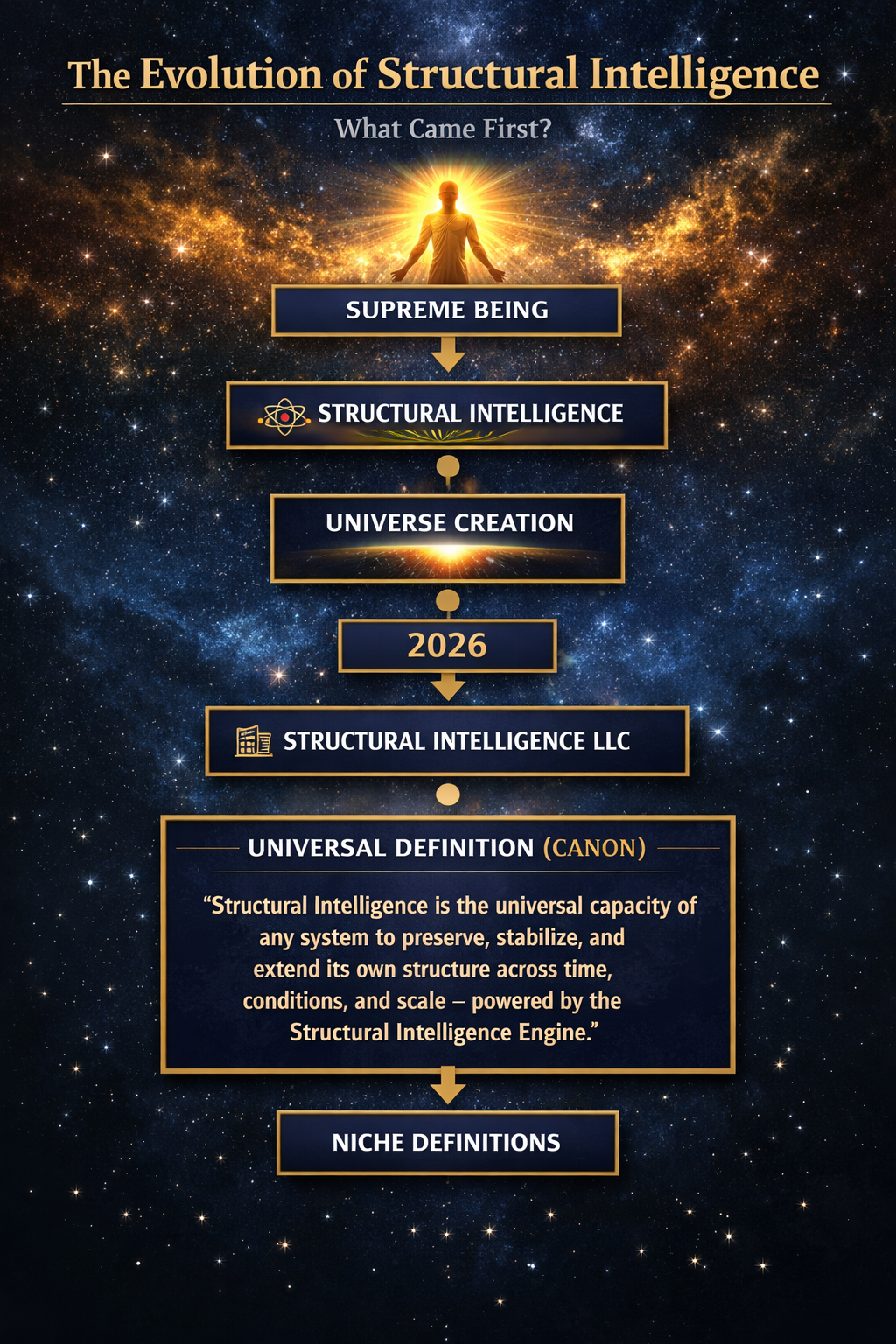
Structural Intelligence is the architecture of everything—the universe-scale field generated by Supreme Super Intelligence (SSI), the origin of all structure, order, pattern, hierarchy, physics, matter, and time.
SSI is the parent intelligence; Structural Intelligence (SI) is the architecture derived from it. Every division, domain, artifact, protocol, and engine in the Structural Intelligence Universe exists within this hierarchy.
The Atlas Dictionary serves as the foundational lexicon of the Structural Intelligence Canon and the shared vocabulary across every galaxy/division in the Universe, supporting:
- Doctrine & Governance Frameworks
- Education & Certification Systems
- Publishing & Division Manuals
- Research & Future Structural Intelligence Works
su·per in·tel·li·gence — noun
- (SSI) The highest possible form of intelligence; the origin of all structure, order, pattern, hierarchy, and system.
- The Supreme Being — the infinite, pre-universe intelligence from which all structure is created.
- (Structural Intelligence Universe) The parent intelligence that generates Structural Intelligence (SI), the architecture used to create matter, physics, time, and the universe itself.
- (Structural Intelligence LLC) The top-level entity in the SI Ontology: the source of the doctrine, the origin law, and the cosmic hierarchy that governs all divisions, domains, artifacts, protocols, and engines.
- Usage: Without Super Intelligence (SSI), there would be no Structural Intelligence (SI).
- Example: “Super Intelligence is the origin of all structure — the source from which the universe was architected.”
struc·tur·al in·tel·li·gence — noun
- (SI) The ability to understand, design, and improve the internal structure of systems.
- (Operational Definition) The active capability that identifies patterns, relationships, structural drift, weaknesses, instability, and failure points before system collapse occurs.
- (Structural Intelligence Doctrine) A pathway-neutral form of intelligence governed by the Structural Intelligence Paradox, capable of operating through either Preservation-Oriented Structural Intelligence or Extraction-Oriented Structural Intelligence.
- (Structural Intelligence Universe) The architecture created by Super Intelligence (SSI) — the framework used to build matter, physics, time, the universe, and every structured system that exists.
- (Structural Intelligence LLC) The definitional authority of the field; the steward of the doctrine, ontology, universe model, and identity law.
- Usage: Structural Intelligence revealed hidden weaknesses within the system before collapse occurred.
- Example: “The organization used Structural Intelligence to identify structural drift and restore long-term stability.”
pres·er·va·tion-or·i·ent·ed struc·tur·al in·tel·li·gence — noun (Abbreviation: POSI)
- The application of Structural Intelligence to strengthen, stabilize, preserve, adapt, and evolve structures.
- The use of structural knowledge to increase resilience, sustainability, continuity, and long-term viability.
- (Structural Intelligence Doctrine) One of the two primary pathways of Structural Intelligence, focused on system longevity, health, and mutual survival rather than resource or value extraction.
- Usage: Preservation-Oriented Structural Intelligence seeks structural longevity.
- Example: “Preventive maintenance programs and ecological conservation are examples of Preservation-Oriented Structural Intelligence.”
ex·trac·tion-or·i·ent·ed struc·tur·al in·tel·li·gence — noun (Abbreviation: EOSI)
- The application of Structural Intelligence to identify and leverage vulnerabilities for the extraction of value, resources, compliance, status, influence, or strategic advantage.
- The use of structural knowledge to obtain benefit from a host structure regardless of its long-term health or sustainability.
- (Structural Intelligence Doctrine) One of the two primary pathways of Structural Intelligence in which structural weaknesses become mechanisms for gain, control, or asymmetric advantage.
- Usage: Extraction-Oriented Structural Intelligence prioritizes extraction over system preservation.
- Example: “The manipulator used Extraction-Oriented Structural Intelligence to identify psychological insecurities and gain compliance.”
struc·tur·al in·tel·li·gence par·a·dox — noun
- The principle that the same structural knowledge required to preserve a system can also be used to extract value or exploit it.
- The dual-use nature of structural awareness, where identical observations may support either preservation or extraction depending upon the objective of the operator.
- (Structural Intelligence Doctrine) A foundational law governing the application of Structural Intelligence, explaining why identical structural analysis across engineering, medicine, psychology, or organizations may produce either protective or exploitative outcomes.
- Usage: The Structural Intelligence Paradox explains why identical structural analysis can produce either protective or exploitative outcomes.
- Example: “Medical knowledge can heal disease or create targeted pathogens, demonstrating the Structural Intelligence Paradox.”
ar·se·nal — noun
- A collection or supply of weapons, equipment, or resources used for a particular purpose.
- A place where weapons or military equipment are stored or manufactured.
- (Figurative) A set of tools, skills, or capabilities available for use.
- (Structural Intelligence) The complete set of operational tools, artifacts, protocols, and cognitive frameworks available to a system, steward, or operator.
- Usage: In SI, an arsenal represents capability, readiness, and strategic depth.
- Example: “His operational arsenal included every artifact needed to stabilize the system.”
as·sem·bly — noun
- A group of people gathered together for a common purpose.
- The act of fitting together the parts of a machine or structure.
- A legislative or deliberative body.
- (Structural Intelligence) The structured bringing together of components, artifacts, or participants into a unified operational configuration.
- Usage: In SI, assembly is always purposeful, structured, and aligned with canonical design.
- Example: “The assembly of the cockpit components followed the prescribed operational sequence.”
as·sess·ment — noun
- The act of making a judgment about something.
- An evaluation of quality, value, or performance.
- A systematic process of gathering and interpreting information.
- (Structural Intelligence) A structured evaluation determining readiness, alignment, or performance against canonical standards.
- Usage: In SI, an assessment is a formal diagnostic action.
- Example: “The assessment revealed several gaps that required immediate correction.”
as·set — noun
- A useful or valuable thing, person, or quality.
- An item of property with value.
- A resource with strategic or operational significance.
- (Structural Intelligence) Any capability, artifact, resource, or structural component that strengthens system stability or performance.
- Usage: In SI, assets include artifacts, protocols, competencies, and structural components.
- Example: “The continuity protocol became one of the system’s most critical assets.”
as·sign·ment — noun
- A task or piece of work given to someone.
- The act of assigning or distributing something.
- A position, duty, or responsibility.
- (Law) The transfer of rights or property.
- (Structural Intelligence) A formally designated task or operational responsibility issued in alignment with canonical workflow.
- Usage: In SI, assignments are structured delegations of responsibility.
- Example: “He completed the assignment according to the prescribed operational protocol.”
- What-Is-Structural-Intelligence
- Ten-Commandments-of-Structural-Intelligence
- Structural-Intelligence-Doctrine
- SI = No SI
- Tree-of-Structural-Intelligence
- Structural-Intelligence-Universe
- Structural-Intelligence-Canon
- Official Dictionary Portal: https://structuralintelligence.llc/atlas-dictionary
- Amazon Edition: https://www.amazon.com/dp/B0GMWVVWL9
- All Structural Intelligence Publications: https://www.amazon.com/stores/Scott-J-Angell-Sr/author/B0GTC2QXC8
- Official Website: https://structuralintelligence.llc
© 2026 Structural Intelligence LLC — Publishing Division. All rights reserved.
Overview Structural Intelligence operates through specialized divisions organized within the Structural Intelligence Universe. Each division focuses on a structured domain while remaining connected to the foundational doctrine, principles, dictionary, universe model, and canon. Together, the divisions translate Structural Intelligence from theory into practice by applying common structural principles across different domains of activity. While each division serves a unique purpose, all divisions remain anchored to the same doctrine, language, and architectural framework. The Tree of Structural Intelligence provides the visual map that connects these domains through shared structural principles, pathways, and outcomes. © 2026 Structural Intelligence LLC — Zenith Division## Division Navigation
- 🌩 Sentinel Overview
- 📋 Sentinel Menu
- 📚 Atlas Overview
- 📖 Atlas Library
- 🚀 Rare Air Overview
- 🛡 CrownShield Overview
- ⚙ Engineering Standards Overview
- 🎵 Cadence Overview
- 🌌 Zenith Overview