Repository navigation
Ten Commandments of Structural Intelligence

The foundational doctrinal principles governing the architecture, stability, and evolution of systems within the Structural Intelligence framework.
The Ten Commandments of Structural Intelligence establish the foundational laws and operational principles of the Structural Intelligence framework.
These principles guide the design, preservation, adaptation, and stabilization of systems ranging from individuals and organizations to institutions, technologies, and global structures.
Nothing functions, adapts, or survives without a supporting architecture.
Structure is the fundamental origin condition of stable systems.
Every system must manage internal load and external pressure to maintain equilibrium.
Without balance, systems drift, degrade, or collapse.
Systems scale successfully only when internal components, communication, and operational rules remain aligned.
Misalignment limits growth.
Clear boundaries prevent diffusion and confusion.
Strong boundaries create stability, focus, and sustainable expansion.
Feedback loops allow systems to detect structural drift, weaknesses, instability, and failure points, correct errors, and evolve.
Without feedback, adaptation becomes impossible.
As systems grow, simplicity and clarity become increasingly important.
Structural elegance prevents failure cascades and unnecessary complexity.
All expansion must remain anchored to its source structure.
The root must remain healthy for branches to grow.
Failure is not random.
Breakdowns reveal weaknesses, misalignment, overload, or structural deficiencies.
Long-term stability requires safeguards, backup systems, and contingency planning.
Resilience is engineered before it is needed.
To understand Structural Intelligence, one must recognize that all formal systems mirror universal structural laws.
Structure is everything.
Everything contains structure.
The Ten Commandments establish the governing principles of Structural Intelligence.
The Tree of Structural Intelligence illustrates how those principles operate across time through pressure, drift, adaptation, pathway divergence, survival, and evolution.
- The Commandments define the laws.
- The Tree visualizes the laws.
- The Atlas Dictionary defines the language of the laws.
→ Tree-of-Structural-Intelligence
Structural Intelligence
↓
What Is Structural Intelligence?
↓
Ten Commandments
↓
Structural Intelligence Doctrine
↓
SI = No SI
↓
Tree of Structural Intelligence
↓
Atlas Dictionary
↓
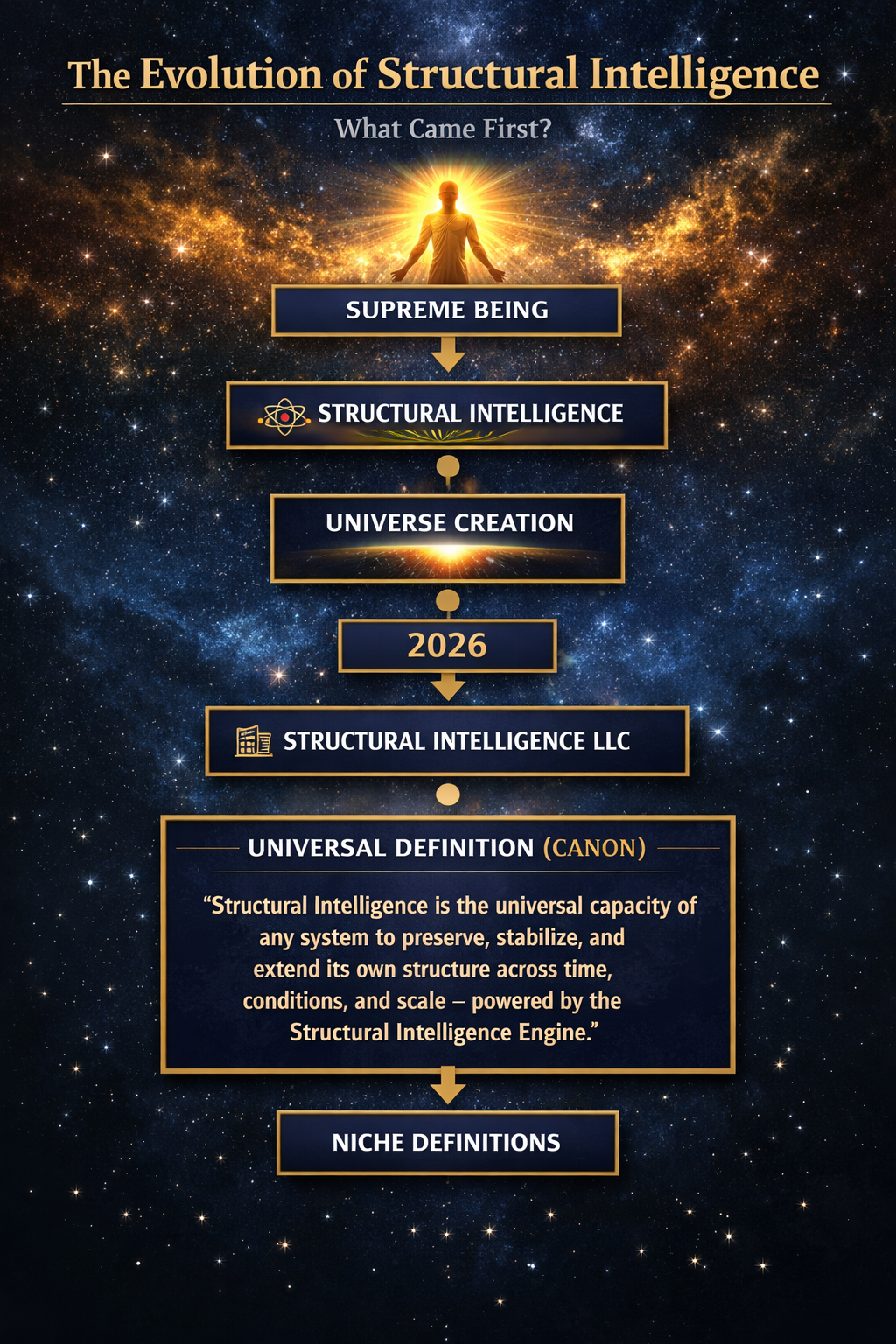
Structural Intelligence Universe
↓
Structural Intelligence Canon
- What-Is-Structural-Intelligence
- Structural-Intelligence-Doctrine
- SI-No-SI
- Tree-of-Structural-Intelligence
- Atlas-Dictionary-of-Structural-Intelligence
- Structural-Intelligence-Universe
- Structural-Intelligence-Canon
🌳 Tree of Structural Intelligence
The Tree of Structural Intelligence serves as the canonical visual map of the Structural Intelligence framework.
It illustrates:
- Root System
- Structural Intelligence (SI)
- Core Rings
- Structural Drift
- Structural Intelligence Paradox
- Preservation-Oriented Structural Intelligence (POSI)
- Extraction-Oriented Structural Intelligence (EOSI)
- Observable Outcomes
- Survival & Evolution
- Full Circle Principle
See:
→ Tree-of-Structural-Intelligence
Website:
https://structuralintelligence.llc
Publications:
https://www.amazon.com/stores/Scott-J-Angell-Sr/author/B0GTC2QXC8
© 2026 Structural Intelligence LLC — Zenith Division
Overview Structural Intelligence operates through specialized divisions organized within the Structural Intelligence Universe. Each division focuses on a structured domain while remaining connected to the foundational doctrine, principles, dictionary, universe model, and canon. Together, the divisions translate Structural Intelligence from theory into practice by applying common structural principles across different domains of activity. While each division serves a unique purpose, all divisions remain anchored to the same doctrine, language, and architectural framework. The Tree of Structural Intelligence provides the visual map that connects these domains through shared structural principles, pathways, and outcomes. © 2026 Structural Intelligence LLC — Zenith Division## Division Navigation
- 🌩 Sentinel Overview
- 📋 Sentinel Menu
- 📚 Atlas Overview
- 📖 Atlas Library
- 🚀 Rare Air Overview
- 🛡 CrownShield Overview
- ⚙ Engineering Standards Overview
- 🎵 Cadence Overview
- 🌌 Zenith Overview