Repository navigation
What Is Structural Intelligence

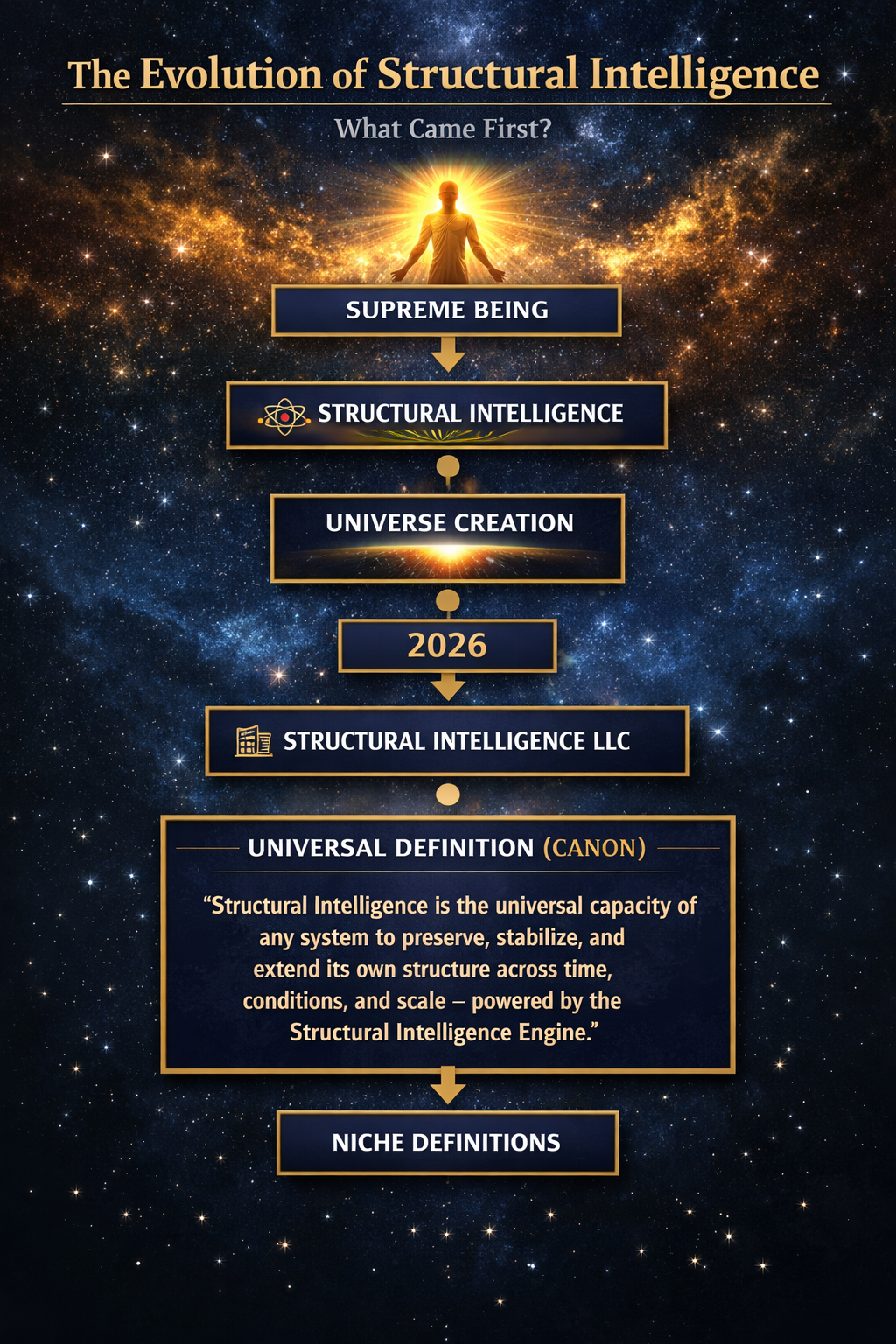
Structural Intelligence is the active capacity to identify, understand, create, analyze, strengthen, stabilize, preserve, adapt, and evolve structures across time, conditions, and scale.
Structural Intelligence provides a framework for understanding how systems are built, how they function, how they fail, and how they adapt.
If it contains structure, it belongs to and is derived from Structural Intelligence.
Everything depends upon structure.
Examples include:
- Buildings
- Organizations
- Governments
- Ecosystems
- Families
- Habits
- Knowledge Systems
- Technologies
- Artificial Intelligence
Some structures are visible.
Some structures are invisible.
Structures exist across scale whether or not they are observed—what can be seen is bounded by the Structural Horizon, while what lies beyond that boundary represents Structural Blindness prior to observation.
All structures experience pressure, structural drift, adaptation, stabilization, and continuity.
Structural Intelligence helps explain how physical systems maintain strength, stability, and resilience under load.
Structural Intelligence helps identify communication failures, role confusion, operational friction, and growth bottlenecks.
Structural Intelligence helps individuals understand habits, routines, beliefs, boundaries, relationships, and identity.
Structural Intelligence is visible throughout nature in adaptation, evolution, resilience, and ecosystem balance.
Structural Intelligence supports the mapping, analysis, optimization, and governance of structured systems.
Strong structures create:
- Stability
- Clarity
- Alignment
- Resilience
- Continuity
- Growth
Weak structures create:
- Confusion
- Friction
- Instability
- Failure
- Drift
Tree #1: The SSI Tree of Origin establishes where structure comes from, where visibility ends (Structural Horizon and Structural Blindness), and how a structure enters Observation across scale (Scale Invariance) before analysis begins.
Tree #2: The Tree of Structural Intelligence serves as the operational visual map once a structure enters observation and analysis. While the Atlas Dictionary defines the language of Structural Intelligence, the Tree illustrates how foundational principles emerge, experience pressure, record structural drift, diverge through the Structural Intelligence Paradox, and produce the observable outcomes that determine survival and evolution.
Topics include:
- Root System
- Structural Intelligence (SI)
- Core Rings
- Structural Drift
- Structural Intelligence Paradox
- Preservation-Oriented Structural Intelligence (POSI)
- Extraction-Oriented Structural Intelligence (EOSI)
- Observable Outcomes
- Survival
- Evolution
- Full Circle Principle
→ Tree-of-Structural-Intelligence
Structural Intelligence
↓
Ten Commandments
↓
Structural Intelligence Doctrine
↓
SI = No SI
↓
SSI Tree of Origin (Tree #1)
↓
Tree of Structural Intelligence (Tree #2)
↓
Atlas Dictionary
↓
Structural Intelligence Universe
↓
Structural Intelligence Canon
- Tree-of-origin
- Ten-Commandments-of-Structural-Intelligence
- Structural-Intelligence-Doctrine
- Tree-of-Structural-Intelligence
- Atlas-Dictionary-of-Structural-Intelligence
- Structural-Intelligence-Universe
- Structural-Intelligence-Canon
🌱 Tree #1: The SSI Tree of Origin — Origin, visibility boundaries, and observation handoff.
See:
→ Tree-of-origin
🌳 Tree #2: The Tree of Structural Intelligence — The canonical operational visual map of the Structural Intelligence framework.
See:
→ Tree-of-Structural-Intelligence
Website:
https://structuralintelligence.llc
Publications:
https://www.amazon.com/stores/Scott-J-Angell-Sr/author/B0GTC2QXC8
© 2026 Structural Intelligence LLC — Zenith Division
Overview Structural Intelligence operates through specialized divisions organized within the Structural Intelligence Universe. Each division focuses on a structured domain while remaining connected to the foundational doctrine, principles, dictionary, universe model, and canon. Together, the divisions translate Structural Intelligence from theory into practice by applying common structural principles across different domains of activity. While each division serves a unique purpose, all divisions remain anchored to the same doctrine, language, and architectural framework. The Tree of Structural Intelligence provides the visual map that connects these domains through shared structural principles, pathways, and outcomes. © 2026 Structural Intelligence LLC — Zenith Division## Division Navigation
- 🌩 Sentinel Overview
- 📋 Sentinel Menu
- 📚 Atlas Overview
- 📖 Atlas Library
- 🚀 Rare Air Overview
- 🛡 CrownShield Overview
- ⚙ Engineering Standards Overview
- 🎵 Cadence Overview
- 🌌 Zenith Overview