Repository navigation
GammaOS Pico 1.0.0 for the Konkr Pocket Advance

Caution
This release is out of date: use GammaOS Pico 1.1.1 instead
Do not download or install this version. GammaOS Pico 1.1.1 has every fix and feature since this one, for both the Konkr Pocket Advance and the Konkr Pocket Block. This page is kept for reference only.
Get GammaOS Pico 1.1.1
GammaOS Pico for the Konkr Pocket Advance, release 1.0.0 (lk-mt6785 4786949).
GammaOS Pico replaces only the console's bootloader (LK). With the GammaOS Pico microSD card in the slot the
console starts a console menu and plays Game Boy, Game Boy Color, Game Boy Advance, SNES,
Mega Drive / Genesis, Master System, Game Gear and SG-1000 games from the card. Without the card,
or after Boot to Android in the menu, Android starts exactly as before.
What makes it different
GammaOS Pico isn't an app on top of Android or a Linux distro. It runs inside the console's
bootloader, before any operating system, and owns the hardware outright.
- Fast on. From power on to the GBA boot logo in about two and a half seconds (Android takes
around 25). Hold Power to save where you are and switch off; turn it back on and you're back
in the game. - Low latency by design. The panel is retimed to each console's real refresh rate (59.73 Hz
for GBA and Game Boy, 60.1 Hz for SNES, 50 Hz for PAL), every frame is paced to the panel's scan,
buttons are read as late as possible, and run-ahead ("Preemptive Frames") hides the games' own lag. - Android stays. Only the bootloader changes. Pull the card (or pick Boot to Android) and the
console starts its stock Android, untouched. - Everything on the card. Emulators, settings, saves, states and box art all live on the
microSD card. Swap the card, swap the whole setup. - Your card, your way. Games are found in GammaOS's
roms/<system>/or where another front
end keeps them:ROMs/<system>/(ES-DE),Emulation/roms/<system>/(EmuDeck) or any
<folder>/roms/<system>/, with the usual folder names (gba,snes,megadrive,
mastersystem,gamegearand so on). Drop a PNG cover named like the game into aboxart
folder beside it and the console sizes it for the menu at the next power on. - Zipped games welcome. Games can stay in .zip or .7z archives, unpacked as they start (about
half a second for a 16 MB GBA game, resume at power on included). An archive with several games
lists each one, and one that cannot be opened says why instead of failing quietly. - Made for big libraries. Tens of thousands of games list in moments. Hold a direction to
speed through a library, jump letter by letter with L / R, or press Y to search by name, in one
system or all of them, with an on-screen keyboard. Box art loads as you reach it. - The good stuff from the start. Rewind, fast forward, save states (written to the card while
the game plays on), scanline and LCD filters and colour correction, in a box art menu: the
Current theme, with the Classic and GBA Indigo themes in beta. - The real time. The console's own clock runs the games that keep time (Pokemon Ruby,
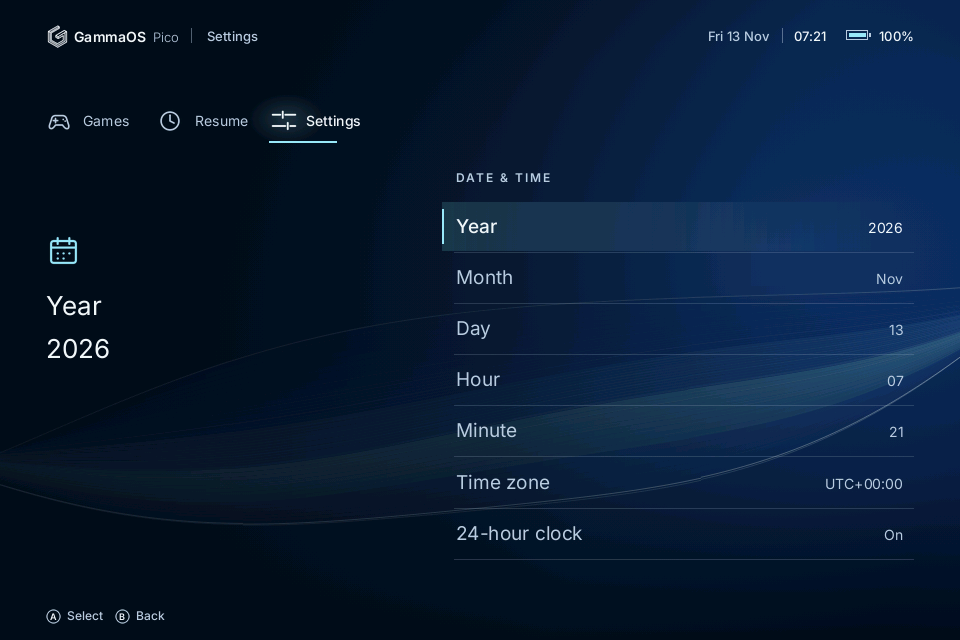
Sapphire, Emerald, Gold, Silver and Crystal, Boktai), shows in the menus, and is set with its
time zone in Settings > Date & Time. Each game shows how long it has been played and when last. - Sharper motion with black frame insertion. The backlight goes dark for part of every frame,
in step with the screen's refresh, so moving pictures stay crisp the way they did on a CRT
instead of smearing. 25 %, 50 % or 75 % dark (Settings > Black Frame Insertion, or per game in
the in-game menu's Display page); the screen looks dimmer the higher it is set. - Tilt, gyro and rumble. The console's own motion sensor and vibration motor stand in for the
cartridges': Yoshi Topsy-Turvy and Kirby Tilt 'n' Tumble tilt (a flick of the console makes
Kirby jump), WarioWare: Twisted! turns and rumbles, as do Drill Dozer and the Game Boy Color's
rumble cartridges. - Headphones. Sound moves to the 3.5 mm jack as soon as headphones are plugged in, and back
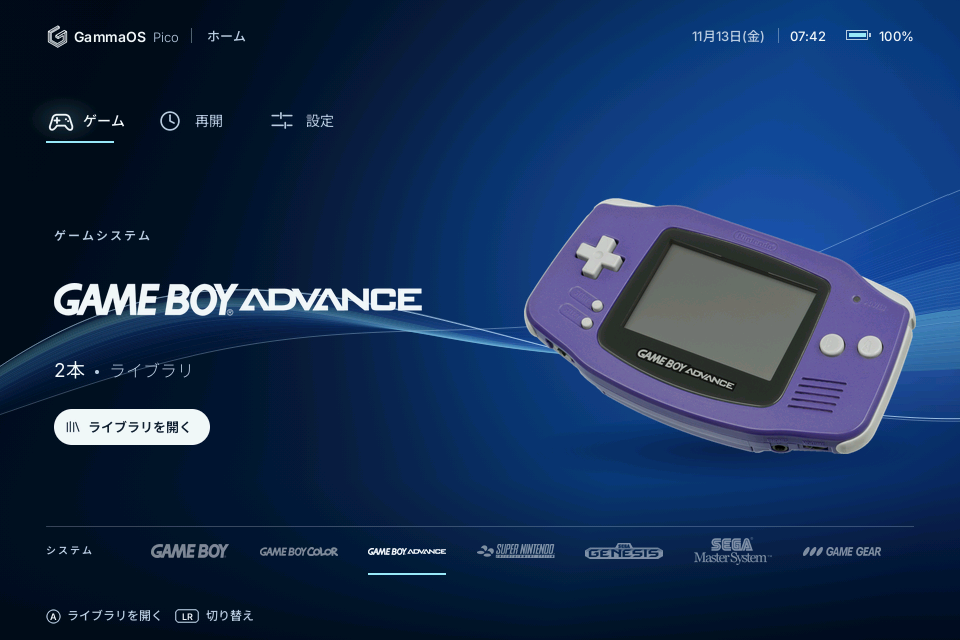
to the speakers when they come out. - In your language. The menus and the in-game menu in 17 languages: English, French, German,
Spanish, Italian, Dutch, Portuguese, Russian, Japanese, Korean, Simplified and Traditional
Chinese, Polish, Turkish, Arabic, Hebrew and Persian (Settings > Language).
Put the real Game Boy Advance BIOS on the card. Copy your own console's BIOS as
bios/gba_bios.bin(16 KB). GBA games then start on Nintendo's own BIOS: the original boot logo
and chime, and the exact BIOS routines every game was made against. Without it armGBA falls back
to its built-in replacement, which runs most games but not all of them the same way, and gpSP
(the second GBA emulator) cannot run at all. The BIOS is Nintendo's and is not included.
Screenshots
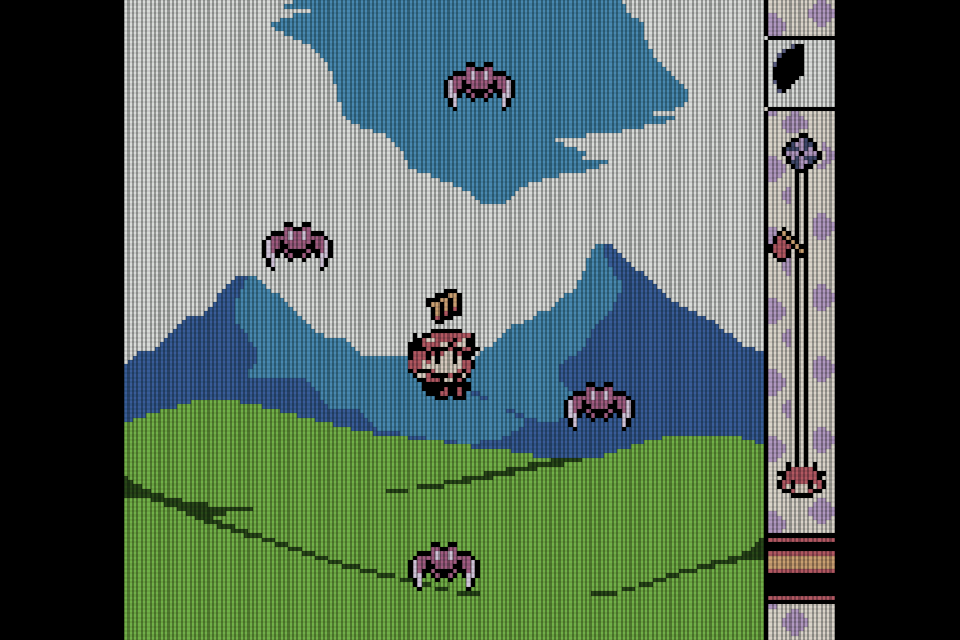
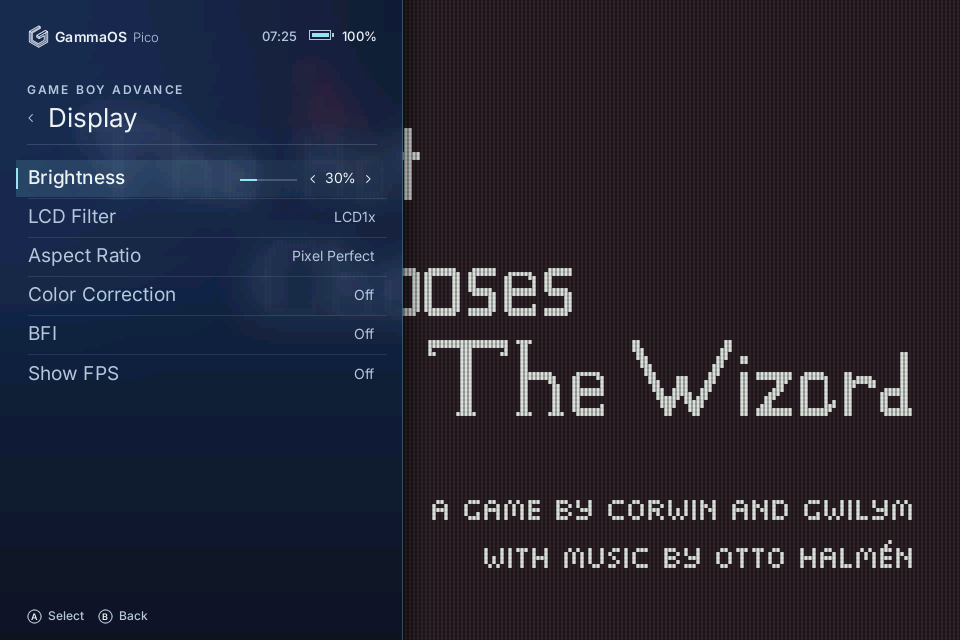
Captured on a Konkr Pocket Advance from the display buffers, with the demo games from the release;
the in-game menu shots lay its drawer over the game the way the display hardware blends them.
|
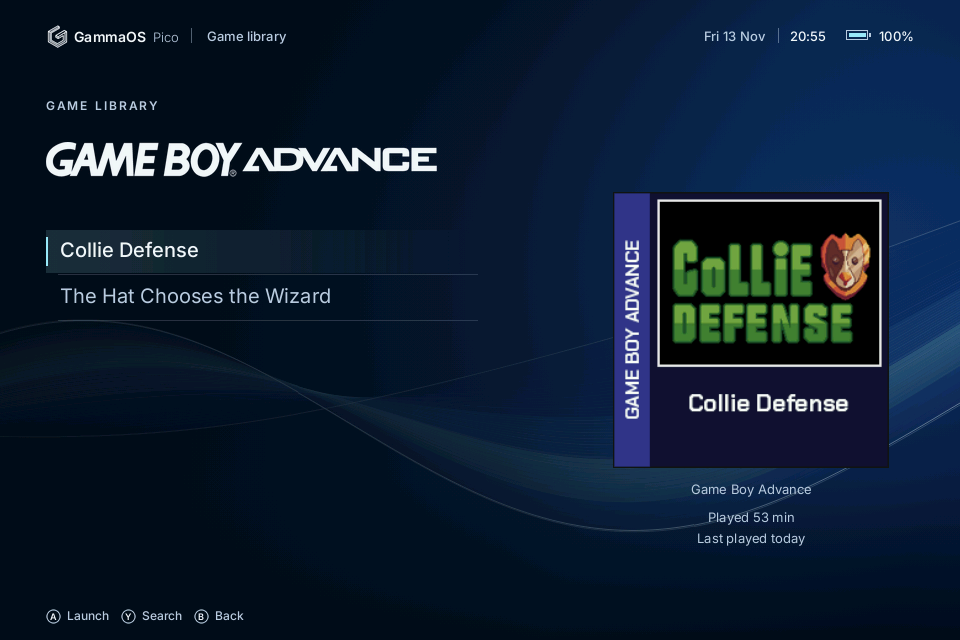 |
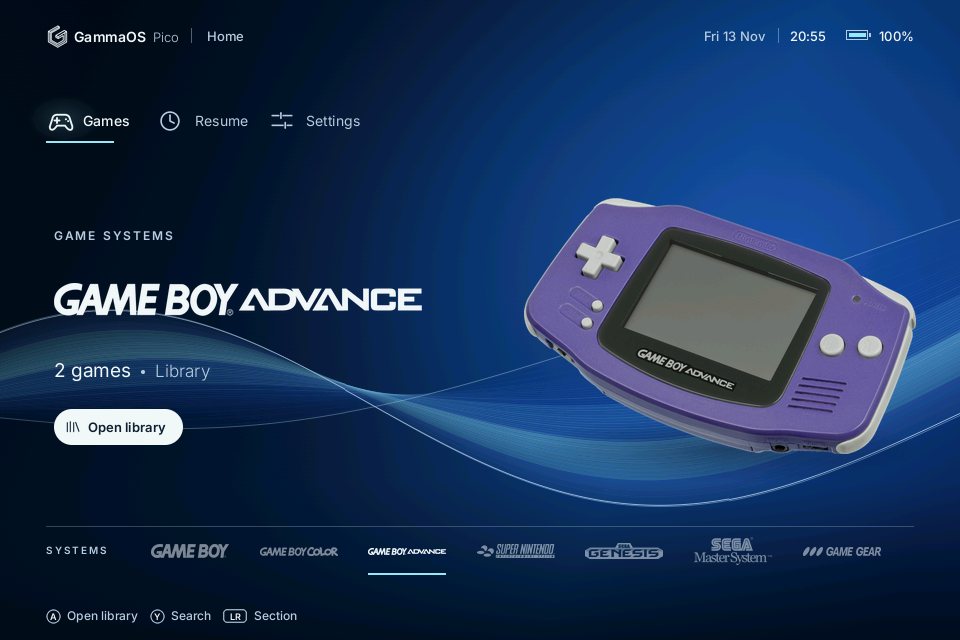
| Home: the systems on the card, with the date, the time and the battery | A system's library: box art, how long each game has been played and when last |
 |
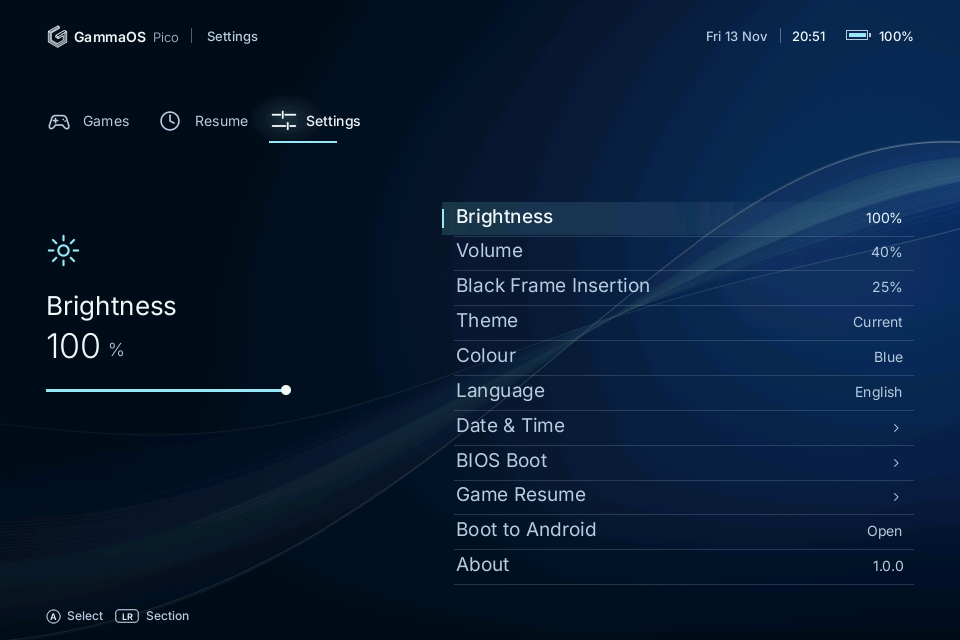 |
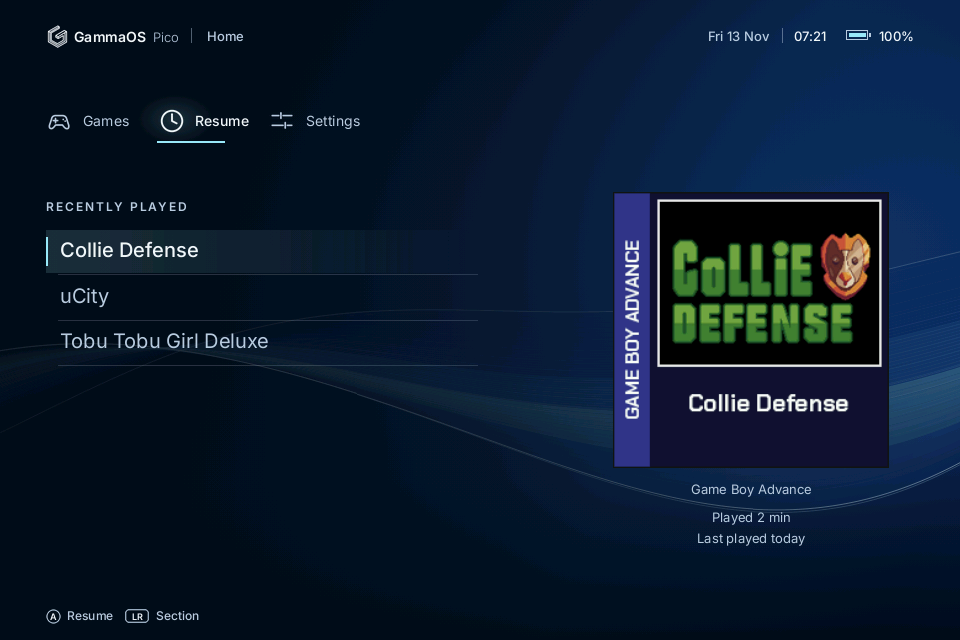
| Resume: the games played most recently | Settings |
 |
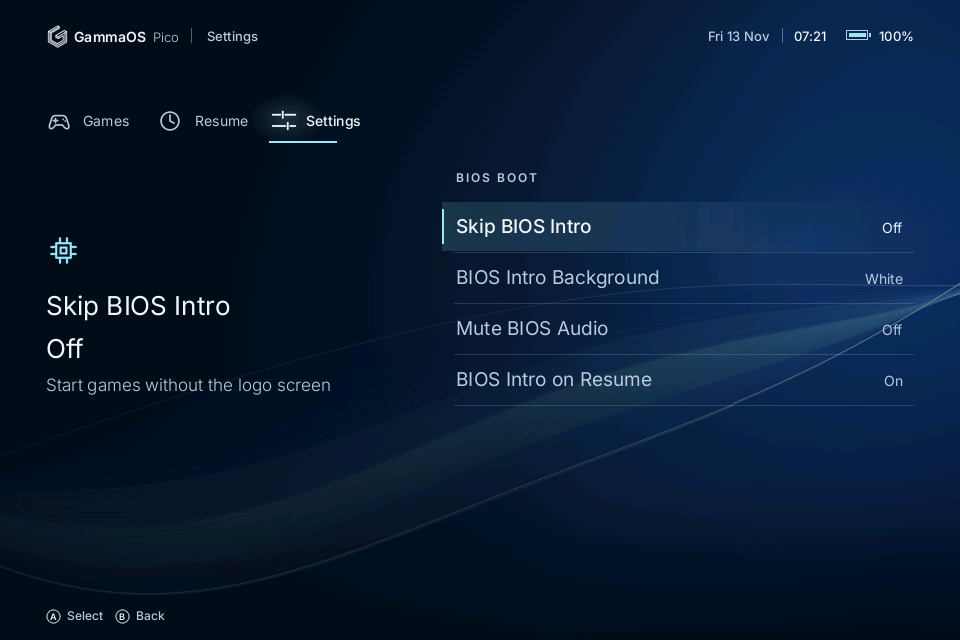 |
| Date & Time: the console's clock and time zone, which the games' clocks run on | BIOS Boot: the Game Boy Advance start-up screen |
 |
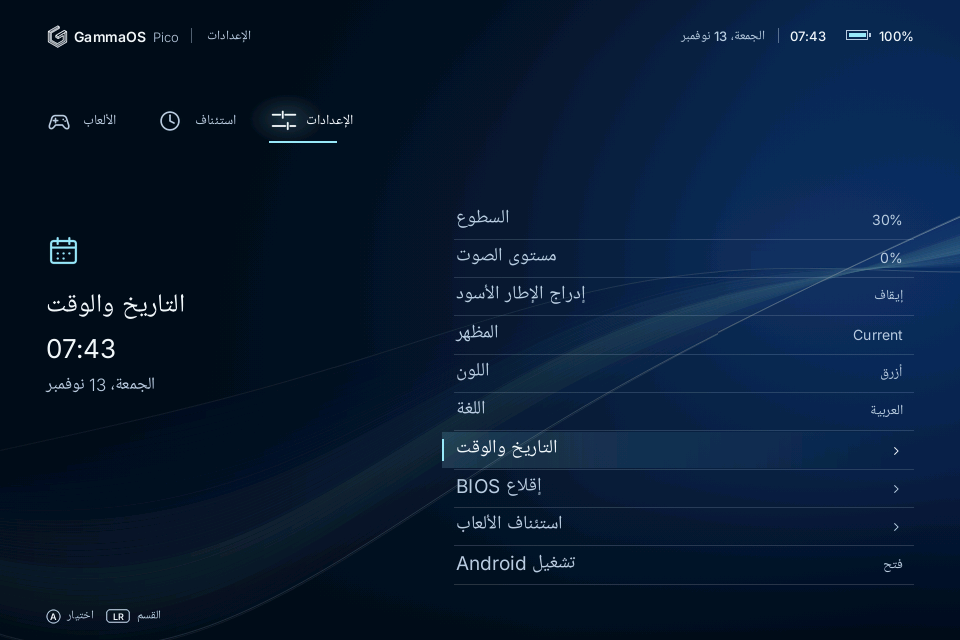 |
| In Japanese | In Arabic, written right to left |
 |
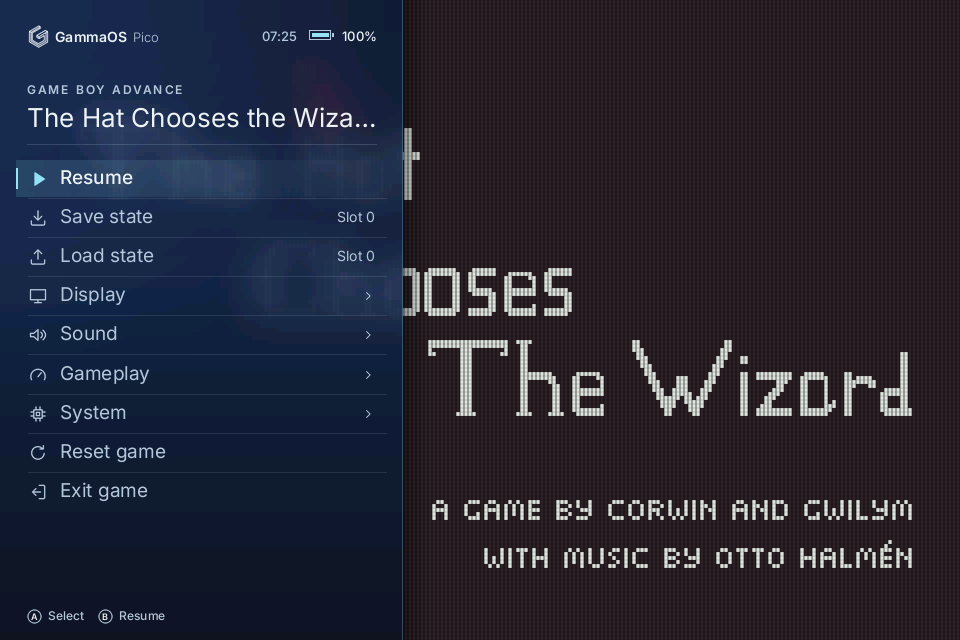 |
| In game (Tobu Tobu Girl Deluxe, LCD filter) | The in-game menu over the game (Menu button) |
 |
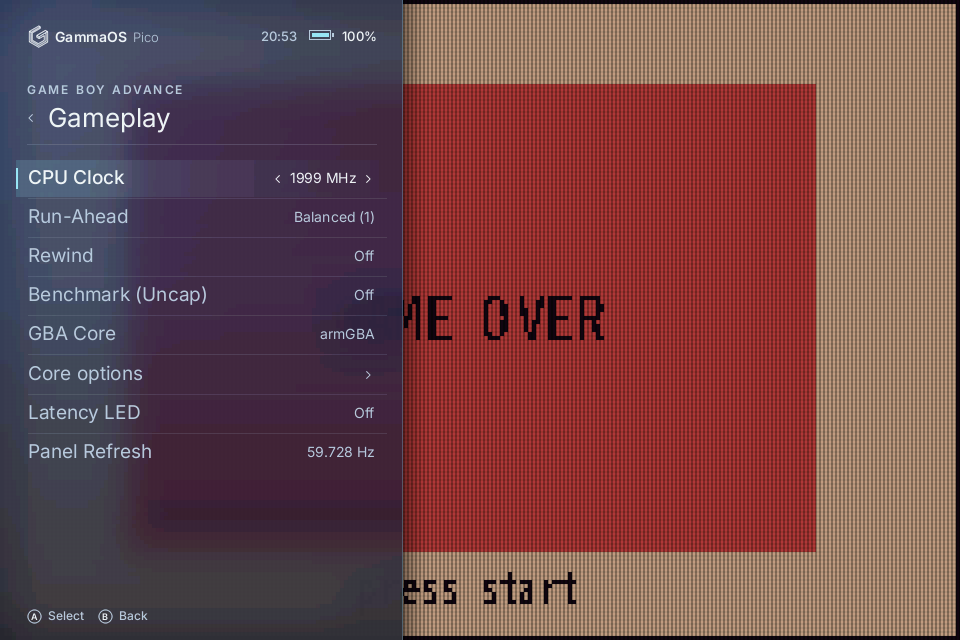 |
| Display: brightness, filters, aspect ratio, colour correction, BFI | Gameplay: CPU clock, run-ahead, rewind, the GBA core, the live panel refresh |
 |
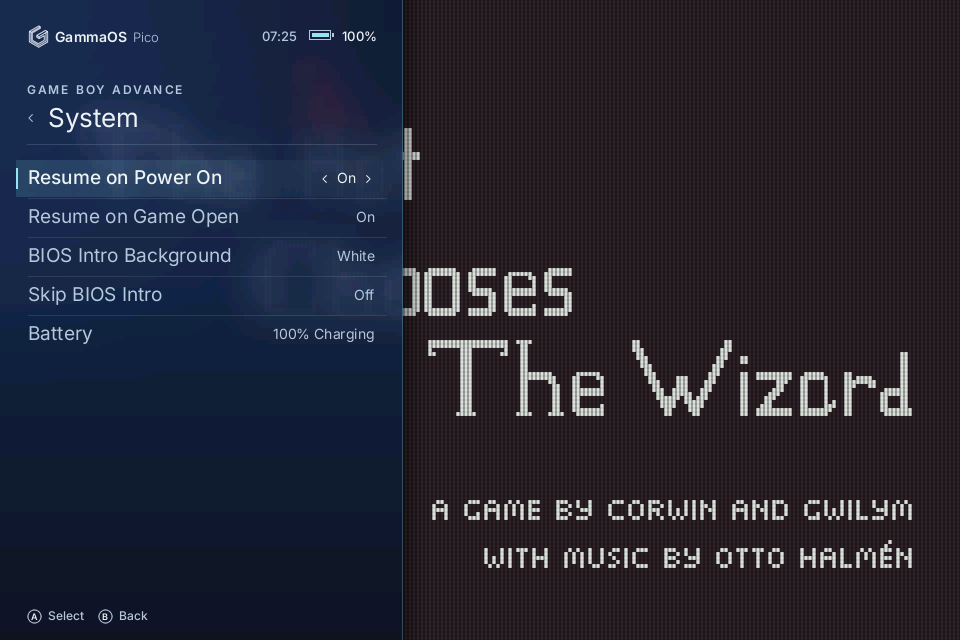 |
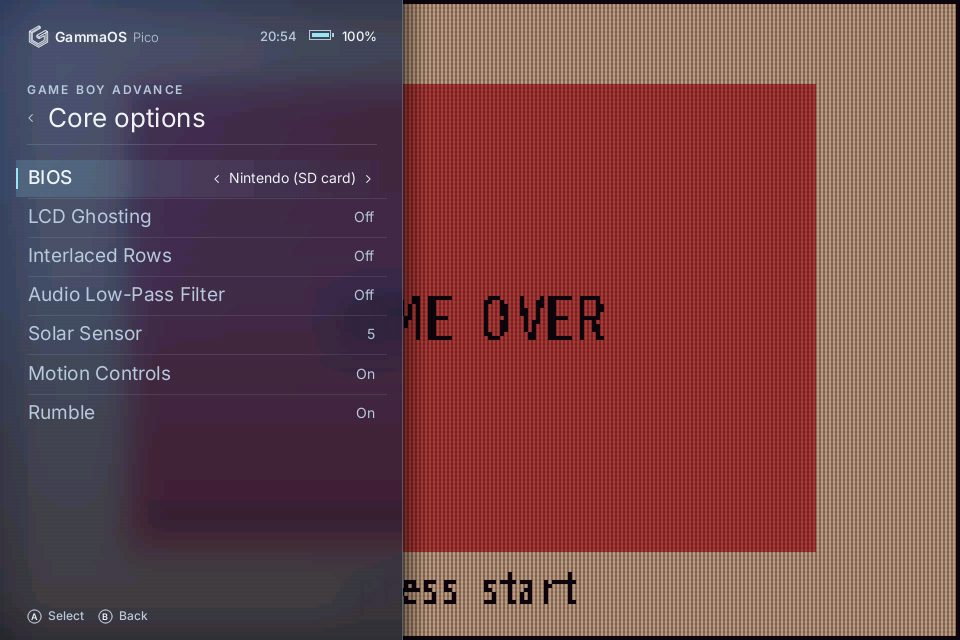
| armGBA's own options | System: resume, the BIOS intro and the battery |
 |
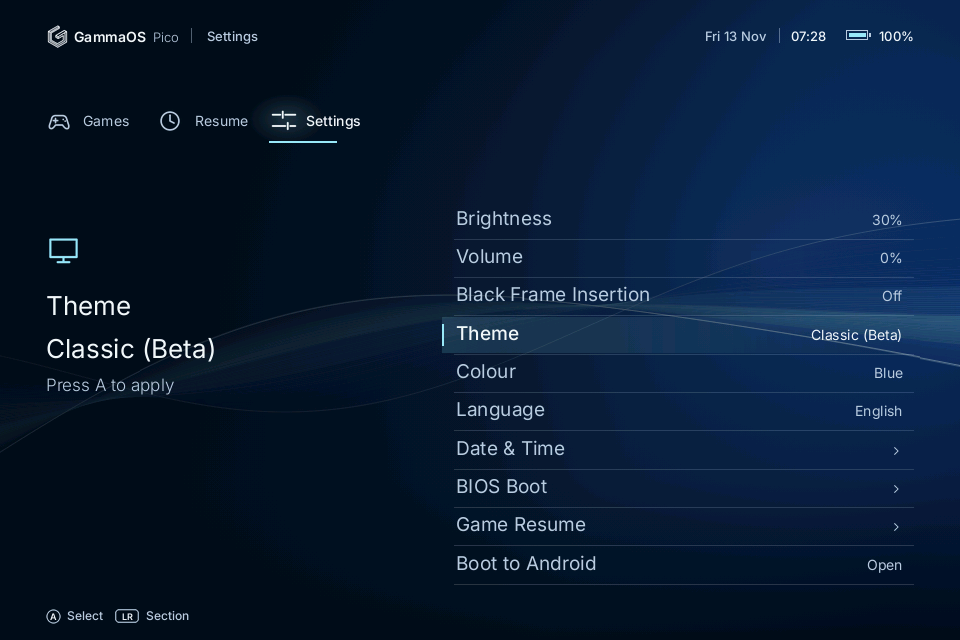 |
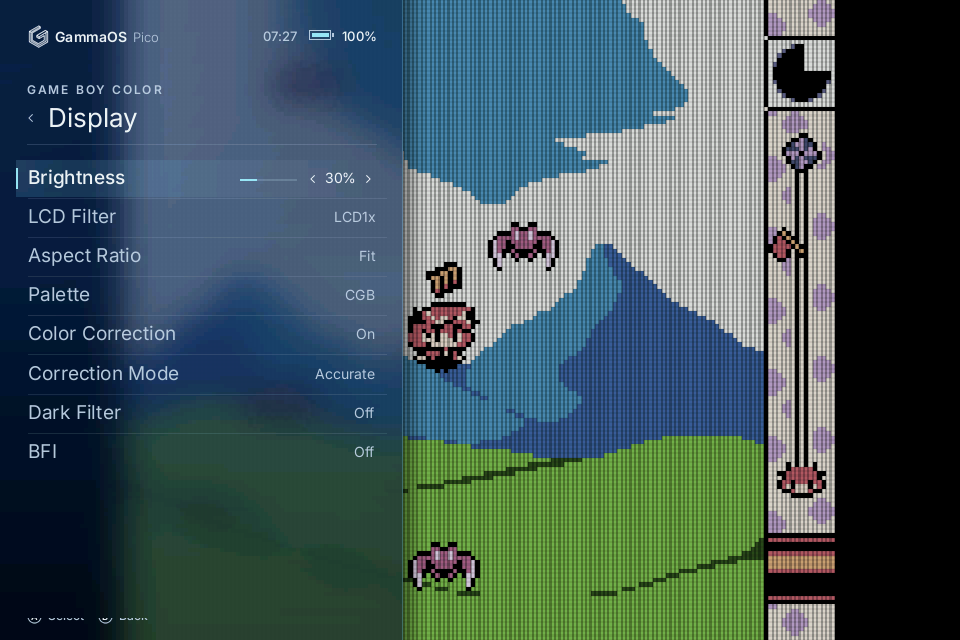
| A Game Boy Color game's Display page: palette, colour correction, dark filter | Picking a theme |
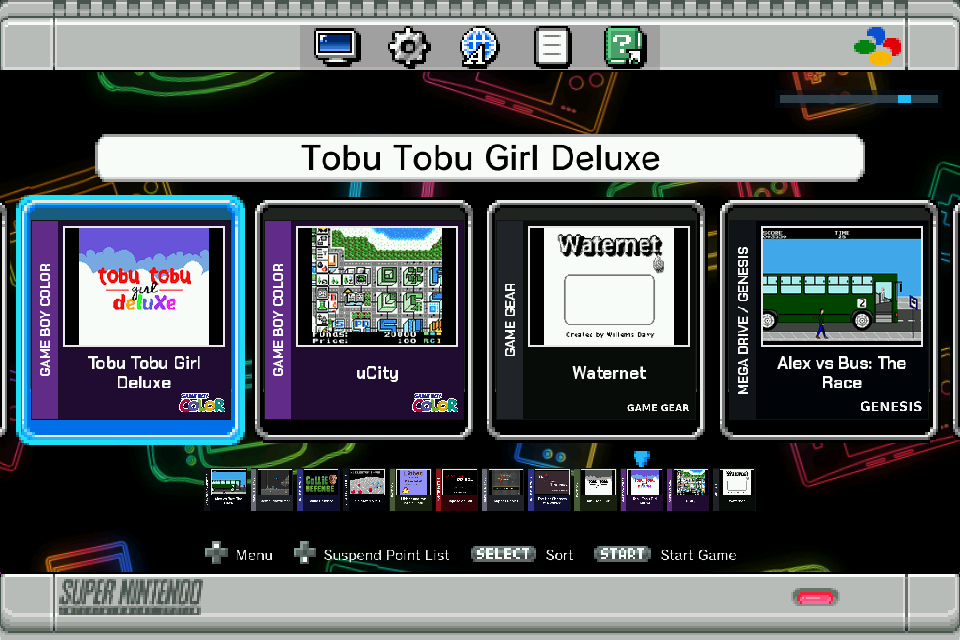 |
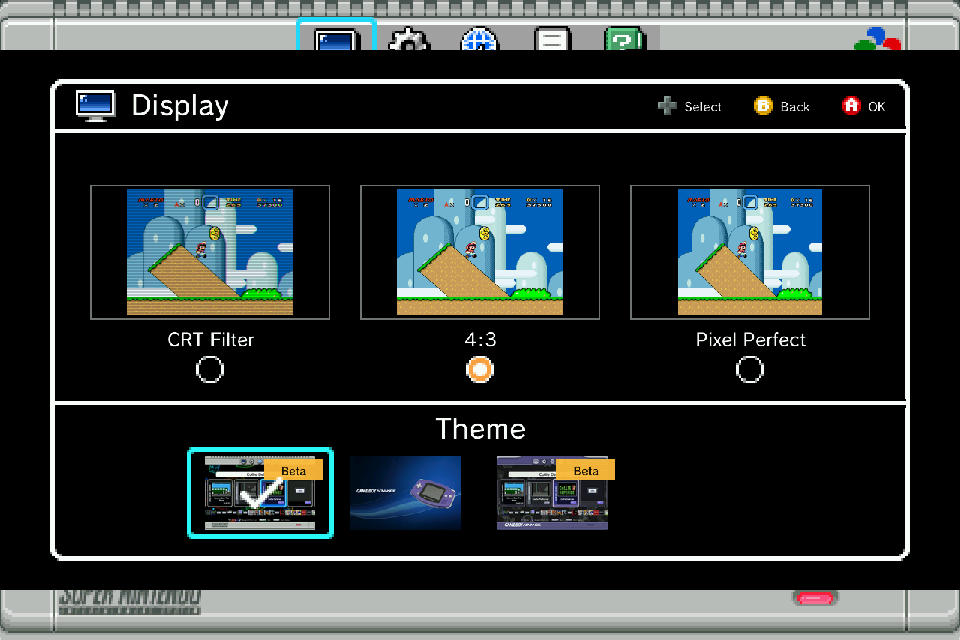 |
| The Classic theme (beta) | Its Display page, with the themes |
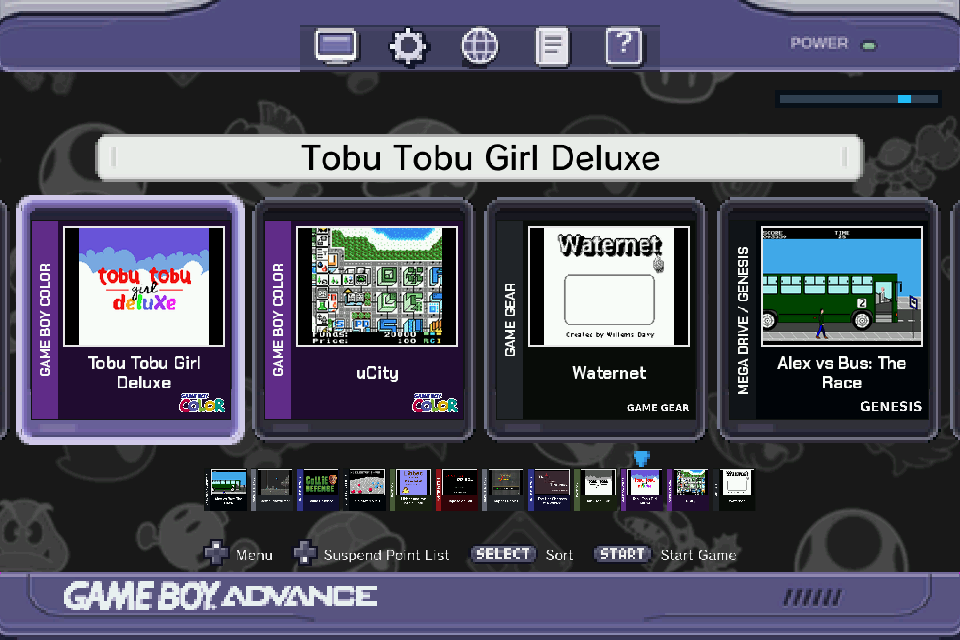 |
|
| The GBA Indigo theme (beta) |
Buttons
At power on:
| Hold | Starts |
|---|---|
| nothing | whatever the card is set to (GammaOS Pico, or Android after Boot to Android) |
| SELECT | GammaOS Pico (the way back after Boot to Android) |
| SELECT + START | Android |
| SELECT + START + R | the bootloader (fastboot), for updates |
No card, or a card without GammaOS Pico on it, always starts Android.
In a game:
| Button | Does |
|---|---|
| Menu | the Pico menu (save and load states, filters, settings); hold 1.5 s to go back to the game list |
| R2 | fast forward on / off |
| L2 | rewind on / off |
| SELECT + START + L + R (hold) | restart the game |
| Volume wheel | volume; with SELECT held, brightness |
| X / Y | autofire B / A |
| Power (hold 1.2 s) | save and switch off |
In the game list, START plays, SELECT sorts and X switches between systems. During the boot logo,
hold B to skip it; the volume wheel works there too.
The menus
Everything GammaOS Pico can set, as it is laid out on the console (the Current theme, the default).
Every menu is in the language chosen in Settings.
Home
| Tab | What it holds |
|---|---|
| Games | the systems on the card, each with its console and logo; Left / Right move between systems, A opens a system's library (its games with their box art, how long each has been played and when last), where holding Up / Down speeds up, Left / Right turn a page and L / R jump from letter to letter; Y searches the system (or, on this page, every system) with an on-screen keyboard |
| Resume | the games played most recently, newest first, to carry on with one press |
| Settings | the console settings below |
L and R switch between the tabs, A picks and B goes back. The header shows the menu you are in,
the date, the time and the battery.
Settings
| Row | Values |
|---|---|
| Brightness | the backlight, 0 to 100 % |
| Volume | 0 to 100 % |
| Black Frame Insertion | Off, 25 %, 50 %, 75 %: the backlight strobes for sharper motion |
| Theme | Current; Classic and GBA Indigo (beta). A applies |
| Colour | Blue, Indigo, Violet, Orchid, Rose, Crimson, Coral, Amber, Lime, Emerald, Teal, Sepia, Graphite |
| Language | the 17 languages. A applies |
| Date & Time | a page: Year, Month, Day, Hour, Minute (the console's clock, which Android shares), Time zone (UTC-12:00 to UTC+14:00 in quarter hours), 24-hour clock |
| BIOS Boot | a page: Skip BIOS Intro, BIOS Intro Background (Black or White), Mute BIOS Audio, BIOS Intro on Resume |
| Game Resume | a page: Resume on Power On (switching off in a game saves your place and the next power on goes straight back), Resume on Game Open (opening a game carries on where you left it; hold B while opening to start afresh) |
| Boot to Android | restarts the console into Android; hold SELECT at power on to come back |
In a game
The Menu button opens the in-game menu over the game. Its first page: Resume, Save state and Load
state (Left / Right pick the slot), the Display, Sound, Gameplay and System pages, Reset game and
Exit game. The pages hold what each emulator offers:
| Page | Game Boy Advance | Game Boy / Game Boy Color | SNES | Mega Drive, Master System, Game Gear, SG-1000 |
|---|---|---|---|---|
| Display | Brightness, LCD Filter, Aspect Ratio, Color Correction, BFI, Show FPS | Brightness, LCD Filter, Aspect Ratio, Palette (original Game Boy), Color Correction, Correction Mode, Dark Filter, BFI, Show FPS | Brightness, LCD Filter, Aspect Ratio, Overscan, Hi-Res Blend, BFI, Show FPS | Brightness, Aspect Ratio, LCD Filter, BFI, Show FPS |
| Sound | Volume | Volume | Volume, Audio Filter | Volume |
| Gameplay | CPU Clock, Run-Ahead, Rewind, Benchmark, GBA Core (armGBA or gpSP), Core options, Latency LED, Panel Refresh | CPU Clock, Run-Ahead, Rewind | CPU Clock, Run-Ahead, Rewind, Turbo (auto-fire), Benchmark, Panel Refresh | CPU Clock, Run-Ahead, Rewind, Region, Refresh Rate |
| System | Resume on Power On, Resume on Game Open, BIOS Intro Background, Skip BIOS Intro, Battery | Resume on Power On, Battery | Resume on Power On, Battery | Resume on Power On, Battery |
armGBA's Core options: BIOS (Nintendo from the card, or armGBA's built-in), LCD Ghosting, Interlaced
Rows, Audio Low-Pass Filter, Solar Sensor (for Boktai), Motion Controls (tilt and gyro cartridges)
and Rumble.
The values: LCD Filter Off, Scanlines, LCD Grid, Dot Matrix, LCD1x, LCD3x (Genesis: Grid, Grid+);
Aspect Ratio Stretch, Fit, Pixel Perfect (SNES 4:3, Pixel, NTSC, PAL, Stretch; Genesis Pixel, Core,
Stretch, 4:3, Square, 16:9); Run-Ahead Off, Balanced, Responsive, Max; Overscan Crop 8, 12 or 16 px
or Off; Audio Filter Linear, Gaussian, Cubic, Sinc, None; Hi-Res Blend Off, Merge, Blur; Turbo Off,
A, B, A+B; Region Auto, USA, Europe, Japan.
Classic theme (beta)
The SNES Classic style carousel, with its own pages from the top bar: Display (CRT filter, 4:3 or
pixel perfect, and the Theme row), Options (Mute BIOS Audio, Mute Menu Audio, burn-in reduction,
Boot to Android),
Language (English, French, German, Spanish, Italian, Dutch, Portuguese, Russian; the others leave
it in English), Legal notices and the manual. Suspend points are made when you reset a game.
X shows one system at a time; in a long carousel L / R jump from letter to letter.
Downloads
- gammaos-pico-kpa-1.0.0-flash.zip: the LK for
lk_aandlk_b, to install GammaOS Pico and to go
back to stock: SP Flash Tool v5 packages (Windows) and mtkclient scripts (Linux), both of which
work on a stock console with a locked bootloader, plus fastboot scripts for updates. Read its
README.txt. - gammaos-pico-kpa-windows-tools.zip: what the Windows install needs: SP Flash Tool v5.1924
and MediaTek's USB driver installer (MediaTek SP Driver 5.23.07.02), as MediaTek ships them.
SP Flash Tool V6 does not work with these packages. - gammaos-pico-kpa-1.0.0-sdcard.zip: the card. Copy its contents to the root of a FAT32 or
exFAT microSD card. It has the menu, the five emulator cores and the demo games below.
GammaOS Pico Tool (GammaOSPico-Tool,
Windows, macOS and Linux) sets up or updates the card from this release, scrapes box art onto it,
and once GammaOS Pico is installed backs up, updates and restores the bootloader over USB.
Install
- Flash the GammaOS Pico LK from the flash package: on Windows
spflash/gammaos/with SP Flash Tool
v5 from the windows-tools package (install its USB driver first; the.txtscatter, mode
Download Only, onlylk_aandlk_bticked); on Linuxmtkclient/flash_gammaos.shwith
mtkclient. - Copy the sdcard package's contents to a microSD card, put it in and power on.
- Put your own Game Boy Advance BIOS on the card as
bios/gba_bios.bin(16 KB). GBA games then
run on Nintendo's own BIOS, with the original boot logo; without it armGBA falls back to its
built-in replacement, which not every game runs the same way on, and gpSP cannot run.
To go back, flash spflash/stock/ or run mtkclient/flash_stock.sh the same way.
What has been tested on a console
| Method | Status |
|---|---|
SP Flash Tool v5.1924 with the .txt scatter |
tested |
| fastboot scripts (updates) | tested: both slots written, the console starts GammaOS Pico |
| mtkclient on Linux | untested on a console (writes the same two partitions) |
| SP Flash Tool V6 | does not work with these packages |
Demo games
| Game | System | By | Licence |
|---|---|---|---|
| The Hat Chooses the Wizard | Game Boy Advance | by Corwin Kuiper and Gwilym Inzani (agb examples) | MPL-2.0; music "Sylvan Waltz" by Otto Halmén, CC BY 3.0 (https://creativecommons.org/licenses/by/3.0/) |
| Collie Defense | Game Boy Advance | by Yann Vaillant; art by Yulianto Hiu and Lea Espanet; music by Drozerix and JAM | code GPL-3.0, art CC BY-SA 4.0 (https://creativecommons.org/licenses/by-sa/4.0/), music public domain (CC0) |
| Libbet and the Magic Floor | Game Boy | by Damian Yerrick (with code by Martin Korth) | zlib |
| Tobu Tobu Girl | Game Boy | (c) 2017 Tangram Games | code MIT, assets (images, text, sound, music) CC BY 4.0 (https://creativecommons.org/licenses/by/4.0/) |
| Tobu Tobu Girl Deluxe | Game Boy Color | (c) 2017 Tangram Games | code MIT, assets (images, text, sound, music) CC BY 4.0 (https://creativecommons.org/licenses/by/4.0/) |
| uCity | Game Boy Color | by Antonio Niño Díaz | GPL-3.0-or-later; graphics and music CC BY-SA 4.0 (https://creativecommons.org/licenses/by-sa/4.0/); GBT Player BSD-2-Clause |
| Super Sudoku | SNES | (c) 2019-2022 Raphaël Assenat | MIT |
| Castle Platformer | SNES | (c) 2015 The UnDisbeliever | MIT; graphics CC0 (Jetrel, qubodup, Jason-Em on OpenGameArt) |
| KleleAtoms MD | Mega Drive / Genesis | (c) 2022 Nightwolf-47, graphics by GreffMASTER | MIT (built with SGDK, MIT) |
| Alex vs Bus: The Race | Mega Drive / Genesis | by Alexandre Almeida (M374LX) | code GPL-3.0-or-later, assets CC BY-SA 4.0 (https://creativecommons.org/licenses/by-sa/4.0/) |
| Raposa do Sol | Master System | (c) 2024 tibonev | MIT (with sms-fxsample, MIT, (c) 2020 Jordi Montornés Solé) |
| Waternet | Game Gear | (c) 2022 Willems Davy | MIT |
Each is redistributed under its licence; the texts are in licences/games/ on the card.
Source
- LK: https://github.com/TheGammaSqueeze/lk-mt6785 (branch
lk-gba-emu-sd-card-kpa); build this
release withtools/release/make_release_kpa.sh. - Cores: armGBA-pico,
gpsp-pico,
gambatte-pico,
snes9x-pico,
genesis-plus-gx-pico.
Checksums are in SHA256SUMS.