Repository navigation
Releases
GammaOS Pico 1.2.0 for the Konkr Pocket Advance and the Konkr Pocket Block

GammaOS Pico for the Konkr Pocket Advance and the Konkr Pocket Block, release 1.2.0
(lk-mt6785 61e4e94).
GammaOS Pico replaces only the console's bootloader (LK). With the GammaOS Pico microSD card in the slot the
console starts a console menu and plays Game Boy, Game Boy Color, Game Boy Advance, NES, Famicom
Disk System, SNES, Mega Drive / Genesis, Master System, Game Gear and SG-1000 games from the card.
Without the card, or after Boot to Android in the menu, Android starts exactly as before.
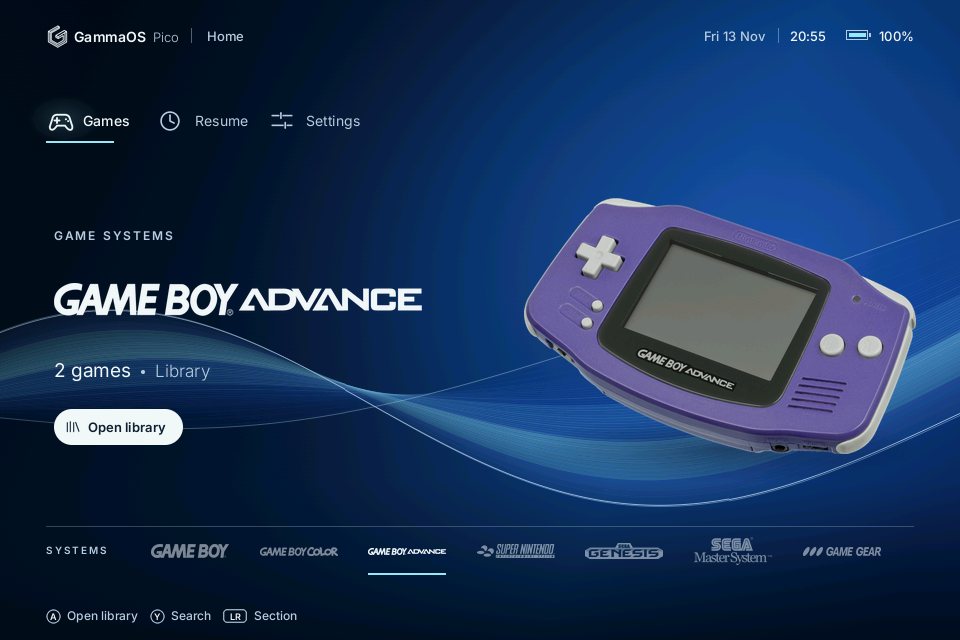
What's new in 1.2.0
- Big Core. Both consoles have big CPU cores the bootloader never used. Every system's in-game
menu gets two rows on its Gameplay page: Big Core runs the game's emulation on one big core
while the picture, the sound and the menus stay where they were, and Big Core Clock sets that
core's clock (the console's own stock levels, up to 2050 MHz on the Pocket Advance and 2000 MHz
on the Pocket Block). The emulation itself then takes a half to a third of the time. Off by
default, kept per system. A game that stalls on the big core closes back to the menu, and
netplay and link sessions stay on the usual core. - The release now installs the console's secure firmware too. Powering the other cores needs a
one instruction change to the console's secure firmware (tee), so from 1.2.0 the flash packages
and GammaOS Pico Tool write it beside the bootloader: the console's own stock tee with that
change, in tee_a and tee_b. Android starts with it as before, and the packages that go back to
stock put the stock tee back. It is made from one stock firmware version per console (BW03 on the
Pocket Advance, V02 on the Pocket Block): read the flash package's README before installing on a
console with another version. A console still on the stock tee runs 1.2.0 as before, with the
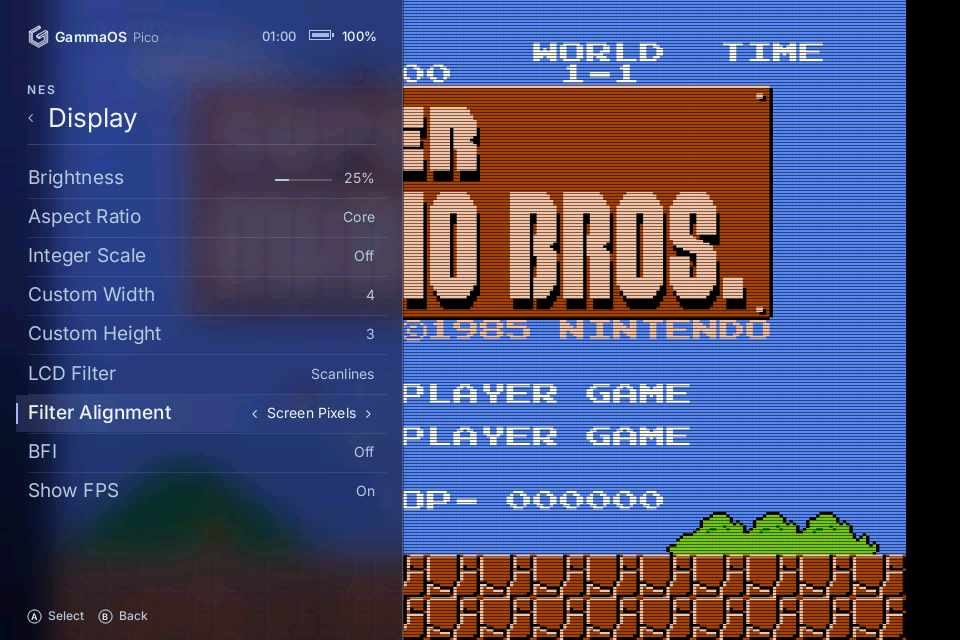
Big Core rows reading "Not available". - More aspect ratios, and your own. The Aspect Ratio row of every system goes on past its own
choices to 4:3, 3:2, 16:9, 16:10, 5:4, 8:7, 10:9, 1:1 and Custom, whose two numbers are the
Custom Width and Custom Height rows under it. - Integer Scale. On keeps the picture at a whole multiple of the game's lines, whatever the
ratio, so every line of the game is as tall as the next. Overscale takes the next whole
multiple up, filling the screen's height and cutting the edges that no longer fit (on the Pocket
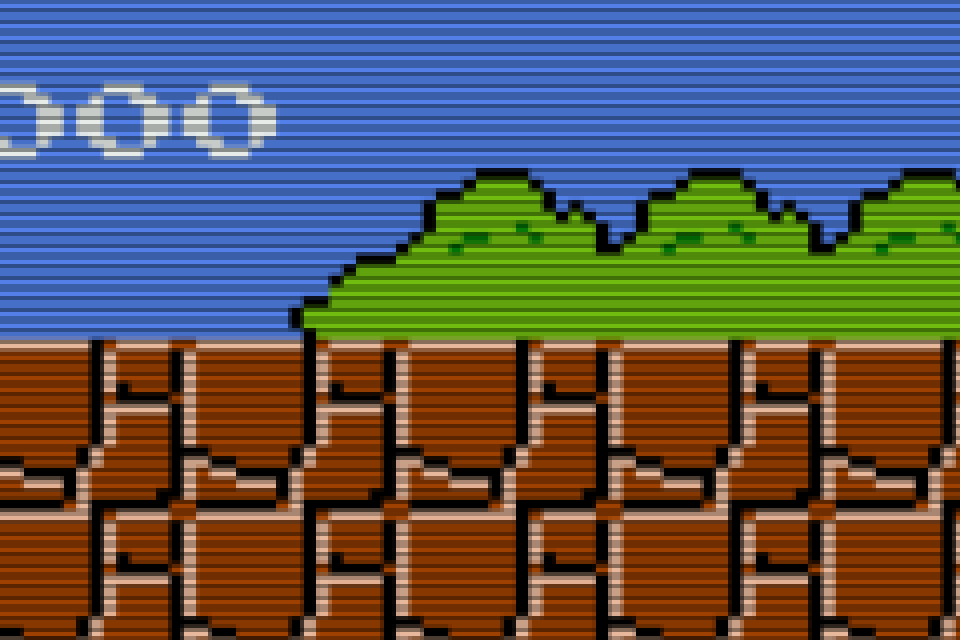
Advance a NES game goes from 2x with borders to 3x with 14 lines cut top and bottom). - Filter Alignment. Scanlines, the LCD grids and LCD1x / LCD3x were drawn on the game's pixels
and then scaled with the picture, so at a scale that is not a whole number their lines came out
uneven. Set to Screen Pixels, the filter is laid on the screen's own pixels instead, even at
any size and ratio; Game Pixels is the way it was. It takes a few milliseconds a frame more,
and the console raises the game's clock for it as it does for LCD1x and LCD3x. - armSNES 1.1 and armNES 1.5. armSNES no longer needs 80 MB of tables while a game loads;
armNES brings upstream's fix for flash saves. Save states from 1.1.2 load as they are.
All of these are per system and stay as you set them. The new rows are in all 16 languages.
 |
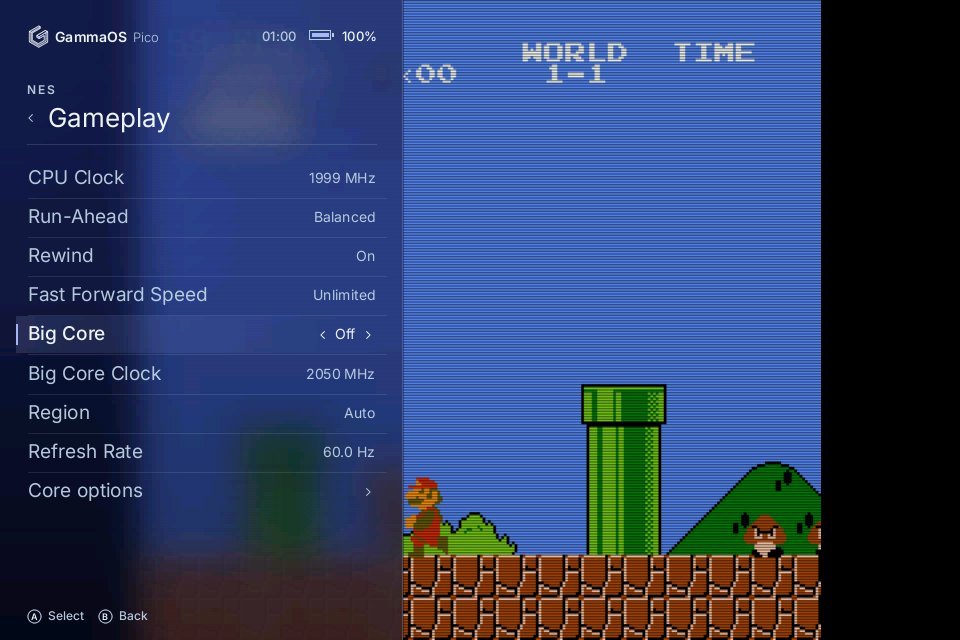 |
| The Display page: Aspect Ratio, Integer Scale, the custom ratio, Filter Alignment | Big Core and Big Core Clock on the Gameplay page |
 |
 |
| Scanlines on the game's pixels at a scale of 2.67 | The same with Filter Alignment at Screen Pixels |
Updating
Flash the 1.2.0 bootloader and secure firmware and put the 1.2.0 card files on the card.
GammaOS Pico Tool 1.2.0 does all of it and keeps your files; an older Tool updates the bootloader
and the card but not the secure firmware, so Big Core stays "Not available" until the flash
package's own scripts or Tool 1.2.0 write it. Your games, saves, states, settings, cheat files and
button maps stay as they are.
What's new in 1.1.2
- Faster fast forward, battles above all. Fast forward runs as many frames as each refresh has
time for, and less of that time now goes elsewhere: the speed badge drew through the screen's
uncached memory (2.9 ms of every refresh, now 0.6), and with armGBA 2.0 and a GBA frame drawn after
skipped ones no longer redrawing every line, a Pokemon LeafGreen battle on the Konkr Pocket
Advance fast forwards at about 4 to 5 times instead of 2 (the overworld at well over 10). Battles
stay slower than the overworld: the game takes an interrupt on every line of the screen there. - Fast Forward Speed. A new row on the in-game menu's Gameplay page, for every system: Unlimited
(as fast as the console goes, the default) or a cap from 2x to 10x. - Rewind while held. L2 now rewinds while you hold it, and the game goes on as soon as you let go
(it was on and off with each press). Both stay in the Controls page: Rewind for the press that
turns it on and off, Rewind (hold) for the button held. A button map you saved in 1.1.1 that
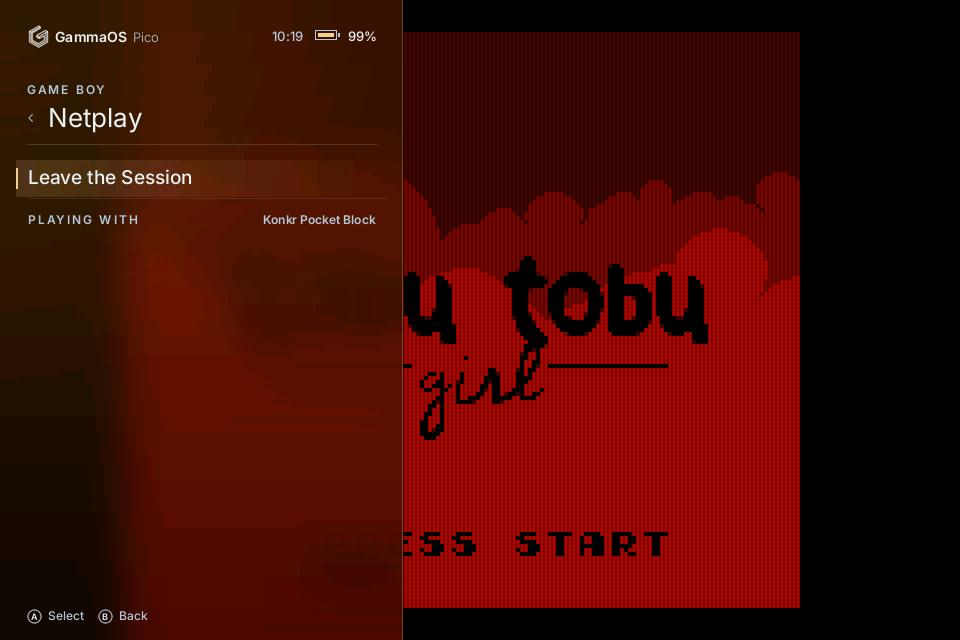
still had the old L2 toggle moves to the hold; one where you chose another button keeps it. - Play together from inside a game. Game Boy, Game Boy Color and Game Boy Advance games have a
Netplay page in the in-game menu (a tab in the Classic themes): Host a Session waits for a
friend, Join a Session finds the consoles nearby hosting a game that links with yours, and the
session starts from where both games are, no save going anywhere. Leave the Session ends it,
and each console's game carries on alone; so does the other's when one console leaves or goes out
of reach. A console in a game and one on the Link screen find each other either way round. - Joining is near instant. What the two consoles exchange to start a session (each one's game
as it stands) now crosses Bluetooth packed: a Game Boy Advance start went from about 15 seconds to
well under one, from the Link screen and from the Netplay page alike. While a start takes longer,
the Netplay page shows how far it has got and the time left, and B cancels on either console (both
games carry on). A console still on 1.1.1 or 1.1.2 links as before, without the packing. - Two different games link with one copy each. Pokemon Red on one console and Pokemon Green on
the other (or Ruby and Sapphire, FireRed and LeafGreen) no longer need both games on both cards:
each console needs only the game it plays. - Linked Game Boy sessions keep your colours: the palette you picked for an original Game Boy
game stays on through a session and after it, where it went grey. And the two consoles' checks
that they run the same game no longer disagree while an in-game menu is open (a byte of the save
state nobody wrote; the games themselves never parted). - armGBA 2.0, built the way upstream builds it for this kind of processor: about a fifth faster
in busy GBA scenes. Save states from 1.1.1 load as they are.
 |
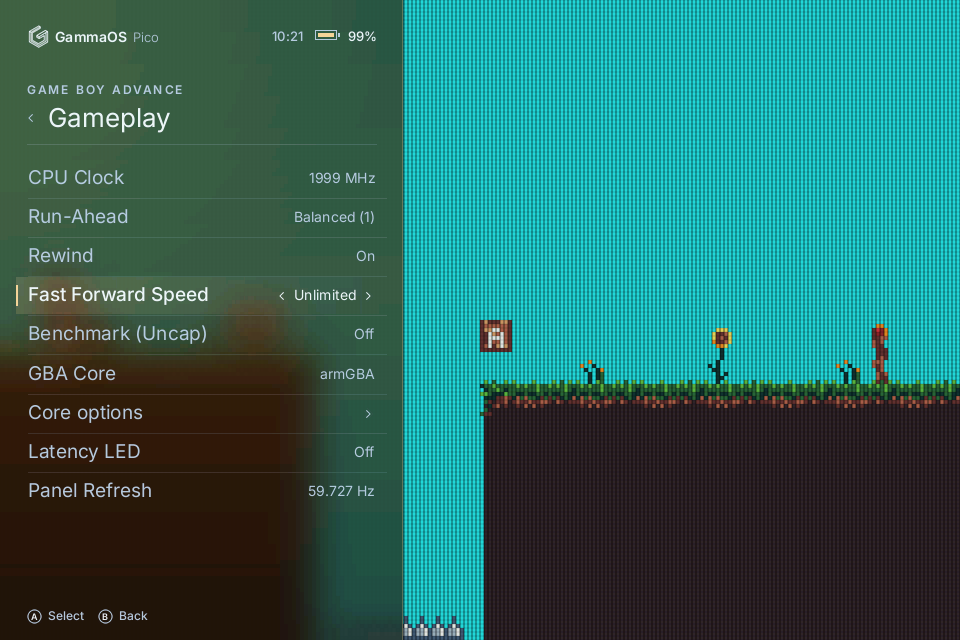 |
| A session started from the game's Netplay page | Fast Forward Speed on the Gameplay page |
Updating
Flash the 1.2.0 bootloader and put the 1.2.0 card files on the card (GammaOS Pico Tool's
card update does both the files and keeps yours; use Tool 1.1.2 or newer, which also keeps your
button maps). Your games, saves, states, settings, cheat files and button maps stay as they are.
What's new in 1.1.1
- Cheats for every system. The in-game menu has a Cheats page (a tab in the Classic
themes) with the game's cheats from RetroArch's cheat database, which comes on the card
(gammaos/cheats/, from libretro-database, CC BY-SA 4.0). A game is found by its dump's checksum,
whatever its file is called, so each code is the one made for that dump; each cheat turns on and
off with A. When a game is not found, or you want another list, the page's Cheat list row
picks one: any title of the database (it opens at your game's name, and a Search row narrows
it letter by letter) or one of your own RetroArch.chtfiles ingammaos/cheats/<system>/
(one named as the game is used by itself). L and R move through long lists a page at a time.
The list you pick and the cheats you turn on stay as you left them, across games and restarts. Every core takes
its own codes: GameShark, Action Replay and CodeBreaker on the GBA, Game Genie and GameShark on
the Game Boy, Game Genie and Pro Action Replay on the SNES, Game Genie and Action Replay on the
Sega consoles, Game Genie and raw codes on the NES. While a cheat is on, RetroAchievements waits. - armSNES, a second SNES core. armSNES, Magnominus's accurate SNES emulator (a port of ares),
comes beside snes9x, as gpSP is beside armGBA: pick it with SNES Core in the in-game menu's
Gameplay page, from the next game on. Its save states and core options are its own. snes9x stays
the default and plays the games whose chips need firmware files. - Change the buttons, and hotkeys. The in-game menu has a Controls page (a tab in the
Classic themes) for every system: which of the console's buttons plays each ...
GammaOS Pico 1.1.2 for the Konkr Pocket Advance and the Konkr Pocket Block
GammaOS Pico for the Konkr Pocket Advance and the Konkr Pocket Block, release 1.1.2
(lk-mt6785 604031f).
GammaOS Pico replaces only the console's bootloader (LK). With the GammaOS Pico microSD card in the slot the
console starts a console menu and plays Game Boy, Game Boy Color, Game Boy Advance, NES, Famicom
Disk System, SNES, Mega Drive / Genesis, Master System, Game Gear and SG-1000 games from the card.
Without the card, or after Boot to Android in the menu, Android starts exactly as before.
What's new in 1.1.2
- Faster fast forward, battles above all. Fast forward runs as many frames as each refresh has
time for, and less of that time now goes elsewhere: the speed badge drew through the screen's
uncached memory (2.9 ms of every refresh, now 0.6), and with armGBA 2.0 and a GBA frame drawn after
skipped ones no longer redrawing every line, a Pokemon LeafGreen battle on the Konkr Pocket
Advance fast forwards at about 4 to 5 times instead of 2 (the overworld at well over 10). Battles
stay slower than the overworld: the game takes an interrupt on every line of the screen there. - Fast Forward Speed. A new row on the in-game menu's Gameplay page, for every system: Unlimited
(as fast as the console goes, the default) or a cap from 2x to 10x. - Rewind while held. L2 now rewinds while you hold it, and the game goes on as soon as you let go
(it was on and off with each press). Both stay in the Controls page: Rewind for the press that
turns it on and off, Rewind (hold) for the button held. A button map you saved in 1.1.1 that
still had the old L2 toggle moves to the hold; one where you chose another button keeps it. - Play together from inside a game. Game Boy, Game Boy Color and Game Boy Advance games have a
Netplay page in the in-game menu (a tab in the Classic themes): Host a Session waits for a
friend, Join a Session finds the consoles nearby hosting a game that links with yours, and the
session starts from where both games are, no save going anywhere. Leave the Session ends it,
and each console's game carries on alone; so does the other's when one console leaves or goes out
of reach. A console in a game and one on the Link screen find each other either way round. - Joining is near instant. What the two consoles exchange to start a session (each one's game
as it stands) now crosses Bluetooth packed: a Game Boy Advance start went from about 15 seconds to
well under one, from the Link screen and from the Netplay page alike. While a start takes longer,
the Netplay page shows how far it has got and the time left, and B cancels on either console (both
games carry on). A console still on 1.1.1 or 1.1.2 links as before, without the packing. - Two different games link with one copy each. Pokemon Red on one console and Pokemon Green on
the other (or Ruby and Sapphire, FireRed and LeafGreen) no longer need both games on both cards:
each console needs only the game it plays. - Linked Game Boy sessions keep your colours: the palette you picked for an original Game Boy
game stays on through a session and after it, where it went grey. And the two consoles' checks
that they run the same game no longer disagree while an in-game menu is open (a byte of the save
state nobody wrote; the games themselves never parted). - armGBA 2.0, built the way upstream builds it for this kind of processor: about a fifth faster
in busy GBA scenes. Save states from 1.1.1 load as they are.
|
|
| A session started from the game's Netplay page | Fast Forward Speed on the Gameplay page |
Updating
Flash the 1.1.2 bootloader and put the 1.1.2 card files on the card (GammaOS Pico Tool's
card update does both the files and keeps yours; use Tool 1.1.2 or newer, which also keeps your
button maps). Your games, saves, states, settings, cheat files and button maps stay as they are.
What's new in 1.1.1
- Cheats for every system. The in-game menu has a Cheats page (a tab in the Classic
themes) with the game's cheats from RetroArch's cheat database, which comes on the card
(gammaos/cheats/, from libretro-database, CC BY-SA 4.0). A game is found by its dump's checksum,
whatever its file is called, so each code is the one made for that dump; each cheat turns on and
off with A. When a game is not found, or you want another list, the page's Cheat list row
picks one: any title of the database (it opens at your game's name, and a Search row narrows
it letter by letter) or one of your own RetroArch.chtfiles ingammaos/cheats/<system>/
(one named as the game is used by itself). L and R move through long lists a page at a time.
The list you pick and the cheats you turn on stay as you left them, across games and restarts. Every core takes
its own codes: GameShark, Action Replay and CodeBreaker on the GBA, Game Genie and GameShark on
the Game Boy, Game Genie and Pro Action Replay on the SNES, Game Genie and Action Replay on the
Sega consoles, Game Genie and raw codes on the NES. While a cheat is on, RetroAchievements waits. - armSNES, a second SNES core. armSNES, Magnominus's accurate SNES emulator (a port of ares),
comes beside snes9x, as gpSP is beside armGBA: pick it with SNES Core in the in-game menu's
Gameplay page, from the next game on. Its save states and core options are its own. snes9x stays
the default and plays the games whose chips need firmware files. - Change the buttons, and hotkeys. The in-game menu has a Controls page (a tab in the
Classic themes) for every system: which of the console's buttons plays each of the game's (A, B,
START, the d-pad, turbo A and B, the Mega Drive's six buttons and MODE, the NES Zapper's trigger)
and the hotkeys: fast forward and rewind (toggled or held), save state, load state, reset game,
open the menu, and the disk side for Famicom Disk System games. Press A on a row, then the button
you want; a hotkey takes up to three buttons pressed together. Every button of the console can
be used, the ones no game used before included (the Konkr Pocket Block's MODE key, second side
key and back key, the Konkr Pocket Advance's spare buttons). The buttons can be the same for
all of a system's games or the game's own, and stay across restarts (gammaos/controls/). The
Menu button, Power and SELECT + START + L + R always keep their jobs, so the menu can never be
locked out. - Newer emulator cores: armGBA 1.8.1, armNES 1.4, and the latest fixes of Genesis Plus GX and
snes9x. - Games with big achievement sets start much faster. A set of a few hundred achievements over
pointer chains held the game's start for seconds while it loaded (Pokemon LeafGreen on the Konkr
Pocket Block: 6.4 s to start, now 2.0 s); the set is the same.
What's new in 1.1
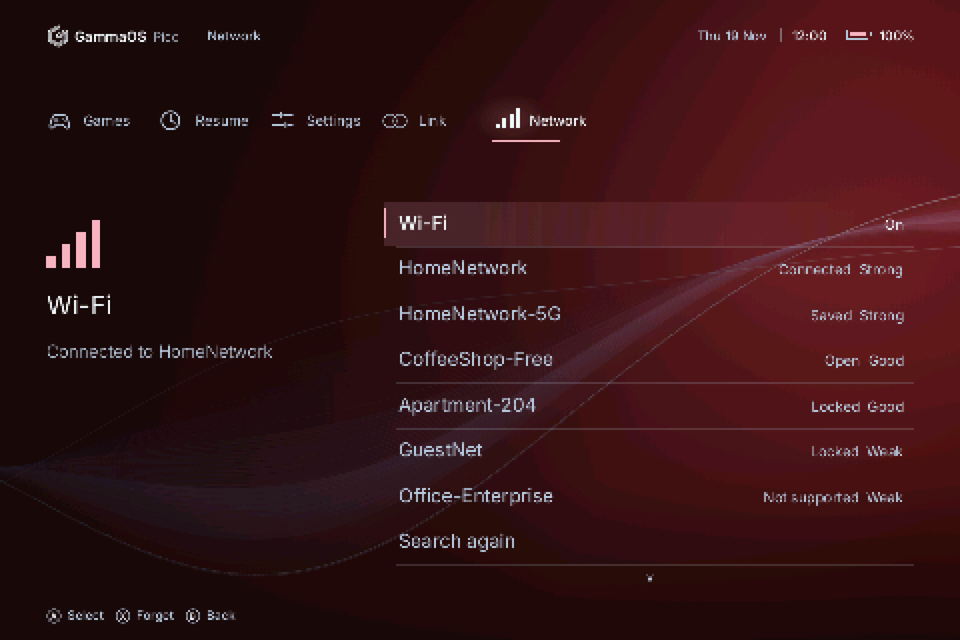
- Wi-Fi. Both consoles join Wi-Fi networks from the bootloader: a new Network tab in the
Pico menu (System > Network in the Classic themes) turns Wi-Fi on and off, lists the networks
around you strongest first with their security and signal, joins them with a password typed on
the on-screen keyboard, and remembers them. Saved networks join by themselves when they are in
range, and Wi-Fi stays as you left it across power ons. A Saved networks page lists every
network kept on the card, in range or not, and forgets one with two presses of A. WPA2 and open
networks are supported (WPA3-only and enterprise networks are not yet). Wi-Fi costs nothing
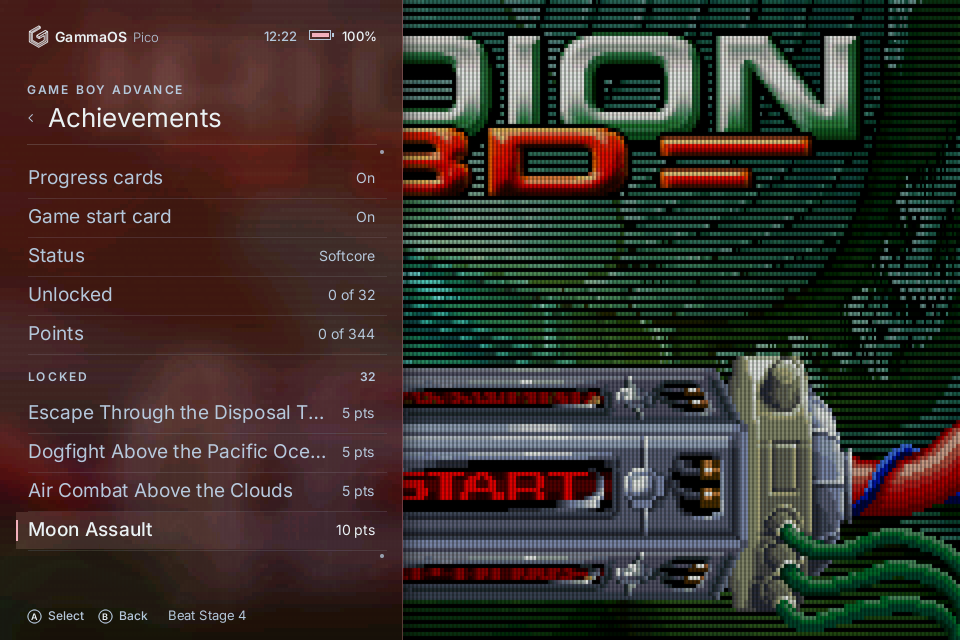
while it is off, and it sleeps while you play. - RetroAchievements. Sign in with your retroachievements.org account on the Network tab and
every system earns achievements: Game Boy, Game Boy Color, Game Boy Advance, NES, SNES, Mega
Drive / Genesis, Master System and Game Gear. Achievements are softcore. Unlocks earned without
a network are kept on the card and sent with their time once you are back online. The in-game
menu has an Achievements page with the game's set in groups (almost there, locked,
unlocked, waiting to be sent), each achievement's badge and a full screen detail, plus the
account and the settings (achievements on or off, which cards show). Unlock, progress and game
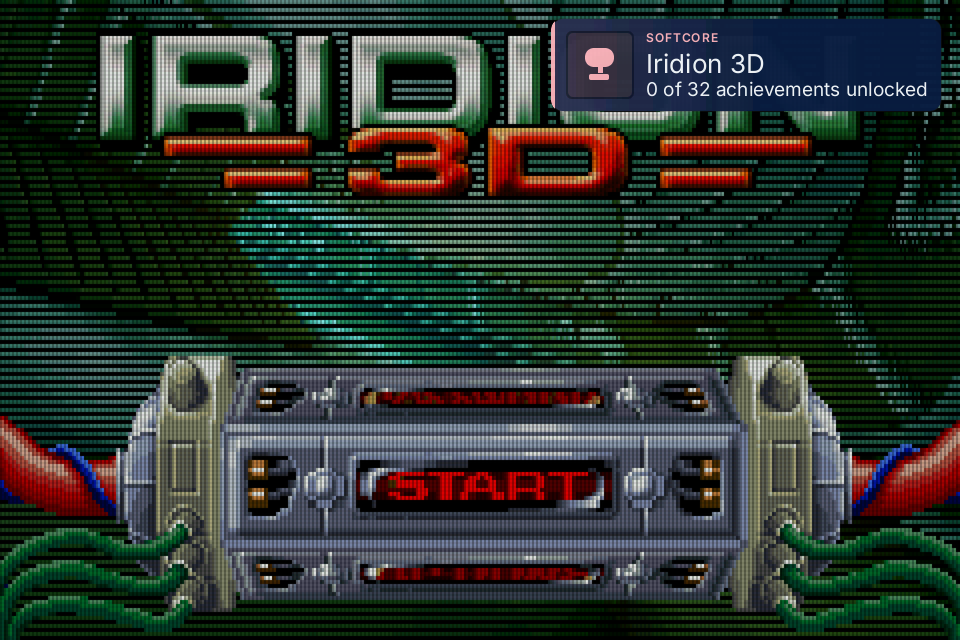
start cards appear over the game in your theme's own look. Save states keep achievement
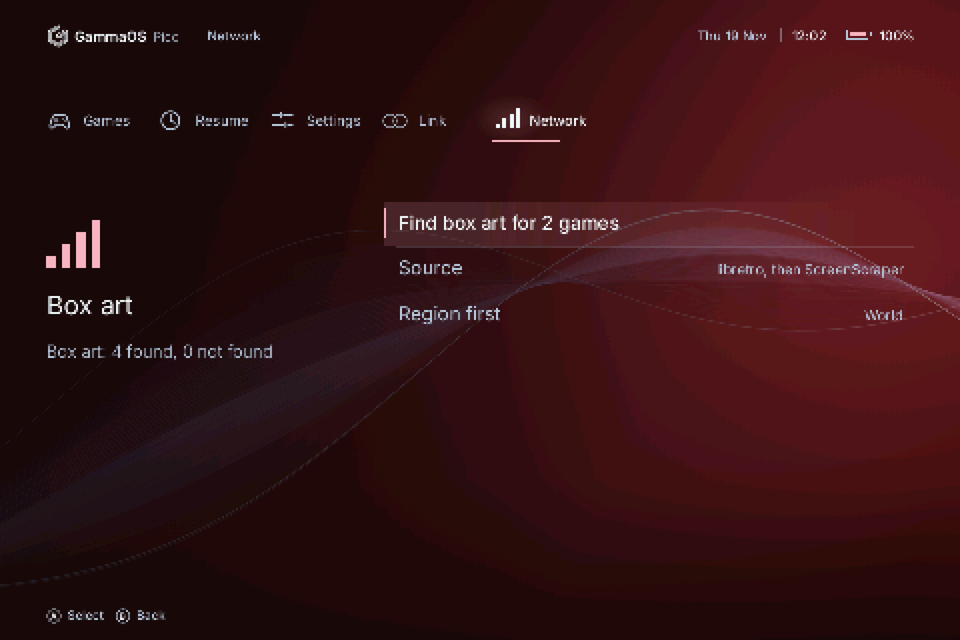
progress. GammaOS Pico identifies itself to RetroAchievements with its own name and each core's. - Box art from the network. The Network tab's Box art page finds covers for every game
that has none: libretro's thumbnails first (matched by the game's No-Intro checksum, so files
with any name are found, zipped games included), then ScreenScraper for the rest. Choose the
region you prefer; covers appear in the menu as soon as they arrive. Games no source has are
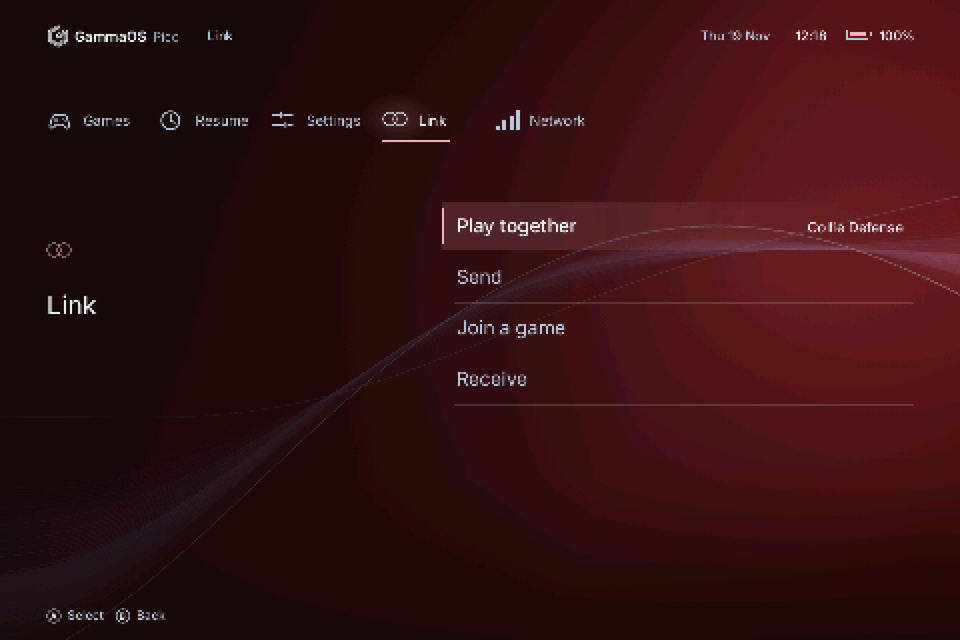
not asked again for 30 days. - Play together over Bluetooth. Two consoles link over Bluetooth with no cables: Play
together runs lockstep netplay for NES, SNES, Mega Drive / Genesis, Master System, Game Gear
and Game Boy / Game Boy Color / Game Boy Advance link games (trading, link battles), Send and
Receive copy a game you own from one card to the other, and Join a game offers the same
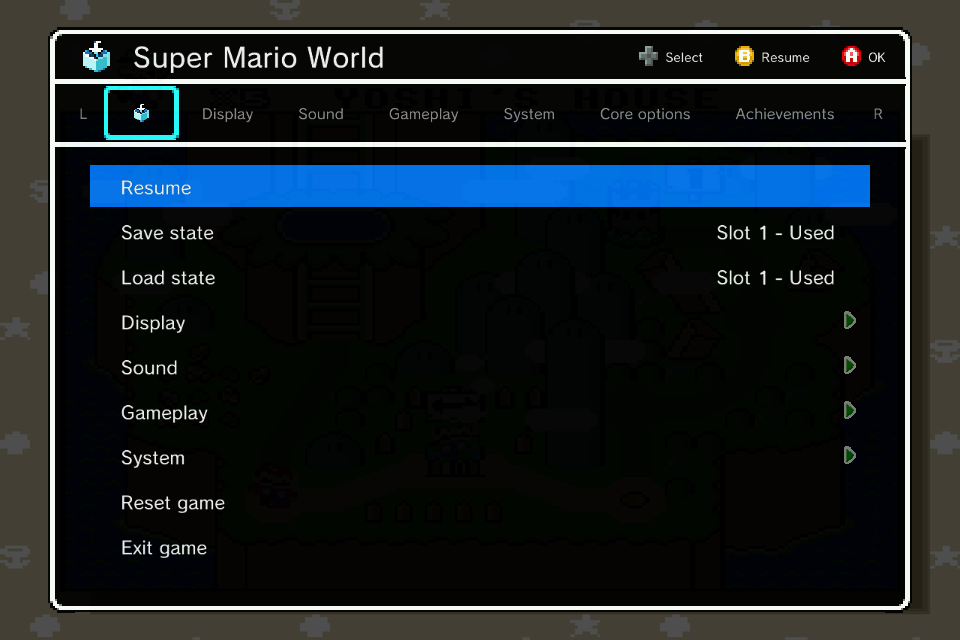
game when the other console has it. The consoles also share the time. - Each core's own options in the in-game menu, for every system, cropping among them.
- The Classic themes' own in-game menu: a sheet in the menu's look, with L and R for its tabs.
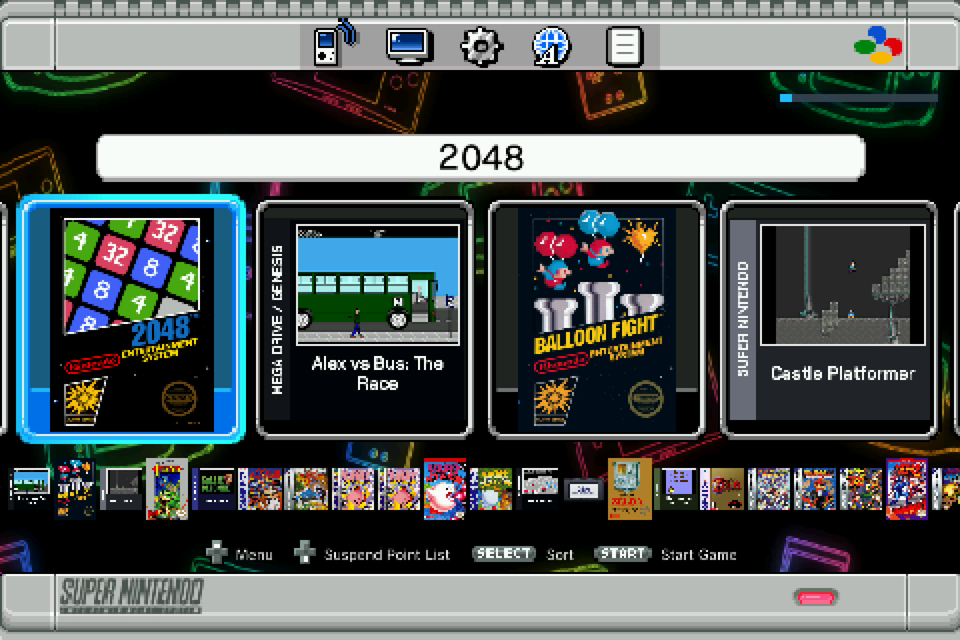
The Classic menubar starts with Link and has the Current theme's settings (Display, Settings,
System ...
GammaOS Pico 1.1.1 for the Konkr Pocket Advance and the Konkr Pocket Block
GammaOS Pico for the Konkr Pocket Advance and the Konkr Pocket Block, release 1.1.1
(lk-mt6785 9bf1419).
GammaOS Pico replaces only the console's bootloader (LK). With the GammaOS Pico microSD card in the slot the
console starts a console menu and plays Game Boy, Game Boy Color, Game Boy Advance, NES, Famicom
Disk System, SNES, Mega Drive / Genesis, Master System, Game Gear and SG-1000 games from the card.
Without the card, or after Boot to Android in the menu, Android starts exactly as before.
What's new in 1.1.1
- Cheats for every system. The in-game menu has a Cheats page (a tab in the Classic
themes) with the game's cheats from RetroArch's cheat database, which comes on the card
(gammaos/cheats/, from libretro-database, CC BY-SA 4.0). A game is found by its dump's checksum,
whatever its file is called, so each code is the one made for that dump; each cheat turns on and
off with A. When a game is not found, or you want another list, the page's Cheat list row
picks one: any title of the database (it opens at your game's name, and a Search row narrows
it letter by letter) or one of your own RetroArch.chtfiles ingammaos/cheats/<system>/
(one named as the game is used by itself). L and R move through long lists a page at a time.
The list you pick and the cheats you turn on stay as you left them, across games and restarts. Every core takes
its own codes: GameShark, Action Replay and CodeBreaker on the GBA, Game Genie and GameShark on
the Game Boy, Game Genie and Pro Action Replay on the SNES, Game Genie and Action Replay on the
Sega consoles, Game Genie and raw codes on the NES. While a cheat is on, RetroAchievements waits. - armSNES, a second SNES core. armSNES, Magnominus's accurate SNES emulator (a port of ares),
comes beside snes9x, as gpSP is beside armGBA: pick it with SNES Core in the in-game menu's
Gameplay page, from the next game on. Its save states and core options are its own. snes9x stays
the default and plays the games whose chips need firmware files. - Change the buttons, and hotkeys. The in-game menu has a Controls page (a tab in the
Classic themes) for every system: which of the console's buttons plays each of the game's (A, B,
START, the d-pad, turbo A and B, the Mega Drive's six buttons and MODE, the NES Zapper's trigger)
and the hotkeys: fast forward and rewind (toggled or held), save state, load state, reset game,
open the menu, and the disk side for Famicom Disk System games. Press A on a row, then the button
you want; a hotkey takes up to three buttons pressed together. Every button of the console can
be used, the ones no game used before included (the Konkr Pocket Block's MODE key, second side
key and back key, the Konkr Pocket Advance's spare buttons). The buttons can be the same for
all of a system's games or the game's own, and stay across restarts (gammaos/controls/). The
Menu button, Power and SELECT + START + L + R always keep their jobs, so the menu can never be
locked out. - Newer emulator cores: armGBA 1.8.1, armNES 1.4, and the latest fixes of Genesis Plus GX and
snes9x. - Games with big achievement sets start much faster. A set of a few hundred achievements over
pointer chains held the game's start for seconds while it loaded (Pokemon LeafGreen on the Konkr
Pocket Block: 6.4 s to start, now 2.0 s); the set is the same.
Updating from 1.1.0
Flash the 1.1.1 bootloader and put the 1.1.1 card files on the card (GammaOS Pico Tool 1.1.1's card
update does both the files and keeps yours). The new files are the cheat database
(gammaos/cheats/), armSNES (cores/armsnes-pico.blob) and the updated cores; your games, saves,
states, settings, your own cheat files and your button maps stay as they are.
What's new in 1.1
- Wi-Fi. Both consoles join Wi-Fi networks from the bootloader: a new Network tab in the
Pico menu (System > Network in the Classic themes) turns Wi-Fi on and off, lists the networks
around you strongest first with their security and signal, joins them with a password typed on
the on-screen keyboard, and remembers them. Saved networks join by themselves when they are in
range, and Wi-Fi stays as you left it across power ons. A Saved networks page lists every
network kept on the card, in range or not, and forgets one with two presses of A. WPA2 and open
networks are supported (WPA3-only and enterprise networks are not yet). Wi-Fi costs nothing
while it is off, and it sleeps while you play. - RetroAchievements. Sign in with your retroachievements.org account on the Network tab and
every system earns achievements: Game Boy, Game Boy Color, Game Boy Advance, NES, SNES, Mega
Drive / Genesis, Master System and Game Gear. Achievements are softcore. Unlocks earned without
a network are kept on the card and sent with their time once you are back online. The in-game
menu has an Achievements page with the game's set in groups (almost there, locked,
unlocked, waiting to be sent), each achievement's badge and a full screen detail, plus the
account and the settings (achievements on or off, which cards show). Unlock, progress and game
start cards appear over the game in your theme's own look. Save states keep achievement
progress. GammaOS Pico identifies itself to RetroAchievements with its own name and each core's. - Box art from the network. The Network tab's Box art page finds covers for every game
that has none: libretro's thumbnails first (matched by the game's No-Intro checksum, so files
with any name are found, zipped games included), then ScreenScraper for the rest. Choose the
region you prefer; covers appear in the menu as soon as they arrive. Games no source has are
not asked again for 30 days. - Play together over Bluetooth. Two consoles link over Bluetooth with no cables: Play
together runs lockstep netplay for NES, SNES, Mega Drive / Genesis, Master System, Game Gear
and Game Boy / Game Boy Color / Game Boy Advance link games (trading, link battles), Send and
Receive copy a game you own from one card to the other, and Join a game offers the same
game when the other console has it. The consoles also share the time. - Each core's own options in the in-game menu, for every system, cropping among them.
- The Classic themes' own in-game menu: a sheet in the menu's look, with L and R for its tabs.
The Classic menubar starts with Link and has the Current theme's settings (Display, Settings,
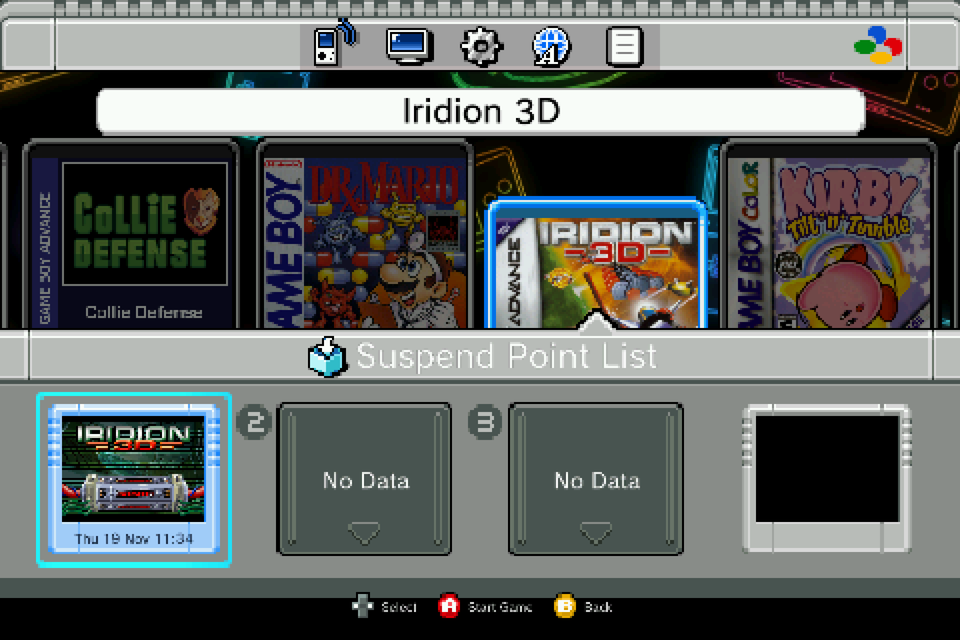
System with Date & Time, Network and About), and Down on the home opens the Suspend Point
List: the focused game's save states, each with its picture and when it was made. - Konkr Pocket Block: tilt, gyro and rumble for the cartridges that have them, as on the Pocket Advance.
- Faster and safer under the hood: the clock is set from the network, HTTPS connections are
checked against trusted roots, and keys come from the chip's hardware random generator.
 |
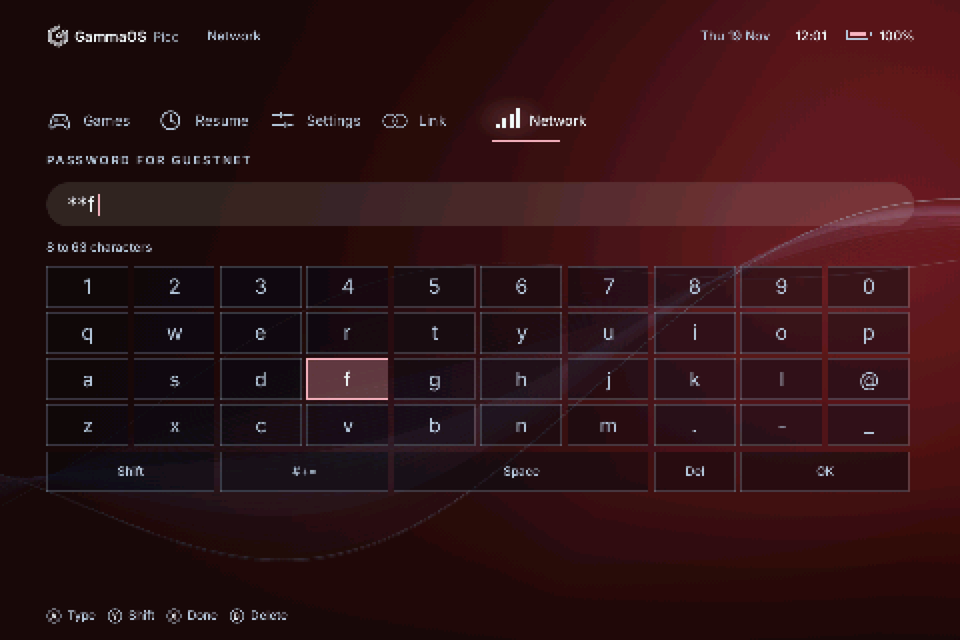 |
| Network > Wi-Fi: the networks around, strongest first | Typing a password |
 |
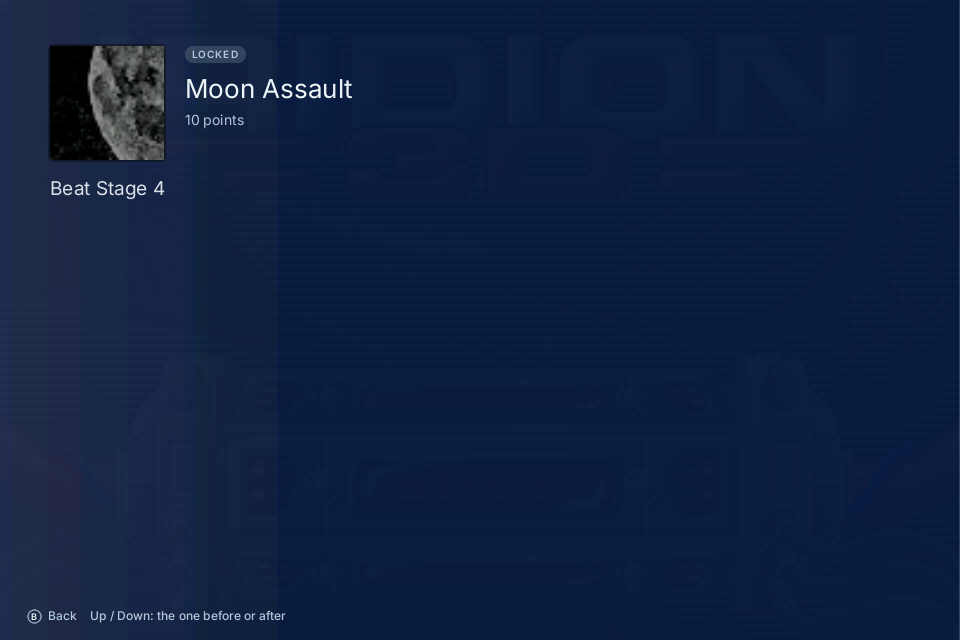 |
| A game's achievements in the in-game menu | An achievement's full screen detail |
 |
 |
| The game start card over the game | Box art from the network |
 |
 |
| Play together, Send, Join a game, Receive | The Classic themes' own in-game menu |
 |
 |
| The Classic theme, Link first in its menubar | The Suspend Point List under the games |
The Wi-Fi screenshots show example network names.
Updating from 1.0.x
Flash the 1.1.1 bootloader and put the 1.1.1 card files on the card (GammaOS Pico Tool 1.1.1's card
update does both the files and keeps yours). The card brings the Wi-Fi and Bluetooth chip's
firmware in bios/connsys/ and HTTPS's trusted roots in bios/certs/: without them Wi-Fi and
Bluetooth do not start. Your games, saves, states and settings stay as they are.
Known issue
On the Konkr Pocket Advance the USB connection to a computer (fastboot, GammaOS Pico Tool's
console features) can drop after a game is started while Wi-Fi is busy. The console and the game
carry on; unplugging and plugging the cable back in, or a restart, brings it back.
What makes it different
GammaOS Pico isn't an app on top of Android or a Linux distro. It runs inside the console's
bootloader, before any operating system, and owns the hardware outright.
- Fast on. From power on to the GBA boot logo in about two and a half seconds (Android takes
around 25). Hold Power to save where you are and switch off; turn it back on and you're back
in the game. - Low latency by design. The panel is retimed to each console's real refre...
GammaOS Pico 1.1.0 for the Konkr Pocket Advance and the Konkr Pocket Block
Caution
This release is out of date: use GammaOS Pico 1.1.1 instead
Do not download or install this version. GammaOS Pico 1.1.1 has every fix and feature since this one, for both the Konkr Pocket Advance and the Konkr Pocket Block. This page is kept for reference only.
Get GammaOS Pico 1.1.1
GammaOS Pico for the Konkr Pocket Advance and the Konkr Pocket Block, release 1.1.0
(lk-mt6785 25520fe).
GammaOS Pico replaces only the console's bootloader (LK). With the GammaOS Pico microSD card in the slot the
console starts a console menu and plays Game Boy, Game Boy Color, Game Boy Advance, NES, Famicom
Disk System, SNES, Mega Drive / Genesis, Master System, Game Gear and SG-1000 games from the card.
Without the card, or after Boot to Android in the menu, Android starts exactly as before.
What's new in 1.1
- Wi-Fi. Both consoles join Wi-Fi networks from the bootloader: a new Network tab in the
Pico menu (System > Network in the Classic themes) turns Wi-Fi on and off, lists the networks
around you strongest first with their security and signal, joins them with a password typed on
the on-screen keyboard, and remembers them. Saved networks join by themselves when they are in
range, and Wi-Fi stays as you left it across power ons. A Saved networks page lists every
network kept on the card, in range or not, and forgets one with two presses of A. WPA2 and open
networks are supported (WPA3-only and enterprise networks are not yet). Wi-Fi costs nothing
while it is off, and it sleeps while you play. - RetroAchievements. Sign in with your retroachievements.org account on the Network tab and
every system earns achievements: Game Boy, Game Boy Color, Game Boy Advance, NES, SNES, Mega
Drive / Genesis, Master System and Game Gear. Achievements are softcore. Unlocks earned without
a network are kept on the card and sent with their time once you are back online. The in-game
menu has an Achievements page with the game's set in groups (almost there, locked,
unlocked, waiting to be sent), each achievement's badge and a full screen detail, plus the
account and the settings (achievements on or off, which cards show). Unlock, progress and game
start cards appear over the game in your theme's own look. Save states keep achievement
progress. GammaOS Pico identifies itself to RetroAchievements with its own name and each core's. - Box art from the network. The Network tab's Box art page finds covers for every game
that has none: libretro's thumbnails first (matched by the game's No-Intro checksum, so files
with any name are found, zipped games included), then ScreenScraper for the rest. Choose the
region you prefer; covers appear in the menu as soon as they arrive. Games no source has are
not asked again for 30 days. - Play together over Bluetooth. Two consoles link over Bluetooth with no cables: Play
together runs lockstep netplay for NES, SNES, Mega Drive / Genesis, Master System, Game Gear
and Game Boy / Game Boy Color / Game Boy Advance link games (trading, link battles), Send and
Receive copy a game you own from one card to the other, and Join a game offers the same
game when the other console has it. The consoles also share the time. - Each core's own options in the in-game menu, for every system, cropping among them.
- The Classic themes' own in-game menu: a sheet in the menu's look, with L and R for its tabs.
The Classic menubar starts with Link and has the Current theme's settings (Display, Settings,
System with Date & Time, Network and About), and Down on the home opens the Suspend Point
List: the focused game's save states, each with its picture and when it was made. - Konkr Pocket Block: tilt, gyro and rumble for the cartridges that have them, as on the Pocket Advance.
- Faster and safer under the hood: the clock is set from the network, HTTPS connections are
checked against trusted roots, and keys come from the chip's hardware random generator.
|
|
| Network > Wi-Fi: the networks around, strongest first | Typing a password |
|
|
| A game's achievements in the in-game menu | An achievement's full screen detail |
|
|
| The game start card over the game | Box art from the network |
|
|
| Play together, Send, Join a game, Receive | The Classic themes' own in-game menu |
|
|
| The Classic theme, Link first in its menubar | The Suspend Point List under the games |
The Wi-Fi screenshots show example network names.
Updating from 1.0.x
Flash the 1.1.0 bootloader and put the 1.1.0 card files on the card (GammaOS Pico Tool 1.1.0's card
update does both the files and keeps yours). The card brings the Wi-Fi and Bluetooth chip's
firmware in bios/connsys/ and HTTPS's trusted roots in bios/certs/: without them Wi-Fi and
Bluetooth do not start. Your games, saves, states and settings stay as they are.
Known issue
On the Konkr Pocket Advance the USB connection to a computer (fastboot, GammaOS Pico Tool's
console features) can drop after a game is started while Wi-Fi is busy. The console and the game
carry on; unplugging and plugging the cable back in, or a restart, brings it back.
What makes it different
GammaOS Pico isn't an app on top of Android or a Linux distro. It runs inside the console's
bootloader, before any operating system, and owns the hardware outright.
- Fast on. From power on to the GBA boot logo in about two and a half seconds (Android takes
around 25). Hold Power to save where you are and switch off; turn it back on and you're back
in the game. - Low latency by design. The panel is retimed to each console's real refresh rate (59.73 Hz
for GBA and Game Boy, 60.1 Hz for SNES, 50 Hz for PAL), every frame is paced to the panel's scan,
buttons are read as late as possible, and run-ahead ("Preemptive Frames") hides the games' own lag. - Android stays. Only the bootloader changes. Pull the card (or pick Boot to Android) and the
console starts its stock Android, untouched. - Everything on the card. Emulators, settings, saves, states and box art all live on the
microSD card. Swap the card, swap the whole setup. - Your card, your way. Games are found in GammaOS's
roms/<system>/or where another front
end keeps them:ROMs/<system>/(ES-DE),Emulation/roms/<system>/(EmuDeck) or any
<folder>/roms/<system>/, with the usual folder names (gba,snes,megadrive,
mastersystem,gamegearand so on). Drop a PNG cover named like the game into aboxart
folder beside it and the console sizes it for the menu at the next power on. - Zipped games welcome. Games can stay in .zip or .7z archives, unpacked as they start (about
half a second for a 16 MB GBA game, resume at power on included). An archive with several games
lists each one, and one that cannot be opened says why instead of failing quietly. - Made for big libraries. Tens of thousands of games list in moments. Hold a direction to
speed through a library, jump letter by letter with L / R, or press Y to search by name, in one
system or all of them, with an on-screen keyboard. Box art loads as you reach it. - The good stuff from the start. Rewind, fast forward, save states (written to the card while
the game plays on), scanline and LCD filters and colour correction, in a box art menu: the
Current theme, with the Classic and GBA Indigo themes in beta. - The real time. The console's own clock runs the games that keep time (Pokemon Ruby,
Sapphire, Emerald, Gold, Silver and Crystal, Boktai), shows in the menus, and is set with its
time zone in Settings > Date & Time. Each game shows how long it has been played and when last. - Sharper motion with black frame insertion. The backlight goes dark for part of every frame,
in step with the screen's refresh, so moving pictures stay crisp the way they did on a CRT
instead of smearing. 25 %, 50 % or 75 % dark (Settings > Black Frame Insertion, or per game in
the in-game menu's Display page); the screen looks dimmer the higher it is set. - Tilt, gyro and rumble (both consoles). The console's own motion sensor and vibration
motor stand in for the cartridges': Yoshi Topsy-Turvy and Kirby Tilt 'n' Tumble tilt (a flick of the console makes
Kirby jump), WarioWare: Twisted! turns and rumbles, as do Drill Dozer and the Game Boy Color's
rumble cartridges. - Headphones. Sound mov...
GammaOS Pico 1.0.2 for the Konkr Pocket Advance and the Konkr Pocket Block
Caution
This release is out of date: use GammaOS Pico 1.1.1 instead
Do not download or install this version. GammaOS Pico 1.1.1 has every fix and feature since this one, for both the Konkr Pocket Advance and the Konkr Pocket Block. This page is kept for reference only.
Get GammaOS Pico 1.1.1
GammaOS Pico for the Konkr Pocket Advance and, new in this release, the Konkr Pocket Block,
release 1.0.2 (lk-mt6785 07e2910).
GammaOS Pico replaces only the console's bootloader (LK). With the GammaOS Pico microSD card in the slot the
console starts a console menu and plays Game Boy, Game Boy Color, Game Boy Advance, NES, Famicom
Disk System, SNES, Mega Drive / Genesis, Master System, Game Gear and SG-1000 games from the card.
Without the card, or after Boot to Android in the menu, Android starts exactly as before.
What's new in 1.0.2
- The Konkr Pocket Block. GammaOS Pico now runs on the Konkr Pocket Block (MediaTek MT8786,
960 x 720) as it does on the Konkr Pocket Advance: the same menus, cores, saves and settings,
the panel retimed to each system's refresh, run-ahead, rewind, fast forward, black frame
insertion, the clock, the battery gauge, the power light and headphones, with the CPU at
1800 MHz on every system. The same microSD card works in both consoles. The Block has its own
packages (gammaos-pico-block-*); on the Block the bootloader combo is SELECT + START + R1, the
in-game menu is on the side key, volume and brightness are set in the in-game menu, and the
BIOS intro is off by default (Settings > BIOS Boot turns it on). Not on the Block yet: tilt and
rumble for the cartridges that have them. - NES, Famicom and Famicom Disk System. A new core, armNES 1.1, plays
.nesand.unf
cartridges and.fdsDisk System games, also from .zip and .7z archives, with run-ahead,
rewind, fast forward, save states, the LCD filters, aspect ratios and NTSC, PAL and Dendy
timing. Disk System games need the Disk System BIOS on the card asbios/disksys.rom; Swap
Disk Side on the in-game menu's first page turns the disk over. Disk System games run on the core's fast
path, so they keep run-ahead at full speed like cartridges do. Games go inroms/nes/(or
famicom,fds). - Zipped games start every time. On some cards a game in a .zip or .7z could refuse to start
with "This archive is too large to open" after a power on that found every archive already
listed; the archive reader now has memory of its own. - The NES's words in all 17 languages.
What makes it different
GammaOS Pico isn't an app on top of Android or a Linux distro. It runs inside the console's
bootloader, before any operating system, and owns the hardware outright.
- Fast on. From power on to the GBA boot logo in about two and a half seconds (Android takes
around 25). Hold Power to save where you are and switch off; turn it back on and you're back
in the game. - Low latency by design. The panel is retimed to each console's real refresh rate (59.73 Hz
for GBA and Game Boy, 60.1 Hz for SNES, 50 Hz for PAL), every frame is paced to the panel's scan,
buttons are read as late as possible, and run-ahead ("Preemptive Frames") hides the games' own lag. - Android stays. Only the bootloader changes. Pull the card (or pick Boot to Android) and the
console starts its stock Android, untouched. - Everything on the card. Emulators, settings, saves, states and box art all live on the
microSD card. Swap the card, swap the whole setup. - Your card, your way. Games are found in GammaOS's
roms/<system>/or where another front
end keeps them:ROMs/<system>/(ES-DE),Emulation/roms/<system>/(EmuDeck) or any
<folder>/roms/<system>/, with the usual folder names (gba,snes,megadrive,
mastersystem,gamegearand so on). Drop a PNG cover named like the game into aboxart
folder beside it and the console sizes it for the menu at the next power on. - Zipped games welcome. Games can stay in .zip or .7z archives, unpacked as they start (about
half a second for a 16 MB GBA game, resume at power on included). An archive with several games
lists each one, and one that cannot be opened says why instead of failing quietly. - Made for big libraries. Tens of thousands of games list in moments. Hold a direction to
speed through a library, jump letter by letter with L / R, or press Y to search by name, in one
system or all of them, with an on-screen keyboard. Box art loads as you reach it. - The good stuff from the start. Rewind, fast forward, save states (written to the card while
the game plays on), scanline and LCD filters and colour correction, in a box art menu: the
Current theme, with the Classic and GBA Indigo themes in beta. - The real time. The console's own clock runs the games that keep time (Pokemon Ruby,
Sapphire, Emerald, Gold, Silver and Crystal, Boktai), shows in the menus, and is set with its
time zone in Settings > Date & Time. Each game shows how long it has been played and when last. - Sharper motion with black frame insertion. The backlight goes dark for part of every frame,
in step with the screen's refresh, so moving pictures stay crisp the way they did on a CRT
instead of smearing. 25 %, 50 % or 75 % dark (Settings > Black Frame Insertion, or per game in
the in-game menu's Display page); the screen looks dimmer the higher it is set. - Tilt, gyro and rumble (Konkr Pocket Advance). The console's own motion sensor and vibration
motor stand in for the cartridges': Yoshi Topsy-Turvy and Kirby Tilt 'n' Tumble tilt (a flick of the console makes
Kirby jump), WarioWare: Twisted! turns and rumbles, as do Drill Dozer and the Game Boy Color's
rumble cartridges. - Headphones. Sound moves to the 3.5 mm jack as soon as headphones are plugged in, and back
to the speakers when they come out. - Names in any language. Game names show as the card has them: accented letters, Greek,
Cyrillic, Japanese, Chinese, Korean, Hebrew and Arabic, and search finds them by their letters
without accents. - In your language. The menus and the in-game menu in 17 languages: English, French, German,
Spanish, Italian, Dutch, Portuguese, Russian, Japanese, Korean, Simplified and Traditional
Chinese, Polish, Turkish, Arabic, Hebrew and Persian (Settings > Language).
Put the real Game Boy Advance BIOS on the card. Copy your own console's BIOS as
bios/gba_bios.bin(16 KB). GBA games then start on Nintendo's own BIOS: the original boot logo
and chime, and the exact BIOS routines every game was made against. Without it armGBA falls back
to its built-in replacement, which runs most games but not all of them the same way, and gpSP
(the second GBA emulator) cannot run at all. The BIOS is Nintendo's and is not included.
Screenshots
Captured on a Konkr Pocket Advance from the display buffers, with the demo games from the release;
the in-game menu shots lay its drawer over the game the way the display hardware blends them.
|
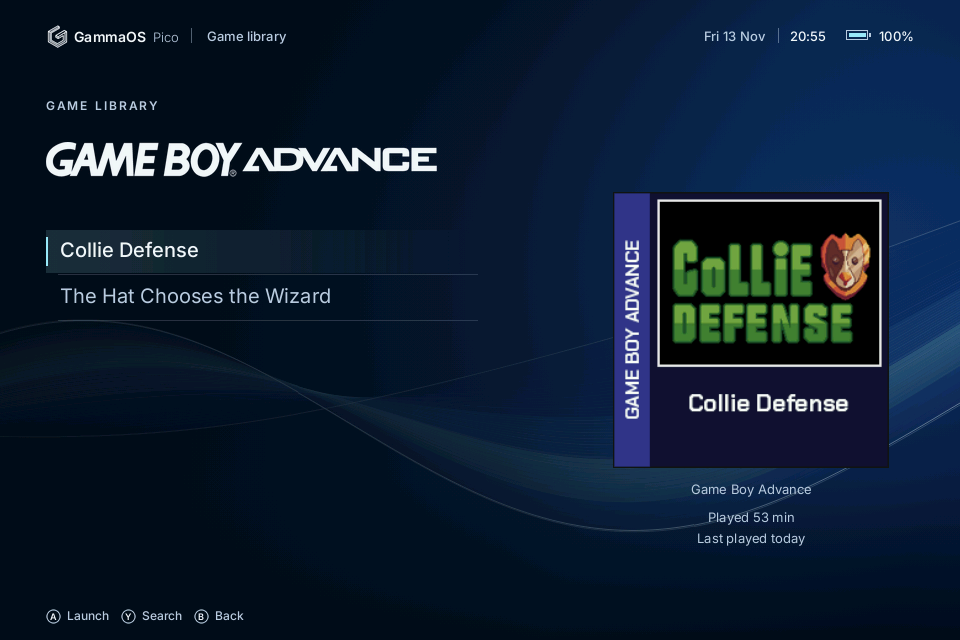 |
| Home: the systems on the card, with the date, the time and the battery | A system's library: box art, how long each game has been played and when last |
 |
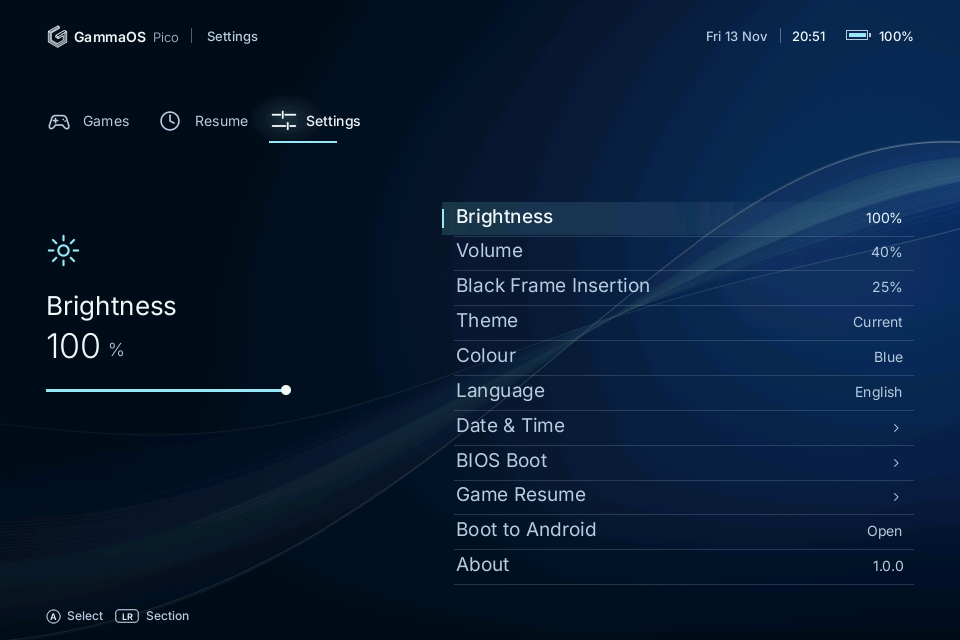 |
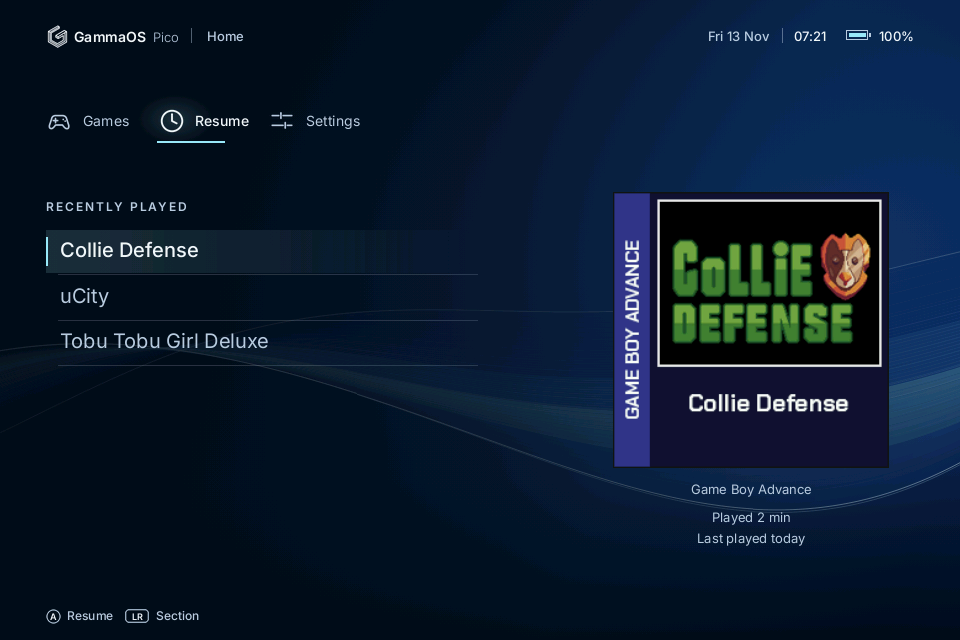
| Resume: the games played most recently | Settings |
 |
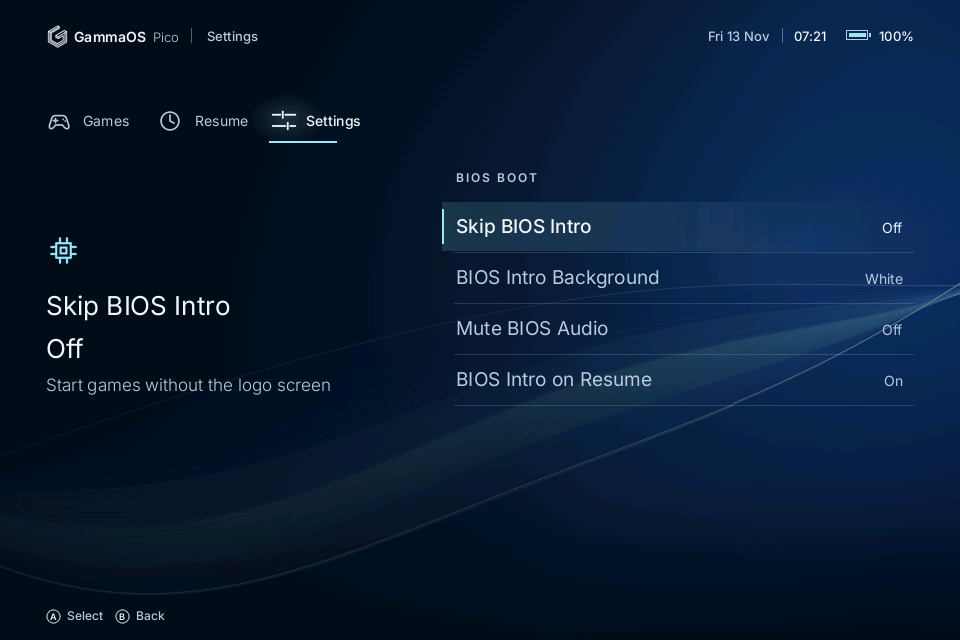 |
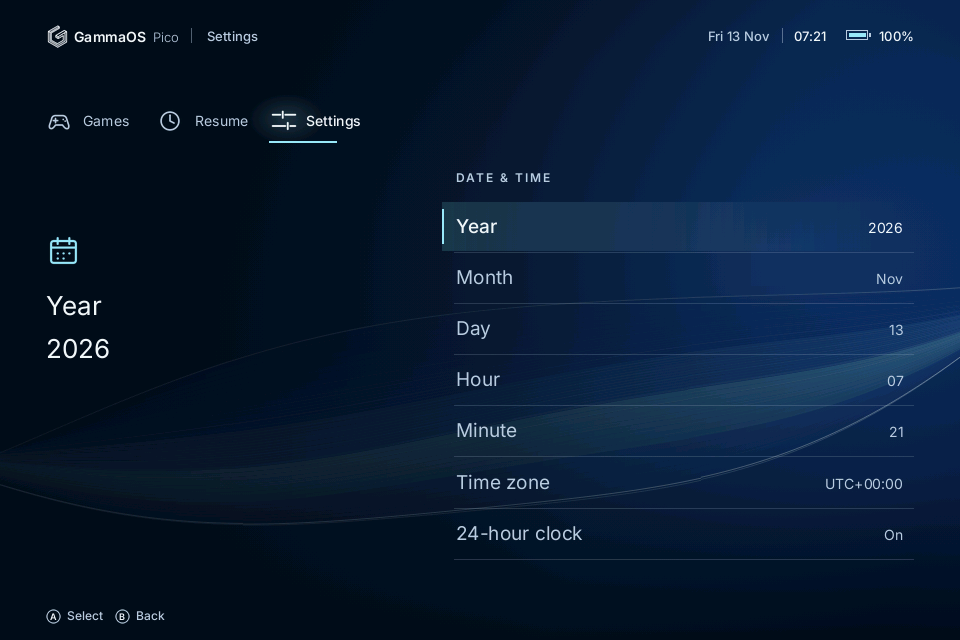
| Date & Time: the console's clock and time zone, which the games' clocks run on | BIOS Boot: the Game Boy Advance start-up screen |
 |
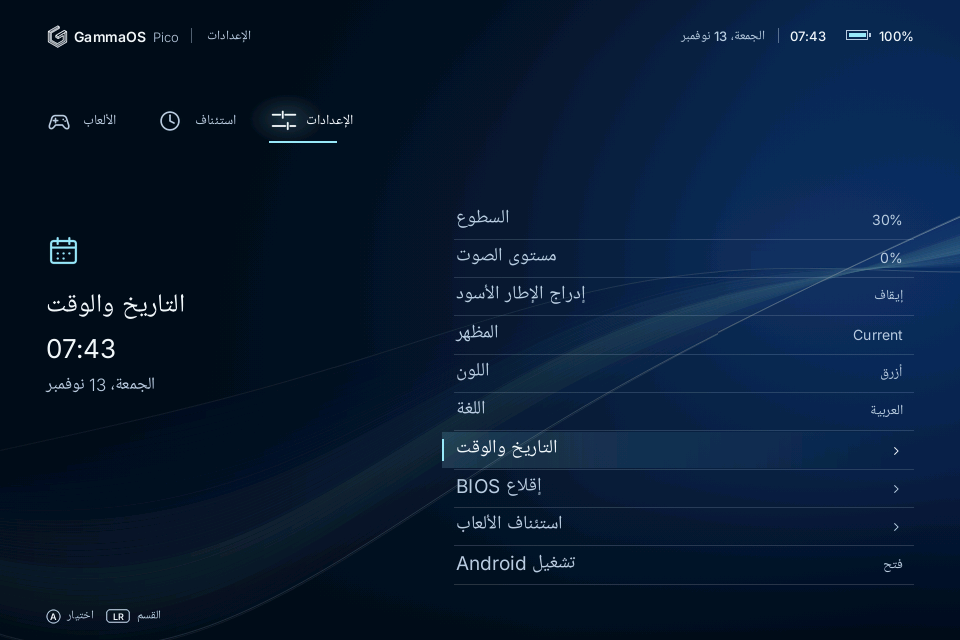 |
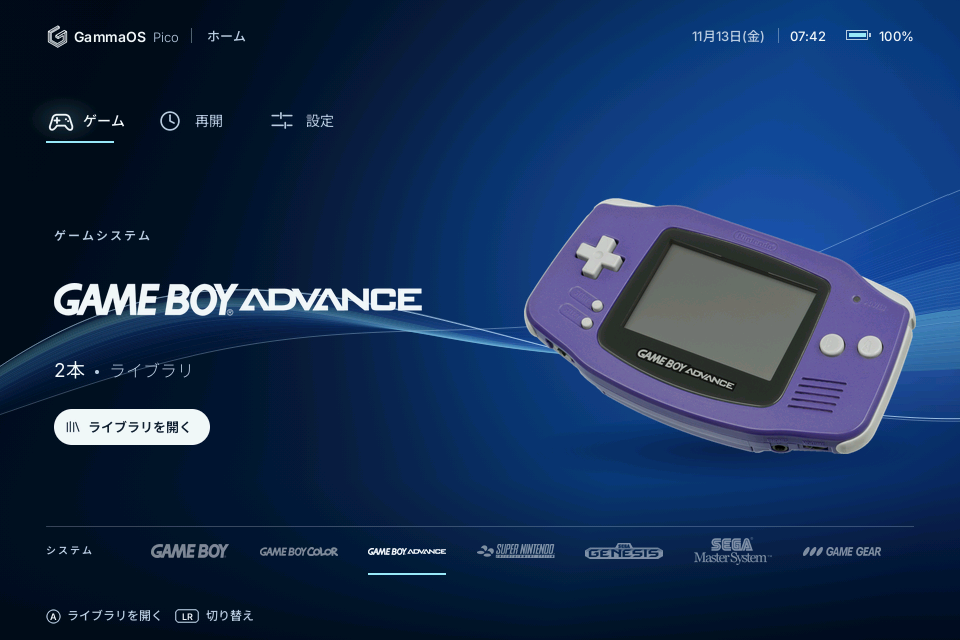
| In Japanese | In Arabic, written right to left |
 |
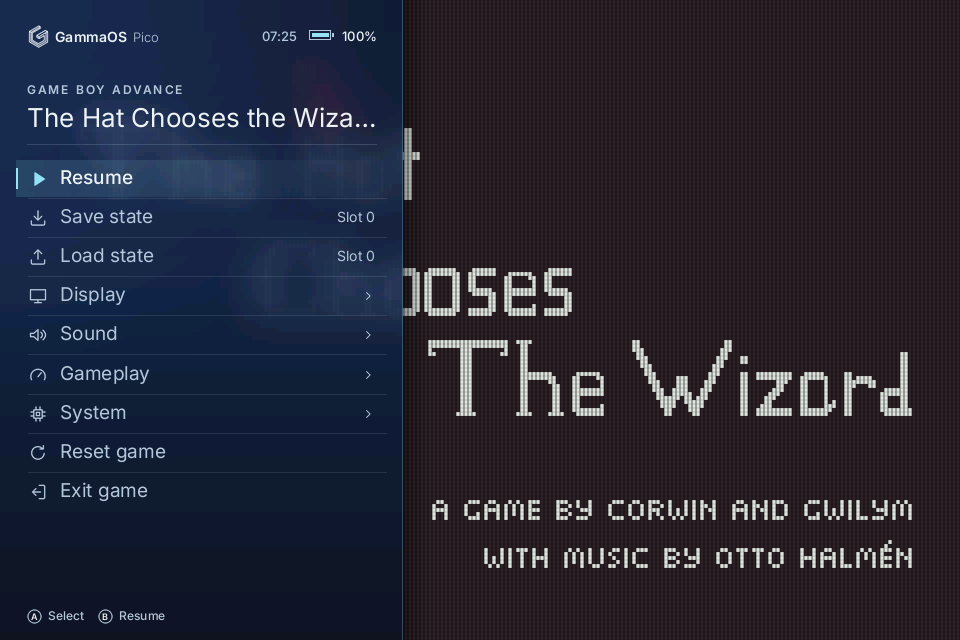 |
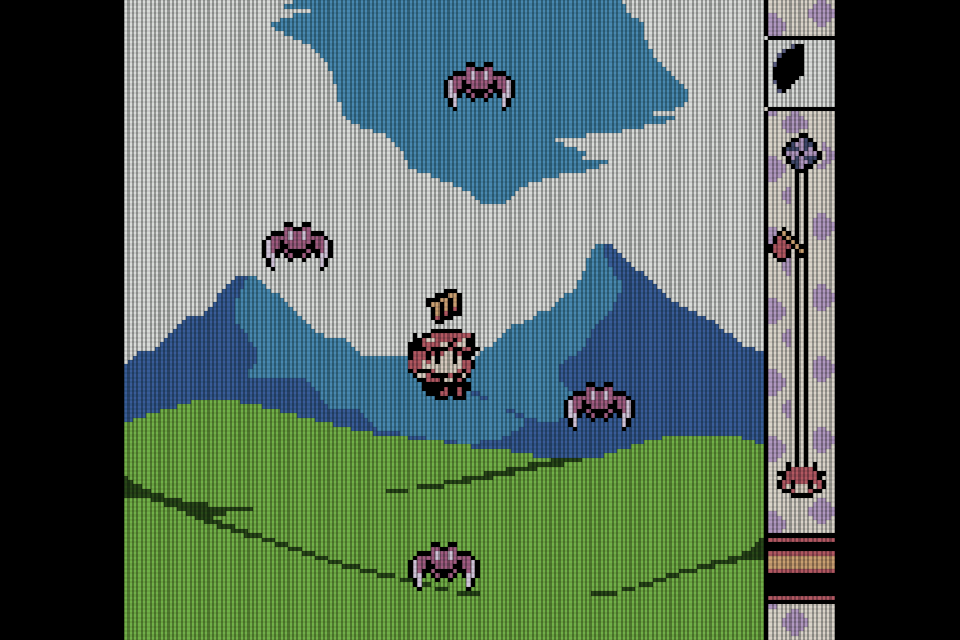
| In game (Tobu Tobu Girl Deluxe, LCD filter) | The in-game menu over the game (Menu button) |
 |
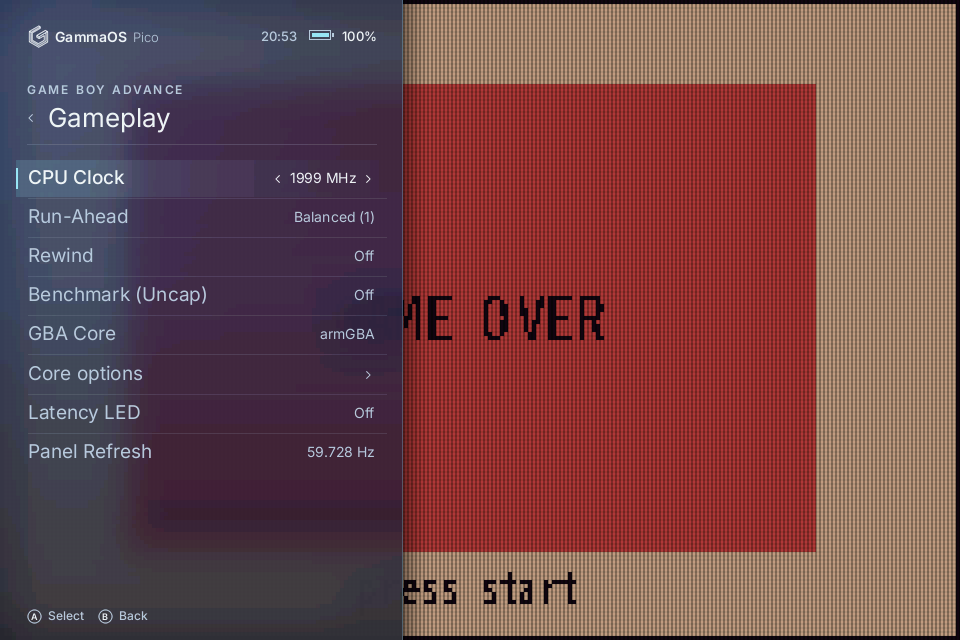 |
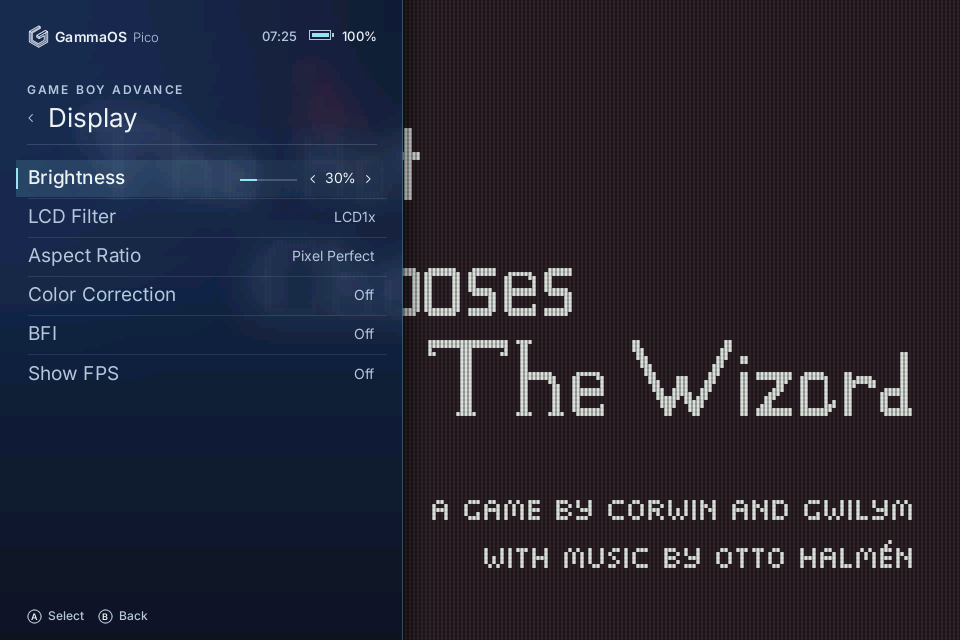
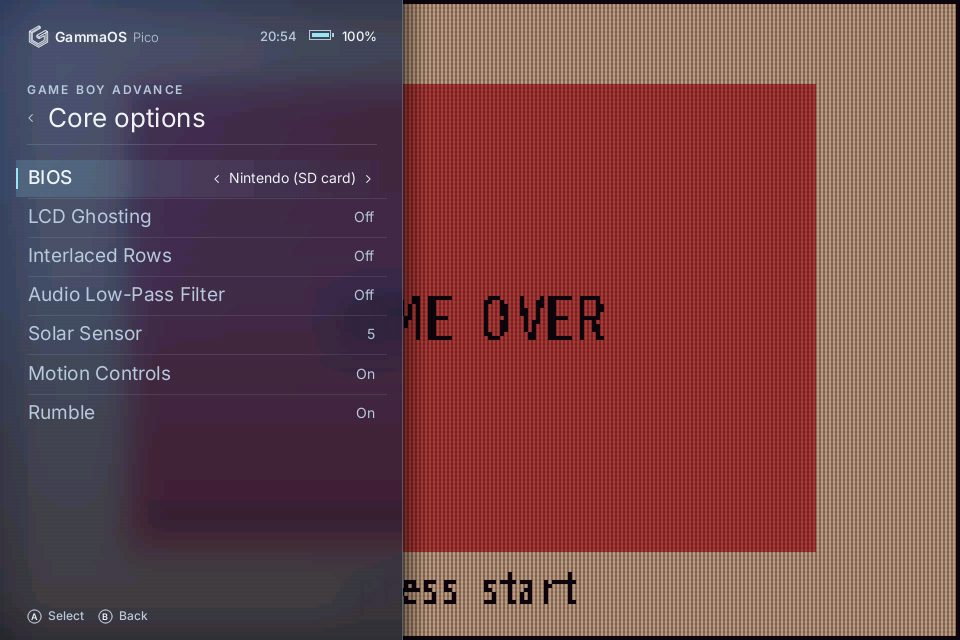
| Display: brightness, filters, aspect ratio, colour correction, BFI | Gameplay: CPU clock, run-ahead, rewind, the GBA core, the live panel refresh |
 |
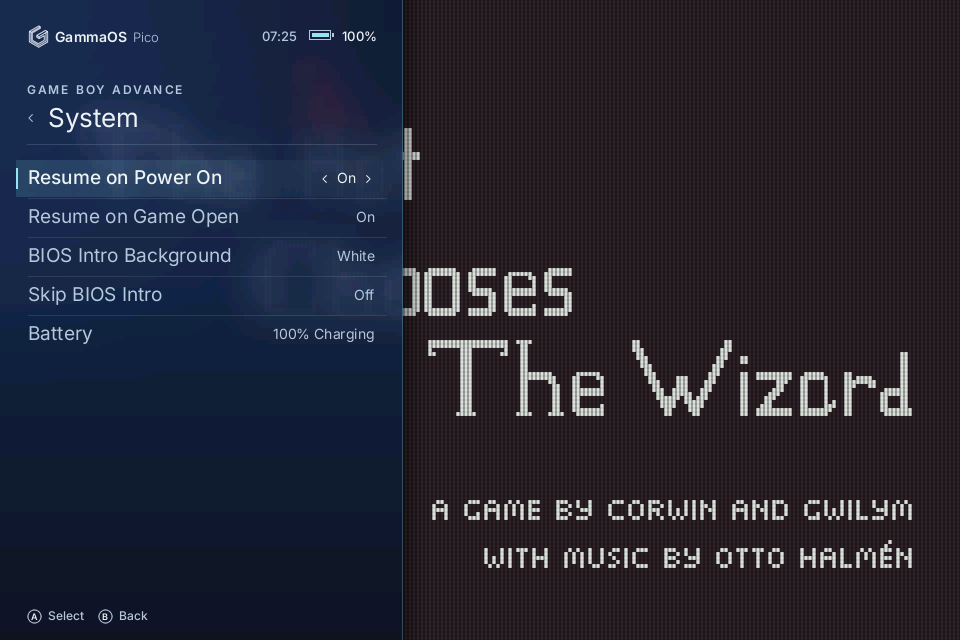 |
| armGBA's own options | System: resume, the BIOS intro and the battery |
 |
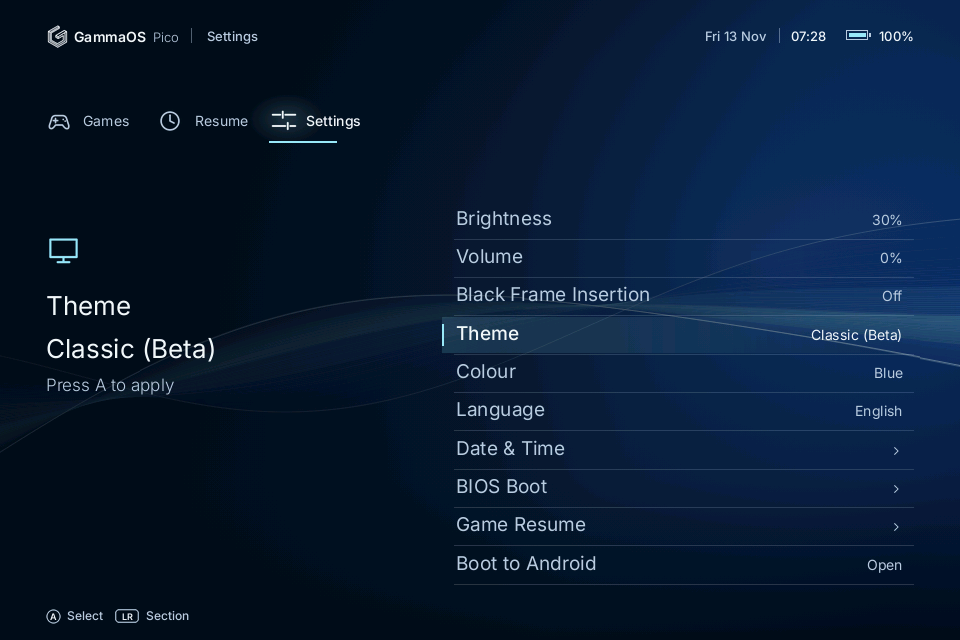 |
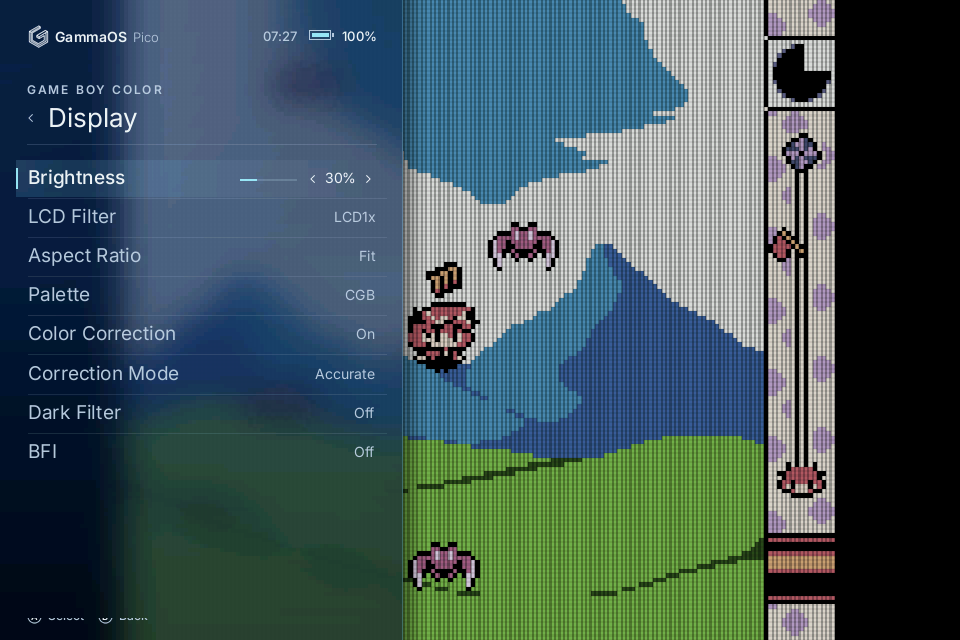
| A Game Boy Color game's Display page: pal... |
GammaOS Pico 1.0.1 for the Konkr Pocket Advance
Caution
This release is out of date: use GammaOS Pico 1.1.1 instead
Do not download or install this version. GammaOS Pico 1.1.1 has every fix and feature since this one, for both the Konkr Pocket Advance and the Konkr Pocket Block. This page is kept for reference only.
Get GammaOS Pico 1.1.1
GammaOS Pico for the Konkr Pocket Advance, release 1.0.1 (lk-mt6785 17d292c).
GammaOS Pico replaces only the console's bootloader (LK). With the GammaOS Pico microSD card in the slot the
console starts a console menu and plays Game Boy, Game Boy Color, Game Boy Advance, SNES,
Mega Drive / Genesis, Master System, Game Gear and SG-1000 games from the card. Without the card,
or after Boot to Android in the menu, Android starts exactly as before.
What's new in 1.0.1
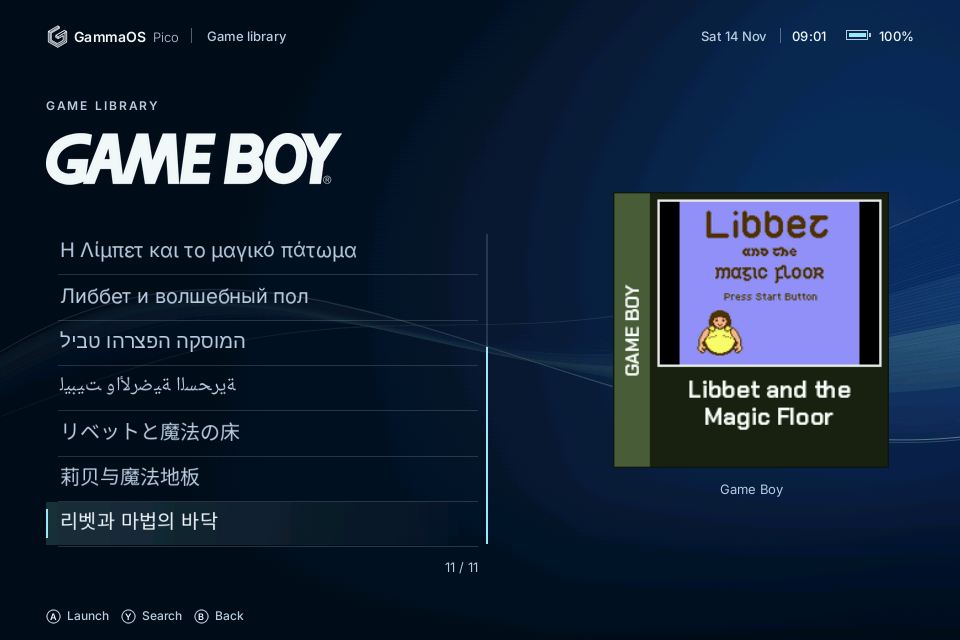
- Game names in any language. Names show as the card has them: accented letters, Greek,
Cyrillic, Japanese, Chinese, Korean, Hebrew and Arabic, in the library, the recently played
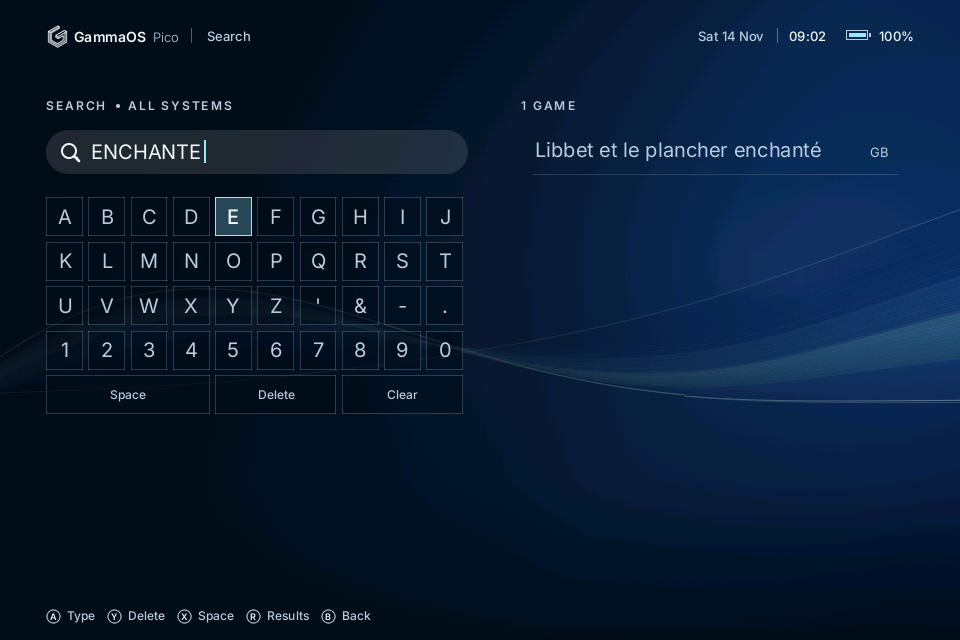
list, search and the in-game menu. Names written on a Mac show the same, and search and the A to
Z jumps ignore accents (typingenchantefinds "enchanté"). - No more merged games. Two games whose names differed only outside plain ASCII (two Chinese
titles of the same length, say) were listed as one and shared a save. Each is now listed, with
its own saves. - Saves under the real name. Battery saves, states, box art and play time are kept under the
game's full name. Those made by 1.0.0 are still found and move to the full name on the next save. - Windows install. The flash packages are for SP Flash Tool v5;
gammaos-pico-kpa-windows-tools.zip
has it, with MediaTek's USB driver. - A game named longer than 127 bytes that sits in two folders is listed once, and the card carries
the menu fonts' licences (licences/fonts).
 |
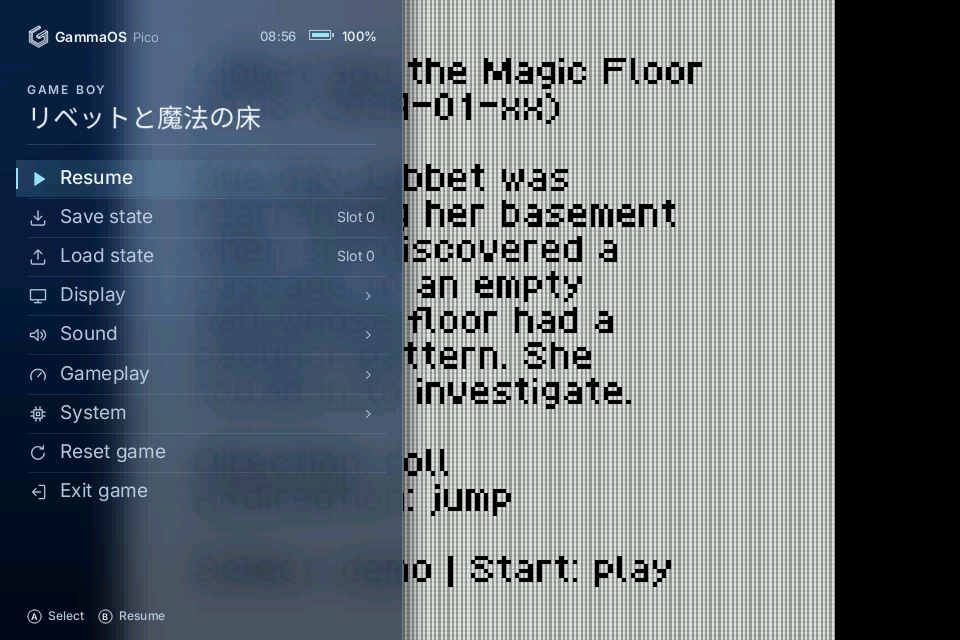 |
| A library with names in seven scripts | The in-game menu with a Japanese name |
 |
|
| Search finds accented names by their plain letters |
What makes it different
GammaOS Pico isn't an app on top of Android or a Linux distro. It runs inside the console's
bootloader, before any operating system, and owns the hardware outright.
- Fast on. From power on to the GBA boot logo in about two and a half seconds (Android takes
around 25). Hold Power to save where you are and switch off; turn it back on and you're back
in the game. - Low latency by design. The panel is retimed to each console's real refresh rate (59.73 Hz
for GBA and Game Boy, 60.1 Hz for SNES, 50 Hz for PAL), every frame is paced to the panel's scan,
buttons are read as late as possible, and run-ahead ("Preemptive Frames") hides the games' own lag. - Android stays. Only the bootloader changes. Pull the card (or pick Boot to Android) and the
console starts its stock Android, untouched. - Everything on the card. Emulators, settings, saves, states and box art all live on the
microSD card. Swap the card, swap the whole setup. - Your card, your way. Games are found in GammaOS's
roms/<system>/or where another front
end keeps them:ROMs/<system>/(ES-DE),Emulation/roms/<system>/(EmuDeck) or any
<folder>/roms/<system>/, with the usual folder names (gba,snes,megadrive,
mastersystem,gamegearand so on). Drop a PNG cover named like the game into aboxart
folder beside it and the console sizes it for the menu at the next power on. - Zipped games welcome. Games can stay in .zip or .7z archives, unpacked as they start (about
half a second for a 16 MB GBA game, resume at power on included). An archive with several games
lists each one, and one that cannot be opened says why instead of failing quietly. - Made for big libraries. Tens of thousands of games list in moments. Hold a direction to
speed through a library, jump letter by letter with L / R, or press Y to search by name, in one
system or all of them, with an on-screen keyboard. Box art loads as you reach it. - The good stuff from the start. Rewind, fast forward, save states (written to the card while
the game plays on), scanline and LCD filters and colour correction, in a box art menu: the
Current theme, with the Classic and GBA Indigo themes in beta. - The real time. The console's own clock runs the games that keep time (Pokemon Ruby,
Sapphire, Emerald, Gold, Silver and Crystal, Boktai), shows in the menus, and is set with its
time zone in Settings > Date & Time. Each game shows how long it has been played and when last. - Sharper motion with black frame insertion. The backlight goes dark for part of every frame,
in step with the screen's refresh, so moving pictures stay crisp the way they did on a CRT
instead of smearing. 25 %, 50 % or 75 % dark (Settings > Black Frame Insertion, or per game in
the in-game menu's Display page); the screen looks dimmer the higher it is set. - Tilt, gyro and rumble. The console's own motion sensor and vibration motor stand in for the
cartridges': Yoshi Topsy-Turvy and Kirby Tilt 'n' Tumble tilt (a flick of the console makes
Kirby jump), WarioWare: Twisted! turns and rumbles, as do Drill Dozer and the Game Boy Color's
rumble cartridges. - Headphones. Sound moves to the 3.5 mm jack as soon as headphones are plugged in, and back
to the speakers when they come out. - Names in any language. Game names show as the card has them: accented letters, Greek,
Cyrillic, Japanese, Chinese, Korean, Hebrew and Arabic, and search finds them by their letters
without accents. - In your language. The menus and the in-game menu in 17 languages: English, French, German,
Spanish, Italian, Dutch, Portuguese, Russian, Japanese, Korean, Simplified and Traditional
Chinese, Polish, Turkish, Arabic, Hebrew and Persian (Settings > Language).
Put the real Game Boy Advance BIOS on the card. Copy your own console's BIOS as
bios/gba_bios.bin(16 KB). GBA games then start on Nintendo's own BIOS: the original boot logo
and chime, and the exact BIOS routines every game was made against. Without it armGBA falls back
to its built-in replacement, which runs most games but not all of them the same way, and gpSP
(the second GBA emulator) cannot run at all. The BIOS is Nintendo's and is not included.
Screenshots
Captured on a Konkr Pocket Advance from the display buffers, with the demo games from the release;
the in-game menu shots lay its drawer over the game the way the display hardware blends them.
|
|
| Home: the systems on the card, with the date, the time and the battery | A system's library: box art, how long each game has been played and when last |
|
|
| Resume: the games played most recently | Settings |
|
|
| Date & Time: the console's clock and time zone, which the games' clocks run on | BIOS Boot: the Game Boy Advance start-up screen |
|
|
| In Japanese | In Arabic, written right to left |
|
|
| In game (Tobu Tobu Girl Deluxe, LCD filter) | The in-game menu over the game (Menu button) |
|
|
| Display: brightness, filters, aspect ratio, colour correction, BFI | Gameplay: CPU clock, run-ahead, rewind, the GBA core, the live panel refresh |
|
|
| armGBA's own options | System: resume, the BIOS intro and the battery |
|
|
| A Game Boy Color game's Display page: palette, colour correction, dark filter | Picking a theme |
 |
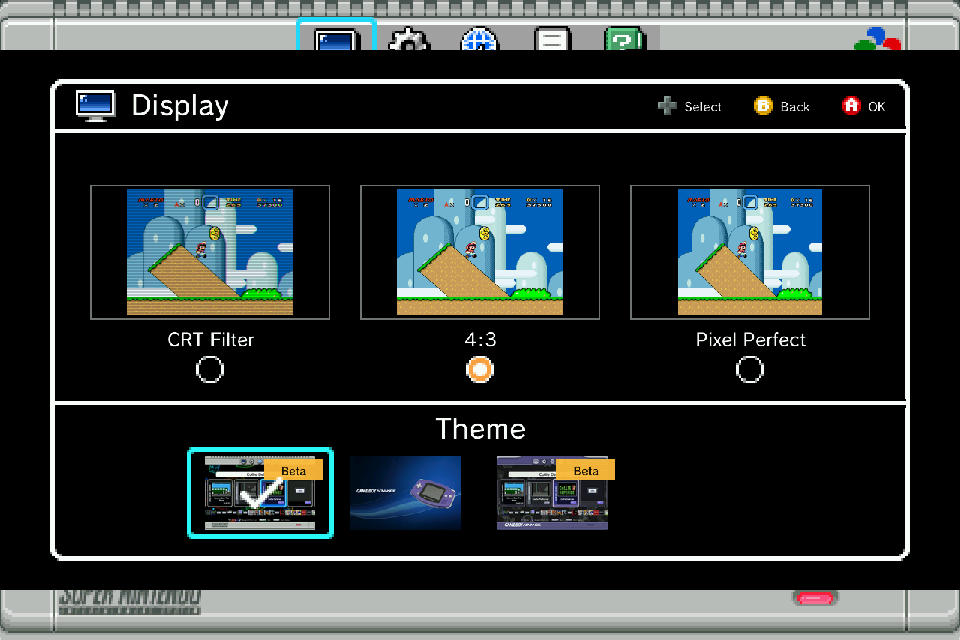 |
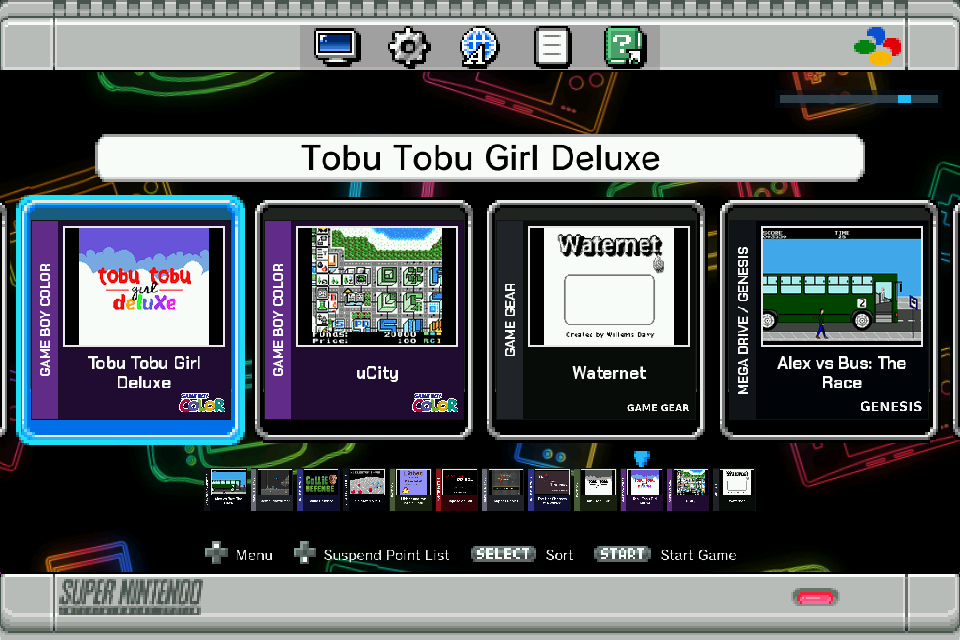
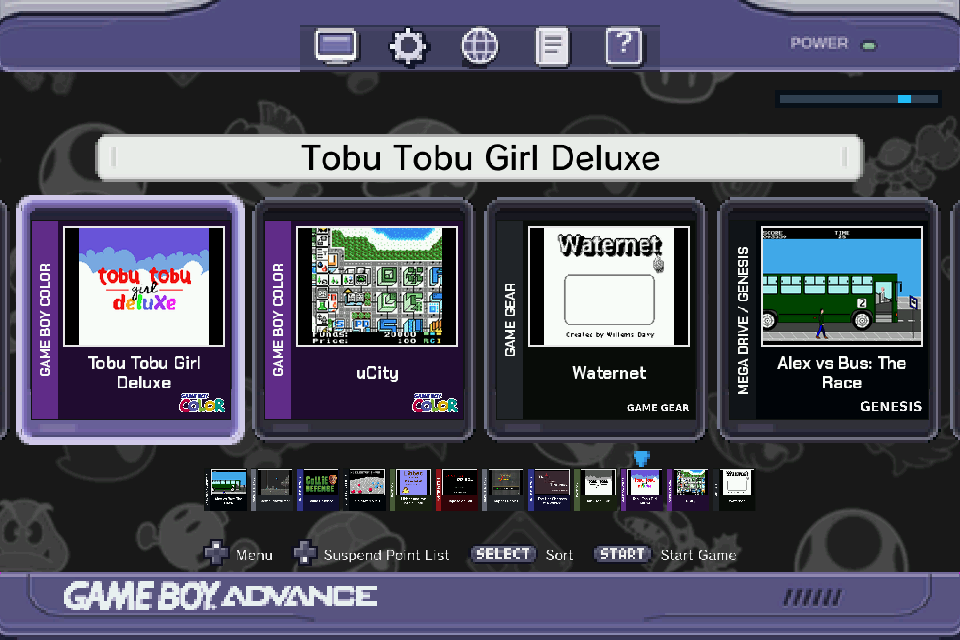
| The Classic theme (beta) | Its Display page, with the themes |
 |
|
| The GBA Indigo theme (beta) |
Buttons
At power on:
| Hold | Starts |
|---|---|
| nothing | whatever the card is set to (GammaOS Pico, or Android after Boot to Android) |
| SELECT | GammaOS Pico (the way back after Boot to Android) |
| SELECT + START | Android |
| SELECT + START + R | the bootloader (fastboot), for updates |
No card, or a card without GammaOS Pico on it, always starts Android.
In a game:
| Button | Does |
|---|---|
| Menu | the Pico menu (save and load states, filters, settings); hold 1.5 s to go back to the game list |
| R2 | fast forward on / off |
| L2 | rewind on / off |
| SELECT + START + L + R (hold) | restart the game |
| Volume wheel | volume; with SELECT held, brightness |
| X / Y | autofire B / A |
| Power (hold 1.2 s) | save and switch off |
In the game list, START plays, SELECT sorts and X switches between systems. During the boot logo,
hold B to skip it; the volume wheel works there too.
The menus
Everything GammaOS Pico can set, as it is laid out on the console (the Current theme, the default).
Every menu is in the language chosen in Settings.
Home
| Tab | What it holds |
|---|---|
| Games | the systems on the card, each with its console and logo; Left / Right move between systems, A opens a system's library (its games with their box art, how long each has been played and when last), where holding Up / Down speeds up, Left / Right turn a page and L / R jump from letter to letter; Y searches the system (or, on this page, every syste... |