Put error message as tag into failed trace. #4000
Conversation


Prior error message doesn't put error tag into failed trace.
This is nice to have and useful on trouble shooting within request context via modern UI in Jaegar or Zipkin.

With a minor change in primitive action flow which didn't enclose with failed trace.

Signed-off-by: Tzu-Chiao Yeh <su3g4284zo6y7@gmail.com>
 tz70s
force-pushed
the
add-error-trace
branch
from
tz70s
force-pushed
the
add-error-trace
branch
from
b66eb43 to
e3c3899
Compare

Codecov Report
@@            Coverage Diff             @@
##           master    #4000      +/-   ##
==========================================
- Coverage    85.9%   80.82%   -5.09%
==========================================
  Files         146      146
  Lines        7095     7102       +7
  Branches      443      439       -4
==========================================
- Hits         6095     5740     -355
- Misses       1000     1362     +362
Continue to review full report at Codecov.
|


|
Surfacing error state in trace would be useful. @sandeep-paliwal Thoughts? |

|
|
||
| postedFuture andThen { | ||
| case Success(_) => transid.finished(this, startLoadbalancer) | ||
| case Failure(e) => transid.failed(this, startLoadbalancer, e.getMessage, logLevel = ErrorLevel) |

There was a problem hiding this comment.
Should the error log level be eliminated here? An activation failure doesn't always imply a system failure
There was a problem hiding this comment.
Thanks for reminding, we can use the default warn level. Or I can match exception types for different levels. However, I think logging here is quite redundant b.c. we've already logged this at doInvoke.
Should this get changed as well?
https://github.com/apache/incubator-openwhisk/blob/0242a60aeb976d070abda76a8ac2aa7e3306e393/core/controller/src/main/scala/whisk/core/controller/Actions.scala#L292
BTW, in opentracing, there's no standardized warn tag provided, is this fine?
There was a problem hiding this comment.
I think that using the standard warn level would be fine.
The snippet you provided is depicting the system error, so the error log level in that place is fine IMO.
As long as it doesn't disturb anyone else, I'm fine with leaving the err tag for the tracing. My main point was to avoid the log overflood with the messages produced by users, since it could significantly hamper the performance.
There was a problem hiding this comment.
Ah yes, it's a system error, thanks!
| } | ||
| } andThen { | ||
| case Success(_) => transid.finished(this, startActivation) | ||
| case Failure(e) => transid.failed(this, startActivation, e.getMessage, logLevel = ErrorLevel) |
There was a problem hiding this comment.
The same question regarding the log level...

|
@chetanmeh agree. Having error information in trace for failed Invocations will be very useful. |

|
|
||
| private def setErrorTags(span: Span, message: => String): Unit = { | ||
| span.setTag("error", true) | ||
| span.setTag("message", message) |

There was a problem hiding this comment.
Tag is usually added to make it easy to search for a specific span. Since key in this case is always going to be "error" do you think its more appropriate case for span.log() ?
There was a problem hiding this comment.
Hi @sandeep-paliwal, thanks for suggestion.
I think the big difference between tag and log is timestamp; as you mentioned, the tag is much easier to search for a specific span, or make it explicit on what's going on.
I've tried capturing errors guidance in open tracing data model standard. This is not that useful to know that what's really going on in Jaegar.
Some code snippet:
private def setErrorTags(span: Span, message: => String): Unit = {
  span.log(Map("event" -> "error", "message" -> message).asJava)
}
Snapshot:
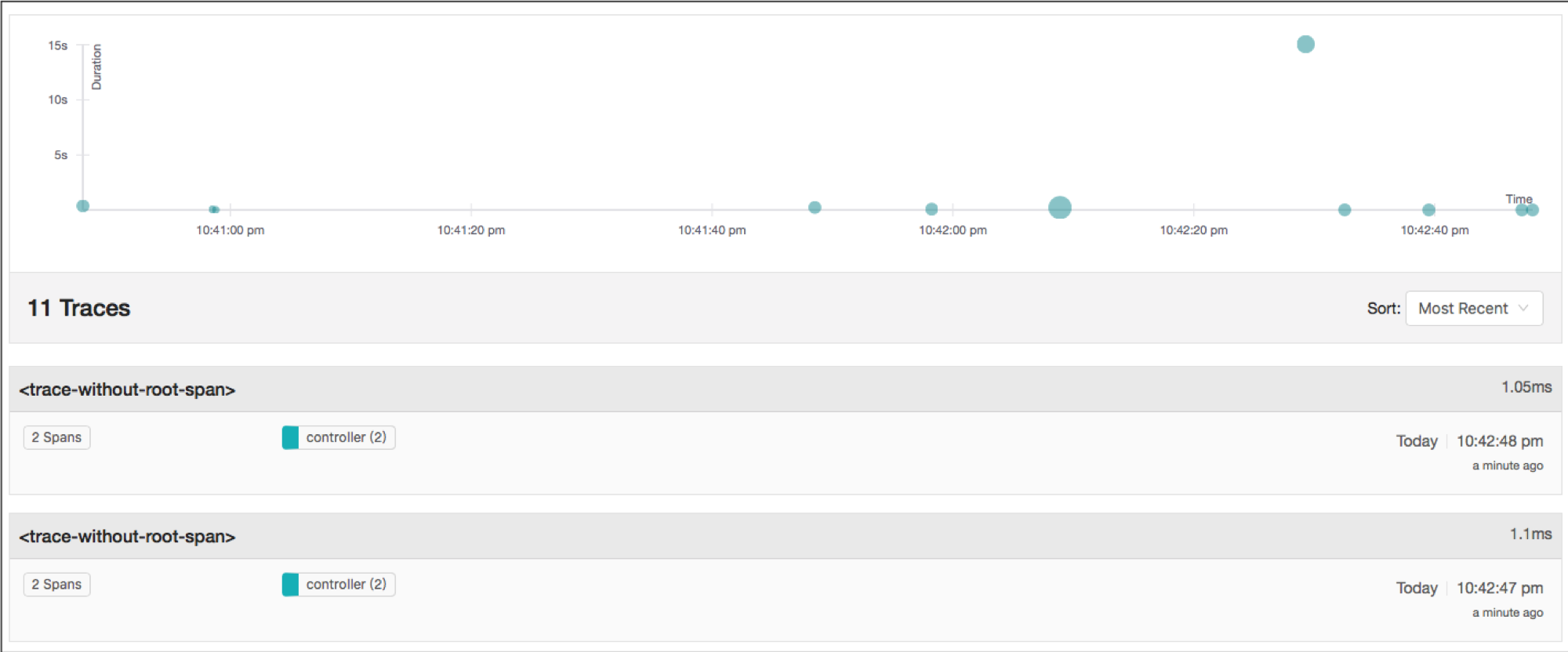
The error is not explicit.
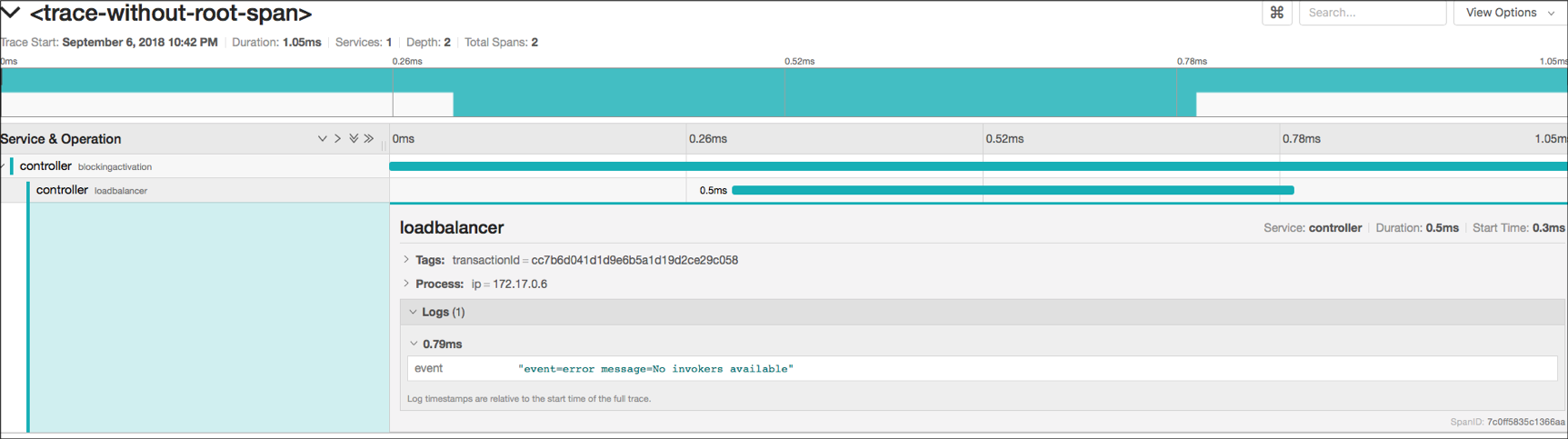
Am I missing something? If not, I think an alternative way is still use error as tag, and attach the log that we can eliminate the message tag field, if this is necessary. WDYT?
i.e.
private def setErrorTags(span: Span, message: => String): Unit = {
  span.setTag("error", true)
  span.log(Map("event" -> "error", "message" -> message).asJava)
}There was a problem hiding this comment.
Yeah I see that just adding log to trace is not that helpful in UI. I guess using tag has a better option then. Is there any use case to search for all failed invocations with a specific error? In that case error message as tag will also be useful compared to log().
There was a problem hiding this comment.
Yeah it might be useful if someone knows internal error messages. One drawback is polluting tracing system if it's mixed with some other systems besides OpenWhisk, but it can be filtered by module though. I think we can keep it as tag for advanced usage as you mentioned.
Signed-off-by: Tzu-Chiao Yeh <su3g4284zo6y7@gmail.com>
tz70s
force-pushed
the
add-error-trace
branch
from
f022d8c to
53264d5
Compare


Put error message as tag into failed trace. This is nice to have and useful on trouble shooting within request context via modern UI in Jaegar or Zipkin.
5 participants


Prior error message doesn't put error tag into failed trace.
This is nice to have and useful on trouble shooting within request context via modern UI in Jaegar or Zipkin.
With a minor change in primitive action flow which didn't enclose with failed trace.
I'm not sure folks are consistent with tracing system because of conflicting goals that we already have transid in log. IMHO, at least, it shouldn't make traces confused once if user decides to take it into system: whether there's an accurate error message existed or not, we should know which one get failed.
Semantics followed by:
https://github.com/opentracing/specification/blob/master/semantic_conventions.md
Snapshots in Jaegar:
Signed-off-by: Tzu-Chiao Yeh su3g4284zo6y7@gmail.com
Description
Related issue and scope
My changes affect the following components
Types of changes
Checklist: