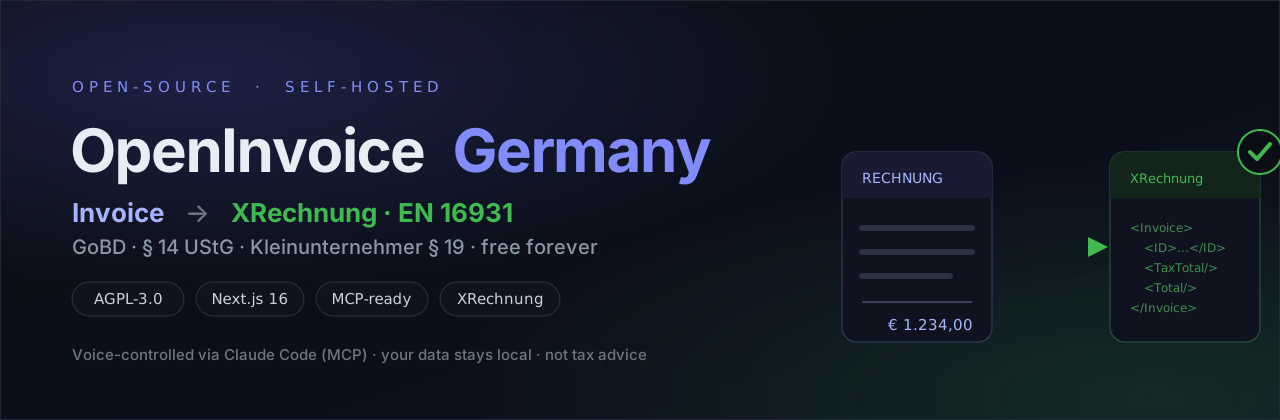
Free, self-hostable open-source invoicing software for Germany. E-invoice (XRechnung / ZUGFeRD) · GoBD · § 14 UStG · small business § 19 · GDPR
 · Licence: AGPL-3.0 · English · Deutsch
Why? From 2025 German B2B must be able to receive structured e-invoices; from 2027/2028 sending becomes mandatory. Many freelancers and SMEs pay a monthly fee just to stay compliant. This project makes it free and open — you host it yourself, your data stays with you.
⚠️ Not tax or legal advice. GoBD compliance additionally requires the user's own process documentation (Verfahrensdokumentation). All legal references with sources live in COMPLIANCE.md (single source of truth). No warranty.
Connect your local instance to Claude Code or Claude Desktop and create legally sound invoices just by describing them:
"Create an invoice to Müller GmbH for 3 hours of consulting at €95, delivered today, finalise it and export the XRechnung."
Claude calls the right tools in order (create customer/service → invoice → finalise → PDF + XRechnung). Finalising enforces the § 14 UStG mandatory fields — non-compliant invoices are rejected. The invoice is created and stored locally. Setup + examples: docs/MCP.md.
npm run mcp # start the MCP server (stdio) / wire it into Claude Code via .mcp.json🔒 Data protection (GDPR). The app core runs 100% locally, but the MCP feature is optional and not automatically GDPR-compliant: when you let a cloud LLM (e.g. Claude) create the invoice, the data you describe (customer name, items, amounts = personal data) is sent to that provider and processed on your behalf (Art. 28 GDPR). For business use with real personal data, either use a local model (the MCP server is model-agnostic) or a commercial API with a DPA — note that Claude Code/Desktop always use Anthropic's cloud and the consumer Pro/Max subscription has no DPA. List the provider as a sub-processor in your records and privacy policy. Details: docs/MCP.md. Not legal advice.
- Voice control via MCP (Claude Code/Desktop) — see above.
- GoBD core: finalisation (draft → immutable), gapless number ranges, append-only audit hash-chain, cancellation instead of deletion.
- § 14 UStG: mandatory-field check blocks finalisation when data is missing.
- Tax schemes: standard rating (19/7/0), small business (§ 19), reverse charge (§ 13b), intra-EU supply, margin scheme (§ 25a), small amount (§ 33).
- E-invoice: XRechnung (UBL, EN 16931) and ZUGFeRD/Factur-X hybrid PDF (embedded EN-16931 CII), both validated against the official Schematron rules (SaxonJS, no Java) — cross-checked by the KoSIT validator in CI.
- Documents: quotes, order confirmations, pro-forma — convertible into an invoice.
- Payments & dunning: record (partial) payments; staged reminders (payment reminder → 1st/2nd dunning) with default interest (§ 288 BGB, day-accurate) + €40 flat fee (B2B), each as a PDF.
- Recurring invoices / subscriptions: weekly–yearly templates, optional auto-finalisation, run via UI/MCP or cron (
npm run recurring:run). - Credit notes: full cancellation or partial credit, original stays finalised.
- PDF export ("other invoice") with all mandatory fields.
- Self-hosted: SQLite solo without a server or PostgreSQL via Docker.
- Sign-in: built-in admin account (scrypt hash + signed session cookie) — app and API protected.
MVP. What works: master data/customers/products, quotes & invoices, draft → finalise → cancel, partial credit notes, payments + dunning (§ 288 BGB), recurring invoices/subscriptions, PDF + XRechnung + ZUGFeRD export, GoBD number range + audit. On the roadmap: DATEV/CSV export, B2G/Leitweg-ID EAS codes, OSS/ZM, multi-user, built-in scheduler. See docs/ARCHITEKTUR.md (MVP / stage 2 / stage 3) and the honest list of known limitations.
Next.js 16 (App Router) · TypeScript (strict) · Prisma 6 · SQLite/PostgreSQL · TailwindCSS · Zod · Vitest. Money as integer cents, quantities as integer milli-units, tax per EN-16931 group — see docs/ARCHITEKTUR.md.
git clone https://github.com/automationsmanufaktur-labs/open-invoice-germany.git
cd open-invoice-germany
npm install
cp .env.example .env            # DATABASE_URL="file:./dev.db" is the default
npm run db:migrate              # create the schema
npm run db:seed                 # optional demo data
npm run dev                     # http://localhost:3000
The SQLite file lives at prisma/dev.db and belongs to you alone. On first start you create your admin account under /setup (after npm run db:seed there is a demo login admin@example.com / demo1234 — please change it). For production: set AUTH_SECRET in .env (openssl rand -base64 32) and run behind HTTPS.
In the app: Settings (create company) → Customers → New invoice → add line items → Finalise (assigns the number, makes it GoBD-immutable) → PDF and XRechnung export. Full step-by-step guide: docs/ANLEITUNG.md (German).
cp .env.example .env            # switch DATABASE_URL to the postgresql:// line
docker compose up --build
docker-compose.yml starts the app + PostgreSQL + the Mustang sidecar (XRechnung/ZUGFeRD generation & validation). The Postgres schema lives in prisma/schema.postgres.prisma (model-identical, only a different datasource).
npm test # Vitest: money, tax, number ranges, GoBD immutability, hash-chain, EN 16931The integration tests prove, among other things, gapless, immutable number ranges and that finalised invoices cannot be edited.
npm run validate:erechnung # official Schematron rules, no JavaValidates the generated XRechnung against the official Schematron rules in pure Node via SaxonJS:
- EN-16931 UBL Schematron (ConnectingEurope) and
- XRechnung CIUS / BR-DE (official KoSIT config 3.0.2; requires
unzip).
This is essentially the same Schematron check as the KoSIT validator — and runs as a hard gate in CI. The KoSIT validator (Java) additionally runs there as an independent cross-check (also covering the upstream XSD check). Fast core rules are part of npm test.
Contributions welcome — see CONTRIBUTING.md. Please file legal corrections with a source (statute/BMF letter) against COMPLIANCE.md.
AGPL-3.0. You may use, modify and self-host the software. Anyone who runs it as a network service must make the (modified) source available to its users — keeping the project free for everyone. Rationale for the licence choice: docs/ARCHITEKTUR.md.