Design Patterns
This site contains a list of comic design patterns. Each pattern is described by a name, a description and examples.
The print-out version is here: https://drive.google.com/file/d/0B1zFhCjto4BXTU9UNHJfd3haaHM/view?usp=sharing
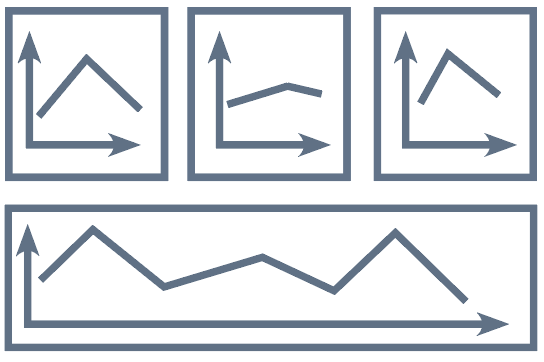
Definition: This pattern starts with a potentially complex and detailed visualization in a single panel (overview panel). Consequent panels (detail panels) will refer to this visualization and explain details important for the story.
Examples: If the visualization is complex, it may require a larger panel and potentially can span an entire page (see Monoframe).
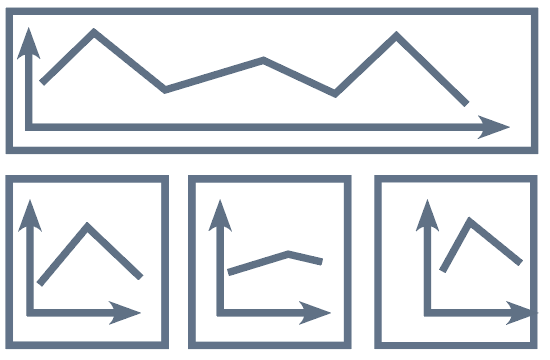
Definition: This pattern consists of a panel that sums up details explained in earlier panels. For example, it can show the entire data set in a single picture while the previous panels have been showing individual facets of the data. This pattern can be seen as the inverse of Overview & Detail,
Start with a question, answer with visualization or eventual resolution. Question & answer could engage audience and drop a hint of the contents that going to be shown in the comic. Usually, the question is unfamiliar or fallible to the reader, which, stimulates the reader's curiosity and motivate them to discover the facts.
Build-up visualization piecewise by explaining the visual encoding
Explain the a visualization metaphor in abstract terms (time curves, confluent graphs)
show temporal change by changing the visualization over time (e.g. small multiples for temporal data.
highlights the transition between two states of a visualization---temporal, logical, data set, camera movement
Continuously zoom into our out of a visualization, disaggregating or aggregating data (e.g. large network)
describes a data-element (following changes over time, explaining different dimensions, relations, etc)
Provides several explanations on the same visualization (data in visualization is not changing, but visualization can change emphasis)
Compares two (or more) datasets/visualizations/data elements through (vertical?)splitpanels.
Explains visual encodings for reference. E.g. legend for color encoding,
lays out panels in an intentionally non-sequential way, implying that panels are supplementary to the story (similar to footnotes?)
Superimposes a narrative sequence through a visualization (e.g. insets?)
Starts with an illustrated/narrative story motivating story and data.
Provide alternatives for explanations or scenarios
Refers to a previous panel by repetition or a specific visual means (e.g. arrow)
Show the result or conclusion first, and the reveal the fact
Repetition of the same frame, or visual element. Helps creating a rythm and aviods flash-back
Single picture spanning entire page. [Groensteed]