-
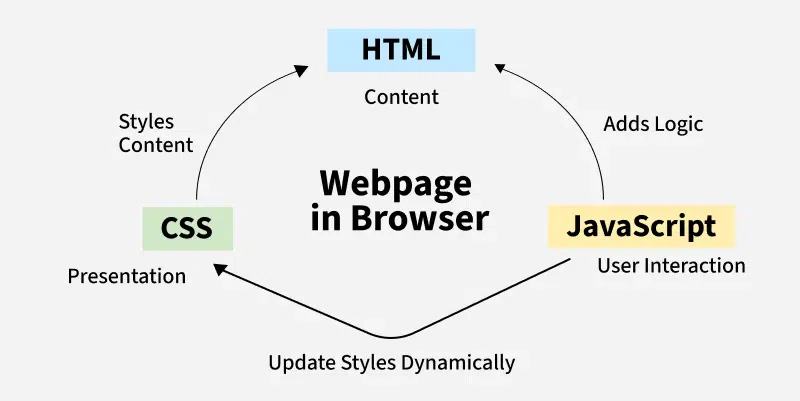
HTML adds Structure to a web page, CSS styles it and JavaScript brings it to life by allowing users to interact with elements on the page, such as actions on clicking buttons, filling out forms, and showing animations.
JavaScript on the client side is directly executed in the user's browser. Almost all browsers have JavaScript Interpreter and do not need to install any software. There is also a browser console where you can test your JavaScript code.
JavaScript is also used on the Server side (on Web Servers) to access databases, file handling and security features to send responses, to browsers.
- Definition: JavaScript (JS) is a lightweight, interpreted, or just-in-time compiled programming language with first-class functions. It is most commonly used as a scripting language for web pages but is also used in non-browser environments like Node.js.
- Purpose: JavaScript enables interactive web pages, dynamic content updates, and client-side logic.
- Paradigm: Multi-paradigm (supports procedural, object-oriented, and functional programming).
- Standardization: ECMAScript (ES) is the official standard for JavaScript, maintained by ECMA International.
- Created by: Brendan Eich in 1995 while working at Netscape.
- Initial Release: 1995, as part of Netscape Navigator 2.0.
- Name Changes: Originally called "Mocha," then "LiveScript," and finally "JavaScript" to capitalize on Java's popularity.
- ECMAScript: JavaScript was standardized as ECMAScript in 1997 (ES1). The latest version is ECMAScript 2022 (ES13).
- Dynamic Typing: Variables are not bound to a specific data type.
- Prototype-based Object Orientation: Objects inherit properties and methods from prototypes.
- First-class Functions: Functions can be passed as arguments, returned from other functions, and assigned to variables.
- Event-driven: Supports asynchronous programming with callbacks, promises, and async/await.
- Cross-platform: Runs in browsers, servers (Node.js), and even on IoT devices.
- Interoperability: Works seamlessly with HTML and CSS.
JavaScript syntax is similar to other C-style languages like Java and C++. Here are some basics:
let x = 10; // Block-scoped variable
const y = 20; // Constant, cannot be reassigned
var z = 30; // Function-scoped variable (older way)- Primitive Types:
string,number,boolean,null,undefined,symbol,bigint. - Non-primitive Types:
object,array,function.
function greet(name) {
    return `Hello, ${name}!`;
}
const greet = (name) => `Hello, ${name}!`; // Arrow functionconst person = {
name: "John",
age: 30,
greet: function() {
console.log(`Hello, ${this.name}`);
}
};const fruits = ["Apple", "Banana", "Cherry"];
fruits.push("Orange"); // Add an itemif (condition) {
// code
} else if (anotherCondition) {
// code
} else {
// code
}
for (let i = 0; i < 10; i++) {
console.log(i);
}// Callbacks
setTimeout(() => console.log("Hello"), 1000);
// Promises
fetch('https://api.example.com/data')
.then(response => response.json())
.then(data => console.log(data))
.catch(error => console.error(error));
// Async/Await
async function fetchData() {
try {
const response = await fetch('https://api.example.com/data');
const data = await response.json();
console.log(data);
} catch (error) {
console.error(error);
}
}- Frontend Development: Used with HTML and CSS to create interactive web pages.
- Backend Development: Node.js allows JavaScript to run on servers.
- Mobile App Development: Frameworks like React Native enable cross-platform mobile apps.
- Desktop Applications: Electron.js is used to build desktop apps.
- Game Development: JavaScript can be used with libraries like Phaser or Three.js for 2D/3D games.
- IoT: JavaScript can run on microcontrollers and IoT devices.
- Frameworks and Libraries:
- Frontend: React, Angular, Vue.js.
- Backend: Express.js, NestJS.
- Package Managers: npm, Yarn.
- Build Tools: Webpack, Babel, Vite.
- Testing Tools: Jest, Mocha, Cypress.
- Runtime Environments: Node.js, Deno.
- Versatility: Can be used for both client-side and server-side development.
- Large Community: Extensive resources, tutorials, and libraries.
- Ease of Learning: Beginner-friendly syntax and widespread use.
- Interactivity: Enables dynamic and responsive web pages.
- Cross-platform: Runs on almost all modern browsers and devices.
- Browser Compatibility: Different browsers may interpret JavaScript differently.
- Security: Client-side code can be exploited (e.g., XSS attacks).
- Performance: Not as fast as lower-level languages like C++.
- Let and Const: Block-scoped variable declarations.
- Arrow Functions: Shorter syntax for functions.
- Template Literals: String interpolation with backticks.
- Destructuring: Unpack values from arrays or objects.
- Modules:
importandexportfor modular code. - Promises and Async/Await: Better handling of asynchronous operations.
- Classes: Syntactic sugar for prototype-based inheritance.
- Documentation: MDN Web Docs
- Online Courses: FreeCodeCamp, GeeksForGeeks, Codecademy, Udemy ect.
- Books: "Eloquent JavaScript," "You Don't Know JS."
- Practice Platforms: LeetCode, HackerRank, Codechef, Codewars.
- WebAssembly: JavaScript will continue to work alongside WebAssembly for performance-critical tasks.
- AI and Machine Learning: Libraries like TensorFlow.js enable AI in the browser.
- Progressive Web Apps (PWAs): JavaScript will play a key role in building offline-capable web apps.
JavaScript is a powerful and evolving language that remains essential for modern web development. Its versatility and widespread adoption ensure its relevance for years to come.