Repository navigation
Releases
Photo Offloader 2.6.0

Know when a camera card is safe to format, and tell your cards apart.
Highlights
-
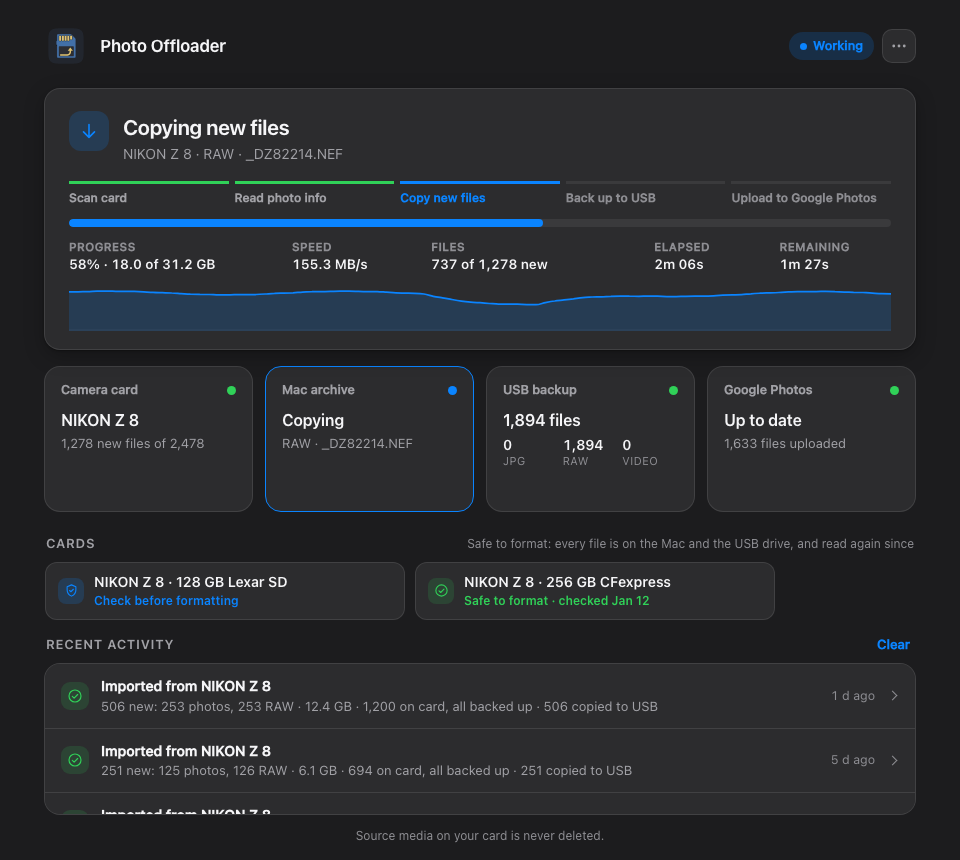
Know when a card is safe to format. A Cards row above Recent activity shows each card Photo Offloader has seen in one of three states:
- Don't format says how many of its files aren't on the Mac or the USB drive yet.
- Check before formatting means every file has a copy on both, verified when it was made.
- Safe to format means a check has also read every copy again since, with the date.
A card's report offers Check new copies (only the copies no check has read yet) and Check every copy. The card doesn't need to be inserted, so a backup days after the import still moves it on, with a notification. The Camera card box, the menu bar (
✓,?or!by its icon) and the end of each import say the same. -
Cards are told apart. Every card from one camera has the same name, so each now shows its size and kind, such as 64 GB SanDisk SD or 256 GB CFexpress, and can be renamed. An SD card in the Mac's built-in slot is recognised by its serial number, so after a format it keeps its name.
-
Taking a card out mid-copy is now documented: nothing half-copied looks finished, and putting the card back resumes file by file.
Upgrading
From your checkout, git pull and run ./install.sh. Your photos, catalog, history and settings are kept.
The full list of changes is in the changelog.
Photo Offloader 2.5.0
The first public release. Insert a camera card into your Mac and Photo Offloader copies it to the Mac, checks every copy with SHA-256, mirrors the archive to a USB drive and can upload JPGs and video to Google Photos. It never writes to or deletes from a card, and never overwrites a saved file.
Highlights
- A dashboard and a menu bar. Follow each import's progress, speed and time left, see past runs, and pause, stop or start Photo Offloader. It runs as its own app with its own icon.
- Copies that are really checked. Each copy is reread from the disk, not from memory, after the drive has flushed it, before it gets its final name. Check saved copies… rereads the whole archive on the Mac and the USB drive later on, to catch damaged or missing files.
- Clear failure reports. When a card can't be fully read, the dashboard lists which files weren't saved and why, tells you not to format the card, and offers a debug package to look through or share.
- Fast re-inserts. Inserting a card again copies only what's new, and an unchanged card isn't reread: on a 2,722-file card the check went from 26 seconds to under one.
- USB backup that keeps up. It shows how far behind the drive is, can start by itself when the drive connects, and steps aside when a card is inserted, carrying on afterwards.
- Google Photos upload control. Pause, resume, and automatic retries after a network failure or a restart.
- A settings file. Choose the archive folders and the backup drive with Edit settings…. Updates and reinstalls keep it.
Install
macOS with Python 3.9 or newer. From a clone of the repository:
./install.shSee Get started for the requirements and the optional USB drive and Google Photos setup.
Upgrading from 2.3 or earlier: run ./install.sh from the new checkout. It removes the old flat layout. Your photos, catalog and history are kept.
Tested on
macOS 26 with a Nikon Z 8 (SD and CFexpress cards) and an HFS+ USB drive. Other cameras, exFAT backup drives and real card failures haven't been tried yet. Reports of what works, or doesn't, are very welcome as issues. Keep your own backup until you trust it.
The full list of changes is in the changelog.