Repository navigation
Optimizer-planned grid charging is not reliably executed by E3/DC #36364

Replies: 20 comments 6 replies

|
Thanks for the detailed report. The failed night window can't be analyzed yet, so there is no confirmed cause. What the code does: for To narrow it down, please provide:
Related: #33774 (E3/DC discharging during optimizer-planned charging), discussion #34078. 🤖 Generated with Claude Code |

Additional data from InfluxDB for the affected nightI checked the historical evcc measurements for the window on 15 November 2026, 23:45–00:00 CET (22:45–23:00 UTC). They show that charging suggestions for both batteries were still present during the window. The following are the last recorded values within each five-minute interval:
The suggestion values come from the per-battery InfluxDB measurement batterySuggestionCharge; the power values come from batteryPower. Each of these four time series contains 92 recorded points in the full 15-minute window. The last recorded point was at 23:59:52 CET; the E3/DC SoC was 47%. This updates my original report: the recorded per-battery suggestions indicate that the optimizer was still suggesting approximately 3 kW of charging for the E3/DC at the sampled points during the affected interval, while its measured battery power was 0 W. At the same sampled points, the Marstek was charging close to its suggested power. These InfluxDB measurements do not establish which battery mode was actually applied, whether an RSCP charge request was sent or acknowledged, or why the E3/DC did not charge. The RSCP trace for the failed window remains unavailable. The three rows are sampled values, not a claim that every value between them was identical. Does this additional comparison help narrow down where the optimizer suggestion and the actual E3/DC charging behavior diverged? |
|
Thanks for the InfluxDB comparison. It shows the optimizer still suggested about 3 kW charge for the E3/DC while measured power was 0 W. That narrows the gap to "suggestion present, no effective charging", but it doesn't show which mode evcc applied or whether the RSCP commands were sent and acknowledged. So there is still no confirmed cause. To go further we need the next occurrence with
Also helpful: the E3/DC part of your redacted config and the E3/DC portal settings for grid charging or power limits. Related: #33774, discussion #34078. 🤖 Generated with Claude Code |
Earlier trace: charge requested, but E3/DC remained at 0 WI found an earlier trace from 15 November 2026, which may help investigate a similar failure. This is a daytime example, not the night-time window described above. All times below are CET. At 12:30:04, evcc logged the following RSCP write and battery mode changes: The E3/DC battery power remained at 0 W in the recorded measurements through the charging window. For example, at 12:35:11:
At approximately 12:45, evcc changed to holddischarge and sent START_MANUAL_CHARGE 0. A hold state and START_MANUAL_CHARGE 0 had also preceded the charge request at approximately 12:28. For comparison, on 7 November at 13:59:41, evcc logged the same basic power settings and START_MANUAL_CHARGE 50000. At 13:59:53, the E3/DC battery was charging at approximately 2,913 W. The successful controlled test in the issue description is another example. This narrows down a daytime case to a logged charge request followed by no measured E3/DC charging. It does not establish the cause, the E3/DC's internal response, or which command was sent during the separate failed night-time window. I did not find an error line containing the word error in the inspected daytime window; this is not proof that E3/DC accepted or executed the request. The daytime example also qualifies my earlier PV observation: PV was present here, but charging did not start. The simultaneous EV charging, the high battery SoC, the preceding mode and any E3/DC limits may be relevant; the logs do not establish which, if any, caused the behavior. The optimizer line for the load point refers to EV charging and should not be interpreted as the battery plan. Could the team assess whether this comparison helps identify the state, command sequence or response that evcc should check to make E3/DC charging reliable? Insights from other E3/DC users would also be welcome. |
|
Thanks for the daytime trace. It shows the same command pair that worked on 7 November ( Two code facts that matter here:
To narrow it down:
The night-time failure still needs the trace of the failed window. Related: #33774, discussion #34078. 🤖 Generated with Claude Code |
Follow-up: observations and possible evcc approachI reviewed the available daytime trace in response to the questions above:
The successful and unsuccessful examples show that the same basic command sequence can have different measured results. An E3/DC state or limit may be involved, but the cause has not been established. The code observations above suggest a possible area for an evcc solution: check whether each battery actually starts charging after a charge request, allow for normal delays and device limits, and report a persistent mismatch. Depending on the identified cause, an appropriate recovery or command sequence could then be considered. Repeating a command is only one untested possibility; it may not resolve the underlying issue. Could the evcc team assess this approach and whether the E3/DC integration can handle the relevant device states so optimizer-planned charging is implemented reliably? In a multiple-battery setup, a per-battery result would help identify when one battery charges and another does not. I would also appreciate observations from other E3/DC users. |
|
Thanks for the follow-up. Nothing in it changes the picture: the same command pair is sent in working and failing cases, so there is still no confirmed cause, and I won't speculate further. Your idea (verify per battery that charging actually starts, tolerate delays, report a persistent mismatch) is feasible in principle: What would help most:
Related: #33774, discussion #34078. 🤖 Generated with Claude Code |
Controlled test: same RSCP charge request works, then fails after a short stopI have now captured a daytime test with evcc trace/debug logs and the E3/DC manual-charge state recorded by Home Assistant. This is a controlled reproduction, not the original night-time window. All times are CET on 16 November 2026; evcc The EV was disconnected. E3/DC was at 44–45% SoC; the second battery (Marstek) was at 100%. PV was producing. I requested an external Selected log linesNegative battery power means charging in these evcc logs. After the second request, some battery charging was measured alongside PV production, but grid power was close to zero at the sampled points; charging did not return to the approximately 3 kW seen after the first request. I found no further E3/DC state from Home AssistantThe existing E3/DC RSCP integration recorded Correction to the issue form: I discovered that Home Assistant has an E3/DC RSCP integration accessing the device in parallel. The checked box stating that no external automation is accessing the device was therefore inaccurate. I have not established from this test whether any HA automation issued writes during the interval. What remains openThe available evcc trace contains the requests and measured effects, but I could not find the requested per-tag RSCP responses. The checked current evcc code sets the The short stop/start interval is a hypothesis, not a proven cause. Please could a maintainer assess the logged transition and how evcc could detect and handle the resulting mismatch, taking E3/DC-specific conditions into account? The goal remains reliable optimizer control of the configured batteries. |
|
Thanks for the controlled test and the correction. Still no confirmed cause, but two points stand out:
Code facts, unchanged: To narrow down:
Related: #33774, discussion #34078. 🤖 Generated with Claude Code |
Alternative E3/DC power control: three short grid-charging testsI have tested another way of controlling my E3/DC S10 E. This is a possible approach for evcc to investigate; it does not yet establish the cause of the original night-time failure. For these tests, the evcc Nightly container was stopped, the Marstek was physically disconnected, and the EV was disconnected. I disconnected the Marstek because its independent grid-point control can counteract the test by discharging to offset the E3/DC's additional grid demand, making the measurements harder to interpret. The Home Assistant E3/DC RSCP integration (v3.11.1) was active. The E3/DC power limits were reported as off. Solar power was present. All times are CET on 16 November 2026. I used the HA action Measured observationsThe following are selected Home Assistant readings, not continuous traces. Battery power below is expressed as positive charging power; grid power is import. PV is the production reported by the E3/DC, not both PV systems combined.
For example, before the second 2,000 W test, the E3/DC was charging at approximately 3 W and grid import was approximately 0 W. During the test, these rose to approximately 1,962 W charging and 2,050 W grid import. After the stop, they returned to approximately 24 W charging and 10 W grid import at a later sample. In the 1,000 W test, charging rose from approximately 75 W to 954 W, and grid import from approximately 0 W to 770 W; after the stop, charging was approximately 180 W and grid import approximately 0 W. The HA script trace for the first 2,000 W test shows the action started at 12:18:28, the 20-second delay and the Comparison with evccAs documented in my earlier controlled evcc trace, evcc logged These are different conditions: HA was accessing E3/DC in parallel during the evcc test, whereas evcc was stopped, the Marstek disconnected, and power limits reported off in the alternative tests. They therefore do not isolate the cause of the evcc failure or establish that the alternate method will work under evcc control. They do show that this E3/DC can respond to an external power-based grid-charge request in these short tests. Request to the evcc teamCould a maintainer please assess whether an E3/DC power-based grid-charging mode could be supported in evcc, instead of or alongside the current manual-charge request, to implement optimizer-planned charging reliably? In particular:
I would appreciate the evcc team's assessment and observations from other E3/DC users. My aim is a reliable evcc-integrated solution for optimizer-planned charging, including configurations with multiple batteries. Longer-running, night-time and repeated-window behaviour remains to be tested. |
|
Thanks for the additional tests. They show the E3/DC accepts a power-based grid charge through the HA integration, but they don't change the open points, so there is still no confirmed cause for the failed optimizer window.
Please run, with the HA E3/DC integration fully disabled (not only its automations):
Then report whether charging is reliable. Retry or read-back logic in evcc only makes sense after that. Related: #33774, discussion #34078. 🤖 Generated with Claude Code |

|
One has to keep in mind that only one (1) manual grid charge per 24h is allowed. One doesn't know what counts as one - I.e. if a short stop and immediate restart request within seconds counts as one or two grid charge requests. Peter, could you check, via portal or else, if your grid charge requests during the test would lead to the before mentioned 24h blocking? |
|
Thanks for pointing this out. I checked the E3/DC portal after the controlled test on 16 November. The successful evcc manual-charge request started at approximately 10:56:01. The portal subsequently showed that manual battery charging would be available again on 17 November at 10:56:02. The timing strongly suggests that the first request triggered the 24-hour restriction. After evcc stopped manual charging, it sent another manual-charge request at 10:57:11. This second request did not restore the earlier grid-charging level, and Home Assistant did not subsequently show manual charge as active. This is consistent with the restriction having affected the second request, although the test does not prove that the 24-hour restriction was the cause. For comparison, the later Home Assistant tests using the power-based Could the 24-hour restriction also explain why optimizer-planned charging sometimes works initially but fails in a later charging window? And could the power-based control method be a suitable approach for evcc to investigate for repeated optimizer-planned charging? |
|
(A) (A1) to start grid charging The battery is supposed to charge to the energy level of 50kWh with 4.5kWh power (4500 could be extracted from a battery config parameter, not checked yet in the source, 4500 is the my charge power of my battery) (A2) to stop grid charging (B) (B1) to start grid charging The battery is supposed to have a energy reserve of 12kWh, regardless how this would be achieved, be it via solar or grid energy. The command can be sent as often as required. No timeout or lock. (B2) to stop grid charging Restriction: does not respect existing reserve energy setting (but it is a test on my end) (C) (C1) to start grid charging with (C2) to stop grid charging explicitely and before the 30sec timer expires with Summary 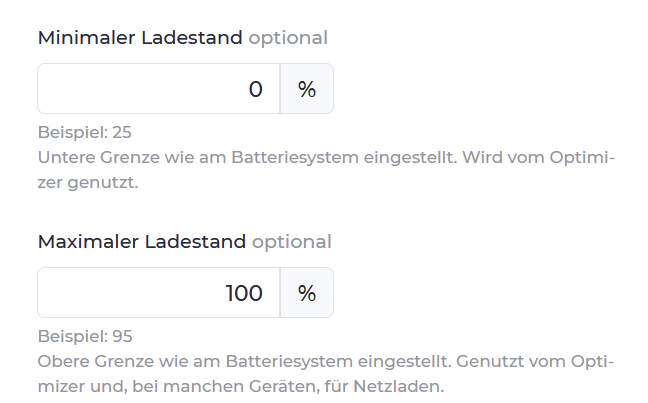
|
Additional observation: planned grid charging with PV production and a full second batteryI monitored an optimizer-controlled charging window on 18 November 2026, from 09:45 to 10:00 CET. Setup: E3/DC S10 E at 7% SoC at the start; Marstek Venus E 3.0 at 100% and approximately 0 W during the samples; PV production present; EV disconnected; optimizer automatic mode Plan and observed commandsFor the current interval, the optimizer planned approximately 2.7–3.0 kW of E3/DC charging and 2.3–2.6 kW of grid import. The plan was recalculated during the interval. These are planned values, not necessarily device power setpoints. The following are selected, sanitized lines from the evcc trace. Times are CET. Battery 1 is E3/DC; battery 2 is Marstek. Negative battery power means charging; negative grid power means export. During the charge interval, the optimizer's individual suggestion for the full Marstek was Measured resultAcross 44 evcc state samples during the 15-minute window:
The E3/DC did charge, but the planned additional grid import was not visible in these measurements. Its charging can largely be explained by available PV surplus. The readings are samples, not a certified energy balance. The battery page displayed “Netzladen” while this was happening. In this case, the displayed operating mode alone did not establish that the planned grid import was actually taking place. Comparison with earlier testsOn 16 November, an alternative E3/DC These tests had different conditions, including PV production, so they do not prove that the same method would work reliably at night or alongside evcc and a second battery. The write lines above do not independently prove how the E3/DC accepted or interpreted the request. Home Assistant's RSCP connection was active in the current setup; an interaction cannot yet be ruled out. The previously observed 24-hour manual-charge restriction is also a possible factor, but I have not established its state for this interval. Questions
I have the timestamped measurements and trace logs available and can provide further sanitized excerpts if useful. |
Follow-up: grid charging worked after the next charge requestFollowing the 09:45–10:00 observation, evcc returned the E3/DC to Selected sanitized evcc trace lines: Negative battery power indicates charging; negative grid power indicates export. Battery 1 is the E3/DC; PV power is the combined production reported by evcc. At 10:15 the E3/DC was at 11% SoC. A subsequent live sample showed the Marstek at 100% and 0 W, with the EV disconnected. The request at 10:15 used the same basic power settings and manual-charge request as the 09:45 request, but this time substantial grid import followed within the next measurement cycle. At 10:16, the optimizer suggestion was approximately 427 W charging and 427 W grid import, whereas actual E3/DC charging was approximately 2,946 W and grid import approximately 2,305 W. These plan values are not necessarily power setpoints sent to the E3/DC. The roughly 15-minute Could this comparison help identify which E3/DC state or response should be checked when the same request has different measured effects? Implication for evcc: The E3/DC is demonstrably capable of grid charging, including following an evcc request, and the optimizer-to-device integration did not reliably achieve its planned outcome in the preceding window. The evidence does not yet isolate the root cause to evcc or E3/DC: device-side restrictions and concurrent RSCP access remain possible. Nevertheless, could the evcc team investigate how the integration can account for the relevant E3/DC states and restrictions, and detect and report when planned charging does not occur? The earlier successful alternative power-mode tests may also provide a route to evaluate, subject to safe stop and failure handling. |
Follow-up: manual-charge status during failed and successful windowsI checked the E3/DC RSCP integration's Manual charge history against the previously documented evcc traces and measured power. All times are CET on 18 November 2026. The HA timestamps are observed state changes and may be affected by polling; they are not per-tag RSCP acknowledgements.
Selected sanitized log lines for the 03:55 and 10:15 comparisons (battery 1 is E3/DC; negative battery power means charging; positive grid power is import): The 03:55 and 10:15 command entries above are abbreviated from the trace; the full sanitized 09:45 and 10:15 lines and additional samples are in my preceding two comments. The 13:17–14:01 trace contains battery and grid readings, but no matching start command; polling requests such as This comparison suggests that the observed manual-charge state and its prior history are useful diagnostic signals. It does not establish why the request fails: the 24-hour portal restriction, timing, device state and possible competing writes remain open. The HA RSCP integration was connected in parallel; no competing write during these windows has been established. PV alone is not a sufficient explanation: the 09:45 case and the earlier 16 November unsuccessful restart both had PV. The earlier isolated HA Could the maintainers help identify which E3/DC response or state should be captured alongside The complete trace contains private network/session information; I can provide further sanitized excerpts if useful. For context, universal-dilettant compared the manual-charge, reserve and power-control approaches. The proposed reserve approach needs careful restoration of the existing setting, including after interruptions; its suitability for my setup is not established. The reported manual-charge restriction and power-mode timeout are useful leads, but their precise behaviour on this device still needs verification. |

|
My question again: was the portal indicating a grid charge lock situation? The rscp commands used by Evcc seem to be be causing that - can you confirm? |
New observation: successful restart after a 15-minute pause, including without PVAs a follow-up to my earlier comparison, I captured a complete optimizer-controlled stop–start–stop sequence on 18 November 2026. All times are CET. This adds a successful reference case to the failed 03:55 request already documented above.
Selected evcc log linesThese are selected, abbreviated lines from the trace. After the stop, the remaining small battery charge coincided with PV production and approximately zero grid power. The restart was therefore successful in this instance, roughly 15 minutes after the previous stop, even though both PV sources reported 0 W at the start. This corrects my earlier suspicion that PV production might be required for grid charging. It also shows that a blanket assumption that every stop prevents any further manual charge for 24 hours does not explain this sequence. It does not establish how the E3/DC portal restriction applies to RSCP requests or why other starts failed. Regarding @universal-dilettant’s question: after the 16 November test, the portal did show a next available manual-charge time on 17 November, as noted above. I did not record the portal lock state at the time of today’s 03:55 or 15:00 requests, so I cannot confirm whether a lock applied to either request. The exact relationship between the portal indicator and these RSCP commands remains open. The earlier 03:55 case used the same basic logged start request but the E3/DC stayed near 0 W; its SoC was 0%, the EV and Marstek were charging, and PV was 0 W. These conditions differ from 15:00, so the comparison does not isolate a single cause. The Home Assistant RSCP integration has been connected in parallel in this setup; I have not established a competing write in either window. The trace shows the write request and measured outcome, but I could not identify a per-tag RSCP response. Could the maintainers assess which E3/DC status or response is needed to identify why a request is ineffective, and whether evcc can detect and report a persistent mismatch between the requested and measured charging per battery? Given the earlier isolated HA Other E3/DC users have also reported difficulties with grid charging through evcc, for example in #34041 and #25972. The symptoms and conditions differ, so a common cause is not established. @andig, the original issue was converted into this discussion. Since then, I have captured a failed night-time request and a complete successful stop–start–stop sequence, including a successful start with both PV sources reporting 0 W. In your view, do these additional observations justify tracking the unreliable execution of planned grid charging as an issue? If so, would you prefer a new, focused issue that links back to this discussion? The root cause is still open. My aim is to make sure the mismatch between the requested and measured charging is investigated, including whether evcc can detect and report it per battery. The trace and debug logs are available; I can provide further sanitized excerpts if useful. |
|
Peter, |

Atm there's really nothing we could do... |
|
IMHO there is nothing unreliable. I delivered an analysis yesterday, see above, and 2 potential solutions (B) and (C). I prefer (B) over (C), 'cause it's easier to implement and would just need the substitution of a few rscp commands. It would even fit to the description and meaning of the config fields min and max SOC. Given some time I could try to prepare a PR (I'm not really fluent in these matters). |

|
@universal-dilettant Thanks for your analysis and for offering to prepare a PR. I appreciate the work you have already put into comparing the available RSCP approaches. I checked the successful and unsuccessful charging attempts against the evcc logs, Home Assistant history and stored InfluxDB measurements. The following are individual samples from 18 November, local time:
The optimizer suggestions are planned values, not necessarily power setpoints sent to the E3/DC. For the 15:00 attempt, the recorded sequence was:
HA state-change times are subject to polling delay. The HA state indicates whether manual charging is reported as active; it does not tell us whether a new request is locked. I also checked the available InfluxDB measurements and did not find an explicit portal lock or next-allowed-charge timestamp. Unfortunately, I did not record the portal lock state immediately before the 15:00 restart. How do you interpret this successful restart in relation to the 24-hour restriction you observed? Do you know whether the relevant lock state can be read through RSCP? Regarding a potential implementation: I would prefer not to change the emergency-power reserve if there is a reliable alternative, because an existing reserve has its own purpose and would need to be preserved and restored safely. Could we first assess:
In my short Home Assistant tests, C produced measurable battery charging and additional grid import at 1 kW and 2 kW. Those tests had different conditions and do not yet prove reliable operation across repeated optimizer windows. I also understand that C requires periodic refresh and careful stop and communication-loss handling. Do you see a particular technical obstacle to C, or is B mainly preferable because it appears simpler to implement? |
|
Regarding a potential implementation: I would prefer not to change the emergency-power reserve if there is a reliable alternative, because an existing reserve has its own purpose and would need to be preserved and restored safely. Do you see a particular technical obstacle to C, or is B mainly preferable because it appears simpler to implement? At the moment it looks like we are fiddling around with some design decisions of E3/DC (limit manual grid charge to one time in 24h). My own analysis is consistant with this assumption, your observations of today could contradict it. Again (and I don't want to be rude): please check the time stamp on the portal each time when evcc triggers grid charging. 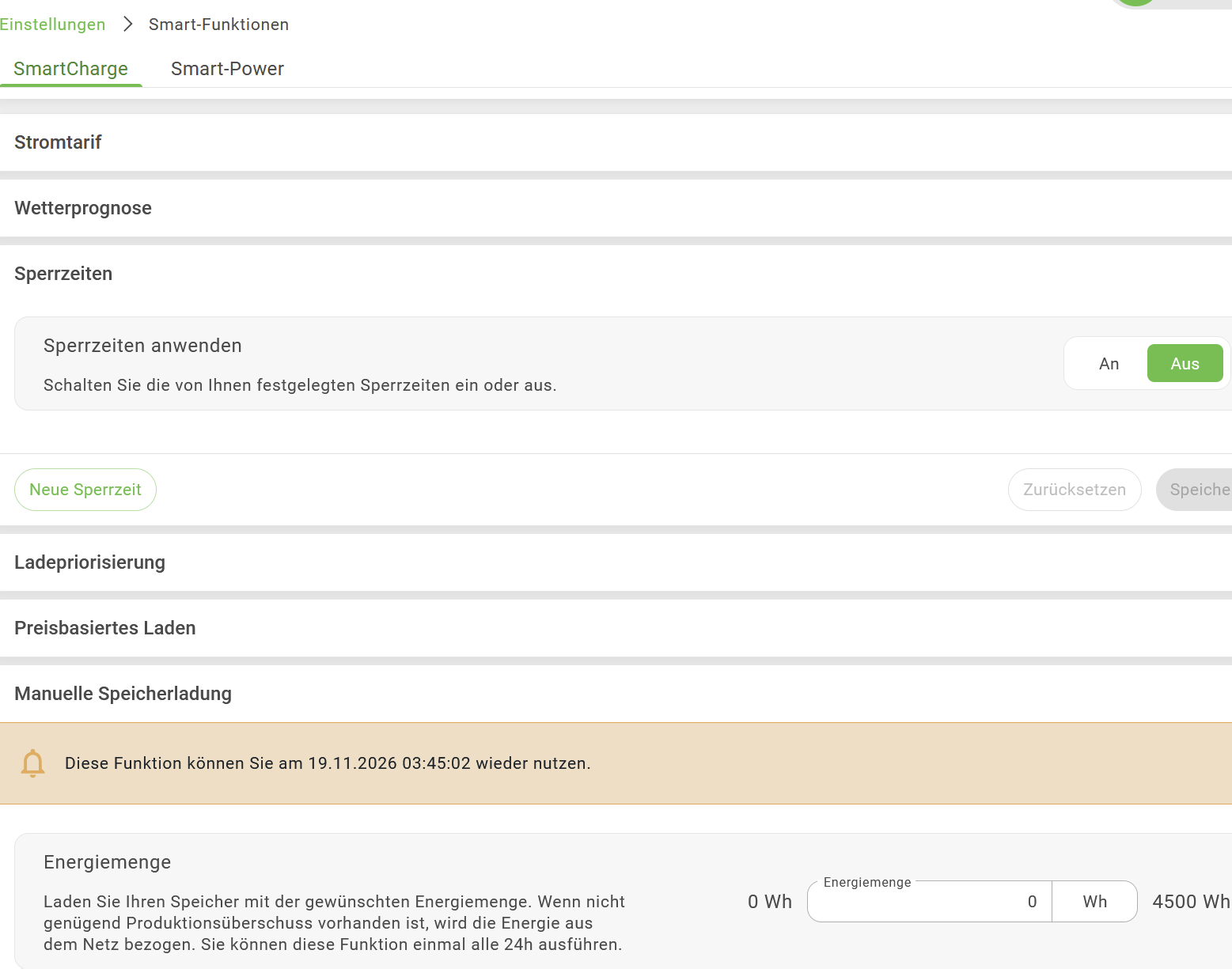
|
|
@universal-dilettant Thanks for explaining your proposed implementation and for pointing me back to the portal status. I will check the displayed timestamp immediately before future charging attempts, as you suggest. After today's charging sequence, the portal showed that manual battery charging would be available again on 19 November 2026 at 15:00:08. The evcc trace shows (all times CET):
The portal's displayed next availability is therefore exactly 24 hours after the successful 15:00:08 start request, not after the 15:15 stop. This suggests a connection between the request and the portal's timestamp, although the timestamp alone cannot establish the mechanism. At the same time, E3/DC was already charging before 14:45 and successfully started again at 15:00 after a roughly 15-minute pause. This seems difficult to reconcile with a blanket rule that every new RSCP manual-charge request is blocked for 24 hours after an earlier successful charge. Unfortunately, I did not record the portal timestamp immediately before the 15:00 restart, so I cannot establish whether the portal displayed a restriction at that point. What do you make of this combination? Does the timestamp strengthen your theory, and how might the successful restart fit into it? Could the portal action and RSCP requests behave differently, or might additional conditions determine when the restriction applies? I would still prefer a solution that preserves the existing emergency reserve if a reliable alternative is possible. My short Home Assistant tests with the power-based I understand your concern about changing the general scheduler for E3/DC. Could the required periodic refresh potentially be handled inside the E3/DC integration itself? I do not know whether that fits evcc's architecture or how best to handle a stop or communication loss. 
|

E3/DC S10 X Pro – Grid charging unexpectedly stops but can be restarted via evccI would like to contribute some observations from my E3/DC S10 X Pro installation. We are currently investigating an issue where grid charging starts successfully but unexpectedly stops during a low-price period. System configuration
Observed incident – 25 November 2026 (CET)The electricity price was €0.259/kWh, below the configured grid-charging limit of €0.30/kWh. The following observations were recorded:
No corresponding change away from battery mode The battery SoC was still well below the configured charging target, and the low-price period had not ended. Restarting grid charging through evccOn 24 November, I manually switched grid charging off and then back on directly in the evcc web interface, not through Home Assistant. Grid charging subsequently resumed. Later that day, evcc also initiated another grid-charging session automatically during the afternoon low-price period. On 25 November, I again toggled grid charging off and on in evcc in the morning. The logs subsequently showed:
These observations demonstrate that multiple grid-charging sessions can be initiated through evcc within 24 hours on my installation. Clarification regarding the 24-hour restrictionI have observed a 24-hour restriction when starting manual battery charging directly from the E3/DC display. However, grid charging initiated through evcc behaves differently in my installation. Both a manual restart through the evcc interface and a subsequent automatic charging session during another low-price period were possible without waiting 24 hours. Therefore, I do not currently consider the 24-hour restriction to be an established explanation for the interruptions observed with evcc. Current assessmentThe RSCP connection and grid-charging functionality work in principle. The main issue is that an already running charging session can stop unexpectedly, even though the requested battery mode remains We have not yet established whether the interruption originates from:
These are possible explanations, not confirmed causes. Planned next stepsWe are preparing additional monitoring to compare evcc battery power measurements with the battery power reported directly by E3/DC. We also plan to investigate a controlled recovery procedure that:
This recovery mechanism is currently disabled for unattended operation. It will be tested under supervision before being enabled. The purpose is to maintain reliable charging while we continue investigating the underlying cause, not to hide the problem. Questions for the evcc maintainers
I can provide the relevant evcc journal logs and additional measurements if needed. Any recommendations for further diagnostics or controlled tests would be appreciated. Note on AI assistanceThis report was prepared with the assistance of ChatGPT to help analyze and structure the technical observations, interpret log entries, and formulate the findings in English. All reported measurements, timestamps, system configurations, and observed charging behavior originate from my actual installation and the available system logs. The root cause has not yet been identified. I am personally conducting the tests and can provide additional logs or measurements if needed. |


Uh oh!
There was an error while loading. Please reload this page.
Describe the bug
Problem
Grid charging of my E3/DC home battery through evcc is not reliable. The optimizer plans grid-charging windows, but the E3/DC does not always charge during those windows. This prevents the optimizer's battery plan from being implemented as intended.
In my setup, a second home battery is also connected. In an affected night-time window, the Marstek battery charged while the E3/DC did not.
The problem is not that the E3/DC can never be charged from the grid through evcc: grid charging has worked repeatedly during the day, and a controlled test through evcc successfully started charging on both batteries. The conditions under which the same overall setup succeeds or fails are not yet clear.
Expected behavior
When optimizer automatic mode plans grid charging, evcc should reliably translate that plan into effective charging of the configured and supported home batteries, including the E3/DC, within their actual capabilities.
When a charging request is issued but a battery does not start charging, evcc should identify and report that the requested action was not carried out. With multiple batteries, the result should be observable for each battery individually.
Request to the evcc team
Please investigate how the E3/DC integration and optimizer control can be made to work together reliably for grid charging.
The successful test shows that this E3/DC can respond to a grid-charging request sent through evcc. The unresolved issue is that grid charging is not consistently achieved in normal optimizer operation. I would therefore like to see this addressed as part of the evcc control and integration solution, even if E3/DC-specific behavior or restrictions have to be taken into account.
Questions that may help identify a solution:
Discussion #34078 includes a community proposal using the E3/DC energy reserve. This could be evaluated as one possible approach. A solution would need to account for restoring the original reserve and for restart, connection loss and manual changes. Its suitability for general use has not been established.
Related: #33774 and #34078.
Other E3/DC users' observations and the evcc team's assessment of possible solutions would be appreciated.
Steps to reproduce
Observed failure
During the night of 15–16 November 2026, the optimizer displayed a planned battery grid-charging window from 23:45 to 00:00.
According to evcc's energy history for that interval:
The evcc/RSCP log for this specific night-time window is not available. Therefore, I cannot determine from this case which command was actually sent to the E3/DC or whether the optimizer plan had changed before the interval.
Successful controlled test through evcc
On 16 November, I tested grid charging using evcc's external battery mode. The EV was disconnected. The log shows this sequence:
At 08:43:31, the measured values were:
Both batteries charged simultaneously. After the external command timed out, evcc returned through
normaltoholddischarge; both batteries subsequently stopped charging.The immediately preceding
holddischargestate did not prevent charging in this test. It is not yet known whether the earlier transition throughnormal, the PV production, an E3/DC-internal restriction, or another condition influenced the result.This controlled test was triggered manually through evcc. It does not prove that the same sequence was sent during the failed optimizer window.
Configuration details
Log details
What type of operating system or environment does evcc run on?
Docker container
External automation
Nightly build
Version
0.320.0-dev.1794708712
All reactions