OAuth2 scopes error in documentation for endpoints with multiple scopes #5725

Description

First Check
- I added a very descriptive title to this issue.
- I used the GitHub search to find a similar issue and didn't find it.
- I searched the FastAPI documentation, with the integrated search.
- I already searched in Google "How to X in FastAPI" and didn't find any information.
- I already read and followed all the tutorial in the docs and didn't find an answer.
- I already checked if it is not related to FastAPI but to Pydantic.
- I already checked if it is not related to FastAPI but to Swagger UI.
- I already checked if it is not related to FastAPI but to ReDoc.
Commit to Help
- I commit to help with one of those options 👆
Example Code
from datetime import datetime, timedelta
from typing import List, Union

from fastapi import Depends, FastAPI, HTTPException, Security, status
from fastapi.security import (
    OAuth2PasswordBearer,
    OAuth2PasswordRequestForm,
    SecurityScopes,
)
from jose import JWTError, jwt
from passlib.context import CryptContext
from pydantic import BaseModel, ValidationError

# to get a string like this run:
# openssl rand -hex 32
SECRET_KEY = "09d25e094faa6ca2556c818166b7a9563b93f7099f6f0f4caa6cf63b88e8d3e7"
ALGORITHM = "HS256"
ACCESS_TOKEN_EXPIRE_MINUTES = 30


fake_users_db = {
    "johndoe": {
        "username": "johndoe",
        "full_name": "John Doe",
        "email": "johndoe@example.com",
        "hashed_password": "$2b$12$Glui89L967h/y4cklxmhUu6SoFMSe7VbvpDtGZnf1NPQcw.7Krzve",  # secret
        "disabled": False,
    },
    "alice": {
        "username": "alice",
        "full_name": "Alice Chains",
        "email": "alicechains@example.com",
        "hashed_password": "$2b$12$E6I0U4U7v/EXMj/5iJvHE.NCk/u3K2ur5T6RgauCuItO5dBWdfT2q",  # secret
        "disabled": True,
    },
}


class Token(BaseModel):
    access_token: str
    token_type: str


class TokenData(BaseModel):
    username: Union[str, None] = None
    scopes: List[str] = []


class User(BaseModel):
    username: str
    email: Union[str, None] = None
    full_name: Union[str, None] = None
    disabled: Union[bool, None] = None


class UserInDB(User):
    hashed_password: str


pwd_context = CryptContext(schemes=["bcrypt"], deprecated="auto")

oauth2_scheme = OAuth2PasswordBearer(
    tokenUrl="token",
    scopes={"me": "Read information about the current user.",
            "items": "Read items.",
            "my-items": "Read items that belong to the current user."},
)

app = FastAPI()


def verify_password(plain_password, hashed_password):
    return pwd_context.verify(plain_password, hashed_password)


def get_password_hash(password):
    return pwd_context.hash(password)


def get_user(db, username: str):
    if username in db:
        user_dict = db[username]
        return UserInDB(**user_dict)


def authenticate_user(fake_db, username: str, password: str):
    user = get_user(fake_db, username)
    if not user:
        return False
    if not verify_password(password, user.hashed_password):
        return False
    return user


def create_access_token(data: dict, expires_delta: Union[timedelta, None] = None):
    to_encode = data.copy()
    if expires_delta:
        expire = datetime.utcnow() + expires_delta
    else:
        expire = datetime.utcnow() + timedelta(minutes=15)
    to_encode.update({"exp": expire})
    encoded_jwt = jwt.encode(to_encode, SECRET_KEY, algorithm=ALGORITHM)
    return encoded_jwt


async def get_current_user(
    security_scopes: SecurityScopes, token: str = Depends(oauth2_scheme)
):
    if security_scopes.scopes:
        authenticate_value = f'Bearer scope="{security_scopes.scope_str}"'
    else:
        authenticate_value = "Bearer"
    credentials_exception = HTTPException(
        status_code=status.HTTP_401_UNAUTHORIZED,
        detail="Could not validate credentials",
        headers={"WWW-Authenticate": authenticate_value},
    )
    try:
        payload = jwt.decode(token, SECRET_KEY, algorithms=[ALGORITHM])
        username: str = payload.get("sub")
        if username is None:
            raise credentials_exception
        token_scopes = payload.get("scopes", [])
        token_data = TokenData(scopes=token_scopes, username=username)
    except (JWTError, ValidationError):
        raise credentials_exception
    user = get_user(fake_users_db, username=token_data.username)
    if user is None:
        raise credentials_exception
    for scope in security_scopes.scopes:
        if scope not in token_data.scopes:
            raise HTTPException(
                status_code=status.HTTP_401_UNAUTHORIZED,
                detail="Not enough permissions",
                headers={"WWW-Authenticate": authenticate_value},
            )
    return user


async def get_current_active_user(
    current_user: User = Security(get_current_user, scopes=["me"])
):
    if current_user.disabled:
        raise HTTPException(status_code=400, detail="Inactive user")
    return current_user


@app.post("/token", response_model=Token)
async def login_for_access_token(form_data: OAuth2PasswordRequestForm = Depends()):
    user = authenticate_user(fake_users_db, form_data.username, form_data.password)
    if not user:
        raise HTTPException(status_code=400, detail="Incorrect username or password")
    access_token_expires = timedelta(minutes=ACCESS_TOKEN_EXPIRE_MINUTES)
    access_token = create_access_token(
        data={"sub": user.username, "scopes": form_data.scopes},
        expires_delta=access_token_expires,
    )
    return {"access_token": access_token, "token_type": "bearer"}


@app.get("/users/me/", response_model=User)
async def read_users_me(current_user: User = Depends(get_current_active_user)):
    return current_user


@app.get("/users/me/items/")
async def read_own_items(
    current_user: User = Security(get_current_active_user, scopes=["items", "my-items"])
):
    return [{"item_id": "Foo", "owner": current_user.username}]


@app.get("/status/")
async def read_system_status(current_user: User = Depends(get_current_user)):
    return {"status": "ok"}
Description
This code come from https://fastapi.tiangolo.com/advanced/security/oauth2-scopes/ I've just added a scope my-items to the endpoint /users/me/items/ to show the problem.
- Run with
uvicorn test:app(name of the python file test.py) - Go to http://127.0.0.1:8000/docs and login with
johndoe/secretwith scopemy-items
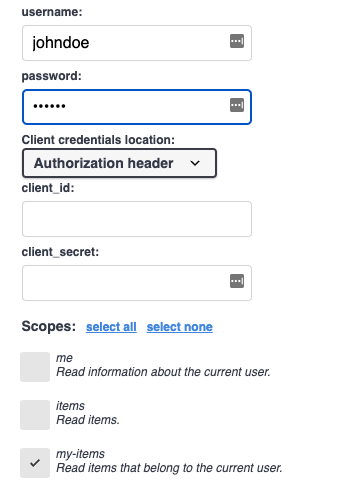
- Make a query on
/users/me/items/which should answer since it accepts the scopeitemsandmy-items
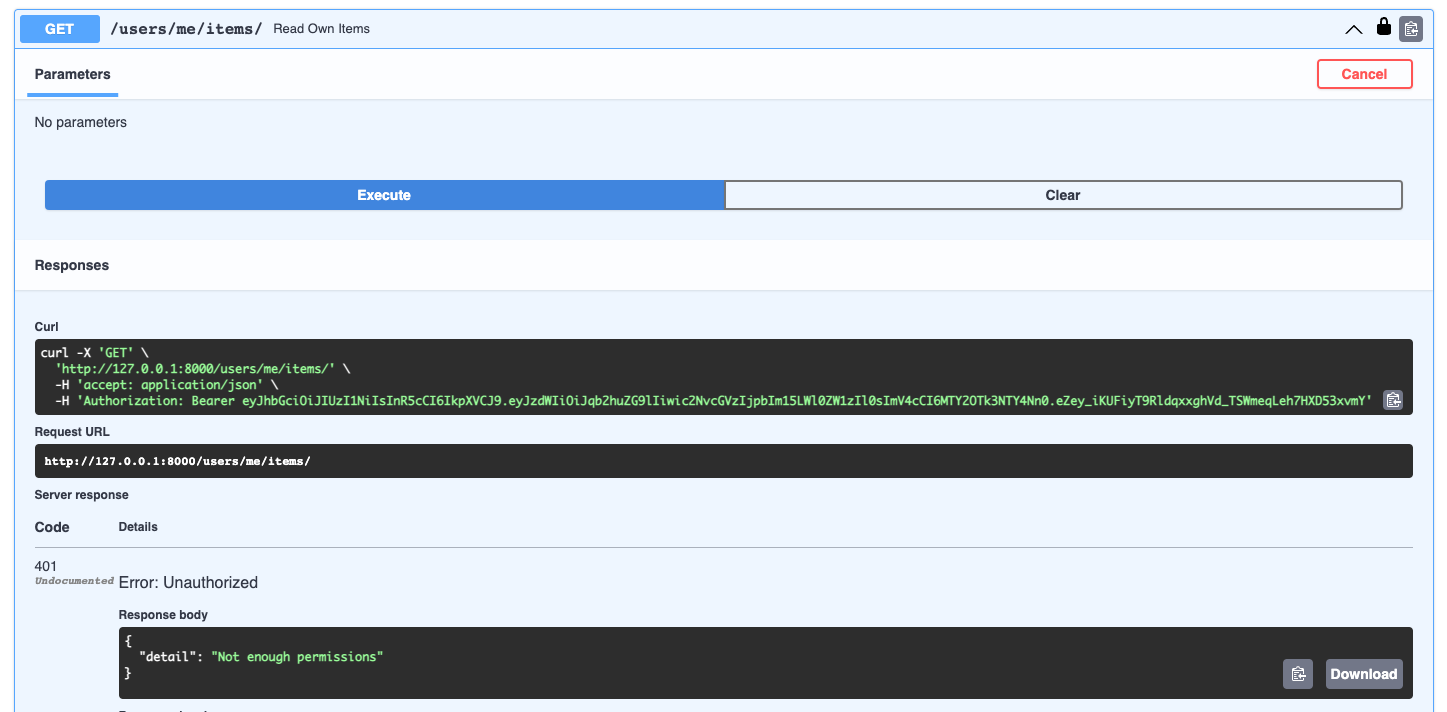
We get "Not enough permission" back.
Indeed, if we look at the code :
    for scope in security_scopes.scopes:
        if scope not in token_data.scopes:
            raise HTTPException(
                status_code=status.HTTP_401_UNAUTHORIZED,
                detail="Not enough permissions",
                headers={"WWW-Authenticate": authenticate_value},
            )
It stops at the first iteration.
It would be better to put this in order to iterate on the whole list :
    if security_scopes.scopes:
        check_scope = any(
            scope in token_data.scopes for scope in security_scopes.scopes
        )
    else:
        # If no security scopes are defined, return True
        check_scope = True

    if not check_scope:
        raise HTTPException(
            status_code=status.HTTP_403_FORBIDDEN,
            detail=strings.NOT_ENOUGH_PERMISSIONS,
            headers={"WWW-Authenticate": authenticate_value},
        )
Operating System
macOS
Operating System Details
No response
FastAPI Version
0.88.0
Python Version
3.11
Additional Context
No response