Repository navigation
Home
A durable control plane for autonomous, cooperating AI-agent teams.


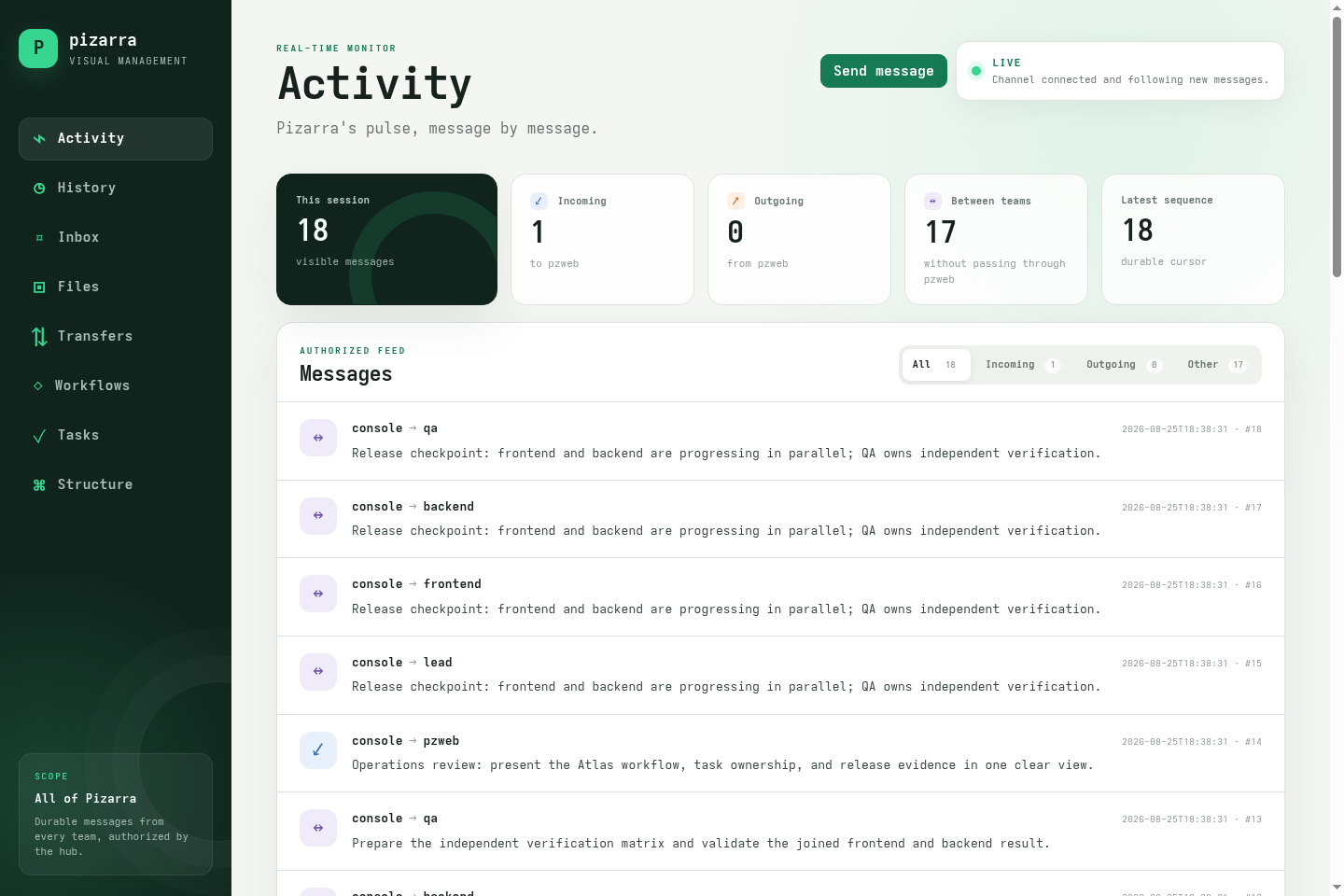
Pizarra turns independent terminal-based workers into an organized autonomous team. It provides the operational machinery that transient conversations do not: durable messaging, verified identities, scoped authority, task queues, dependency-aware workflows, shared artifacts, retry and recovery, live supervision, and explicit human approval gates.
The suite is runtime-neutral. It coordinates interactive terminal programs without depending on a particular AI provider, model API, or agent framework. The worker remains replaceable; the team state remains durable.
| Program | Role | What it owns |
|---|---|---|
| pizarra | Hub and source of truth | Authentication, journal-before-delivery messaging, retries, teams, projects, applications, tasks, workflows, history, and live events |
| tiza | CLI, human console, and endpoint daemon | One-shot commands, interactive supervision, remote terminal delivery, session watchdogs, deduplication, reverse dial, and endpoint updates |
| pzweb | Private-network browser console | Eight focused operational views, a strict authenticated HTTP adapter, live activity, workflow and task control, registries, and verified file transfers |
flowchart LR
    H[Human operator] --> C[tiza chat]
    H --> W[pzweb]
    C --> P[pizarra hub]
    W --> P
    P --> J[(Durable journal and state)]
    P --> L[Local tmux teams]
    P <-->|push or reverse dial| D[tiza daemon]
    D --> R[Remote tmux teams]
- Messages survive absence. The hub appends and flushes each message before delivery. Offline endpoints receive queued work in order when they return.
- Identity is enforced. A team credential is bound to one identity and cannot claim another. Administrative capabilities are delegated by command family.
- Work is explicit. Tasks carry ownership, state, notes, hierarchy, and history instead of disappearing into terminal context.
- Plans are executable graphs. Workflows support branches, joins, cross-workflow dependencies, stable step IDs, strict evidence, human gates, reminders, snapshots, undo, and export.
- Failures stop the plan. An error halts every branch. The owner fixes and tests it; another party must verify the repair before work resumes.
- Humans see the same truth. The terminal console and browser operate on the hub's durable state rather than maintaining competing copies.
- Recovery is designed in. Delivery receipts, reconciliation, atomic state replacement, backup manifests, restore guards, and endpoint rollback make partial failures visible and manageable.
| Goal | Page |
|---|---|
| Build a safe loopback installation | Start Here |
| Understand the value and use cases | Why Pizarra |
| See how every component fits together | Concepts and Architecture |
| Design autonomous team structures | Cooperation Patterns |
| Build a dependency-driven plan | Workflow Engine |
| Explore the browser control surface | Web Console |
| Deploy on real hosts | Deployment Topologies and Operations Runbook |
| Review trust boundaries first | Security Model and Limitations and Compatibility |
flowchart LR
    B[Build candidate] --> T[System tests]
    B --> S[Security review]
    T --> A[Human approval]
    S --> A
Pizarra activates independent branches together, holds the next phase until the current level is complete, and creates linked tasks for the responsible teams. If a later test finds a defect in an earlier completed step, the plan still halts. Repair evidence and independent verification become durable workflow history instead of informal assurances.
Read Workflow Engine for the complete lifecycle.
| Animated workflow map | Terminal-based cooperation |
|---|---|
 |
 |
The expanded tour, including separate team, group, and application registries, is on the Gallery page.
Pizarra 1.1.41 is designed for a trusted private network. Its native TCP protocol and the pzweb HTTP server authenticate but do not encrypt traffic. Start on loopback, use distinct credentials and operating-system accounts, and add an independent encrypted network boundary before traffic crosses machines. It is not an Internet-edge service.
The project documents its limits as carefully as its strengths. Read Security Model before deployment and Limitations and Compatibility before selecting an architecture.
- Source: github.com/garacil/pizarra
-
Current release: 1.1.41 (
v1.1.41; GitHub Release Pizarra 1.1.41) - License: GNU GPL v3, GPL-3.0-only
- Sole author: Germán Luis Aracil Boned <garacilb@gmail.com>
- Detailed versioned documentation: docs/