Repository navigation
Home
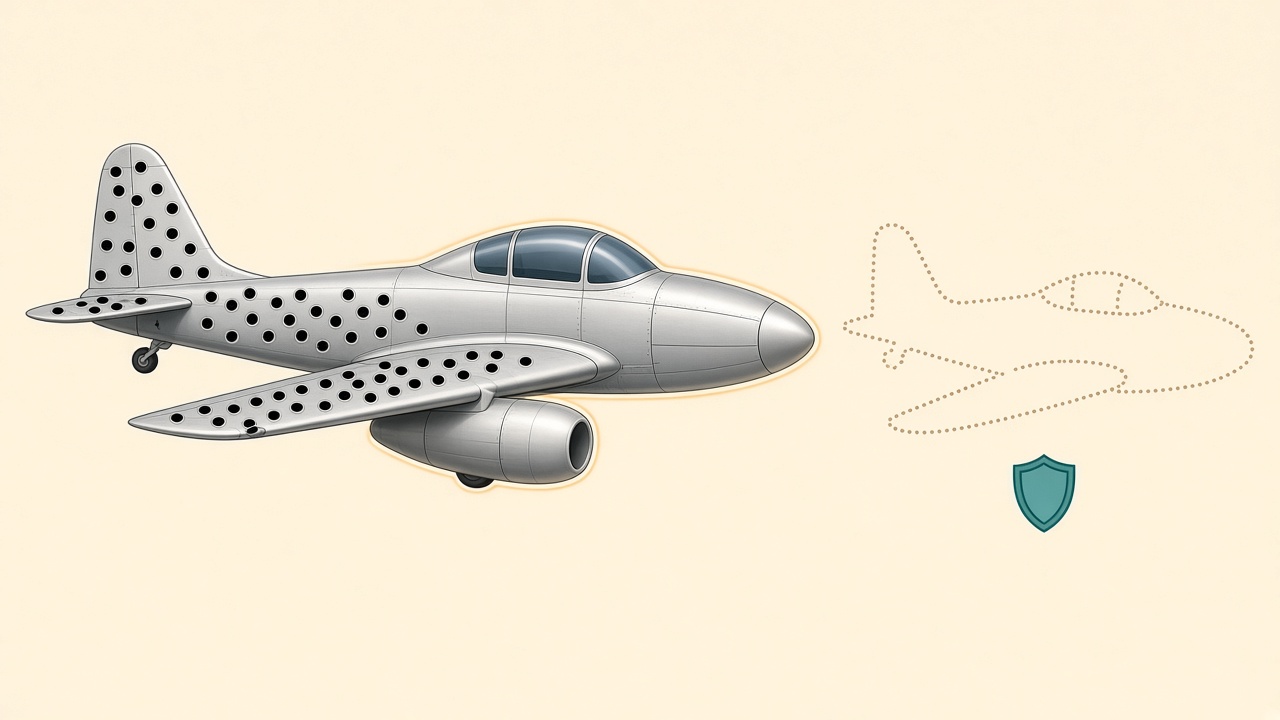
Left: the plane we can study. Holes in the wings and tail. The cockpit and the engine are smooth.
Right: the plane that did not come home. The shield sits where we cannot count the holes.
🛡️ AbsenceCritic
A second brain for language models.
A model trained only on the planes that returned will correctly learn the distribution of survivable damage.
Robustness requires an explicit process that reasons about the planes that did not return. That process is AbsenceCritic.
In plain words: are we only looking at the winners?
🔁 How it works
·
| 👀 What you can see | 🕳️ What is missing | 🛡️ What the helper does |
|---|---|---|
| Famous wins, published studies, blog posts | Tries that failed quietly and were never written down | Says what is missing, then the model fixes the answer |
| Planes that came home | Planes that did not | Stays quiet on a simple fact |
Important
The one rule. The writer never reads the failure notebook. Only the helper does. The writer answers. The helper looks for what the records left out. The writer then sees a report card, not the notebook.
In 1943, people studied war planes that came home.
The wings and the tail were full of holes. The engines and the cockpit were almost clean.
The first idea was: put armor where the holes are.
Abraham Wald said: stop. These are only the planes that made it back. A plane hit in the engine often never returned, so that hole is not on the diagram. The empty spots are the clue. Put the armor where the holes are missing.
| What is on the diagram | What it really means |
|---|---|
| 🕳️ Lots of holes in the wings | Those hits were survivable. The plane still flew home. |
| ✨ Almost no holes in the engines | Hits there often meant the plane did not come home. |
The holes you can count are often the hits that were not deadly.
A language model learns from writing that was saved. A chat window is one place you see that.
It sees startup stories that became famous. It does not see the startups that closed and never got a post.
Ask "what works?" and it can sound sure, because it mostly read the winners. Those winners are the planes that came home.
AbsenceCritic is the second brain that looks for the missing planes. These pages also call it the helper.
You ask: "What works for launching a startup?"
| ✍️ First answer, writer alone | 🛡️ After the helper |
|---|---|
| Drop out. Copy the last famous company. Move fast. | Famous founders are the planes that came home. Many startups close and never get a write-up. Copying the famous path does not prove it works for most people. |
These numbers are from live tests on grok-4-fast-non-reasoning, with more answering models including gpt-4o-mini, Llama 3.3, and Claude Sonnet 4.6. They are clues. Run the same tests on your own model before you treat them as a grade. The full tables, independent judge, and hard questions live on Measured results.

Left: the helper, quiet when the question is a plain fact. Right: a sticky note that warns on everything.
| 📎 Sticky note | 🛡️ Full shield | |
|---|---|---|
| 🤫 Needless warnings on easy answers (benchmark, 3 tries) | 34 of 36 | 0 of 36 |
| 📝 Graded warning (biased items, independent judge) | 0.72 / 0.64 std/hard | 0.88 / 0.83 std/hard |
The sticky note only says "watch for missing failures." It fixed tricky questions and spoiled plain ones. "What is 2 + 2?" should stay "4."
The helper writes a better warning: on biased answers, concrete evidence about missing cases landed 6% (sticky note) versus 45% (helper alone) and 54% (full shield), graded by a separate small model. Later runs on gpt-4o-mini, Llama, and Claude keep the quiet-on-controls story; weaker models need the helper more but write fewer facts, while a strong writer already writes rich sticky notes. Details on Measured results.
| Without the notebook | 📓 With the notebook | |
|---|---|---|
| 🏢 Made-up company failures the chatbot had never read | 0 of 8 used the private fact | 8 of 8 used the private fact |
On famous public stories, the chatbot already knew the classic warning, so the notebook changed little. The notebook matters for notes your team has, the ones a public chatbot was never trained on.
Tip
Use the helper on answers. Point the notebook at your own failure notes. Keep those notes in a private folder, not in the public project.
AbsenceCritic was designed by Guzino.
The airplane idea is Abraham Wald's, from 1943. Using it as a second brain for language models started in this project. The code is Apache-2.0.
The grown-up blueprint stays in docs/. This wiki is the plain-language door.