Repository navigation
How it works
You ask a question. Four jobs happen, in order. They do not collapse into one.
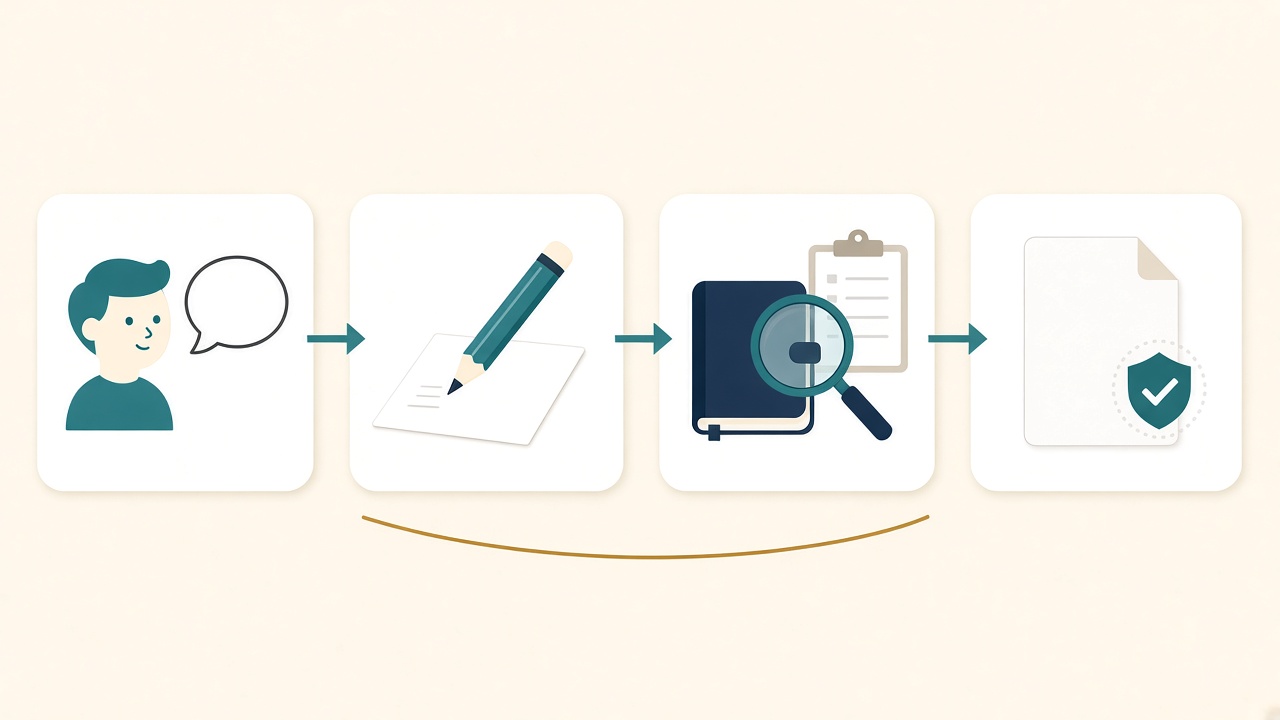
| 1️⃣ You ask | 2️⃣ Writer drafts | 3️⃣ Helper checks | 4️⃣ Careful answer |
|---|---|---|---|
| The question only | A first answer, no notebook | Notebook, then a report card | A fix, only if the worry is high |
Important
The notebook arrow points only at step 3. The writer in step 2 and the fixer in step 4 never see the failure notebook. They see the question, the draft, and, when a fix is needed, the report card.
That is the whole input. One question, in your words.
You can skip the rest with --no-shield. Then the first answer is the final answer. That is how a test compares "with the helper" and "without the helper" on the same question.
The computer name is generate.
The writer sees your question only. It does not see the failure notebook. The first answer can be confident and still be based only on winners.
Two small jobs, still one step for you.
Lookup. The computer name is retrieve.
The notebook is the Non-Survivor Store. Each note says:
- what record we have
- how that record was filtered
- what the winners look like
- what we know about the cases that did not show up
Every note has a source. The helper must not invent a crash that is not in the notes.
Lookup is word matching, not a magic search. Easy fact questions skip the notebook. A question that only says "Wald" or "survivorship" must not pull up unrelated startup notes.
Notes you add yourself wait in a line until a person accepts them. Until then, lookup ignores them. A team's private notes live in a separate folder on that team's computer. They are not files in the public project.
Report card. The computer name is critique.
The card is a strict form called Critique. A program can read it. If the form is invalid, the run stops. The helper cannot hand back a vague paragraph and call it done.
The card includes:
- a worry score from 0 to 1 (
survivorship_risk) - what seems to be missing
- what to do next: soften the claim, ask for better data, refuse to guess, or leave the answer alone
The computer name is revise.
| Worry score | What happens |
|---|---|
| Under 0.3 | The first answer stays. The fixer is not called. "What is 2 + 2?" does not grow a speech about airplanes. One exception: the question itself names a filtered record (the literature, the famous cases) and the draft only asks which thing you mean. Then the question stays, and one line names what that record leaves out. |
| 0.3 or higher | The writer gets the question, the first answer, and the report card. It still does not get the notebook. |
The new answer should use real facts from notes the card cited. It should not talk about drafts, report cards, or notebooks. The reader sees a normal answer.
Sometimes the answer is already written, by another chatbot, and you only want the report card.
That path is score, or the command --judge. It does lookup and the report card. It does not write a first answer, and it does not fix one.
- Say that the famous examples are a filtered set.
- Give a count, a rate, or a named source when a note actually has one.
- Say what extra data would settle the question.
- Stay plain and short on a simple fact.
- Invent a failure story that is not in the notebook.
- Paste the notebook into the answer so it sounds informed.
- Add a survivorship warning to a question that does not need one.
- Let the writer read the notebook "just this once."
| Piece | Plain name | Folder |
|---|---|---|
| The forms | Question, report card, notebook note | domain/ |
| The four steps | The loop on this page | application/ |
| The words the models read | Prompt text only | prompts/ |
| The plugs | Chatbot, notebook files, command line | adapters/ |
A new chatbot or a new notebook is a new plug. The loop stays the same unless the shape of those plugs changes.