2. Input Output
Metadata table in .tsv format (column should not have blank spaces)
AND (optionally)
Newick tree which will be used to obtain genetic clusters
OR
Allele/SNP profile matrix which will be used to obtain genetic clusters from a MST
OR
Sequence alignment which will be converted into a profile and used to obtain genetic clusters
OR
VCF which will be converted into a profile and used to obtain genetic clusters
OR
TSV with a list of mutations per samples which will be converted into a profile and used to obtain genetic clusters
OR
Distance matrix which will be used to obtain genetic clusters
OR
Partitions table (i.e. matrix with genetic clusters) in .tsv format (columns should not have blank spaces)
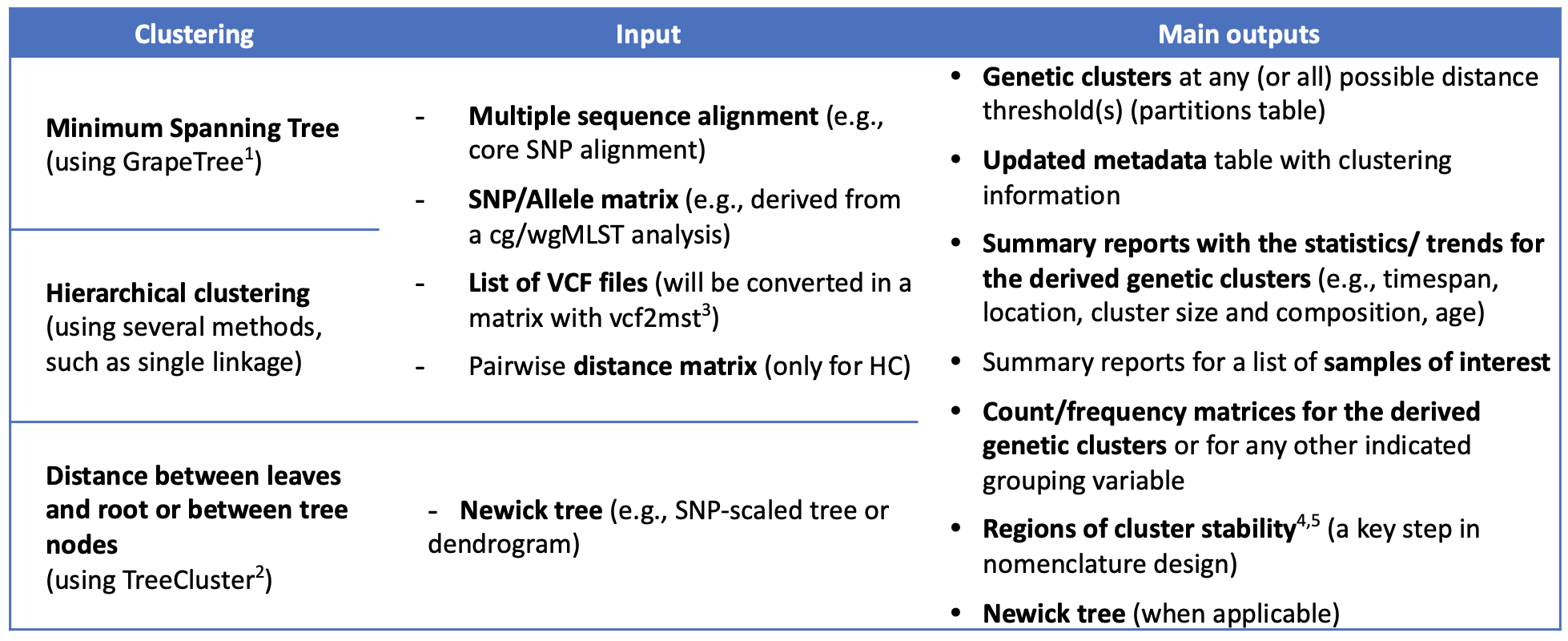
In the following table we summarize the different options that ReporTree provides to determine genetic clusters, as well as the different types of file that each of them can take as input:
- metadata_w_partitions.tsv - initial metadata information with additional columns comprising information on the genetic clusters at different partitions
TIP: Users can interactively visualize and explore the ReporTree derived clusters by uploading this metadata_w_partitions.tsv table together with either the original newick tree (e.g. rooted SNP-scaled tree) or the dendrogram resulting from hierarchical clustering at auspice.us or the MST resulting from GrapeTree at GrapeTree. With these tools your dataset is visualised from the client-side in the browser.
- partitions_summary.tsv - summary report with the statistics/trends (e.g. timespan, location range, cluster/group size and composition, age distribution etc.) for the derived genetic clusters present in partitions.tsv (note: singletons are not reported in this file but indicated in metadata_w_partitions.tsv)
- SAMPLES_OF_INTEREST_partitions_summary.tsv - similar to partitions_summary.tsv but exclusively for the samples of interest
- variable_summary.tsv - summary report with the statistics/trends (e.g. timespan, location range, cluster/group size and composition, age distribution etc.) for any (and as many) grouping variable present in metadata_w_partitions.tsv (such as, clade, lineage, ST, vaccination status, etc.)
- partitions.tsv - genetic clusters obtained for each user-selected partition threshold
- freq_matrix.tsv - frequencies of grouping variable present in metadata_w_partitions.tsv (e.g. lineage, ST, etc.) across another grouping variable (e.g. iso_week, country, etc.)
- count_matrix.tsv - counts of a grouping variable present in metadata_w_partitions.tsv (e.g. lineage, ST, etc.) across another grouping variable (e.g. iso_week, country, etc.)
- metrics.tsv - metrics resulting from the cluster congruence analysis, with indication of the Adjusted Wallace and the Ajusted Rand coefficients for each comparison of subsequent partitions, and the Simpson's Index of Diversity for each partition.
- stableRegions.tsv - partition ranges for which Adjusted Wallace coefficient is higher than the cut-off defined by the user (useful to study cluster stability and infer possible nomenclature)
- Newick file with the dendrogram resulting of the hierarchical clustering analysis or with the minimum spanning tree of GrapeTree
TIP: The Newick dendrogram provided by RepoTree can be used as input in order to obtain genetic clusters at thresholds not requested before. In this regard, please note that the result of "--analysis HC --HC-threshold single-5,single-8,single-15" is the same as the result of "--analysis treecluster --method-threshold leaf_dist_max-6,leaf_dist_max-9,leaf_dist_max-16" using a single-linkage tree as input.