Repository navigation
The Windows installer
losos-desktop_<v>_x86_64-windows-installer.exe installs LosOS beside
Windows, on the same disk, without a USB stick. It is a console program in
src/losos-windows-installer. nixos/modules/windows-installer.nix builds it
from the OS's own configuration with nixpkgs' mingw-w64 cross toolchain, and
every nightly carries it beside the installer ISO. It does the
job of the ISO's installer on a machine that keeps Windows. It
writes what an update would, from the same channel, checked against the same
key.
It runs as administrator, and asks for elevation itself if it was started without it. Then it:
- Checks the machine. It refuses a Windows started in legacy BIOS mode, a machine of another architecture, Secure Boot turned on, and a drive that BitLocker is still encrypting or decrypting, as explained below.
- Finds the newest release on the channel compiled into it, which is the one
the OS updates from. That is a proxy's
losos.update.baseUrl, or, for an OS that updates from GitHub Releases, the channel's index on the documentation site, as Releases explains. From the index it downloads split files part by part and joins them. It checksSHA256SUMS.gpgagainst the update keys innixos/keys/.--release DIRtakes a release from a folder instead, such as aLOSOS-RELEASEdisk. - Asks how much space LosOS gets, 64 GB unless the user types another
number. The minimum is what first boot needs: the boot partition, two
/usrslots, root's and/home's minimums fromdisk.nix, and swap the size of RAM. The maximum leaves Windows its used space plus 10 GB, and never goes past whatGet-PartitionSupportedSizesays C: can shrink to. - Shows what it will do and waits for the word
install. Nothing changes before that, and--dry-runstops there. - Downloads the UKI,
/usrand its hash tree into%ProgramData%\LosOS\Downloadswith Windows' owncurl.exe, which resumes an interrupted download when the program is run again. Each file is checked against its line ofSHA256SUMS. - Turns fast startup off, suspends BitLocker, and shrinks C: with
Resize-Partition. - Adds three partitions in the space. The first is a 512 MB FAT32
XBOOTLDR partition, "LosOS boot", holding the UKI. Then come slot A's
verity and
/usrpartitions, written straight from the.raw.xzfiles. They are named, typed, flagged read-only and given the UUIDs the release's file names carry, exactly as sysupdate would write them, because that is how the initrd finds/usrfromusrhash=. - Copies GRUB to
\EFI\losos\on Windows' EFI system partition, with an emptygrubenvbeside it, and adds a firmware boot entry for it at the front of the boot order. The entry is a copy of Windows Boot Manager's own with the file swapped, so it points at the same disk in the same way. Some Windows updates and some firmware put Windows Boot Manager first again. Every LosOS start that reachesboot-complete.targetmoves the LosOS entry back to the front, throughlosos-boot-orderingrub.nix, and GRUB's menu still offers Windows. - Offers to restart.
If any step after the shrink fails, it removes what it added and gives C: its space back.
At the next start, GRUB offers LosOS from the XBOOTLDR partition, and Windows
Boot Manager, which it finds on the ESP by
itself. LosOS's first boot then does what it does after dd. disk.nix
creates slot B, root, /home and swap in the rest of the space, and
first-boot setup asks for an account. Windows' partitions are never touched
again.
--uninstall undoes the install. It deletes the partitions behind C: whose
types are LosOS's, the files on the ESP it recorded in
\EFI\losos\losos-windows-installer.txt, and the boot entry, then grows C:
back into the space.
ESP                  Windows' own, ~100M: Windows Boot Manager, GRUB
MSR                  Windows' own
C:                   shrunk
LosOS boot           XBOOTLDR, 512M: the UKIs              installer
usr-verity A                                               installer
usr A                                                      installer
usr-verity B                                               first boot, _empty
usr B                                                      first boot, _empty
root, home, swap                                           first boot
Recovery             Windows' own, left where it was
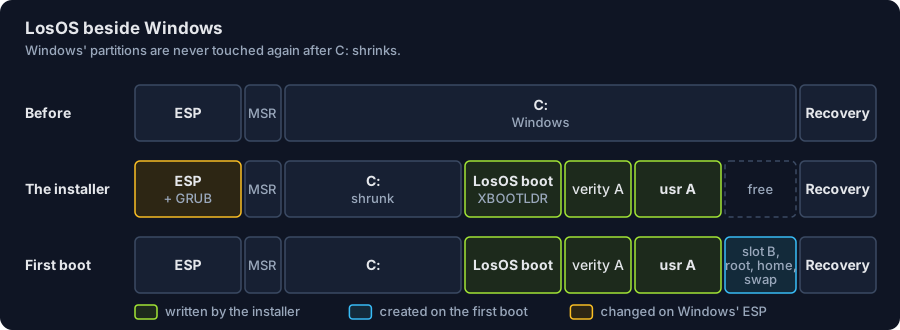
Windows makes its ESP 100 MB, with its own partitions right behind it, so
the ESP cannot grow and has no room for two UKIs of about 45 MB each. So the
UKIs go on an XBOOTLDR partition, which GRUB reads beside the ESP.
update.nix writes them to $BOOT, which is that partition where there is
one and the ESP otherwise. disk.nix accepts whatever ESP the disk has and
no longer asks for 512 MB of it. With that minimum, repart could not grow
Windows' ESP and refused the whole disk on first boot, so the system never
found its root.
Important
A release built before that change cannot be installed beside Windows.
- Secure Boot must be off. The installer registers GRUB itself with the firmware, and a signed GRUB still needs shim in front of it to start with Secure Boot on (Secure Boot). Putting shim there from Windows is not done. The installer says so and stops before changing anything.
-
BitLocker seals its key to the boot chain the TPM measured, and adding
a boot manager in front of Windows' changes that chain. So the installer
suspends protection on C: with
DisableKeyProtectorsuntil Windows has started twice. That lets BitLocker reseal itself to the new chain the first time Windows comes up through GRUB. The installer still tells the user to keep the recovery key at hand. It refuses a drive that is encrypting or decrypting, because such a drive cannot be shrunk safely. -
Fast startup hibernates Windows' kernel instead of shutting it down,
with C: still mounted. LosOS's first boot changes the partition table
around it, so the installer sets
HiberbootEnabledto 0 before anything else. LosOS never mounts Windows' partitions, so this is about the partition table, not shared files.
The Linux build, pkgs.losos-windows-installer, is the same program except
for windows.rs, the part that talks to Windows. Its tests check the
release's real signature and manifest, the layout, the FAT and xz writers,
and the bytes of the firmware boot entry. With --image DISK it installs
into a disk image laid out like a Windows disk, using sfdisk instead of
Windows' disk IOCTLs, and leaves out the firmware entry. That is how the
install was checked. It installed into a 64 GB image with a 100 MB ESP, an
MSR, a C: and a recovery partition. The image then booted under QEMU into
the boot loader's menu with LosOS and Windows Boot Manager, ran first boot,
and left C: and recovery byte-for-byte as they were.
Note
That check was made when the loader was still systemd-boot; with GRUB it has not been run again.
Only a Windows machine can test what windows.rs does: shrinking C:,
writing the partition table through IOCTL_DISK_SET_DRIVE_LAYOUT_EX,
mounting the ESP, writing firmware variables, suspending BitLocker, and how
a firmware treats the new boot entry.