Repository navigation
ps4-native-mac v0.4.0

ps4-native-mac v0.4.0
ps4-native-mac is an ahead-of-time (AOT) static recompiler for Apple Silicon Macs. It translates
the x86-64 code of a PlayStation 4 game (eboot.bin and the PRX modules shipped with the game)
into a native arm64 macOS app. The game code is lifted once, at build time, into ARM64 assembly.
It then runs against a high-level emulation (HLE) runtime of the Orbis OS libraries and a GNM
command processor that renders with Metal. There is no JIT, no interpreter and no MoltenVK.
The project is a fork of PS4Recomp, developed
independently under the new name since 2026-10. License: GPL-2.0.
No game is included. You recompile a game that you own and dumped yourself.
What's new since v0.3.0: the PS4 Native app
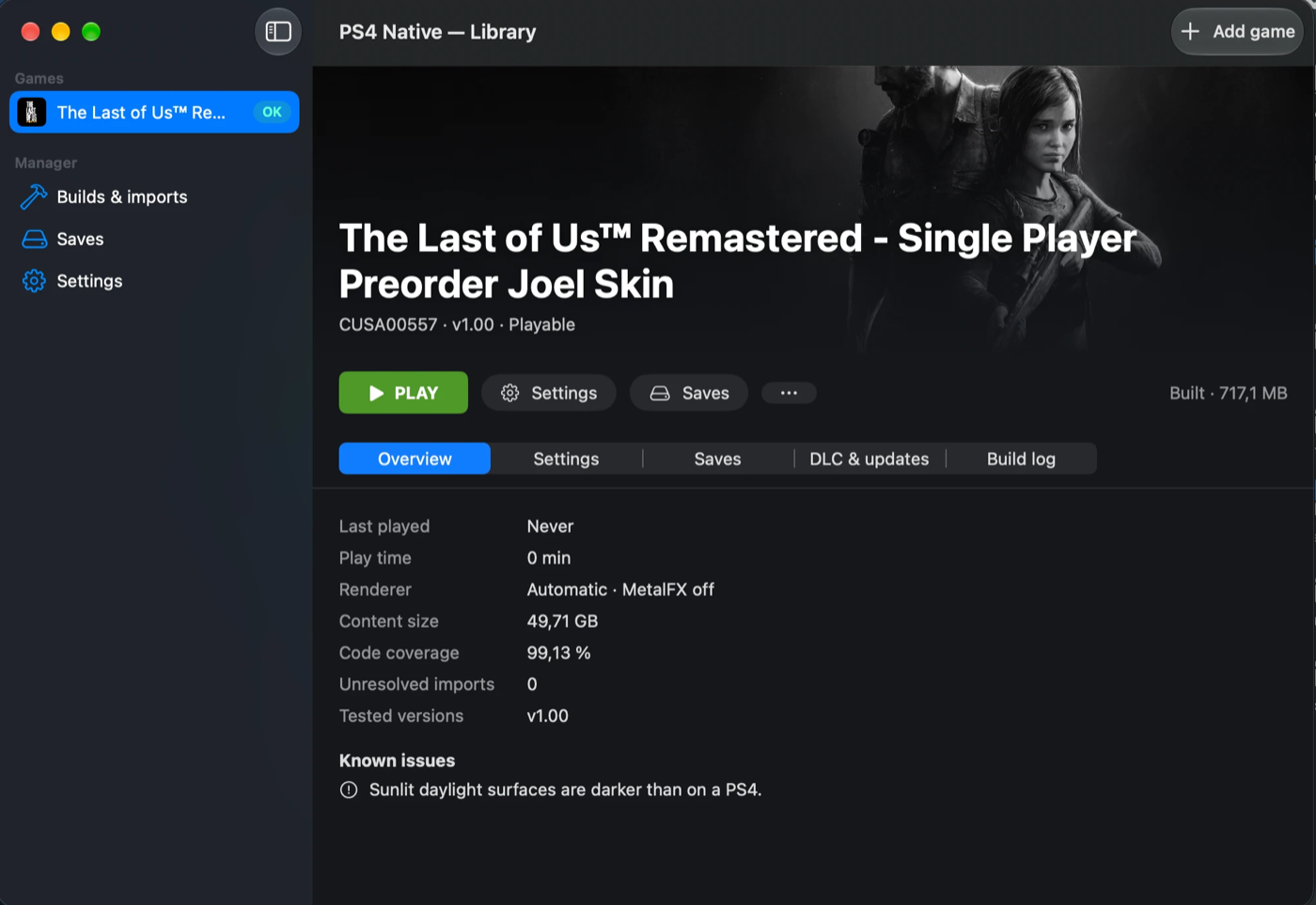
The Last of Us Remastered (CUSA00557) in PS4 Native, built and ready to play.
PS4 Native is a Steam-style library for your own PS4 games on a Mac. It is a native SwiftUI app
that drives the recompiler, so you no longer need the terminal:
- Add a game. Drop a fake-signed PKG or a dumped game folder onto the window, or use
Add game. - Import and analyse. The app imports the game, analyses
eboot.binand shows a support
badge. - Build. One button builds the native version in the background.
- Play. Press PLAY.
What the app does:
- Library and support badges. Each game shows a badge from the analysis and the built-in
compatibility database: OK (playable), WIP (in progress), VER (a version that was not tested),
EXP (experimental, not in the database) or ? (not analysed). A retail PKG, a broken PKG or a
folder withouteboot.binis refused at the add step. - Adding games. A fake-signed
.pkg, or a dumped folder (for exampleCUSA00557/with
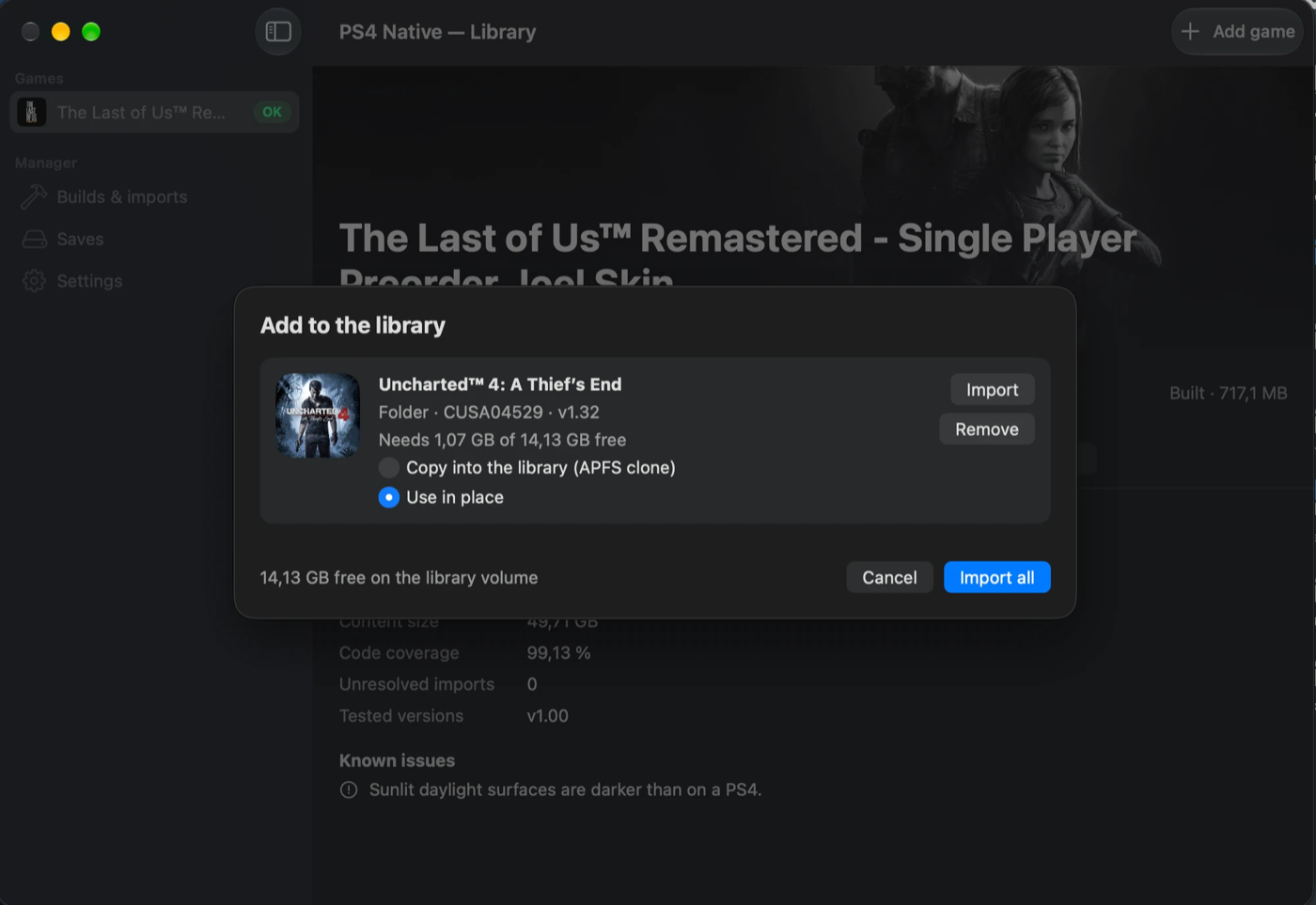
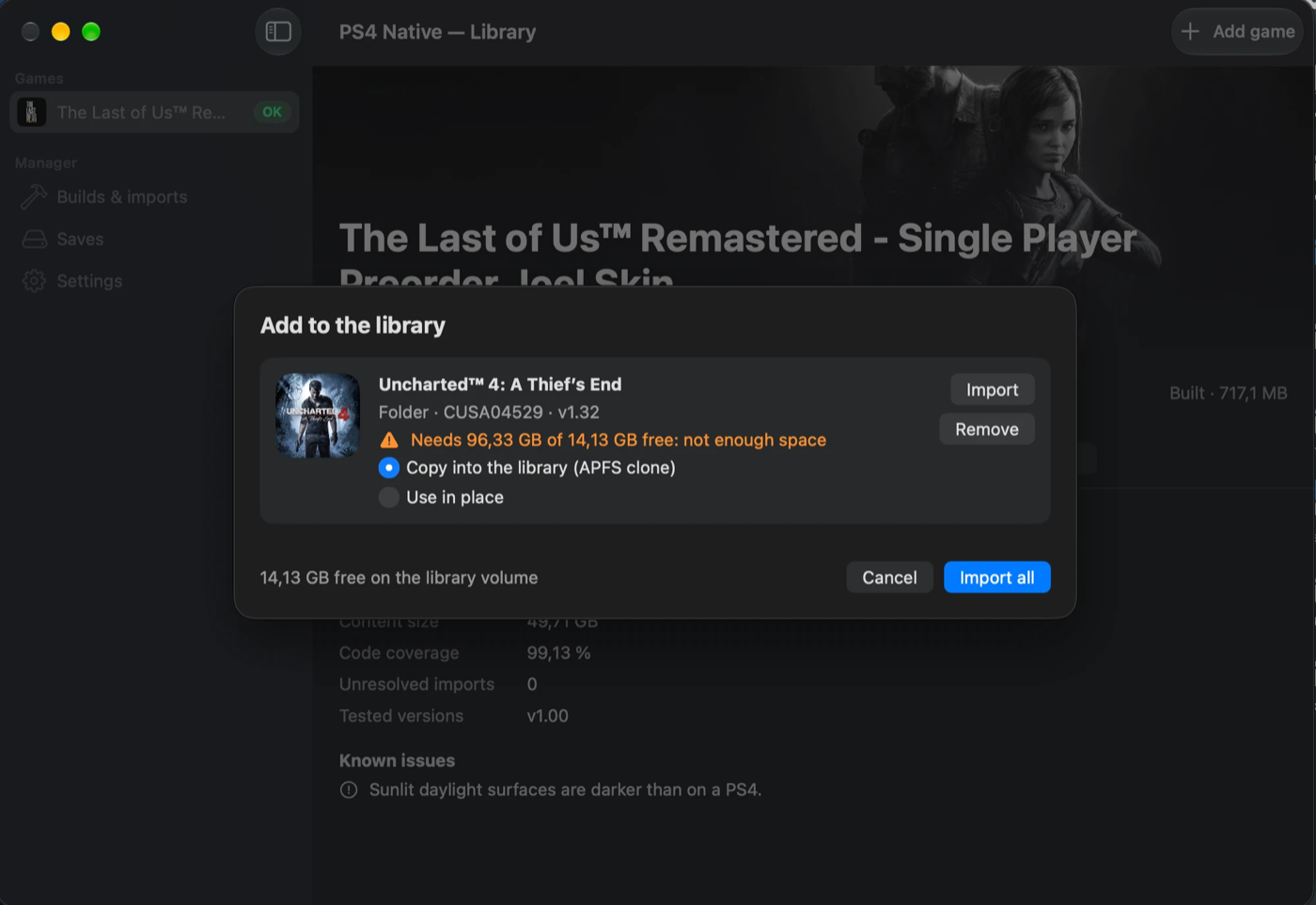
eboot.binandsce_sys/param.sfo). A folder can be copied into the library (an APFS clone on
the same volume) or used in place, where the library only holds a symlink and never writes to
the folder. The add sheet shows the space needed against the free space. Retail PKGs are refused:
the engine never tries to decrypt them. Update PKGs are laid over the game; DLC goes to
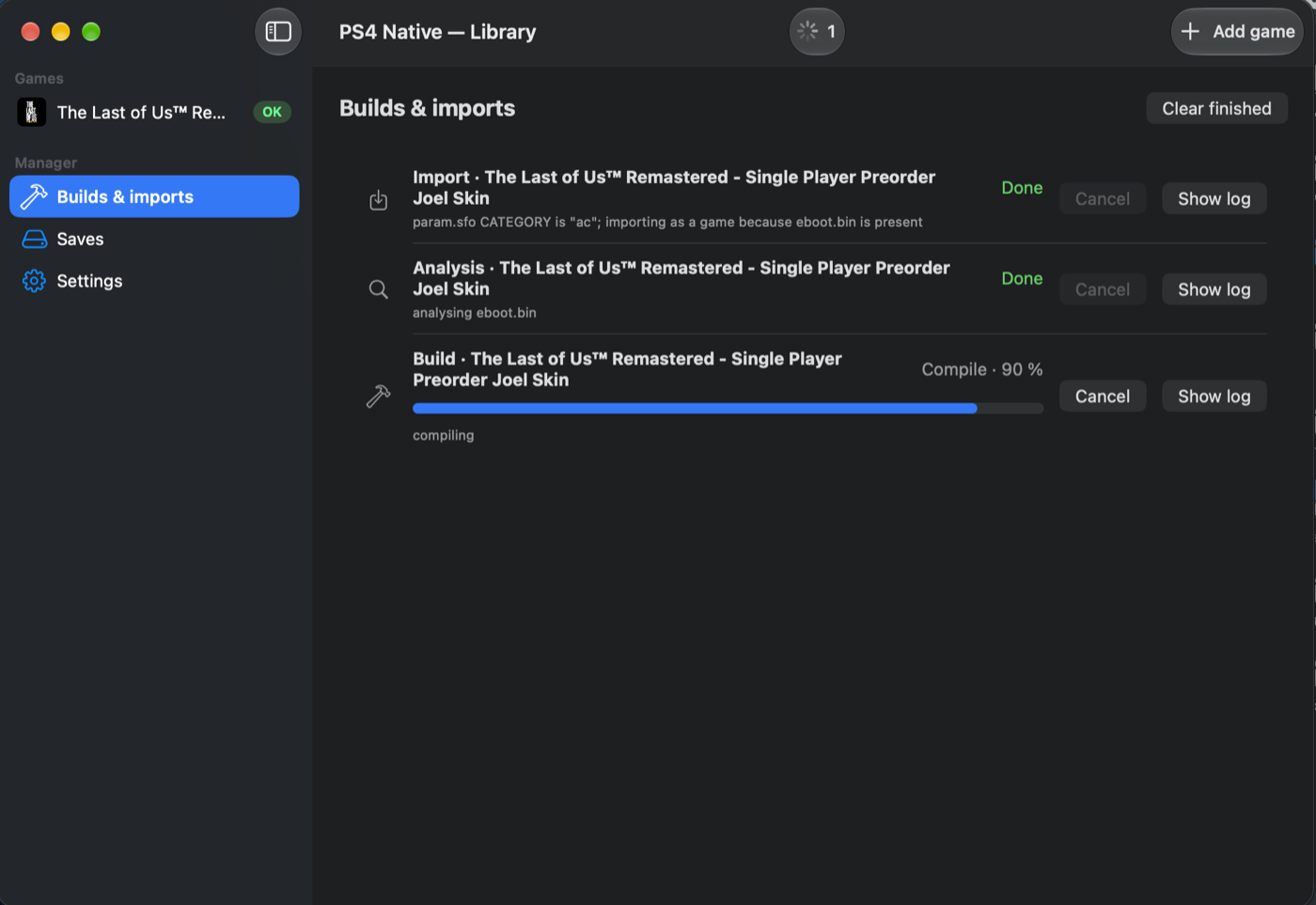
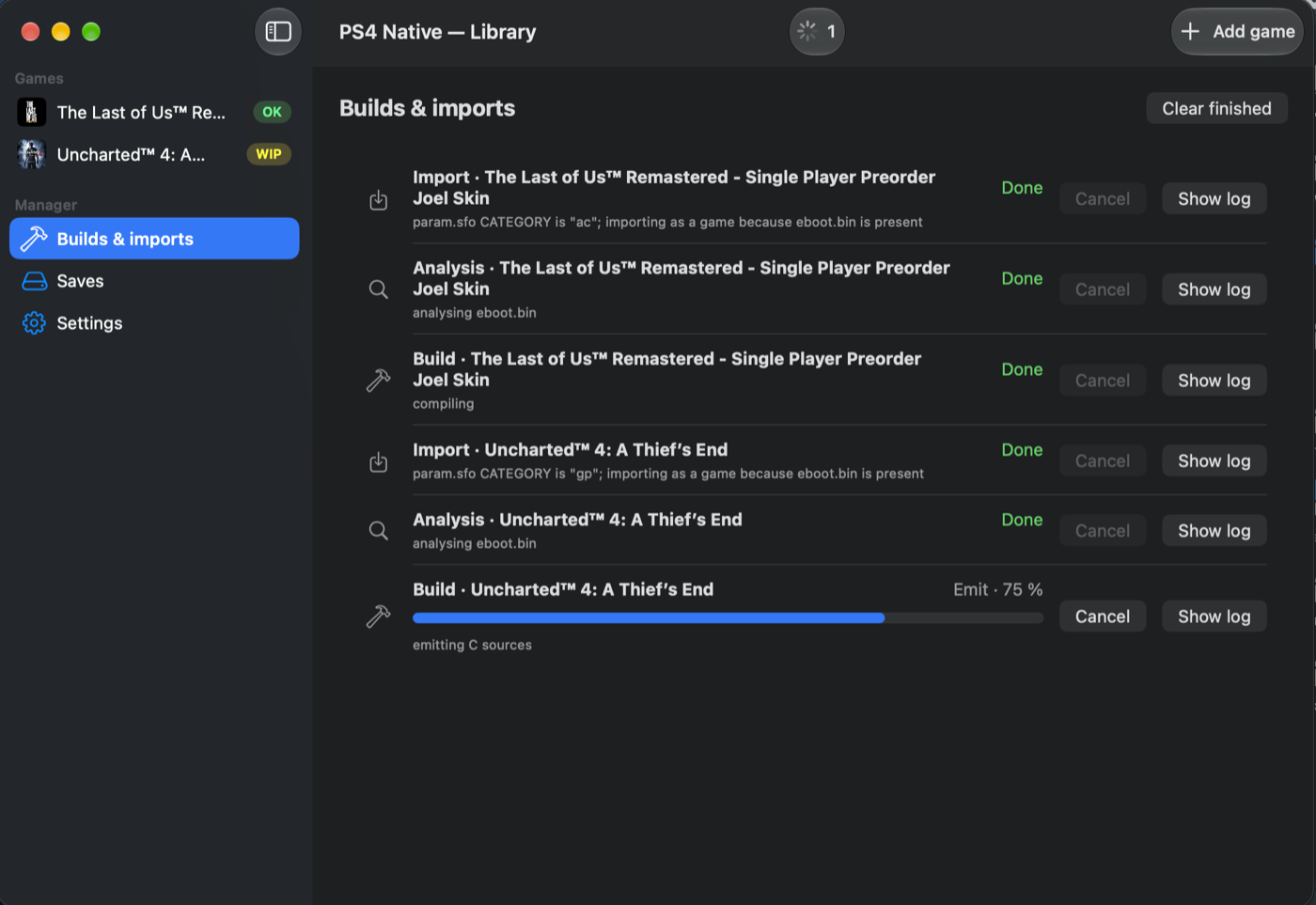
content/addcont/<entitlement>. - Builds & imports queue. Every import, analysis and build is a row with its stage, a progress
bar, Cancel and Show log. One build and one import can run at the same time. The game
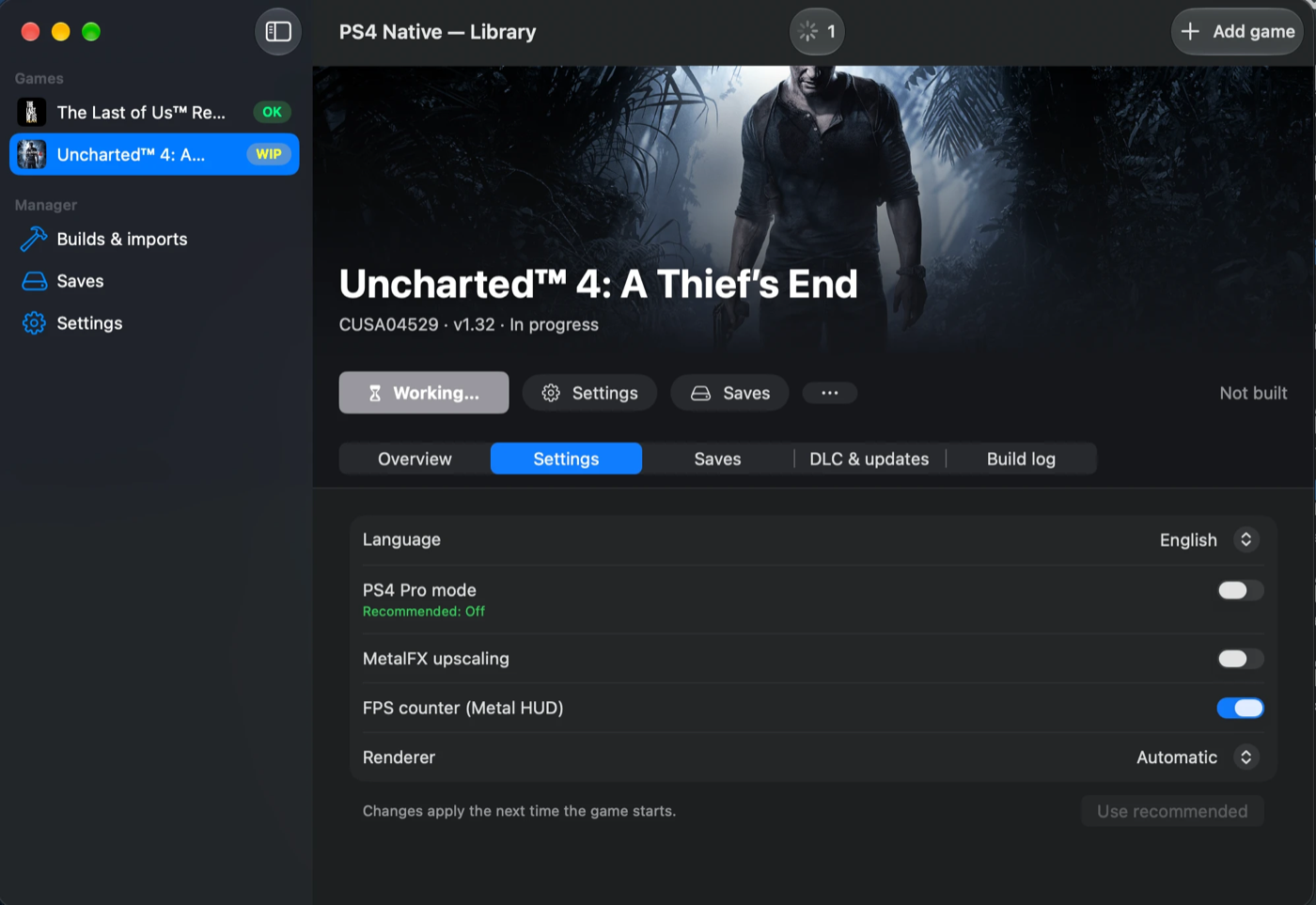
page offers a rebuild when the engine is newer than the one that built the game. - Game page with five tabs: Overview (last played, play time, renderer, size, code
coverage, unresolved imports, tested versions, known issues), Settings (language, PS4 Pro
mode, MetalFX upscaling, FPS counter, renderer Automatic / Metal 3 / Metal 4, with the
database's recommended values marked), Saves (backup, restore, import, export, delete a
slot; removed saves go to the Trash), DLC & updates and Build log. - Play and stop. PLAY starts the built
.app; Stop sends SIGTERM, then SIGKILL after 10 s.
Play time and Last played are recorded; after a crash the page offers the log. - Uninstall shows the space it frees and keeps the saves by default.
- First run checks the Command Line Tools (clang 17 or later, macOS 26 SDK) and the free space,
and offers to install the tools when they are missing.
 |
 |
 |
 |
The full description is in the README ("PS4 Native app") and in docs/game-manager-app.md.
Install
-
Download
PS4Native-0.4.0.dmg, open it and drag PS4 Native to Applications. -
The app and the games it builds are signed ad hoc, not notarized. Gatekeeper blocks the first
launch of a downloaded copy: allow it in System Settings → Privacy & Security → "Open Anyway".
Alternatively remove the quarantine flag:xattr -dr com.apple.quarantine "/Applications/PS4 Native.app" -
Install Apple's Command Line Tools if the first-run check asks for them
(xcode-select --install). They provide theclangthat compiles and links every game build;
they are not bundled.
The app bundles its engine (Contents/Resources/engine): ps4-recomp, the runtime sources, the
3rdparty static libraries, ninja and a static FreeType, with every licence text. Homebrew is not
needed.
Requirements
| Requirement | Notes |
|---|---|
| Apple Silicon Mac | Developed and measured on M1 Pro, 16 GB. Intel Macs are not supported. |
| macOS 26 or later | The app's minimum (Package.swift, Info.plist). Tested on macOS 27.0.1. |
| Command Line Tools | clang 17 or later and the macOS 26 SDK (xcode-select --install). |
| Library on APFS | The default library (~/Library/Application Support/PS4Native/) is on the internal disk. See "Known limits". |
Engine changes
- Engine commands with a JSON protocol.
ps4-recomp inspect,import,analyze-game,
versionandbuild. With--jsoneach writes one JSON event per line to stdout (progress,
warning,error,done), and the last event says whether the operation succeeded. The
contract, result schemas, error codes and library layout are indocs/game-manager-engine.md. - PKG and folder import. Fake-signed PKG and PFS extraction (also PFSC-compressed), ported
from shadPS4;param.sforeader; the game library with a lock, staged commits by rename,
resumable cancel and crash recovery; patches and DLC; retail PKGs are detected and refused. - Compatibility database (
pkg/compat/compat.json, built into the engine): The Last of Us
Remastered CUSA00557 v01.00 playable, Uncharted 4 CUSA04529 v01.32 in progress. Any other game
is experimental. - Per-game keys by TITLE_ID. The runtime keys settings (
settings/<TITLE_ID>.cfg), the save
directory ("<TITLE> [<TITLE_ID>]") and the shader cache by the TITLE_ID fromparam.sfo,
falling back to the game folder name. Bundles get the IDorg.ps4native.<TITLE_ID>. The settings
file also holdsmetal=3|4, used asPS4_GNM_METALwhen the environment has none, and keeps
lines it does not own. - Translator library check.
ps4-recomprefuses alibgcn_recompiler.athat was not built
from the gcn-recompiler sources next to it; rebuild it after any change there. - Engine kit.
tools/make_engine_kit.shassembles the self-contained engine the app ships,
and checks it with a build ofhello_world.elfwithout Homebrew inPATH.
Runtime, lifter and renderer work from the inFAMOUS Second Son bring-up is included as well, among
it: static TLS per module, SSE4A and VZEROUPPER/VZEROALL decoding, jump-table discovery fixes,
sceNetEpoll* over kqueue, direct memory sized from the process parameters, guest-memory sync
objects, thread FP state inheritance, Ajm/AudioOut/Videodec fixes and diagnostics
(PS4_AUDIO_LOG, PS4_AUDIO_DUMP, PS4_AJM_LOG, PS4_VIDEODEC_LOG, PS4_VIDEODEC_DUMP,
headless audio), flip-label waits, inline fetch shaders and vertex buffers at any stride, 1D and
cube textures, save-data dialog fixes, and pad motion sensors (gyro and accelerometer from a
connected DualShock 4 or DualSense; a virtual pad tilted with H and shaken with N). The
README's environment-variable table lists the new switches.
Game status
Unchanged from v0.3.0 for The Last of Us Remastered (playable) and Uncharted 4 (in progress); the
measured numbers are in the README ("Supported games on Mac").
inFAMOUS Second Son: bring-up is in progress. It is not in the compatibility database, so the
app treats it as experimental (EXP). This release makes no claim about how far it runs.
Known limits
- APFS only for the library. On exFAT or FAT, macOS writes
._*AppleDouble files and the
signing ofeboot.appfails, so every build fails after the compile. A folder used in place may
stay on any volume; only the library'sbuild/must be on APFS. - DLC and updates need a copied game. DLC can be installed only into a game copied into the
library; games added in place (by reference) refuse DLC — fixed in the next release. Updates are
likewise applied only to a copied game. - Disk use. A copy costs the game's unpacked size unless it is an APFS clone on the same
volume; the add sheet always counts the full size. - Not notarized. See "Install".
- Shortcuts. A game started from its
/Applicationsshortcut or the Dock uses its settings, but
its play time is not recorded. - The known issues of v0.3.0 are unchanged (TLOU daylight, HTILE on Pro depth arrays, Metal 4
slower than Metal 3, Uncharted 4 rendering gaps, x87 precision and the others). The README lists
them all.
Assets
| File | What it is |
|---|---|
PS4Native-0.4.0.dmg |
The PS4 Native app with its bundled engine (arm64, ad-hoc signed, not notarized) and a link to /Applications |
SHA-256 of PS4Native-0.4.0.dmg:
0f26dcc41843ae4ff6702ba9b0d1389acc7951b9ae16d7a5bf01172364aa9f74
Building from source
The full source of this release is the tag v0.4.0:
git clone --recursive --branch v0.4.0 https://github.com/manjarqo/ps4-native-mac.gitBuild the engine as the README's quick start says, then the app:
swift build --package-path app/PS4Native
PS4NATIVE_ENGINE=/path/to/repo-root swift run --package-path app/PS4Native
app/PS4Native/scripts/package.sh builds the engine kit and packages PS4 Native.app and the
.dmg.
How this release was checked
On the release commit's tree, on an M1 Pro with macOS 27.0.1:
-
go build ./...,go vet ./...andgo test ./pkg/...are clean;gofmtreports nothing. -
swift buildandswift testofapp/PS4Native: 116 tests in 11 suites pass (with
ps4-recompbuilt in the repository root, which three of them run for real). -
Host test suite (
tests/host/run_host_tests.sh): PASS, with 38 cases skipped without the
local game fixtures (game data, not distributed). The Python tool tests pass (112). -
The packaged app passed its smoke run (
app/PS4Native/scripts/smoke.sh: a fake engine and a stand-in game drive import, build, play and stop through the real app), and the.dmgverifies. -
The Last of Us Remastered was imported in place and built through the app.