Repository navigation
Particle Particle Diagrams
A four-point function is drawn with its external points at the corners of a rectangle, counterclockwise from the top
left in the order of the labels given to DiagramPlot. For the fermion vertex Γ⁰(x₁, x₂; x₃, x₄) the fermions leave
at x₁, x₃ and enter at x₂, x₄, so the default order puts an incoming and an outgoing leg on each side. That suits the
particle–hole channels. A particle–particle diagram carries two particles from x₂ and x₄ to x₁ and x₃: in the default
order they enter on opposite sides and run in opposite directions, so the interaction lines between them cross. The
package keeps the corners in the order given, in every diagram, boson or fermion; the option "ExternalOrder" changes
the order, and its value "Uncrossed" exchanges the legs of one side of each diagram where its lines would cross.
The irreducible vertex of the electron gas to second order, Γ⁰ = δ²Φ/δG(x₄, x₃)δG(x₂, x₁), and its diagrams by channel:
Needs["FunctionalDiagrams`"]
DeclareGrassmannSource[eta, etabar];
DeclareField[psi, etabar]; DeclareField[psibar, eta, -1];
Z0 = Exp[-IntegralOver[G0[x, y] etabar[x] ** eta[y], {x, y}]];
DeclareSymmetric[V]; DeclareInteractionLine[V]; DeclareDirectedPropagator[G0, G];
interaction =
  1/2 IntegralOver[V[x, y] psibar[x] ** psibar[y] ** psi[y] ** psi[x], {x, y}];
Phi = LuttingerWardFunctional[Z0, interaction, 2, G0 -> G];
gamma0 = FunctionalDerivative[Phi, G[x4, x3], G[x2, x1]];
channels = ParquetDecomposition[gamma0, {x1, x2, x3, x4}, {G}];
Length[DiagramTerms[#]] & /@ channels
<|FullyIrreducible -> 2, ParticleHole -> 0, TransverseParticleHole -> 4, ParticleParticle -> 2, SeveralChannels -> 0|>
Γ⁰ is irreducible in the particle–hole channel, as it should be; "SeveralChannels" would collect the diagrams reducible
in more than one channel, which the parquet theorem excludes. The two particle–particle diagrams, in the default order:
DiagramPlot[channels["ParticleParticle"], {x1, x2, x3, x4}]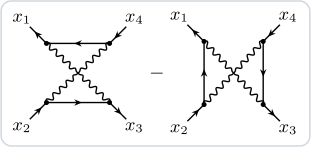
With the incoming legs on the left, "ExternalOrder" -> {"Uncrossed", {x4, x2, x3, x1}}, the two particles propagate
from left to right and the diagrams are ladders: the corners are taken in the order x₄, x₂, x₃, x₁, and when the particle
entering at x₂ leaves at x₁ the legs x₁ and x₃ are exchanged, so that the two lines stay parallel:
DiagramPlot[channels["ParticleParticle"], {x1, x2, x3, x4},
  "ExternalOrder" -> {"Uncrossed", {x4, x2, x3, x1}}]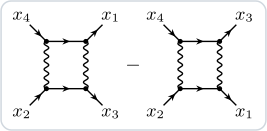
The two pictures are the same diagrams: only the corners differ. The labels keep their meaning, so the weights do not
change. With "ExternalOrder" -> {x4, x2, x3, x1} alone the order is kept in every diagram, and in the second one the
legs x₁ and x₃ cross as an X; "ExternalOrder" -> "Uncrossed" alone starts from x₁, x₂, x₃, x₄ and draws one ladder
upright.
The channels of a real boson are s (a b | c d), t (a c | b d) and u (a d | b c), with a, b, c, d at the corners in this order: the diagrams of t join opposite corners. The four-point vertex of φ⁴ theory to second order, the fourth derivative of the 1PI effective action Γ[φ̄] at φ̄ = 0 (here computed with bare lines, see Conventions):
DeclareSource[J]; DeclareField[phi, J]; DeclareSymmetric[D0]; DeclareCoupling[lambda];
Zb = Exp[1/2 IntegralOver[J[x] D0[x, y] J[y], {x, y}]];
phi4 = lambda/24 IntegralOver[phi[z]^4, {z}];
gamma1PI = EffectiveAction1PI[Zb, phi4, 2, phi -> phiMean, D0 -> D0];
gamma4 = SetSourcesToZero[FunctionalDerivative[gamma1PI,
    phiMean[a], phiMean[b], phiMean[c], phiMean[d]]];
DiagramPlot[gamma4, {a, b, c, d}]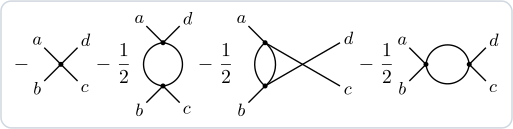
The point vertex, and one bubble in each of the channels u, t and s; Γ⁽⁴⁾ is minus the amputated 1PI four-point
function, hence the weights −1 and −½. The bubble of t keeps the corners in the order given, and its legs c and d
cross as an X just outside it. With "Uncrossed" these two legs are exchanged, the labels moving with them:
DiagramPlot[gamma4, {a, b, c, d}, "ExternalOrder" -> "Uncrossed"]
-
"ExternalOrder"takes any order of the external labels, also for other functions (a three-point vertex, a correlation function with its points at the corners);"Uncrossed"acts on the diagrams with four external points. -
BetheSalpeterLadder[L, R, {x1, x2, x3, x4}, "ParticleParticle", G]joins two vertices by the pair of propagators of the channel, −½ L(x₁, 5; x₃, 6) G(5, 7) G(6, 8) R(7, x₂; 8, x₄): the ladders of the T-matrix. - The kernel irreducible in the particle–particle channel is a derivative with respect to the anomalous propagators:
IrreducibleVertex[..., "Channel" -> "ParticleParticle"]gives the messageppkernel. It is the channel t of the superfield (ψ, ψ̄), projected withSuperfieldComponents(manual: Superfields). - Conventions lists the channels; the showcase draws Γ⁰, F and the parquet decomposition to third order.