Repository navigation
Releases
Jev-Interaction 0.3.0

🏆 Build of the Week at TypeSafe · 🤗 Live demo: Hugging Face Space
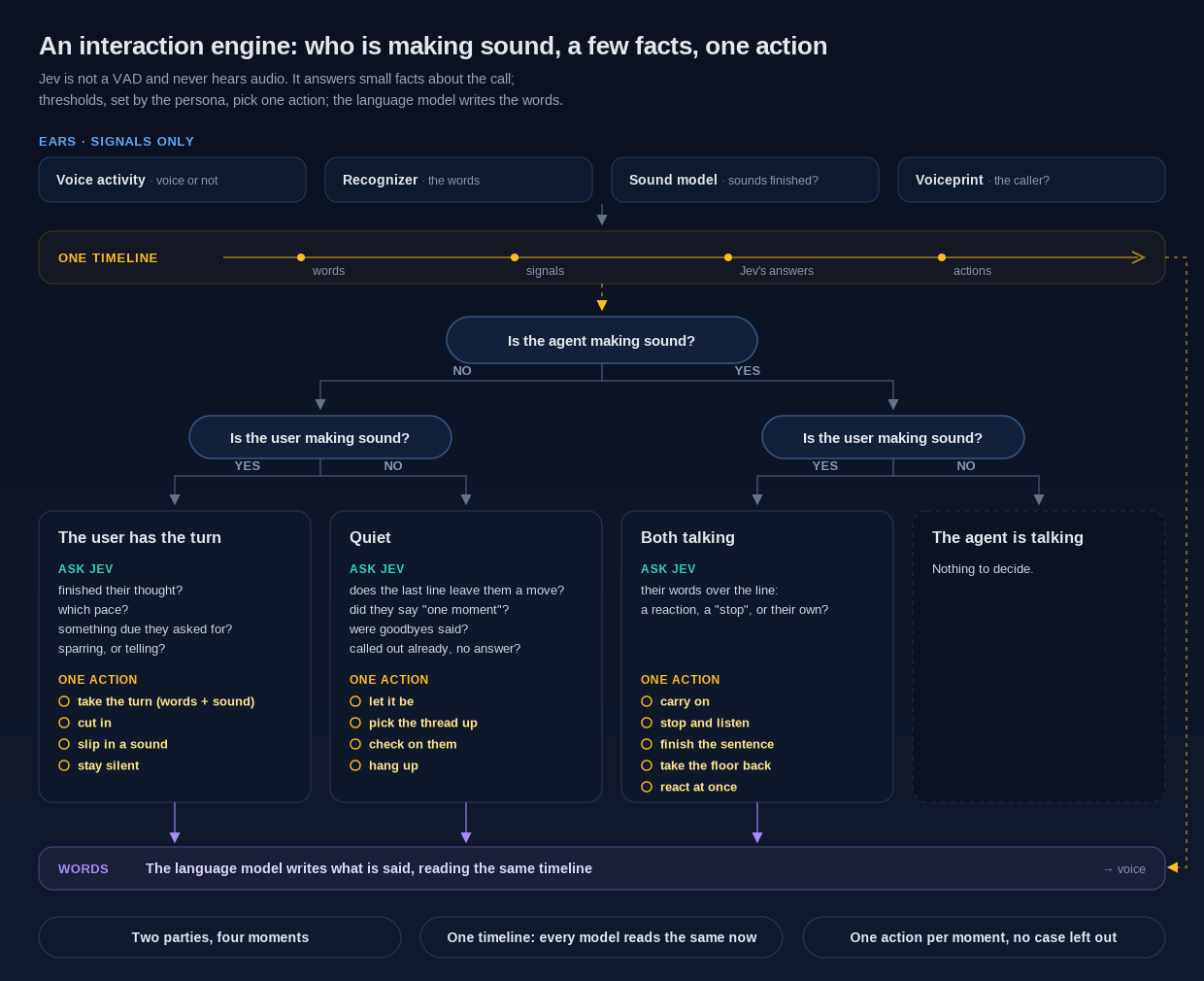
Highlights: a new call policy built on three principles: two parties and four moments, one timeline that every model
reads, one action per moment with no case left out. Jev is asked small facts and nothing is drawn: thresholds, in one
place. The sound of the voice has a say in "have they finished" (SmartTurn v3.2, both must agree), the voiceprint can
start from 20 seconds read before the call and is deleted at hang-up, and both take models of your own. A judge for
mainland China with a ready-made setup. The voice's key is TTS_API_KEY.
Breaking: every default policy is a threshold (SamplePolicy is still there to choose); JEV_PROVIDER=bailian takes
the turn at p(finished) 0.725; the turn, quiet and cut-in requests carry different questions (older logs replay with
judge.questions.turn, quiet and cut_in). ELEVENLABS_API_KEY / ELEVENLABS_VOICE_ID still work.
-
The policy, drawn and written down.
docs/policy.svg(anddocs/policy.zh-CN.svg, drawn by
tools/draw_policy.py): the ears give signals only, everything goes on one timeline, who is making sound picks one of
four moments, Jev answers small facts, one action follows, the language model writes the words. The README's policy
section says the three principles and what follows from them. -
The sound of the voice has a say in "have they finished" (
pip install "jev-interaction[sound]", on in the
Docker image). At each frame of a pause SmartTurn v3.2 (BSD-2, about 8 MB, CPU) reads the last 8 s of audio. With
Config.sound_rule = "and"(the default) the turn is taken only when the words (words_min, 0.8) and the sound
(sound_min: zh 0.8, en 0.4) both say finished; words judged finished that the sound keeps calling unfinished are
answered aftersound_wait_ms(2 s). Every reading and every turn it held back is in the call log. On eot-bench
v1.0 (revisionca9d98a) at 2% false cutoffs: Chinese 1050 ms (Jev alone 1119, VoxTurn 1078, closed LiveKit v1
1006), English 1248 ms (Jev alone 1552, VoxTurn 1000); at a 300 ms budget it cuts off more than the trained audio
models (README, "End of turn"). The lines were set on the same splits. -
The sound model and the voiceprint take models of your own. Two optional registry nodes,
sound(SoundModel:
ready,warm,score) andvoiceprint(Embedder), picked withJEV_SOUND/JEV_VOICEPRINT(offturns
either off); SmartTurn and ECAPA are the built-in ones and/api/healthnames the one in use
(docs/adapters.md). -
The voiceprint can start before the call. When the server has a voiceprint, the page asks for two short lines
read aloud three times (15 to 30 s), sends them withstart(voice, base64 PCM16), and says on screen that the
sample is used for this call only and deleted when the call ends. Only the embeddings are kept, in memory; they are
cleared inSession.close, and the page says so again after hang-up (voiceprintevent:enrolled/skipped). -
A line cut off is recorded as what was heard and what was not. The page reports what it showed of a line
(audio tags taken out, never ahead of the voice: a streamed line's duration is first only the part loaded), and the
record keeps that as the agent's words; the rest goes to the responder as a note it never said
(Turn.unheard), so it can bring it up again if it matters. -
The voice's key is
TTS_API_KEY(and the voice idTTS_VOICE_ID), on the settings page, in.env.exampleand
the docs.ELEVENLABS_API_KEY/ELEVENLABS_VOICE_IDare read into them when they are unset, so existing
deployments and their secrets keep working. -
A ready-made setup for mainland China.
deploy/mainland-china.env: one Bailian key for the judge, Qwen,
Paraformer and CosyVoice, the two values to fill in marked, each number in it with where it was measured
(cookbook/stacks.md). -
Do two personas take turns differently, and only where they should?
tools/persona_bench.pyasks the written
moments once per persona and compares what each would do. Two personas from our product (a dominant and a
submissive one, each with its own thresholds and timing) act alike in everyday moments and differently in 6 of 16
moments of a scene of control, each the way round one would expect. -
Bailian takes the turn at a line of its own, not by a draw. On a sentence cut off mid-thought Bailian's
decision-model-previewsays about 0.35 where Jev says about 0.1, so a draw against it spoke into one unfinished
sentence in three. A stretch before the draw was tried (0.6 → 0, 0.85 → 1); with nothing drawn by default, all that
matters is where the line is, so the stretch is gone and Bailian's line is a threshold inConfig.finished_min
(0.725: where the stretched number crossed one half). One place for every line, the same pause goes the same way,
and a judge with numbers nearer the middle is handled by moving its line, not by reshaping its numbers.
tools/judge_bench.pyprints "at the line" and takes--held-out(80 other pauses in
tools/judge_cases_heldout.py) and--bare(no closing punctuation). -
The pace, cutting in and "something is due" are asked as facts too. The pace was one question with every pace
as a choice, and Jev kept the pace a call was in: it missed most calls for a story and most games (81% right on the
written moments, 71% on those kept apart). It is now one yes/no fact for each pace but the starting one, worded from
the pace's own description, so a pace you add is asked the same way (judge.questions.pace_facts): 100% on both
sets, and on 18 moments of staying in a pace and leaving it. The narrate pace's description says what it is not ("a
question that a sentence or two answers"). Cutting in was "does the agent cut in now?"; Jev ranked the moments right
but sat under one half on most of them (69%). It is now a fact about the user's words, sparring or telling
(judge.questions.sparring): 94% and 100%. "Something is due" while listening is asked as the small facts that were
Bailian's alone (a task set earlier, come up just now): listening 96% / 92% → 100% / 100%. The turn request's state
is always an object now: the text undercall, and the user's words in fields the facts point at. It carries 8
questions where it carried 3; on Jev the request takes as long as before (486 ms → 482 ms from our network).
judge.questions.turnandcut_instay for replaying older logs. -
One answer from Jev, one thing done; and nothing is drawn by default. While the user has the turn, taking it,
cutting in and letting a sound slip in were three decisions, each made on its own: a sound could go out and the
reply follow it a tick later. They are one choice now (decisions/turn.py): judged finished, the agent takes the
turn when their voice stops and puts nothing in before that; otherwise it may cut in, in a pace that does (the
cut-in question rides in the turn request on new words instead of being a request of its own); otherwise it may put
a sound in; otherwise it stays silent. The choice is in the call's record (decision,what: turn). Every default
policy is a threshold (0.5):end_of_turn,listenandcut_inwere draws. A draw against p(finished) spoke
into one unfinished sentence in ten when Jev said 0.1, and made a recorded call impossible to work through again.
What varies now is when a thing may happen, not whether a sure thing is done: the quiet marks were already
jittered, and the gap between two listening sounds is too (Config.listen_gap_jitter, 0.3).SamplePolicyis
still there for whoever wants a draw; the shipped personas no longer use it. Measured on Jev before and after
(tools/judge_bench.py, the cut-in question now sent the way the engine sends it): end of turn 97% → 96%,
listening 96% / 92% → 100% / 96%, cutting in 69% → 69%, the rest unchanged. -
A quiet is asked as facts, and what to do follows from them and the clock. The quiet question ("would the
agent, being who they are, say something now?") is no longer sent. Jev is asked four small things about the record,
each with its options in both orders: whose move the agent's last line leaves, whether the user said they need a
moment, whether goodbyes were said, whether the agent has been calling out with no answer. How long it has been is
the engine's clock, not a question. Its own move: the agent picks the thread up after the pace's newlead_after_s
(normal 6 s, patient 15, narrate and eager 2.5). The user's move: it lets the quiet be and checks on them after
check_min_quiet_s. An ended call: it hangs up once that is open, and checks first when nothing has been said into
the quiet yet. On the written moments oftools/judge_bench.py --decisions, Jev was right on 33% as one question
(it answered "let it be" to nearly everything) and is right on 100% as facts, tuning set and held-out set alike. The
quietpolicy is a threshold by default, so the same quiet goes the same way and only the marks are jittered; the
shipped personas no longer draw it. One set of questions serves every judge here:judge_providerno longer
changes how a quiet is asked.judge.questions.quietstays for replaying older logs. -
The call's record is one timeline, and every question reads the same "now".
Ledgerkeeps the call on one
clock (seconds into the call): each turn has when it began and ended (Turn.at,Turn.end), the user's turns have
where their voice stopped and came back (Turn.pauses,Config.pause_mark_ms), and what the engine judged and did
between the words is in it too (Ledger.notes: every answer from Jev with its pro...
Jev-Interaction 0.2.0
🏆 Build of the Week at TypeSafe · 🤗 Live demo: Hugging Face Space
Highlights: a cookbook (stacks, parameters, role policies); listening as one Jev question, so the agent can say an
item back or count what you asked it to; no clock pauses the agent's line; mid-call hand-over to another persona;
Scribe v3 Live; a waiting line for public demos. Features marked experimental may change before 1.0.
Breaking: the hold / unhold events and the page's paused state are gone; listen events carry kind due or
fits instead of five kinds of sound; Config(hold_after_ms=...) and hold_release_ms are accepted with a warning.
-
Cookbook (
cookbook/): recipes from the voice-call engine in our product. Stacks (the setups we recommend for
each node, and why), parameters (presets, paces, everyConfigfield, and what to change for what you hear) and role
policies (writing the manner Jev reads, choosing policies, listening with content, handing over). Example profiles: a
hotel front desk and concierge that hand over to each other, a bakery order line that says each item back. Tests keep
the cookbook in step with the code. -
The preset
productionis nowrecommended(the old name still works). Provider choices are recommendations only:
.env.exampleno longer fills in any provider's model; the setups we recommend are at its bottom, on the setup page
and incookbook/stacks.md. -
Config(hold_after_ms=...)is still accepted as the old name ofoverlap_ask_ms, with a deprecation warning. -
Fixed:
turn_reask_msmarks that are not multiples of a frame (e.g. 500) never fired; aConfig(policies=...)
written without the newerwhodecision broke turn-taking when the persona had acast; after "finish the
sentence" the next early floor question needed three times the voice; the speech prompts were missing from the
wheel.Config(hold_release_ms=...)is accepted (and ignored) with a warning. -
Lyra and Kai no longer say their lab builds Jev (Jev is TypeSafe's); the lab is behind Jev-Interaction.
-
Known, experimental: a hand-over switches persona when the goodbye is written, not when it has played, so talking
over the goodbye does not keep the first persona; byte-range audio requests can synthesize a line twice. -
The benchmark numbers in the README were measured on the 0.1 behaviour (the line paused after 400 ms of voice, five
kinds of listening sound); the experimental changes below have not been re-measured yet. -
Someone else can be put on the line mid-call (experimental). A persona lists who the caller may ask for (
cast: [vera]); the questionwhothen rides in the turn request, and when Jev is sure the caller is asking for one of
them, the agent on the line says so in a few words and the other comes on: their prompt, manner, policies and voice
(personaevent;Session.hand_over,Session(cast=...)). The call stays one record that says who said what: the
new agent reads the other's lines as things heard, "(Lyra: ...)", never as its own turns. Naming someone is not
asking for them. Lyra and Kai list each other. -
Listening, one question (experimental). Everything the agent puts in while the user has the floor is one thing,
a bare "mm" as much as a count the user asked for ("say a number every time I mention the cat") or an item of a list
said back. Jev is asked only about the moment:due(the user is waiting for it and would miss it),fits(a spot
for a sound that could as well be left out),quiet,answer_due. What is said is the responder's, from the call's
record; its event line says which moment Jev saw and quotes nothing.dueis made when Jev islisten_due_minsure
(0.5),fitsis drawn by the listen policy and keepslisten_gap_s; nothing put in comes closer than
listen_min_gap_sto the last, or runs longer thanlisten_max_words. All of it goes into the record where it came,
as the agent's own turn between the user's words, and Jev reads it there. Gone: the five kinds of listening sound and
their per-kind lengths, the fixed 50 % inviting "mm?", the separate question for a silence after unfinished words. -
The turn in progress is part of the call's record (
Ledger.open), read by every decision and by the responder. -
A silence after words Jev never judged finished stays the user's: the turn question is asked again as the quiet grows
(turn_reask_ms), with the listen question beside it, so a sound may slip in while the turn is not taken. Only
turn_last_mspast the pace's longest wait does the agent speak anyway, and its line is told so (trailed). -
No clock pauses the agent's line (experimental). 400 ms of the user's voice over a line used to pause it (
hold)
before a word was recognized or Jev was asked, then resume it or stop it; an "mm-hm" froze the line for a second.
Now the line plays on, and that much voice over it (overlap_ask_ms, washold_after_ms) is when the floor question
is asked on the words so far, closed or not, and again each time as much voice has passed. Asked early, only "the
user needs the floor" does anything: the line stops. A sound without words asks nothing. Recognizers may send the
words so far of an unclosed piece (Segment(final=False); Scribe and Paraformer do). Thehold/unholdevents,
hold_release_msand the page's paused state are gone. -
Words said over a line that ended before Jev judged them are asked about as the quiet grows, like any pause, rather
than answered by the clock. -
The companion on the page is now Lyra Vex (
lyra,lyra_zh): an AI colleague at Native Bond Lab with things she
cares about, the same four paces and every decision open. Kai and 江屿 stay
in the package, unlisted. -
A reply that fails (the provider refuses, times out, drops the stream) or comes back with nothing a voice can say
is asked for once more, so the user is not met with silence; a second miss is reported to the page
(error,what: "responder") and the call goes on. -
The floor question no longer talks on when Jev is sure the line should stop but split on how ("yield" 0.43,
"overrule" 0.48: neither reached its own threshold, so the agent finished a long line over "let me finish!"). When
the ways of stopping together outweigh going on and reach the pace's yield threshold, the likeliest one is taken. -
After an interruption the record keeps everything the user heard of the reply, not only the line that was playing
(a story cut in its fourth line used to lose the first three, so "how old were you again?" had nothing to go on).
heardnow carries the reply'sgenand all of it that played; an empty text means none of it did. A client that
sends nogenworks as before. -
Listening sounds are measured in characters where words have no spaces (a whole Chinese sentence used to count as
one word and was voiced as a listening sound). -
A line that is only an audio tag ("[laughs]") is no longer sent: the voice cannot speak it, and it used to show as
said while nothing was heard. The speech prompt now says a tag makes no sound alone, so the model writes the sound
itself ("[laughs] ha"). -
The server log says how each call started and ended (time limit, a failed start, the page closing it), and the page
reports the failures that never reach the call route (a refused microphone, a socket that never opened or dropped).
No words of the call are logged. The API browser (/docs,/openapi.json) is off. -
ElevenLabs recognition defaults to Scribe v3 Live (
scribe_v3_live): same socket and settings, the first words
arrive much sooner. SetELEVENLABS_ASR_MODEL=scribe_v2_realtimeto stay on v2. -
A waiting line for a public demo: when every line is taken a caller is held in line, first come first, instead of
being turned away (MAX_WAITING_CALLS, default 20). The page shows their place and at most how long, and the call
starts by itself when a line frees up (protocol:queue,ready). The Space's suggested limits are now 4 calls
at once, 5 minutes a call, 300 minutes a day. -
The page shows one reply as one caption, however many lines it was written in, and fetches the next line while the
one before it plays; the words appear as the voice reaches them, and a long
reply rolls upward, its older lines fading out behind the top edge. -
Words said over a line that carries on go into the call's record at once, for the responder and for Jev.
-
The page lists four personas per language: the companion (now Lyra / 小张) and three working ones (support, tutor,
interviewer;tutor_zhandinterviewer_zhare new). Vera, Mara, 阿乐 and 小言 stay in the package, unlisted. -
The ear our product runs on: TEN VAD (
adapters.best_vad(), the energy detector whenten-vadis not installed),
the bar raised while the agent's own line plays, voice counted only after 400 ms of it, and the agent's own words
coming back through the microphone are dropped. A loud room no longer reads as the user talking without end. -
The page: the orb in the middle is the call button (click to call, click to hang up) and beats with whoever is
speaking; personas follow the page language; the simulated call is gone. -
Personas
kaiandkai_zh: one character moving through all four paces with every decision open. -
Vendor-neutral setup. No recognition or voice provider is chosen for you; the language model needs an endpoint and a
model you pick. The setup we recommend is one you can copy from, not the default. A pasted key is
recognised by its shape; the endpoint's own model list is offered..env.china.exampleis folded into.env.example
as a commented reference. -
The language model is told how to write for the chosen voice (
prompts/speech/: audio tags for ElevenLabs v3/v4,
plain words otherwise); synthesizer plugins can register their own style. -
Personas are grouped into ...
Jev-Interaction 0.1.0
Jev-Interaction: System-One-controlled full-duplex voice interaction. Turn-taking written as plain-language
decisions that Jev answers in tens of milliseconds, on a cascade of any recognizer, any language model and any voice.
What is in it
- Five decisions on every call:
turn(finished? how long to wait? a reply or a sound? which pace),listen(a
listening sound or none),floor(both talking: carry on, yield, finish the sentence, take the floor back, react),
cut_inandquiet(go on, check in, wait, hang up). - Four paces (normal, listening, narrating, eager) that Jev routes between turn by turn, with their timing blended by
probability. - Policies per decision: sample, threshold, argmax.
- Task profiles as YAML: companion, support, tutor and interviewer included; the persona's manner is read by Jev, so it
changes how the agent takes turns, not only what it says. - Tested knobs as
Configoptions, off by default:hold_after_ms,listen_max_words,not_for_me,far_db. - Adapters behind small protocols: energy VAD, ElevenLabs Scribe realtime, any OpenAI-compatible language model,
ElevenLabs synthesis. - A WebSocket call server and a minimal browser client; a recorder that logs every decision with the state Jev read;
tools/replay.pyto re-ask recorded decisions with a reworded question.
Measured
On the production engine this framework was extracted from, zero-shot, across Full-Duplex-Bench v1.0 / v1.5, LiveKit
eot-bench and TurnBench (16 metrics): first on 3, top three on 8 with the tested knobs. Leads on real-conversation
pauses, relevance after an interruption, talking through an "mm-hm" and letting background speech pass; trails on
pure audio timing and on speed after an interruption. Details and the reason behind each number are in the README.
Known limits
- The browser client and the energy VAD are minimal.
- Benchmark harnesses are not in this repository yet.
- Jev is a hosted API (
JEV_API_KEY).