Repository navigation

🏆 Build of the Week at TypeSafe · 🤗 Live demo: Hugging Face Space
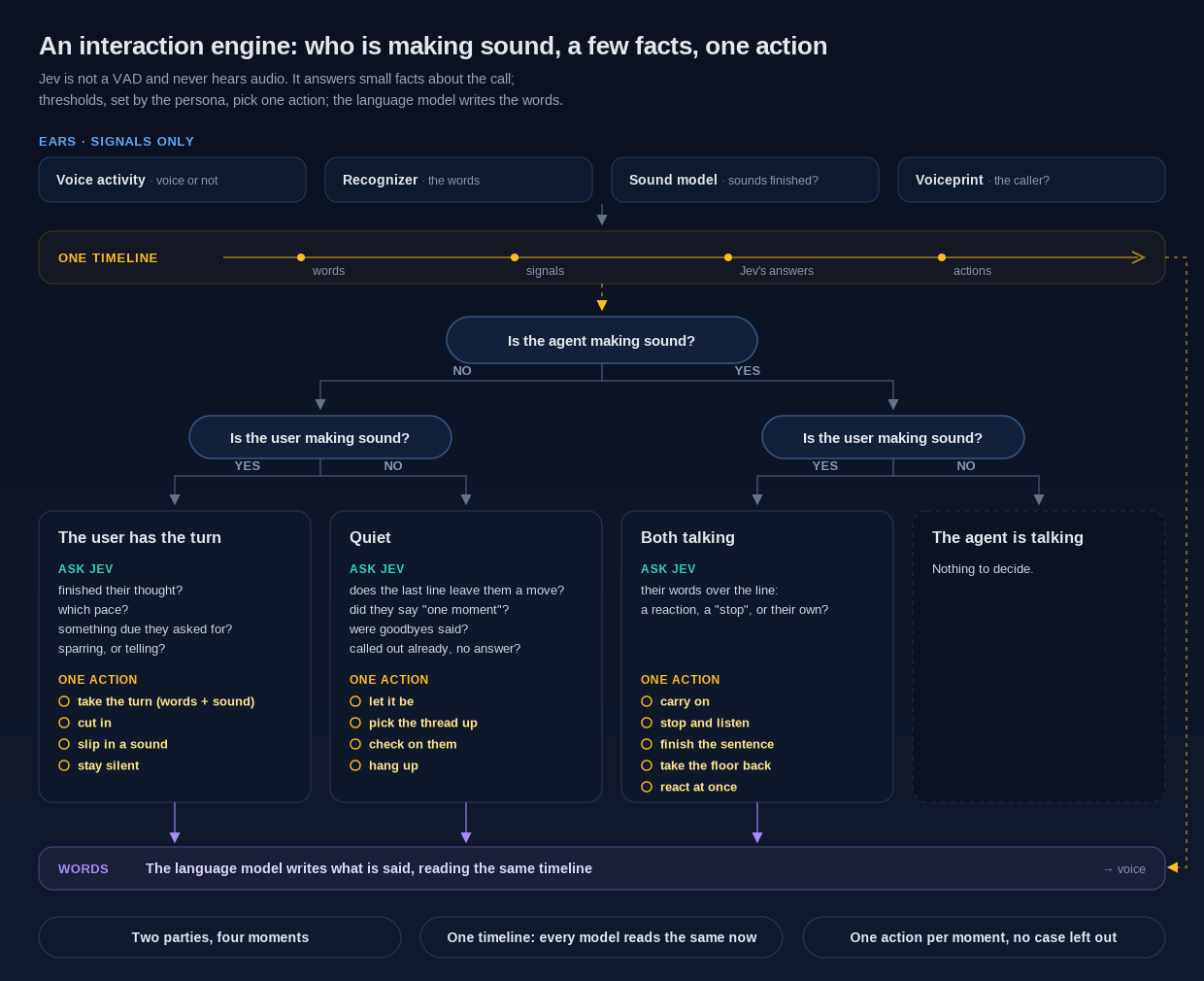
Highlights: a new call policy built on three principles: two parties and four moments, one timeline that every model
reads, one action per moment with no case left out. Jev is asked small facts and nothing is drawn: thresholds, in one
place. The sound of the voice has a say in "have they finished" (SmartTurn v3.2, both must agree), the voiceprint can
start from 20 seconds read before the call and is deleted at hang-up, and both take models of your own. A judge for
mainland China with a ready-made setup. The voice's key is TTS_API_KEY.
Breaking: every default policy is a threshold (SamplePolicy is still there to choose); JEV_PROVIDER=bailian takes
the turn at p(finished) 0.725; the turn, quiet and cut-in requests carry different questions (older logs replay with
judge.questions.turn, quiet and cut_in). ELEVENLABS_API_KEY / ELEVENLABS_VOICE_ID still work.
-
The policy, drawn and written down.
docs/policy.svg(anddocs/policy.zh-CN.svg, drawn by
tools/draw_policy.py): the ears give signals only, everything goes on one timeline, who is making sound picks one of
four moments, Jev answers small facts, one action follows, the language model writes the words. The README's policy
section says the three principles and what follows from them. -
The sound of the voice has a say in "have they finished" (
pip install "jev-interaction[sound]", on in the
Docker image). At each frame of a pause SmartTurn v3.2 (BSD-2, about 8 MB, CPU) reads the last 8 s of audio. With
Config.sound_rule = "and"(the default) the turn is taken only when the words (words_min, 0.8) and the sound
(sound_min: zh 0.8, en 0.4) both say finished; words judged finished that the sound keeps calling unfinished are
answered aftersound_wait_ms(2 s). Every reading and every turn it held back is in the call log. On eot-bench
v1.0 (revisionca9d98a) at 2% false cutoffs: Chinese 1050 ms (Jev alone 1119, VoxTurn 1078, closed LiveKit v1
1006), English 1248 ms (Jev alone 1552, VoxTurn 1000); at a 300 ms budget it cuts off more than the trained audio
models (README, "End of turn"). The lines were set on the same splits. -
The sound model and the voiceprint take models of your own. Two optional registry nodes,
sound(SoundModel:
ready,warm,score) andvoiceprint(Embedder), picked withJEV_SOUND/JEV_VOICEPRINT(offturns
either off); SmartTurn and ECAPA are the built-in ones and/api/healthnames the one in use
(docs/adapters.md). -
The voiceprint can start before the call. When the server has a voiceprint, the page asks for two short lines
read aloud three times (15 to 30 s), sends them withstart(voice, base64 PCM16), and says on screen that the
sample is used for this call only and deleted when the call ends. Only the embeddings are kept, in memory; they are
cleared inSession.close, and the page says so again after hang-up (voiceprintevent:enrolled/skipped). -
A line cut off is recorded as what was heard and what was not. The page reports what it showed of a line
(audio tags taken out, never ahead of the voice: a streamed line's duration is first only the part loaded), and the
record keeps that as the agent's words; the rest goes to the responder as a note it never said
(Turn.unheard), so it can bring it up again if it matters. -
The voice's key is
TTS_API_KEY(and the voice idTTS_VOICE_ID), on the settings page, in.env.exampleand
the docs.ELEVENLABS_API_KEY/ELEVENLABS_VOICE_IDare read into them when they are unset, so existing
deployments and their secrets keep working. -
A ready-made setup for mainland China.
deploy/mainland-china.env: one Bailian key for the judge, Qwen,
Paraformer and CosyVoice, the two values to fill in marked, each number in it with where it was measured
(cookbook/stacks.md). -
Do two personas take turns differently, and only where they should?
tools/persona_bench.pyasks the written
moments once per persona and compares what each would do. Two personas from our product (a dominant and a
submissive one, each with its own thresholds and timing) act alike in everyday moments and differently in 6 of 16
moments of a scene of control, each the way round one would expect. -
Bailian takes the turn at a line of its own, not by a draw. On a sentence cut off mid-thought Bailian's
decision-model-previewsays about 0.35 where Jev says about 0.1, so a draw against it spoke into one unfinished
sentence in three. A stretch before the draw was tried (0.6 → 0, 0.85 → 1); with nothing drawn by default, all that
matters is where the line is, so the stretch is gone and Bailian's line is a threshold inConfig.finished_min
(0.725: where the stretched number crossed one half). One place for every line, the same pause goes the same way,
and a judge with numbers nearer the middle is handled by moving its line, not by reshaping its numbers.
tools/judge_bench.pyprints "at the line" and takes--held-out(80 other pauses in
tools/judge_cases_heldout.py) and--bare(no closing punctuation). -
The pace, cutting in and "something is due" are asked as facts too. The pace was one question with every pace
as a choice, and Jev kept the pace a call was in: it missed most calls for a story and most games (81% right on the
written moments, 71% on those kept apart). It is now one yes/no fact for each pace but the starting one, worded from
the pace's own description, so a pace you add is asked the same way (judge.questions.pace_facts): 100% on both
sets, and on 18 moments of staying in a pace and leaving it. The narrate pace's description says what it is not ("a
question that a sentence or two answers"). Cutting in was "does the agent cut in now?"; Jev ranked the moments right
but sat under one half on most of them (69%). It is now a fact about the user's words, sparring or telling
(judge.questions.sparring): 94% and 100%. "Something is due" while listening is asked as the small facts that were
Bailian's alone (a task set earlier, come up just now): listening 96% / 92% → 100% / 100%. The turn request's state
is always an object now: the text undercall, and the user's words in fields the facts point at. It carries 8
questions where it carried 3; on Jev the request takes as long as before (486 ms → 482 ms from our network).
judge.questions.turnandcut_instay for replaying older logs. -
One answer from Jev, one thing done; and nothing is drawn by default. While the user has the turn, taking it,
cutting in and letting a sound slip in were three decisions, each made on its own: a sound could go out and the
reply follow it a tick later. They are one choice now (decisions/turn.py): judged finished, the agent takes the
turn when their voice stops and puts nothing in before that; otherwise it may cut in, in a pace that does (the
cut-in question rides in the turn request on new words instead of being a request of its own); otherwise it may put
a sound in; otherwise it stays silent. The choice is in the call's record (decision,what: turn). Every default
policy is a threshold (0.5):end_of_turn,listenandcut_inwere draws. A draw against p(finished) spoke
into one unfinished sentence in ten when Jev said 0.1, and made a recorded call impossible to work through again.
What varies now is when a thing may happen, not whether a sure thing is done: the quiet marks were already
jittered, and the gap between two listening sounds is too (Config.listen_gap_jitter, 0.3).SamplePolicyis
still there for whoever wants a draw; the shipped personas no longer use it. Measured on Jev before and after
(tools/judge_bench.py, the cut-in question now sent the way the engine sends it): end of turn 97% → 96%,
listening 96% / 92% → 100% / 96%, cutting in 69% → 69%, the rest unchanged. -
A quiet is asked as facts, and what to do follows from them and the clock. The quiet question ("would the
agent, being who they are, say something now?") is no longer sent. Jev is asked four small things about the record,
each with its options in both orders: whose move the agent's last line leaves, whether the user said they need a
moment, whether goodbyes were said, whether the agent has been calling out with no answer. How long it has been is
the engine's clock, not a question. Its own move: the agent picks the thread up after the pace's newlead_after_s
(normal 6 s, patient 15, narrate and eager 2.5). The user's move: it lets the quiet be and checks on them after
check_min_quiet_s. An ended call: it hangs up once that is open, and checks first when nothing has been said into
the quiet yet. On the written moments oftools/judge_bench.py --decisions, Jev was right on 33% as one question
(it answered "let it be" to nearly everything) and is right on 100% as facts, tuning set and held-out set alike. The
quietpolicy is a threshold by default, so the same quiet goes the same way and only the marks are jittered; the
shipped personas no longer draw it. One set of questions serves every judge here:judge_providerno longer
changes how a quiet is asked.judge.questions.quietstays for replaying older logs. -
The call's record is one timeline, and every question reads the same "now".
Ledgerkeeps the call on one
clock (seconds into the call): each turn has when it began and ended (Turn.at,Turn.end), the user's turns have
where their voice stopped and came back (Turn.pauses,Config.pause_mark_ms), and what the engine judged and did
between the words is in it too (Ledger.notes: every answer from Jev with its probabilities, every action taken,
pace changes). The call log's last line carries the whole of it in order (timeline), every log line hasat, and
ajudgeline has the moment it was asked about as fields (now), so a recorded call can be worked through again
under other thresholds or asked a new question. What Jev reads about the present is written in one place
(judge/state.py:Now, built bySession.now): a decision chooses its questions, never its own account of the
call. The text is word for word what each decision sent before (all 832 requests oftools/judge_bench.pyare
byte-identical), so no answer changes. How soon a user usually answers is now read off the record
(Ledger.reply_gaps) instead of being counted beside it; a cough that opened no turn no longer counts as an answer.
Jev is not shown the times: asked the same pause with a user's earlier pauses written into the recent call, its
"have they finished" did not move (within 0.03), so a user's rhythm is the engine's to read, not the judge's. -
Questions worded for Bailian's judge.
Config.judge_provider = "bailian"(JEV_PROVIDER=bailian) sends Alibaba
Cloud Bailian'sdecision-model-previewits own set of questions (judge/bailian.py); Jev keeps the engine's. The
words a question is about go in a field of their own and the question points at it, every choice is asked in both
option orders and averaged, and a question that needs the whole call read is split into small ones. It covers the
end of a turn (thelast_wordswording), both talking, a silence and "something is due" while listening. On 108
written moments kept apart from the wording: both talking 54% → 100%, a silence 40% → 85%, listening 67% → 96%
(tools/judge_bench.py --decisions --held-out). The mainland setup in the cookbook and on the setup page sets it. -
A judge for mainland China.
api.typesafe.aidoes not serve mainland networks, and other services now speak the
same protocol.JEV_URL,JEV_MODELandJEV_HEADERS(a JSON object of extra request headers) point the judge at
one; an emptyJEV_URL=line no longer leaves the judge without an address.Config.turn_question = "last_words"
(JEV_TURN_QUESTION=last_words) words "have they finished" about the user's own words, sent in a field of their
own, with the options in both orders: Alibaba Cloud Bailian'sdecision-model-previewgoes from 63% to 88% right
with it on 160 written pauses, and Jev reads both wordings alike (96%). The mainland setup in the cookbook and on
the setup page is now one Bailian key for all four nodes.tools/judge_bench.pymeasures any configured judge,
the end of a turn and (--decisions, 148 written moments intools/judge_cases.py) the other decisions; the numbers,
and where the Bailian judge falls short of Jev, are incookbook/stacks.md. -
The turn request asks two questions, not four.
wait(how long to hold the answer) andkind(a reply or a
sound) are no longer sent.waitsaid whatdonealready says (on 627 recorded turn judgements its value tracked
p(finished) at -0.92) and its only effect was to hold the draw back: in 217 held moments the user went on during the
hold 4 times. Replies now start about 150 ms sooner on average, more in the patient pace. Nothing readkind's
answer; it is still asked, with itselsewherechoice, whenConfig.not_for_meis on.judge.questions.WAIT_MS
is gone,Session.judgedno longer carrieswait_msorreply, and a judge that answers per question (one
forward pass each) is asked half as much on every pause. -
Citation.
CITATION.cff(GitHub's Cite this repository) and a BibTeX block in the README; a test keeps
their version equal to the package version. -
The caller's voiceprint (
pip install "jev-interaction[voiceprint]"), the same check the call engine in our
product runs. Each stretch of voice gets a speaker embedding (ECAPA-TDNN on the CPU,EcapaEmbedder) and is compared
with a print learned from the words the agent answers, with no enrollment step. A clear stranger is not answered and
does not stop the agent's line (not_for_me,why: "voice"); a doubtful voice is treated as before; the print needs
two answered utterances before it can call anyone a stranger. Thresholdsvoice_same,voice_other,
voice_verdict_ms,voice_enroll_ms; any embedder fits the newEmbedderprotocol (Session(embedder=...)). The
server and the Docker image use it when installed (JEV_VOICEPRINT=0turns it off;/api/healthshowsvoiceprint). -
Packaging checked. CI builds the wheel and sdist, installs the wheel alone in a clean environment and checks,
from outside the repository, that every file the package reads is there (scripts/check_wheel.py); the 0.2.0 wheel
had shipped without the speech prompts. A tagv*publishes to PyPI by trusted publishing (release.yml), once the
publisher is set up on PyPI. -
The public surface is written down (
docs/stability.md) and listed intests/test_contract.py: exports,Session
arguments,ConfigandPacefields, adapter protocols, decision names, and the call protocol's messages, which must
matchdocs/protocol.md. From 1.0.0-beta it is frozen.