Repository navigation
NeoDesk 3.6.0-rc.5
Pre-release
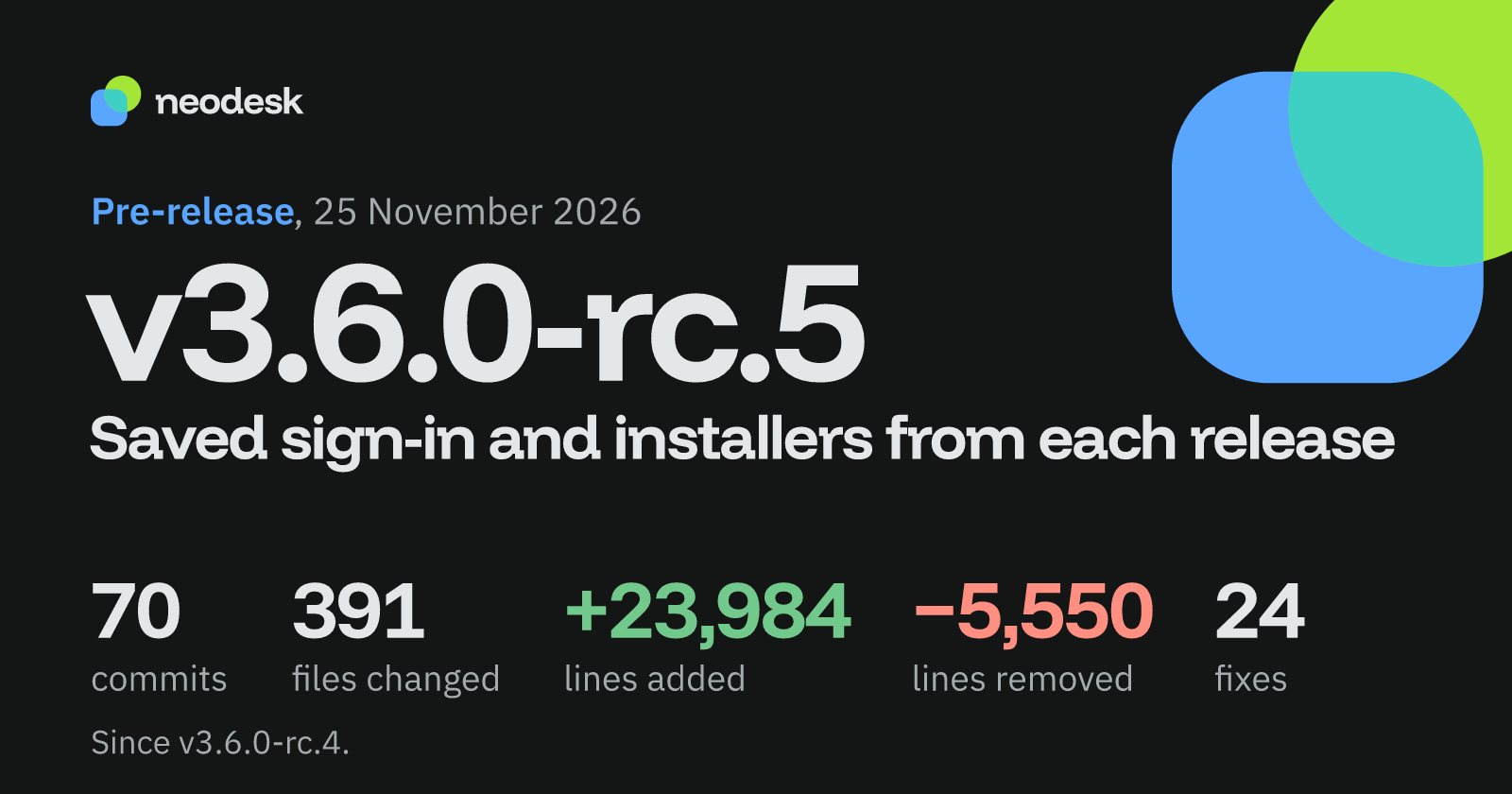
This is the fifth release candidate of 3.6.0. It adds saved sign-in for Windows lock screens, and Connect now uses the device password an organisation's address book stores. The installers come from each release and are fetched from neode.sk, the console's default port is 3375, and neodesk is the command line on every kind of install. A computer whose key the server refuses now really shows offline. It goes with the NeoDesk client 1.5.0-rc.7.
An install of 3.6.0-rc.4 needs one manual step to update, because its update command looks for the installer where it no longer is. See Updating from 3.6.0-rc.4.
What's new
Saved sign-in for Windows lock screens
A device can keep the account name and password of a Windows account: Saved sign-in in the device's menu and on its Actions tab. When a session in the browser viewer opens on the computer's lock or sign-in screen, the viewer signs in with them. It does that by itself when Sign in automatically when a session opens on the lock screen is on (off by default), and otherwise offers Sign in. It tries once per session. If Windows refuses the password, sign in by hand.
The password is stored encrypted on the server and never shown again: you can replace or clear it. It works on Windows computers where NeoDesk runs as a service, in the browser viewer, over a session encrypted end to end with the computer. Two new permissions, Use saved sign-in and Manage saved sign-in, belong to super admins only until you give them to another role. Every save, change, use and refusal is in the audit log. API tokens, and with them the command line and MCP, can save, change and clear the details (neodesk devices signin-set and the other devices signin commands), but can never use or read them.
What works with which client:
- With the client 1.5.0-rc.7 and older, the browser viewer types the details: Ctrl+Alt+Del, then the password (and the account name when the screen asks for it) and Enter. The password reaches the browser for about two seconds. These clients don't report their lock screen, so the viewer signs in by itself only while nobody is signed in on the computer, for example after a restart. When someone is signed in, it shows Sign in and asks first, because on an open desktop the password would be typed into whatever has the focus.
- With a client after 1.5.0-rc.7, which is not released yet, the server seals the details for that computer's NeoDesk, which opens them and types at its own lock screen: the password never reaches the browser. That client reports its lock screen, so saved sign-in acts only on the lock or sign-in screen and never on an open desktop. Once a computer's NeoDesk has reported this way, the server hands out no readable details for it any more, also when an older client is installed on it again.
The details are sealed with a key file of the server, which the console's full backup doesn't hold; see the key file below. The Saved sign-in page has the details.
Connect uses the address book's device password
When an organisation's address book stores a device password for a computer, Connect in the browser viewer now signs in with it instead of asking for it. The server answers the computer's password question itself, so the browser never gets the password. This also works for a contact in the shared address book whose computer isn't assigned to the organisation. If the computer refuses the stored password, the viewer says so and asks for the password, once.
The console, the command line and MCP no longer show that password: neodesk devices connect-password says only whether one is stored. Desktop clients still get it with the shared address book.
These passwords are now sealed with the same key file as saved sign-in. The server moves them to it at its start, so a copy of the database or a backup alone no longer opens them.
Revoking an API token ends what it made
Revoking an API token now also ends what the token made: guest links, device tokens, quick support sessions with their codes, invites, pairing codes, guest desktop links and organization invitations that weren't used yet. The same happens when a token expires or is deleted. The revoke dialog and the token list name what ended.
Computers that joined through the token's invites or pairing codes, or that were approved with it, stay. The revoke dialog lists them so you can check them on the Devices page. Only computers let in from this release on are listed.
neodesk is the command line on every install
- Linux:
neodeskis a copy of the server binary in /usr/local/bin that every user on the server can run; it needs an API token to do anything. The installer's manager is nowsudo neodesk-setup.sudo neodesk --updateand the installer's other options still work and go toneodesk-setup, and a baresudo neodeskon a terminal still opens the menu. - Windows:
neodeskis on the machine's Path, asC:\NeoDesk\bin\neodesk.exe. - Docker:
neodeskin the container, as before.
On a Linux computer that also has the desktop client, neodesk hands the client's own options (--join, --service, --password, --connect and the others) to the client, /usr/bin/neodesk, and so does a join or support link given on its own. --config and --version stay the command line's, and --update, --uninstall and --relay the installer's.
When the console has updated itself, its update screen shows Update the command line too with sudo neodesk-setup --update, and neodesk says on stderr when it is older than the server.
Every command now names the permission its route needs, which neodesk describe lists, every option has a help text, and times without a time zone in tables say UTC. neodesk mcp asks you itself before a tool deletes, ends, runs or changes who may do what, when your MCP client can ask (MCP elicitation). There are now 536 commands in 59 groups.
Installers from each release
The installers and compose files moved into the repository's install/ folder, and every release now carries them: install.sh, neodesk.sh, neodesk.ps1, neodesk-docker.sh and the three compose files. The release's SHA256SUMS lists them, and the new SHA256SUMS.sig signs that list with the release key. The install commands fetch them from neode.sk, which leads to the newest release, and the scripts update themselves from the release they install, never from the repository's main branch. neodesk.sh and neodesk.ps1 check the signature of their new copy; install.sh and the Docker manager check the SHA-256 of what they fetch against the release's list.
The console's default port is 3375
The console's plain HTTP port is now 3375 instead of 5000; HTTPS stays on 5443. New installs use it. Which existing installs move is under Updating from 3.6.0-rc.4.
Renamed paths
- Linux: the installer's backups go to /opt/neodesk-backups. The first run of the new installer as root moves the backups from /opt/rustdesk-backups.
- Docker: the data volume is mounted at /opt/neodesk/data in the container instead of /opt/rustdesk. The update rewrites /opt/rustdesk in .env, in a compose file you changed and in docker-compose.override.yml, and keeps the old files in its backup. A compose file of your own that still mounts the volume at /opt/rustdesk keeps working, and the container's log says to change it to /opt/neodesk/data. Backups now hold the folders neodesk and console, and backups of 3.6.0-rc.4 and older restore as before.
Security fixes
- Accounts that see only some devices can no longer widen their access through the API port 21121. They change no access list, make no group from tags, put no device they can't see into a group, and see only the groups open to them. Access rules on device groups made from tags now reach the devices with the tag.
- A permanently deleted device leaves nothing behind: its key, key requests, stored passwords, grants, groups, folders and settings go with it, so a new install under the same ID inherits none of it.
- A read-only API token sees the enrollment token of an agent template only by its first eight characters.
A refused computer shows offline
A computer whose key the server refuses showed Online in the console and in neodesk devices list (a known issue of 3.6.0-rc.4). It now shows offline, also after the server restarts. Its heartbeats mark nothing online and its system information isn't stored until Approve new key lets it back in.
Smaller changes
- Links that open a device in an app now use
neodesk://and open the NeoDesk client. Open in RustDesk stays as a second choice, and phones keep the RustDesk app. - The invite page tells people on Windows that the exe's permission prompt names Windows Command Processor by Microsoft Windows, and that this is the NeoDesk setup. Only the MSI's prompt names NeoDesk's publisher.
- Starting a browser session no longer logs a failed request (409) for the quick support password.
- The Windows install script for Intune from the console uses the client API port 21121 when the server has no public API address. It used 21114.
- The command line's sign-in error names 3.6.0-rc.4, the release that brought API tokens, instead of a version that doesn't exist.
- Help in the console,
neodesk --helpand the installers' closing summary point to the NeoDesk Discord. - A failed Linux update puts the previous server binary back also when systemd has given up on the new one.
- The Docker update keeps copies of .env and the compose file from before it writes new ones, so its backup holds the old files and a failed update puts them back.
- On Windows, the command line refuses a config file that other accounts may read, and writes its own so that only you, SYSTEM and Administrators can.
- The upgrade path from the old Node.js console and the migration tools are gone. The installers refuse a server that still runs the Node.js console.
Updating from 3.6.0-rc.4
The update command of 3.6.0-rc.4 fetches the installer from the repository's main branch, where it no longer is. On Linux and Windows it still updates the server, but keeps the old installer. On Docker it stops with a download error before it changes anything. Run the new installer once by hand, as below. After that the usual update works again.
The console's own update also updates only the server, so the step is needed once in any case. There is still no migration from 3.6.0-rc.1 or older: install NeoDesk fresh.
Linux
curl -fsSL https://neode.sk/neodesk.sh | sudo bash -s -- --updateIt updates the server, saves the installer as neodesk-setup, puts the command line neodesk in /usr/local/bin and moves the backups to /opt/neodesk-backups. Later updates:
sudo neodesk-setup --updateDocker
curl -fsSL https://neode.sk/install.sh | sudo bashAn install pinned to a version stays on it with this command, for example one installed with --version 3.6.0-rc.4 as the notes of 3.6.0-rc.4 showed. The update's summary then says "pinned". To move it to this release and let it follow new releases again:
curl -fsSL https://neode.sk/install.sh | sudo bash -s -- --version latestLater updates:
sudo bash /opt/neodesk/docker/neodesk-docker.sh updateWindows
Open PowerShell as administrator, download the installer and run its update:
Invoke-WebRequest https://neode.sk/neodesk.ps1 -OutFile neodesk.ps1 -UseBasicParsing
.\neodesk.ps1 -Update
It saves itself as C:\NeoDesk\neodesk.ps1 and puts neodesk on the machine's Path. Later updates:
& 'C:\NeoDesk\neodesk.ps1' -UpdateThe console's port
- Linux and Windows installs keep port 5000. The installers wrote the port into every install's .env, and an install whose settings name a port keeps it.
- Docker installs with the default compose file move to 3375 at this update, and the update says so. To keep 5000, add
NEODESK_CONSOLE_PORT=5000to /opt/neodesk/docker/.env before the update. If the update has moved it already, add the line and runsudo bash /opt/neodesk/docker/neodesk-docker.sh update. - A reverse proxy of your own in front of a Docker install has to forward to 3375 after the update, unless you keep 5000. With
--domain(Traefik) nothing changes for you: the console stays on 443.
The key file of saved sign-in
The key of saved sign-in and of the address book's device passwords is the file .device_vault_key, next to the server's key pair: /opt/neodesk on Linux, C:\NeoDesk on Windows, /opt/neodesk/data in the Docker data volume. The server makes it at its first start of this release.
- The console's full backup doesn't hold it, nor do the backups of the Linux and Windows installers. The Docker manager's backup does, since it copies the whole data volume.
- When you move the server, copy the file with the data. A server without it makes a new key, and the saved sign-in details and the address book's device passwords have to be saved again.
- Keep it as safe as the server's key: the file and a copy of the database together open the details.
- If you set
ORG_PEER_VAULT_KEY, leave it set. The server needs it to open the address book's passwords from before this release, which it moves to the key file at its start.
Also changed
- Scripts that read a stored device password with
neodesk devices connect-passwordorGET /api/devices/<id>/connect-passwordnow get only whether one is stored. - Docker: a hand-made compose file or settings that name /opt/rustdesk should name /opt/neodesk/data. The manager's update rewrites its own files.
- Linux: scripts that call
/usr/local/sbin/neodeskshould callneodesk-setup.sudo neodeskwith the installer's options still reaches it. - Console sessions carry over: nobody has to sign in again.
Install
With Docker, the first line installs the newest release, now this one. The second also serves the console over HTTPS at your domain, which has to point at the server, with ports 80 and 443 open:
curl -fsSL https://neode.sk/install.sh | sudo bash
curl -fsSL https://neode.sk/install.sh | sudo bash -s -- --domain <domain> --letsencrypt-email <email-address>
Without Docker, on Linux:
curl -fsSL https://neode.sk/neodesk.sh | sudo bashThe image is ghcr.io/neodeskapp/neodesk:3.6.0-rc.5. The Linux and Windows pages have the details. A new install's console answers on port 3375, and on 5443 with HTTPS.
Known issues
- Saved sign-in and Connect with the address book's device password have only run in the test suites, not yet against a real Windows computer.
- A computer whose NeoDesk is paused (Stop accepting connections in the tray of the client 1.5.0-rc.7) shows offline, and the viewer says to turn it on.
- Live usage data is wrong: CPU reads 100 % on Windows and 0 % on Linux, network traffic 0, the Metrics tab stays at "No usage samples yet", and Live data can call an online computer offline.
- The client API takes 20 heartbeats a minute from one address and drops the rest without a sign, so more than about five computers behind one address, such as an office's, lose heartbeats and usage data.
- Chat messages from the console to a computer reach nobody, since no NeoDesk or RustDesk client connects to the device chat. The chat inside a remote session works.
- The console offers the NeoDesk agent's terminal and files only to super admins, also when another role holds those permissions.
- Revoking an API token leaves the accounts it made. Enrollment tokens of agent templates can't be revoked at all.
neodesk mcpwith an MCP client that can't ask you (no elicitation) still makes the agent confirm first and leaves asking you to the agent, so give an agent a token with only the permissions it needs.neodesk billing clock-setresets every setting you leave out, andneodesk billing mail-settings-setturns on every switch you leave out.- On SQLite, a backup archive holds the database file twice.
- HTTPS with Let's Encrypt hasn't been run against Let's Encrypt itself yet, not even its staging server. Whether Traefik replaces a staging certificate when you switch to a real one isn't known, and
--no-traefikalso removes aTRUST_PROXYyou had set for a proxy of your own. - Clients that use the console's address as their API server are signed out after the session duration even while they are in use: Extend session on activity and Maximum session lifetime don't apply to them.
- Some permissions only work together with another one, and the Permissions page doesn't say so. Delete devices, Ban, Change device ID and Change connection mode need Edit devices, and Create and Delete users need Edit users, for example.
- Relay servers: the assignment rules are saved but not used; every device uses the default relay.
- USB and drive access and Fleet tasks can't save yet, as the banners on both pages say.
- A slow single sign-on provider ends in "OIDC authentication failed" or a bare page that says "OIDC callback proxy failed".
All changes since v3.6.0-rc.4
- docs: say which backups hold the saved sign-in key in the 3.6.0-rc.5 notes (a6caefd)
- test: give install.sh's release test its own version, so a release's version string does not decide it (45a3b7d)
- chore: release 3.6.0-rc.5 (65696c5)
- docs: write the release notes of 3.6.0-rc.5 (a51a556)
- chore: bump version to 3.6.4 [version-bump] (6bb791d)
- fix: find the source folders again when neodesk.ps1 builds from a checkout (5a720e0)
- test: install the old release for the update test from its own tag, not from main (25afe02)
- chore: bump version to 3.6.3 [version-bump] (a4c0c1d)
- test: record the language vectors and string goldens anew on main with saved sign-in (ae4cec3)
- feat: move the console's default port from 5000 to 3375 (ef90aa3)
- feat: take the installers and compose files from the release they install, not from main (0494fda)
- chore: format the version bump tests after the move (9caede9)
- docs: install from the neode.sk addresses of the newest release (820a4fb)
- chore: move the installers and compose files into install/ and the Dockerfiles into docker/ (943cf3d)
- docs: point to the NeoDesk Discord for help (548bad1)
- feat: hand a join or support link given alone to the desktop client [L431] (7d34dd6)
- feat: say when the command line is older than the server, on the update screen and in the command line [L431] (8b5c8be)
- test: list a backup to a file before checking it, so a broken pipe can't fail the check [L446] (ce9e40b)
- fix: run the command line with a given address and token also when its config folder can't be read [L431] (0a455f9)
- feat: list the computers an API token let in when it is revoked, and leave them in [L431] (79648d2)
- fix: list agent templates to a read-only API token without their enrollment tokens [L473] (b6b8d00)
- chore: name 3.6.0-rc.5 as the release that brings the new install layout (0cc6e6c)
- chore: remove the old Node.js console's service handling from the installers (3d1d66b)
- feat: hand the desktop client's options from neodesk to /usr/bin/neodesk [L431] (6a140b4)
- fix: let every user on a Linux host run the command line neodesk [L431] (c67bfe3)
- fix: start the previous server binary after a failed update also when systemd gave up on the new one (0ed0954)
- fix: leave nothing at the old data and backup paths [L446] (25778fe)
- fix: smoke-test the Docker image with the compose files it was built with [L446] (8d6c4f5)
- chore: remove the upgrade path from the old Node.js console and the migration tools (e5ffd43)
- fix: move backups to /opt/neodesk-backups and Docker data to /opt/neodesk/data, with links at the old paths [L446] (d06d37f)
- fix: say on the invite page what Windows' permission prompt shows for the exe, and name the publisher only for the MSI [L443] (50aa017)
- fix: back up the old settings and compose file before a Docker update rewrites them [L460] (43a0601)
- fix: remove a permanently deleted device's key, passwords, grants and settings with it [L464] (7a9426c)
- fix: point the Intune script without an API address at the client API port 21121 [L449] (d65e1c3)
- fix: keep the command reference's tables whole and give every flag a help text [L445] (8f8789f)
- fix: name 3.6.0-rc.4, the release that brought API tokens, when the command line can't read a server's answer [L444] (f281bd8)
- fix: name in every command the permission its route needs, device.view for devices list [L447] (11d5d8c)
- feat: make neodesk the command line and install the installer's manager as neodesk-setup [L431] (75ee193)
- fix: end what an API token made when the token is revoked, expires or is deleted [L431] (4874f45)
- chore: bump version to 3.6.2 [version-bump] (71e4a81)
- test: record the contract goldens anew over the sign-in texts and the device_sealed_signin table (b19d6af)
- test: record the language vectors anew over the changed sign-in texts (4c4e991)
- feat: offer saved sign-in only on the lock or sign-in screen, and say why a sealed-only computer gets none [L469] (d00a63b)
- feat: hand out no readable saved sign-in for computers whose NeoDesk reports sealed sign-in [L469] (e9d7f76)
- test: record the contract goldens anew over the sealed sign-in texts and status (fa2211b)
- test: give the key file move test an organization PostgreSQL accepts [L454] (88bffbc)
- test: record the language vectors anew over the sealed sign-in texts (99e6494)
- feat: sign in by itself only at a lock screen the computer reports, never on its open desktop, and send the sealed sign-in to a computer whose NeoDesk opens it [L469] (ec8299e)
- feat: hand a computer whose NeoDesk opens sealed sign-ins a sealed packet instead of the password, and no readable details for it after that [L469] (b733750)
- feat: seal a saved sign-in for the computer's own NeoDesk to open, wire format 1 with a test vector [L469] (7626f5f)
- fix: seal the organisations' device passwords with the server's key file and move the old ones at start, so a database copy or a backup no longer opens them [L454] (1bbabb7)
- fix: stop handing out the organisation's stored device password through the console, the command line and MCP [L454] (34339e7)
- test: record the bootstrap goldens anew with the saved sign-in permissions (a372015)
- feat: restore saved sign-in details with the server's device database part of a backup [L469] (2f0a179)
- feat: show saved sign-in in the console to every role given its permissions, not only to super admins [L469] (b622e7c)
- test: record the contract goldens of saved sign-in and of the texts, permissions and table it adds (9deac94)
- test: check that no command uses a saved sign-in or reads its password back [L469] (b8e0be0)
- feat: offer saved sign-in only over a session encrypted end to end with the computer [L469] (1af9515)
- test: record the language vectors anew over the saved sign-in texts (24e281b)
- feat: sign in at a Windows lock screen from the browser viewer with the saved details, once per session, by itself only while nobody is signed in [L469] (b07f328)
- feat: set, replace and clear a device's saved sign-in from its panel, with the switch for automatic sign-in off by default [L469] (d4249d7)
- feat: save a device's sign-in details encrypted on the server, for people with the new saved sign-in permissions only [L469] (6836688)
- fix: let Connect sign in with the device password the organisation's address book stores, without the browser ever holding it [L454] (373989d)
- chore: bump version to 3.6.1 [version-bump] (2cb6bf2)
- fix: keep a device whose key is refused offline and refuse its sysinfo also while it is out of the live list [L452] (88195c1)
- test: give the CI test stack its own NTP server so the contract suite never depends on reaching one [L441] (c3b85da)
- fix: let the command line ask the person before destructive MCP tools and keep its token and config checks tight [L431] (f1cc7b9)
- fix: stop the browser viewer's quick support password check from failing with 409 at every sign-in [L429] (ae78d97)
- fix: keep accounts that see only some devices from widening their access through the API port [L425] (20d374f)
- fix: open devices in NeoDesk by its own link and keep Open in RustDesk as a choice [L423] (faef217)
Full Changelog: v3.6.0-rc.4...v3.6.0-rc.5