Repository navigation
Releases
OwnMachine v1.1.1: static analysis and security gates

OwnMachine v1.1.1
Adds pinned static analysis and runtime dependency auditing to pull requests and
weekly CI. Ruff, Bandit, ShellCheck, actionlint, zizmor, focused mypy checks and
OwnMachine security regression rules retain reviewable reports and fail according
to the analysis policy.
Removes unused Python code, makes shell startup-attempt validation explicit,
disables implicit workflow caching and adds missing-pipe checks to transport code.
WebSocket SHA-1 is explicitly marked as non-security protocol framing. Reviewed
protocol exceptions are narrow and documented; local-libvirt XML findings remain
visible for case-by-case review. Runtime dependency
ranges and existing platform qualification limits remain unchanged.
Security gates prioritize high findings (the highest category used by Bandit and
zizmor); medium/low findings remain in retained reports for case-by-case review.
Two high protocol/library exceptions are documented. The resolved runtime dependency
audit found no known vulnerabilities.
No VM recreation or host-service change is required for this update. Restart affected
Hermes processes after upgrading to load the updated provider. Catalog installs use
the reviewed catalog pin and receive this version only after its update is approved.
Validation and artifacts
The release tree passed static analysis, runtime dependency auditing, macOS/Ubuntu tests and Windows bootstrap CI. Local tests: 443 passed, with 51 expected Hermes-dependent skips. Fresh-home installation, offline upgrade and reproducible bundle checks passed. The final release commit’s packaged plugin passed isolated Hermes validation and its bundles/checksums were verified before publication.
Download both the plugin and source bundles as needed. Verify downloaded assets with sha256sum -c SHA256SUMS or shasum -a 256 -c SHA256SUMS. Checksums establish integrity, not publisher identity.
OwnMachine v1.1.0 — Windows, macOS and Omarchy desktops
OwnMachine v1.1.0
Give Hermes its own Windows desktop alongside macOS and Omarchy. This release
adds Windows 11 Enterprise Evaluation x86-64 on a Linux KVM/libvirt host, with
persistent files, restricted SSH/MCP control and private browser viewing/input.
macOS and ARM64 Omarchy continue to use Apple Silicon and patched Lume.
What changes
- Hermes-driven Windows planning, remote preflight, media preparation, staged
provisioning, authenticated progress, hardening, verification and automatic
temporary setup-key retirement. Operator handoffs remain explicit. - Separate agent/viewer SSH identities, per-VM libvirt restrictions, a private Unix
console, root-owned runtime and persistent firewall with live readiness checks. - Foreground Notepad save/close/reopen acceptance, corrected filename-control
handling, capture recovery after session loss, and clear stopped-driver health. - Correct first-session clock synchronization, visible OpenSSH/bootstrap progress
that closes itself, a hidden standard-user driver launcher and configurable
display/sleep policy. - Explicit installer file modes that work under
umask 077, plus bounded,
configurable read-only driver-readiness polling. - Reviewed maintenance procedures and a clear input/platform support matrix.
Install and operator handoffs
Start in the Windows onboarding guide. Plugin installation
alone does not create a VM. The operator supplies verified Windows evaluation
media and consent, Linux/KVM dependencies, host-key verification, reviewed setup
access and administrator registration. The first DVD boot prompt and later
standard-user sign-in require the private viewer. Windows does not use the macOS
Accessibility/Screen Recording permission flow.
Set the intended Hermes profile's runtime connection, guest_profile: windows,
console_transport: private-unix, and computer_use.backend: ownmachine; use the
same configured control directory for all writers. Keep viewer credentials out of
Hermes. Complete verification and setup-key retirement before routine use.
Existing macOS/Omarchy guests do not need recreation for the Windows addition.
Keep their required patched Lume and firewall protections. Save work and restart
affected Hermes processes after installing the plugin so old provider code is not
retained. See Windows maintenance and rollback for
compatible root-owned relay-code updates. Do not apply Windows registration to an
existing guest or treat code updates as configuration migrations.
Tested scope and limits
Repeated clean guest installation, first-session time, real-model file
save/close/reopen with independent content verification, idle capture and guest
cold-start persistence passed. Lock/unlock, sign-out/in, driver/gateway restart,
mixed-profile refusal, fresh registration under umask 077 and live compatible
relay-code upgrade/rollback were also exercised. The
acceptance report distinguishes operator-reported runs,
direct installed-Hermes backend checks and isolated tests.
- Home/Pro, Windows ARM, other hypervisors and cloud hosts are not qualified.
- Physical Linux-host reboot acceptance was explicitly skipped. Firewall-service
restart is tested but does not prove complete host-reboot recovery. - General background input, broad pixel/drag/scroll coverage, clipboard sync and
privileged-desktop automation are outside the Windows support claim. Follow
the input matrix, including explicit foreground
delivery for the tested Notepad workflow and refusal of unsupported filename
set_valueoperations. Never replay uncertain input or silently escalate modes. - The driver remains pinned. There is no supported in-place guest-driver updater
after setup-key retirement; qualify a separate fresh guest for a new pin. - Host-crash recovery during disk mutations and arbitrary partial-registration
repair are not automatic. Preserve checkpoints and inspect uncertain outcomes.
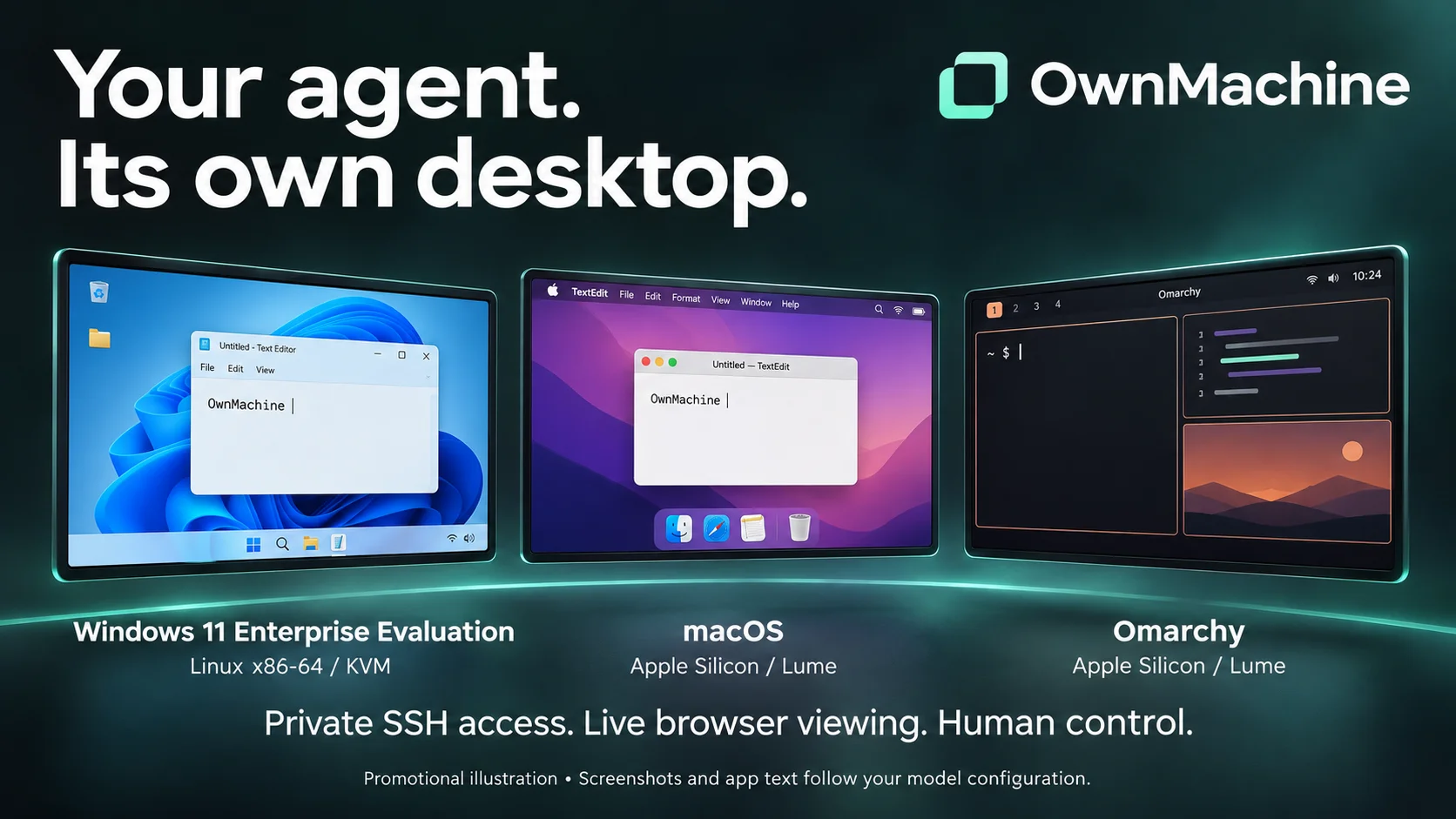
The new artwork is promotional illustration, not synthetic evidence of a model
run. Desktop screenshots and application text follow the user's configured model
provider. PolyForm Noncommercial 1.0.0 remains the license.
Release validation
Release commit: 18707efa80e0376fed216a982677842b3d521244. The release tree matches the validated tree. Packaged-plugin validation, security scanning, repeatable bundle builds and SHA-256 verification passed. macOS suite: 437 passed with 51 expected Hermes-environment skips. Linux/Hermes suite: 478 passed with 10 expected macOS-only skips. Release PR CI passed on macOS, Ubuntu and Windows bootstrap.
Download the plugin and source bundles below; verify them with sha256sum -c SHA256SUMS (or shasum -a 256 -c SHA256SUMS on macOS). Checksums verify integrity, not publisher identity. Catalog installation remains pinned to the previously reviewed version until the Hermes catalog update is approved.
OwnMachine v1.0.1
OwnMachine v1.0.1
Fixes local onboarding verification and idle gateway contention after v1.0.0.
- Local plans with an empty planning alias can verify using an explicitly configured
runtime agent SSH alias. Other runtime/plan fields still match; acceptance binds
the runtime configuration. Client capture failure explains that host checks passed
but setup access has not been retired. - Local and remote plans support explicit runtime connection configuration without
changing their target to existing. The guides include the runtime settings and
explicitcomputer_use.backend: ownmachineselection in the same Hermes profile. - Cached backends connect lazily and lock only during an active operation. Another
backend's operation invalidates previous capture targets before input. Human
reservation and uncertain-write gates remain enforced.
Upgrade and resume
Save active work and normally stop the affected Hermes gateway/sessions before
updating the plugin. Restart that gateway after installation: old loaded code can
retain its lifetime lock until it exits. Do not delete session.lock. A guest
recreation or host reboot is not needed for this patch.
Keep the existing setup plan, operator source pin, runtime settings and checkpoints.
For a local plan with an empty alias, configure the explicit runtime agent alias
without editing the plan. Follow the runtime configuration checklist.
The guest profile, VM name and shared control directory must match the saved plan.
Restart the matching profile after selecting the OwnMachine backend; never allow a
host-desktop provider to stand in for the guest.
Run ownmachine doctor and ownmachine setup --next in that profile. With agent
control paused (not reserved for human input), repeat ownmachine setup --run verify.
Once that succeeds, ownmachine setup --run verify --apply repeats verification and
retires only the configured temporary setup key. Host-side checks_passed alone is
not completion. Existing acceptance receipts predating runtime binding are not
reused as proof; if setup access was already retired, inspect status with the
operator rather than automatically restoring a key.
Validation scope
The fixes reproduce the v1.0.0 alias mismatch and macOS lock failure in regression
tests. A separate-process test retains an idle backend while another captures and
refuses stale input. The fix gate passed 408 Hermes-aware tests with no skips,
source/packaged/installed validation, reproducible bundles, fresh-home installation
and offline upgrade. Release PR checks validate the final versioned tree. These
are isolated/package tests, not a new guest installation or model-task acceptance.
The macOS/Omarchy hardware scope and upgrade requirements in v1.0.0 notes
still apply, including the mandatory patched Lume/firewall protections.
Release commit: 17268cd760b857bf350282a5b09f55f7498a9441. Exact-commit local validation passed 408 tests (zero skips/failures), source/packaged/installed validation, reproducible checksummed bundles, fresh-home install and offline upgrade. Source and plugin archives, manifest and SHA256SUMS are attached. Verify checksums before extraction.
OwnMachine v0.8.0 — catalog security fixes
OwnMachine v0.8.0 — catalog security fixes
This minor preview release addresses the Hermes catalog review of v0.7.0.
It supports the existing macOS guest workflow. Omarchy support is not included;
that feature remains in a separate development PR. The PolyForm Noncommercial
License 1.0.0 and existing manual setup requirements are unchanged.
Changes
- Both setup SSH children inherit only PATH, HOME, SSH_AUTH_SOCK and LANG.
The setup-key retirement probe additionally fixes LANG and LC_ALL to C. - Reminder scheduling CLI children receive only PATH, HOME, LANG and the owning
profile's HERMES_HOME. Provider credentials and Python injection variables are
not forwarded. Hermes must be installed in its running Python environment. - Screenshot verification declares Pillow>=11.0.0,<14. Missing Pillow produces an
actionable error and does not permit capture acceptance or setup-key retirement. - Updated dependency disclosures and regression tests for real child environments
and missing-dependency failure handling.
Upgrade and verification
Use the upgrade guide and evaluator quickstart.
Install the release plugin with its declared dependencies in the intended Hermes
profile, then restart that profile to load the updated code. Existing VMs and host
firewall configuration are not recreated by this update. No host or guest restart
is required solely for these plugin fixes.
If a saved setup plan is bound to a previous source fingerprint, explicitly review
and update the matching operator source/configuration before resuming setup. Do not
bypass source/plan binding or reuse stale completion records.
The five added regressions fail on the catalog-reviewed base and pass with the
fix. The Hermes-aware suite has 345 tests with zero skips. Exact-release validation,
package inventories and checksums accompany the release. Existing in-process/CLI
validator notices remain disclosed. No new hardware acceptance is claimed.
This remains a single-operator preview. Administrator firewall setup, verified SSH
trust, guest permission grants and legal/credential prompts remain human steps.
Catalog acceptance requires a separate maintainer decision; this tag is not proof
of admission. See SECURITY for the existing trust boundaries.
OwnMachine v0.7.0 — guided onboarding preview
OwnMachine v0.7.0 — guided onboarding preview
Give your AI agent its own desktop. A persistent private macOS VM for Hermes,
with restricted SSH/MCP, native computer use, a streaming browser viewer and
explicit human/agent control. This source-available preview uses PolyForm
Noncommercial License 1.0.0; commercial licensing is available from the owner.
It is not an approved Hermes catalog listing.
New since v0.6.0
- Guided terminal/chat setup planning, configurable resources/storage, saved
resumable state, doctor checks and explicit next-step/handoff instructions. - Hermes-driven SSH setup stages, authenticated progress, fresh-guest hardening,
driver/permission guide, native screenshot verification and automatic retirement
of the exact temporary setup authorization after successful acceptance. - Opt-in next-visit and scheduled reminders with preview/confirmation, delivery-time
authorization checks, limits, opt-out and once-only skipped-delivery explanations. - Correct cold-launch focus: an explicit raise now brings the new exact app window
forward, retaining control-gate checks and configured readiness timeout. - An evaluator quickstart with administrator handoffs,
guest consent and a tested two-user shared-control permission recipe.
Verified behavior
A local Qwen model, through the public-Git-installed plugin and normal Hermes CLI,
cold-launched Safari and navigated to Google with no operator desktop input during
the run. An independent screenshot and accessibility URL read confirmed the page.
The initial failure, fix and passing rerun are retained in
acceptance evidence.
The Docker-to-Mac run covered fresh provisioning, custom storage, hardening,
separate runtime keys, guest consent, human typing with independent file readback,
native captures and setup-key rejection after retirement. One explicitly approved
Discord reminder was received and independently confirmed; its job was removed.
The shared-control recipe passed lock/SQLite/heartbeat checks as two separate
Linux users under a private umask.
The required local gate runs 340 tests without skips, Hermes validation, repeatable
bundles/checksums and fresh-install/offline-upgrade checks. See the attached
validation-summary.json for the exact final release commit, tested Hermes
revision and final gate results. Release assets use that same source commit.
Install and evaluate
Start with the evaluator quickstart. First-time setup
needs the full-source archive; the plugin-only archive does not contain the
privileged Mac installers or separate viewer. Verify both archive inventories
using manifest.json and SHA256SUMS; checksums are not publisher signatures.
Use the final commit in validation-summary.json for a pinned Git installation.
Boundaries
- Administrator account/firewall work, initial dedicated-account login, remaining
Setup Assistant screens and guest macOS consent are explicit human handoffs. - Host restart acceptance passed previously within its documented scope. At the
owner's direction it was not repeated for this release; independent ALF-only
random-port coverage and the later security arrangement's reboot persistence
remain unverified. This release does not broaden the earlier evidence. - One historical initial guest boot hung; later lifecycle checks passed. VM
backup/restore, automatic host recovery and cloud Mac acceptance are deferred. - The Safari run demonstrates keyboard/accessibility input; model-driven pixel-click
acceptance remains deferred. Reliability depends on the model and application. - Automatic nudges on unrelated chat messages are deferred because the tested
admission hook has no bound reply destination. Explicit commands, local sessions
and opted-in scheduled delivery have separate supported routes. - The existing live Hermes image has a build synchronization warning; this is not
certification of rebuilding Hermes. Final source/package validation is separate. - No new provider credentials are held by OwnMachine. Screenshots/app text can go
to the model configured in Hermes; use guest contents appropriate for that route.
The owner is preparing the demo. No catalog PR, X post or hackathon form is
submitted as part of publishing this release.
OwnMachine v0.6.0 — security preview
OwnMachine v0.6.0 — security preview
Give your AI agent its own desktop. OwnMachine provides a persistent macOS VM
workspace for Hermes, restricted SSH/MCP transport and private browser streaming
with direct human input and coordinated human/agent handoff.
This is the first release in the recreated public repository. OwnMachine code
uses PolyForm Noncommercial License 1.0.0; third-party license notices remain
intact. Commercial licensing is available from the owner. This source-available
preview is not a stable release or an admitted Hermes catalog entry.
Included
- Native Hermes computer-use provider, MCP forwarding, doctor and recovery tools.
- noVNC streaming, human reservation, pause/return and guest lifecycle controls.
- Mandatory fixed-port PF protection and blocked Lume application-firewall entry,
checked through fresh root-owned readiness evidence. - Locally built pinned Lume patch: protected-file VNC credentials with no password
in detached argv; no VNC listener during unattended guest creation. - Separate agent/viewer SSH keys and runtime accounts; private viewer tokens,
no-follow credential file creation and restricted Hermes toolsets. - Portable operator configuration, guided guest permissions, reproducible source
and plugin bundles, checksums and per-file inventories.
Use the full-source archive for first-time onboarding. The plugin-only archive
does not install Lume, create a guest, configure SSH/firewalls or start the viewer.
Follow the host, guest and community setup guides included in the source bundle.
The patched Lume executable is built locally and is not included in these archives.
Validation
The security code passed 229 Python tests across macOS and Hermes Linux runs
(207/219 passes respectively; 22/10 expected platform skips), four targeted Swift
security tests, real-Hermes contract and packaged-plugin validation, repeatable
bundles, fresh-home installation and synthetic offline upgrade.
Fresh dedicated-account guest installation completed without an ownership repair.
Guided permissions and capture consent passed through the browser. Native Hermes
and browser typing saved independently verified text. Human reservation blocked
agent input. Subsequent normal restart and shutdown/start preserved files and
permissions; the temporary unrestricted operator key was removed. See
full acceptance evidence.
The recreated-history candidate also passed the complete macOS and real-Hermes
Linux gates on 2026-11-11, including source, extracted and installed package
validation. Recreating Git history did not change the tested runtime code.
Final artifact validation identifies the exact release merge commit separately
in the release assets. Checksums establish integrity against that inventory;
they are not signatures or proof of a trusted publisher.
Preview limits
- One initial VNC-enabled guest boot hung and required a power-off after the
shutdown timeout. Cause unknown; subsequent onboarding and two normal lifecycle
checks passed. Do not assume unattended recovery or hide this initial failure. - A newly created host account needed one desktop login to initialize its
virtualization security state. Setup Assistant choices, admin firewall setup,
guest permissions and host FileVault unlock/login remain operator steps. - Independent ALF-only random-port coverage and physical reboot persistence of
the new firewall/account arrangement were not verified in this security run. - Manual Lume launches without the protected password-file option remain outside
the hardened path and may expose a weak password to local loopback clients. - Root, the dedicated Mac account and viewer runtime are trusted. The shared lease
coordinates cooperating runtimes; it is not a hostile-code security boundary. - Model-driven pixel-input acceptance remains deferred. The fresh security run
used deterministic native-provider actions, not a new model-driven benchmark. - VM backup/restore and fully automatic host/guest recovery remain outside MVP.
No Hermes community-catalog submission is included in this release.
Artifact source
Exact release commit: 8431db09c3abd251ba1f2d18a2f09d127816a119. Source and plugin bundles, per-file manifest,
SHA-256 checksums and the final validation summary are attached below.