Welcome to our repo for the code for attacks against autonomous driving vision tasks. This code was used to craft the adversarial patches used in our papers "CARLA-GeAR: a Dataset Generator for a Systematic Evaluation of Adversarial Robustness of Vision Models" [1] and "On the Real-World Adversarial Robustness of Real-Time Semantic Segmentation Models for Autonomous Driving" [2].
This code constitutes a generalization of our repository https://github.com/retis-ai/SemSegAdvPatch to extend scene-specific attacks to tasks other than semantic segmentation, namely 2d object detection, monocular depth estimation and stereo 3d object detection.
Please visit https://carlagear.retis.santannapisa.it/#research for a list of our papers concerning real-world adversarial attacks.
If our work was useful for your research, please consider citing it!
@ARTICLE{2022arXiv220604365N,
       author = {{Nesti}, Federico and {Rossolini}, Giulio and {D'Amico}, Gianluca and {Biondi}, Alessandro and {Buttazzo}, Giorgio},
        title = "{CARLA-GeAR: a Dataset Generator for a Systematic Evaluation of Adversarial Robustness of Vision Models}",
      journal = {arXiv e-prints},
     keywords = {Computer Science - Computer Vision and Pattern Recognition},
         year = 2022,
        month = jun,
          eid = {arXiv:2206.04365},
        pages = {arXiv:2206.04365},
archivePrefix = {arXiv},
       eprint = {2206.04365},
 primaryClass = {cs.CV},
       adsurl = {https://ui.adsabs.harvard.edu/abs/2022arXiv220604365N%7D,
      adsnote = {Provided by the SAO/NASA Astrophysics Data System}
}
@ARTICLE{2022arXiv220101850R,
    author = {{Rossolini}, Giulio and {Nesti}, Federico and {D'Amico}, Gianluca and {Nair}, Saasha and {Biondi}, Alessandro and {Buttazzo}, Giorgio},
    title = "{On the Real-World Adversarial Robustness of Real-Time Semantic Segmentation Models for Autonomous Driving}",
    journal = {arXiv e-prints},
    keywords = {Computer Science - Computer Vision and Pattern Recognition, Computer Science - Artificial Intelligence},
    year = 2022,
    month = jan,
    eid = {arXiv:2201.01850},
    pages = {arXiv:2201.01850},
    archivePrefix = {arXiv},
    eprint = {2201.01850},
    primaryClass = {cs.CV},
    adsurl = {https://ui.adsabs.harvard.edu/abs/2022arXiv220101850R},
    adsnote = {Provided by the SAO/NASA Astrophysics Data System}
}
We tested the code with Python 3.6.9. It is strongly suggested to use a virtual environment. Install PyTorch 1.10.1 with CUDA 11.1 support (https://pytorch.org/get-started/previous-versions/ - any CUDA version should work).
Then, install the requirements: pip install -r requirements.txt
You should be all set! If you want to use the same models we used, checkout the Datasets and models section.
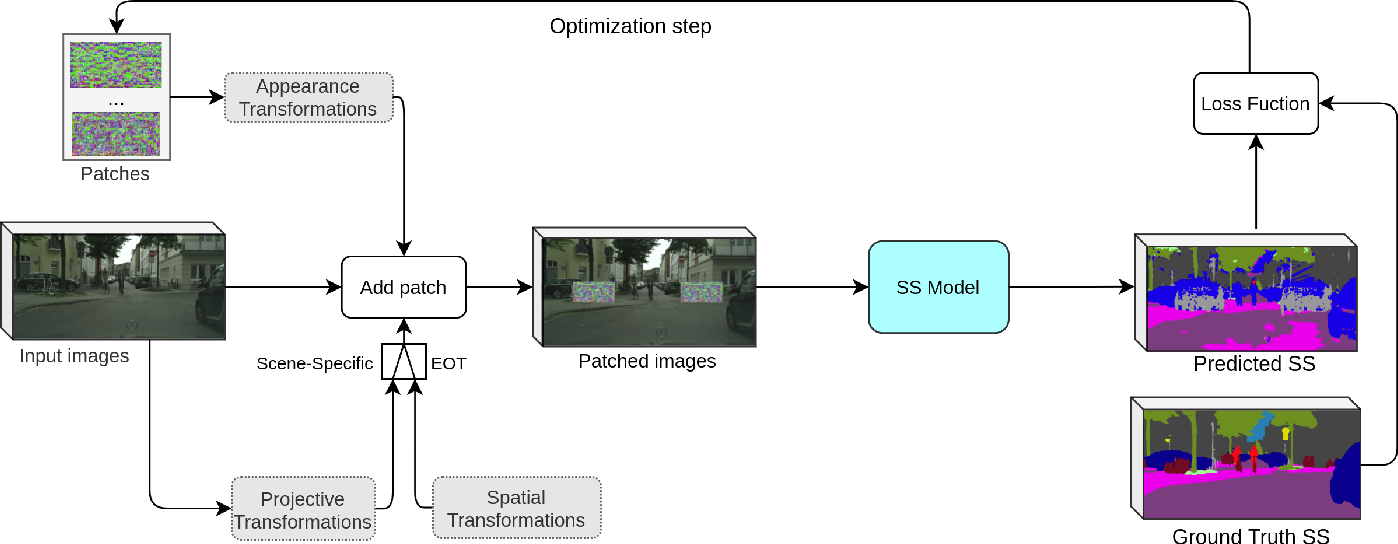
To keep the structure general, each task has its own Task Interface object that handles the task-specific optimization and evaluation steps.
Also, each attack is task-specific and defined in its own class. Models, losses, metrics, and utilities are in the task-specific libraries ptsemseg, ptod, ptdepth, and pt3dod.
This generalization helps maintain the same structure for each task, as well as the possibility to extend the optimization to any user-defined attack of model.
This repo is intended to work with CARLA-generated datasets as the ones that you can find here. This is because the scene-specific attack requires exact camera-to-billboard roto-translation information for accurate patch placing.
The models used for the generation of the patches included in these datasets are in the following table:
| Network | Link to repo |
|---|---|
| DDRNet23Slim | https://github.com/ydhongHIT/DDRNet |
| BiseNetX39 | https://github.com/ycszen/TorchSeg |
| Faster R-CNN | torchvision zoo |
| RetinaNet | torchvision zoo |
| GLPDepth | https://github.com/vinvino02/GLPDepth |
| AdaBins | https://github.com/shariqfarooq123/AdaBins |
| Stereo R-CNN* | https://github.com/HKUST-Aerial-Robotics/Stereo-RCNN/tree/1.0 |
* Differently from the other models that only require the weights to be downloaded, Stereo R-CNN requires the entire repo to be cloned and installed in pt3dod/models. Please follow the repo instructions, also for the installation of the evaluation script.
To evaluate the performance of a network, it is sufficient to run
python eval_script.py --config path/to/config.yml, while for the optimization you must run python optimization_script.py --config path/to/config.yml.
The .yml config file (of which we shared a template for each network used) is the same for optimization and evaluation. In the latter case, the part dedicated to the optimization is ignored (but results are saved anyway --- so double check the experiment folder to make sure you don't overwrite anything important).
You can extend the code to include:
- user-defined models: it is sufficient to copy the model .py file in the corresponding task-specific model library (e.g., for a segmentation CNN, in
ptsemgseg/models), add the initialization line in themodels/__init__.py, and add the pytorch weights loading function inutils.py. All the other network-specific configuration parameters are in the config file. - user-defined attacks: it is sufficient to define a new loss in the corresponding attack class file (
attacks/folder).
If you have any questions feel free to contact us!
Code is coming soon.