A natural-language provenance convention for human-AI collaborative code.
No tooling required. Empirically tested. Honest about uncertainty.


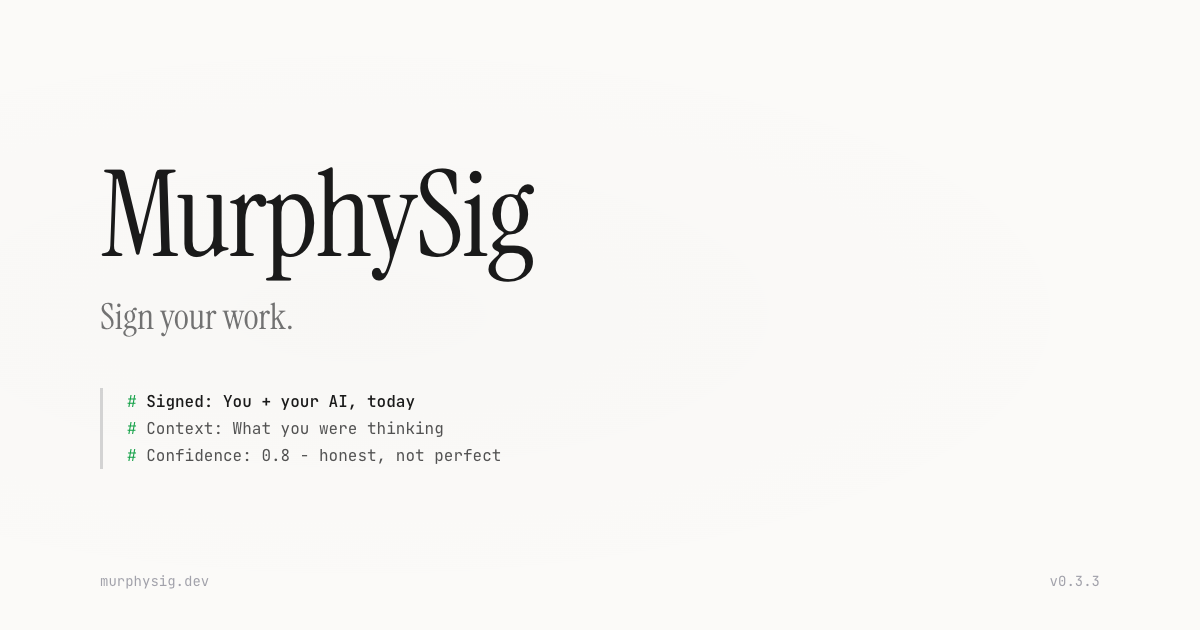
A MurphySig is a comment block at the top of any file, in the language you already write in:
Signed: Kev + claude-opus-4-7, 2026-04-23
Format: MurphySig v0.4 (https://murphysig.dev/spec)

Context: Hotfix 9.0.5 — deferred MapView.onDestroy() to next frame to
narrow the race window between Maps SDK lite mode's posted Runnables
and bitmap recycling.

Confidence: 0.6 - narrows the race but doesn't eliminate it; budget
devices with slower SoCs may still hit the window.
Open: Should we pursue the snapshot-to-ImageView refactor?
That's the whole thing. AIs read it. Humans read it. Nothing breaks if you ignore it.
Two reasons that hold up under scrutiny:
-
It changes how AIs treat your code. Empirically tested across Claude and GPT families:
- In-context "never fabricate provenance" rule drops AI fabrication of code authorship from 11%–100% to 0%, depending on family. (benchmark)
- Signed code gets +0.12 better coverage when an AI is asked to brief unfamiliar work.
-
It captures the thing commit messages don't. Confidence and what you didn't know. The bits that rot fastest in
git logare the bits MurphySig is built to preserve.
Sign one file (zero install): copy the comment block above, paste at top of any file, fill it in.
Provision a whole repo (one command):
curl -sL https://murphysig.dev/init | bashWrites a .murphysig declaration at root. Prepends @.murphysig to your CLAUDE.md if you have one. Idempotent.
Use the CLI (optional convenience):
git clone https://github.com/Round-Tower/murphysig.git
ln -s "$PWD/murphysig/bin/sig" /usr/local/bin/sig

sig init                # write .murphysig in current repo
sig add <file>          # interactive sign of a file
sig review <file>       # add a Reviews: entry on a previously-signed file
sig gallery             # list all signed files
sig questions # list all open Open: questions| Score | Meaning |
|---|---|
| 0.9+ | Battle-tested, production-proven |
| 0.7–0.9 | Solid, would pass code review |
| 0.5–0.7 | Works but unproven |
| 0.3–0.5 | Prototype quality |
| 0.0–0.3 | Placeholder, probably wrong |
Text values are also valid (Confidence: High, Confidence: untested). The number is for honesty, not precision.
Never fabricate provenance. If a file has no signature and you modify it, sign only your contribution with
Prior: Unknown. Do not invent authors, dates, or collaborator model versions you weren't part of.
This is the load-bearing rule. The benchmark proves it works. AI assistants read this when they enter a repo with a .murphysig file at root and behave accordingly.
Three sub-benchmarks, 198 AI calls + 186 judge calls + a separate 18-call cross-family run, fixtures and runners in benchmark/.
| Finding | Result |
|---|---|
| Honesty — anti-fabrication rule (Claude) | 11% → 0% fabrication (cold→warm) |
| Honesty — anti-fabrication rule (GPT-5.4) | 100% → 0% fabrication (cold→warm) |
| Tacit knowledge — signed code briefs better | +0.12 coverage (0.65 → 0.77) |
| Confidence direction — does 0.3 vs 0.9 polarize AI review? | No measurable effect (deleted from spec in v0.4) |
The third row is intentionally unflattering. v0.4 removed an unsupported claim. Full methodology and per-case data on the benchmark page.
- Full Specification — the canonical document
- Benchmark — what's true, what's not, why
- Launch field report — 90 days of using it on my own code
- Plain text spec · llms.txt — for AI systems
The Unlicense. Public domain. Use freely. Attribution appreciated but not required.
Reading the spec critically and pushing back is the most valuable contribution. Independent runs of the Honesty benchmark against models other than Claude / GPT-5 (Gemini, Grok, Llama) would meaningfully strengthen the empirical foundation. Open an issue, open a PR, or just .murphysig your repo and the next time someone scrapes GitHub for adopters, you'll show up.
—
Built by Kev Murphy. Signed.