Repository navigation
Test protocol
The HTML report is for the engineer at the bench. The test protocol is the
document that goes with the unit: into the device history record, to the
customer, into the binder next to the line. Since 0.4.0 every run writes one,
made with test-protocol from the
run's result.json.
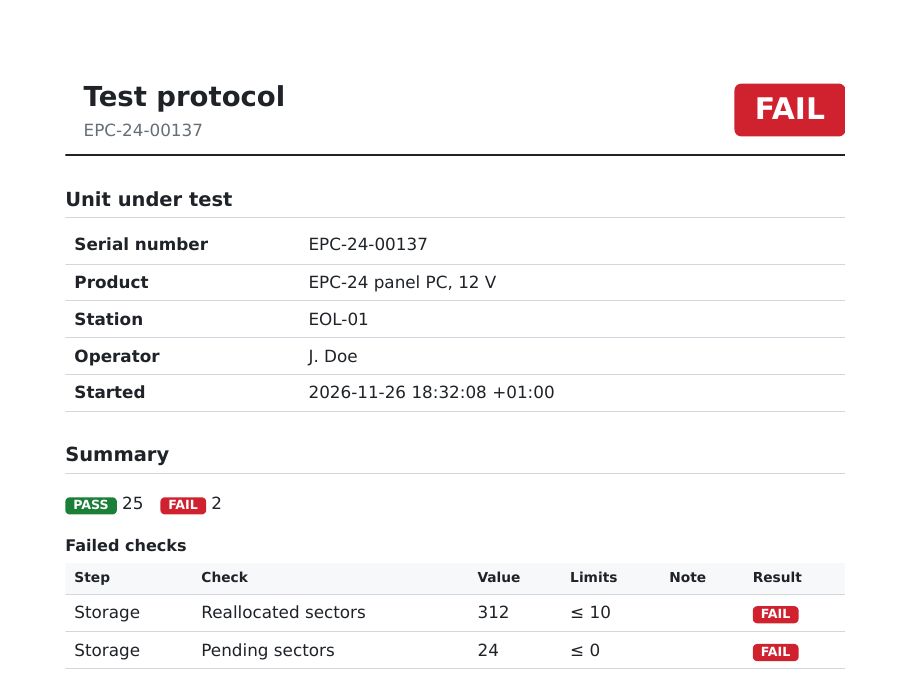
- the verdict, large, at the top right
- unit, product, station, operator and start time
- a summary with the failed checks first, so nobody has to search for them
- every step with its measurements, limits and a small gauge showing where a value sits inside its tolerance band
- the full console log and the instrument identities as attachments
- the SHA-256 of
result.json, so the protocol can be traced back to the raw data - signature boxes for "Tested by" and, optionally, "Approved by"
The protocol section of station.yaml:
protocol:
  product: "EPC-24 panel PC, 12 V"
  lang: en                   # en or de
  approver: true             # adds an "Approved by" signature box
  company: "Your company"
  logo: logo.svg             # PNG, JPEG or SVG, relative to station.yaml
  title: "Final inspection"  # instead of "Test protocol"
Leave the section out and no protocol is written. An empty section
(protocol: {}) writes one with the defaults.
bench run --operator "J. Doe" --pdf--operator fills the name in the "Tested by" box. --pdf also writes
protocol.pdf; it needs either WeasyPrint (pip install weasyprint) or
Chrome, Chromium or Edge on the machine. Without one, the HTML protocol is still
written and the station prints a warning — the verdict and the exit code of the
run do not change because of a missing printout.
lang: de gives a "Prüfprotokoll" with German headings, dates and decimal
commas. The step and measurement names come from the station and stay as they
are.
test-protocol can merge several result files of one unit into one
protocol, for example the bench test and the
interface-test-kit result of
the same board. That is a separate call after both tests:
test-protocol reports/EPC-24-00137_*/result.json itk-run/result.json \
    --html EPC-24-00137.html --operator "J. Doe" --approver
Both files must carry the same serial number; test-protocol stops if they do not.