Repository navigation
Home
opcua-sim simulates OPC UA devices that behave and fail: a drive that ramps up after
Start and latches a trip until Reset, a transmitter whose broken sensor reads
BadSensorFailure, alarms that arrive as real events and wait for your Acknowledge. Develop and
test SCADA links, HMIs, gateways and data loggers without the plant, also in CI.
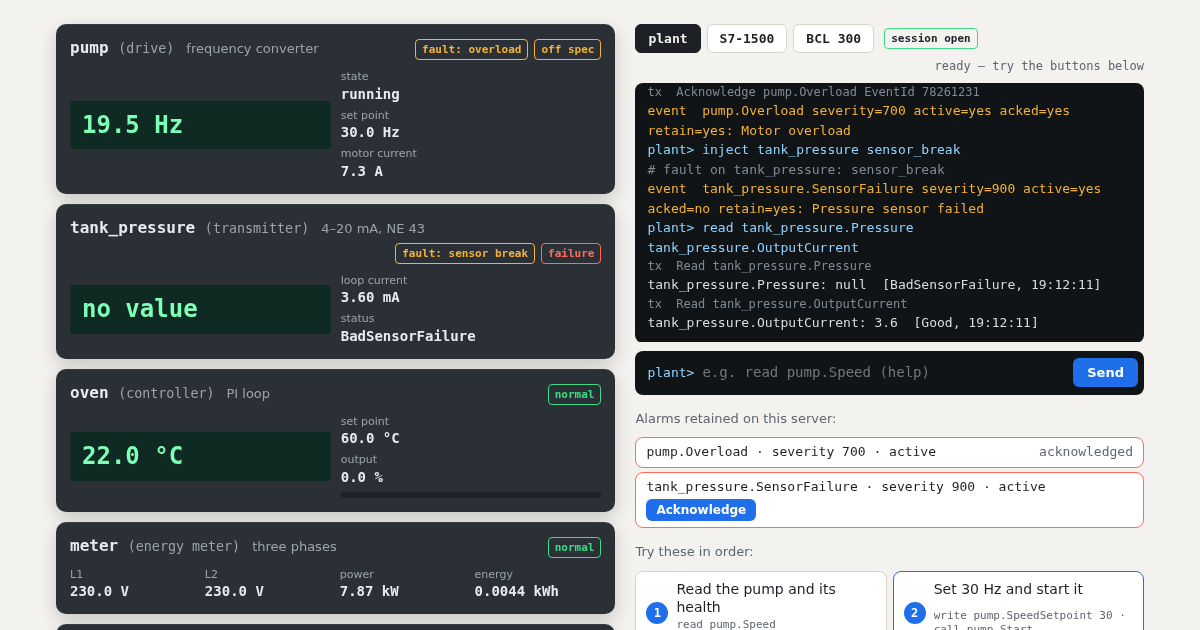
Look at it without installing anything: https://opcua-sim.steitec.net runs the device code in your browser, but not the OPC UA wire protocol. See Browser demo.
-
Testing the unhappy paths. A value that is
Badhas no number at all, a frozen one has a source timestamp that stopped moving, a server restart takes every session and subscription with it. -
Testing alarm handling. Conditions must be acknowledged with the right
EventIdand fetched again withConditionRefreshafter a reconnect. -
Moving between brands. Quotes in Siemens node IDs, the
|var|of CODESYS, a namespace index that differs per server. - Running OPC UA code in CI. A new server for every test, in a pytest fixture or as a background process.
| If you want to … | read |
|---|---|
| look at it without installing the server | Browser demo |
| install it and read a first value | Getting started |
| look like an S7-1500, TwinCAT, PLCnext, CODESYS, Omron NX or Leuze BCL 300 | Product profiles |
| use it in pytest and CI pipelines | Testing in CI |
| check that your code copes with misbehaving devices | Fault injection recipes |
| find out why something is refused or does not connect | Troubleshooting |
The README is the complete reference: the profile format, bench files, every fault, the command line. This wiki adds walkthroughs and background.
| Install |
pip install opcua-sim (Python 3.10+; depends on asyncua and PyYAML) |
| Transport |
opc.tcp://, default port 4840, control channel on 4841 |
| Security | None, Sign, SignAndEncrypt (Basic256Sha256), user names, read-only users |
| Generic devices |
pressure-transmitter, temperature-controller, drive, energy-meter, generic-sensor
|
| Product layouts |
siemens-s7-1500, beckhoff-twincat3, phoenix-plcnext, codesys-control, omron-nx, leuze-bcl300
|
| Device faults |
bad_status, freeze, stale, drift, reject_write, method_fail, health, plus those of each model |
| Server faults |
delay, blackhole, drop_connections, refuse, server_state, service_level, restart
|
| Tested on | Linux, Windows, macOS; Python 3.10 and 3.13; cross-checked with asyncua and node-opcua clients |
| License | MIT; the asyncua stack underneath is LGPL-3.0 and installed as a separate package |
Not tested against UaExpert, commercial SCADA systems, real PLCs or a conformance tool. If your client disagrees with it, please open an issue.