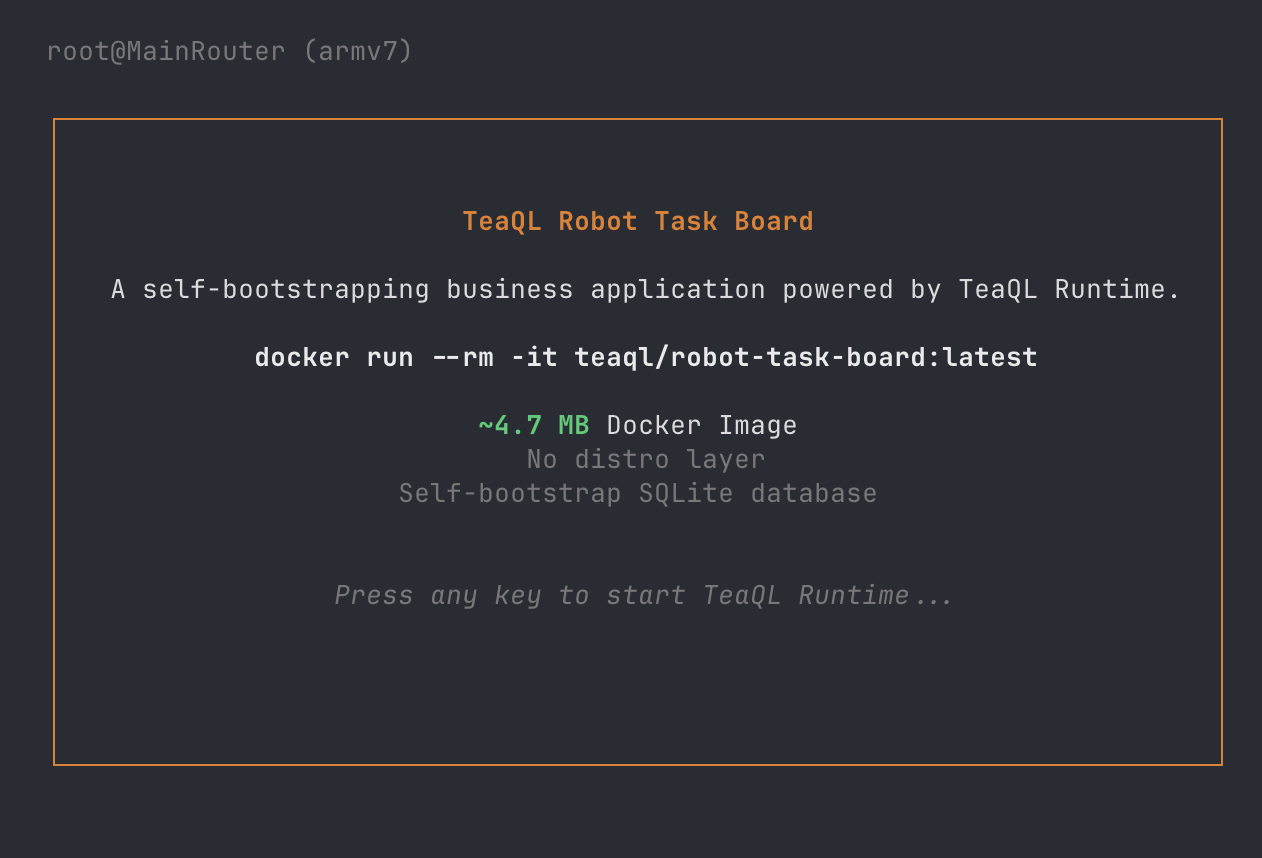
A tiny self-bootstrapping business application built with TeaQL Runtime.
Fully open source: demo app + generated libraries + TeaQL Rust runtime.
docker rmi -f teaql/robot-task-board:latest
docker run --rm -it teaql/robot-task-board:latest- ~4.7 MB Docker image
- No distro layer
- Self-bootstrap SQLite DB
- Business Trace & SQL Introspection
- Domain-model-driven runtime
- Runs comfortably within a few megabytes of memory
Tiny Docker image: about 2.5 MB on disk.
Watch TeaQL Runtime bootstrap itself, verify the domain schema, initialize reference data, and start the application.
A 65-second walkthrough to demo live TeaQL runtime trace, click to play:
A short live proof that the TeaQL Robot Task Board exists, runs, and exposes the full runtime trace:
The demo is fully open source, including:
- the demo application
- the generated TeaQL domain libraries
- the TeaQL Rust runtime
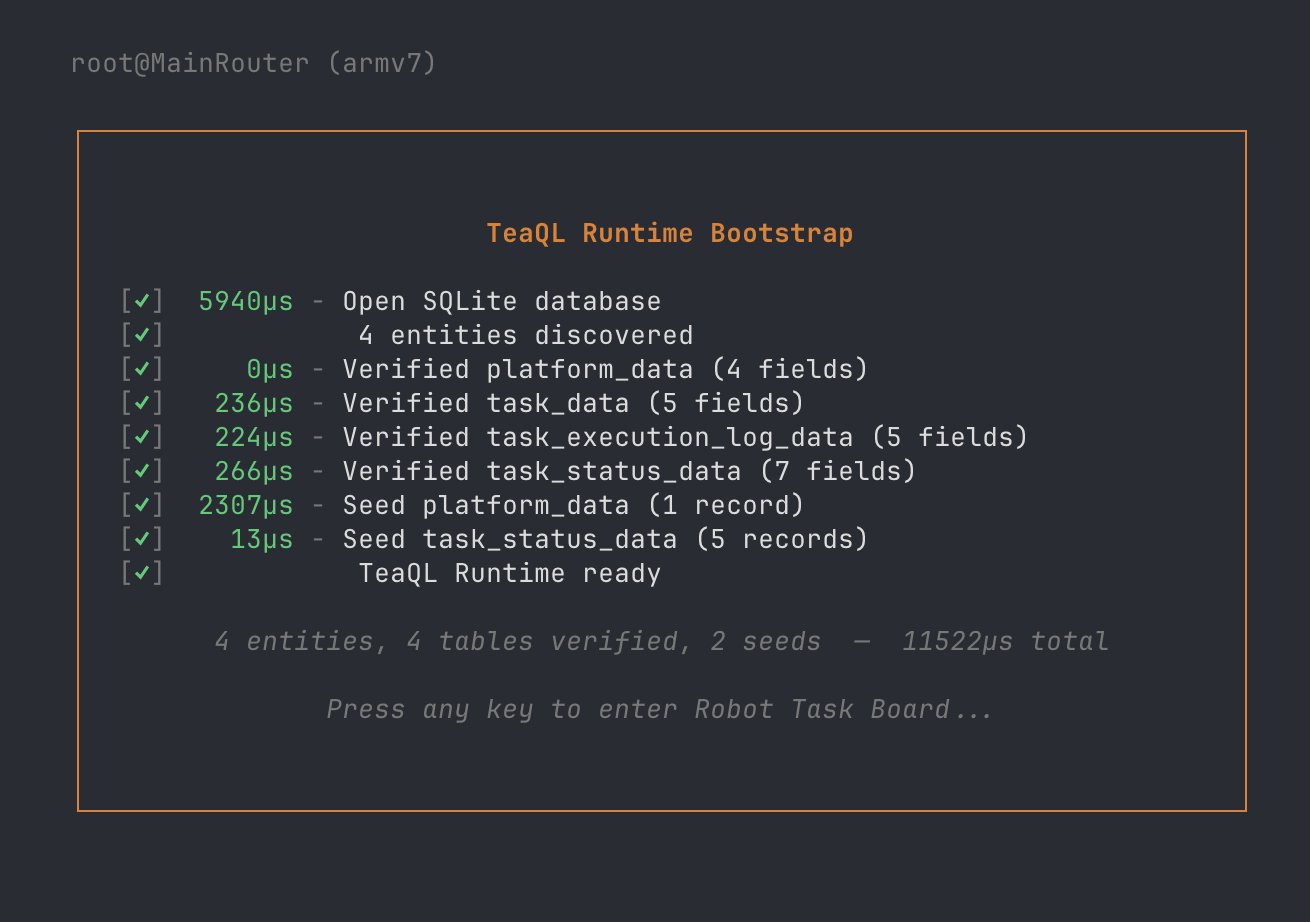
TeaQL Runtime starts from an empty environment and automatically:
- Opens the database
- Discovers domain entities
- Verifies storage structures
- Verifies reference data
- Starts the runtime
Example startup trace:
Open SQLite database

4 entities discovered

Verified platform_data (4 fields)
Verified task_data (5 fields)
Verified task_execution_log_data (5 fields)
Verified task_status_data (7 fields)

Seed platform_data (1 record)
Seed task_status_data (4 records)

TeaQL Runtime ready

4 entities, 4 tables verified, 2 seeds
24348μs total
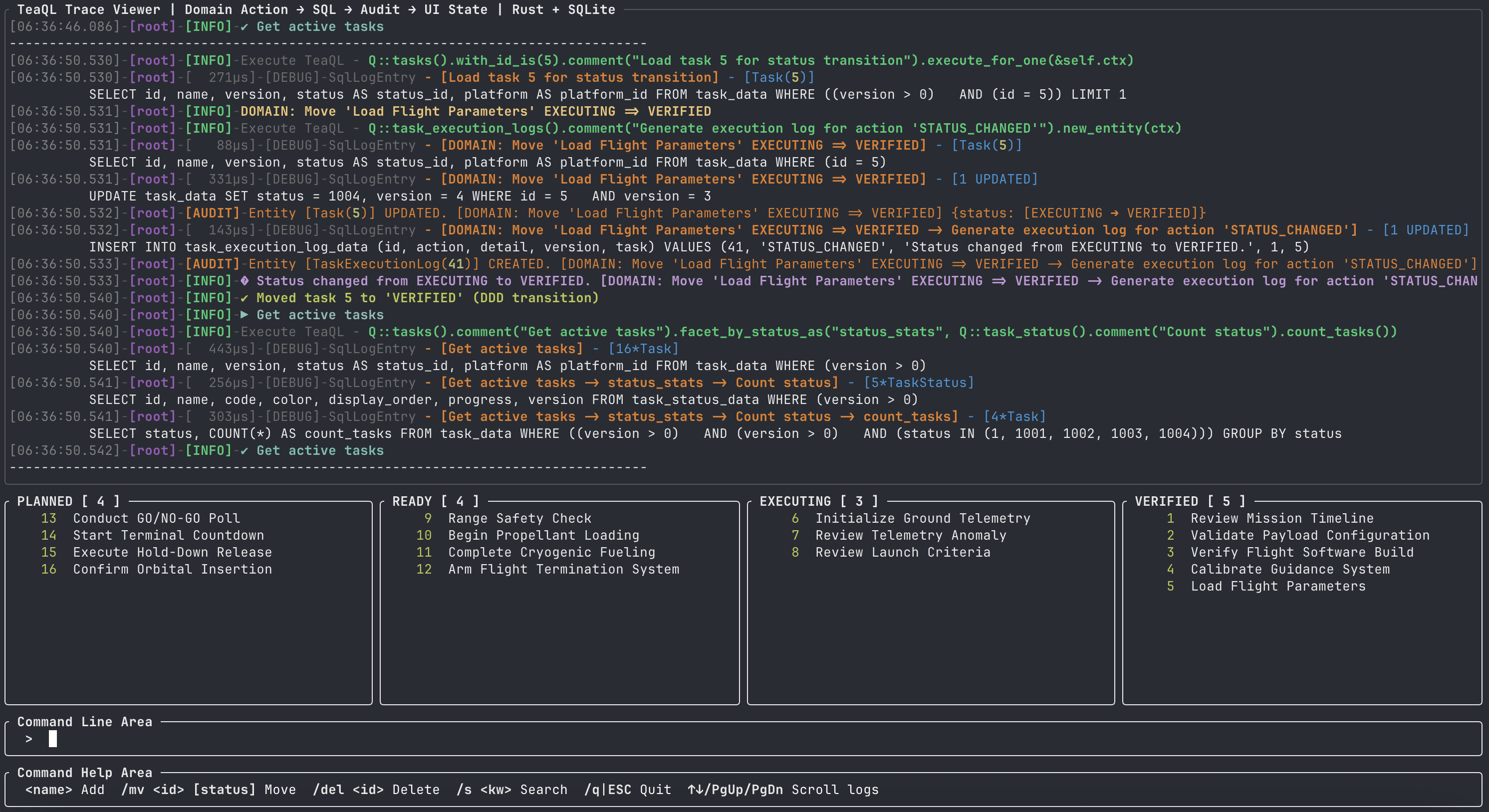 The task board is intentionally simple.
Its purpose is not to demonstrate task management.
Its purpose is to demonstrate how TeaQL Runtime powers a real business application through generated domain models, business traces, audit trails, and query execution.
Unlike traditional ORMs, TeaQL exposes how business operations are translated into runtime behavior.

Example: Comment Propagation
Get active tasks
 └── status_stats
      └── Count status
         └── count_tasks
[06:36:50.540]-[root]-[INFO]-Execute TeaQL - Q::tasks().comment("Get active tasks").facet_by_status_as("status_stats", Q::task_status().comment("Count status").count_tasks())          │
│[06:36:50.540]-[root]-[  443µs]-[DEBUG]-SqlLogEntry - [Get active tasks] - [16*Task]                                                                                                    │
│          SELECT id, name, version, status AS status_id, platform AS platform_id FROM task_data WHERE (version > 0)                                                                     │
│[06:36:50.541]-[root]-[  256µs]-[DEBUG]-SqlLogEntry - [Get active tasks -> status_stats -> Count status] - [5*TaskStatus]                                                               │
│          SELECT id, name, code, color, display_order, progress, version FROM task_status_data WHERE (version > 0)                                                                      │
│[06:36:50.541]-[root]-[  303µs]-[DEBUG]-SqlLogEntry - [Get active tasks -> status_stats -> Count status -> count_tasks] - [4*Task]                                                      │
│          SELECT status, COUNT(*) AS count_tasks FROM task_data WHERE ((version > 0)   AND (version > 0)   AND (status IN (1, 1001, 1002, 1003, 1004))) GROUP BY status                 │
│[06:36:50.542]-[root]-[INFO]-✔ Get active tasks                                                                                                                                         │
│--------------------------------------------------------------------------------
TeaQL propagates comments through nested queries, facets, and aggregates, so every generated SQL statement can still be traced back to the business intent that produced it.
TeaQL applications are composed of three layers.
┌─────────────────────────────────────┐
│ Application Layer                   │
│                                     │
│ Robot Task Board                    │
│ ERP                                 │
│ API Services                        │
│ CLI Applications                    │
│ Industrial Systems                  │
│                                     │
│ Controlled by application teams     │
└─────────────────────────────────────┘
                  │
                  ▼
┌─────────────────────────────────────┐
│ Generated Domain Model Layer        │
│                                     │
│ Entities                            │
│ Requests                            │
│ State Changes                       │
│ Query APIs                          │
│ Business Behaviors                  │
│                                     │
│ Generated from domain definitions   │
└─────────────────────────────────────┘
                  │
                  ▼
┌─────────────────────────────────────┐
│ TeaQL Runtime Layer                 │
│                                     │
│ Query Execution                     │
│ SQL Generation                      │
│ Transactions                        │
│ Audit Trails                        │
│ Business Trace                      │
│ Facets                              │
│ Bootstrap                           │
│ Schema Verification                 │
│ Runtime Infrastructure              │
│                                     │
└─────────────────────────────────────┘
TeaQL Runtime is not the application itself.
TeaQL Runtime is the infrastructure layer that supports generated domain model code and allows business applications to run.
Traditional business software often requires heavyweight infrastructure.
TeaQL Runtime is designed to support business applications across a very wide range of environments.
- Routers
- Industrial gateways
- ARM devices
- Embedded Linux systems
- Edge computing platforms
- Internal enterprise applications
- ERP systems
- Workflow systems
- Operational platforms
- Financial systems
- Trading infrastructure
- Audit-heavy applications
- Low-latency business services
The same domain model can scale from embedded devices to mission-critical business systems.
TeaQL focuses on making business software:
- Observable
- Traceable
- Domain-driven
- Resource-efficient
- AI-friendly
- Portable
The goal is to let developers understand what their business code actually does.
This project is fully open source.
The demo application, generated TeaQL libraries, and the TeaQL Rust runtime are released under the Apache License 2.0.
Powered by TeaQL (@teaqlio)