How can a parameter name support multiple variable types? #3751

Description

First Check
- I added a very descriptive title to this issue.
- I used the GitHub search to find a similar issue and didn't find it.
- I searched the FastAPI documentation, with the integrated search.
- I already searched in Google "How to X in FastAPI" and didn't find any information.
- I already read and followed all the tutorial in the docs and didn't find an answer.
- I already checked if it is not related to FastAPI but to Pydantic.
- I already checked if it is not related to FastAPI but to Swagger UI.
- I already checked if it is not related to FastAPI but to ReDoc.
Commit to Help
- I commit to help with one of those options 👆
Example Code
# -*- coding:utf-8 -*-
import traceback
from typing import Optional
import uvicorn
from fastapi import FastAPI, File, Form, UploadFile

app = FastAPI()


@app.post("/filesper/")
def filesper(
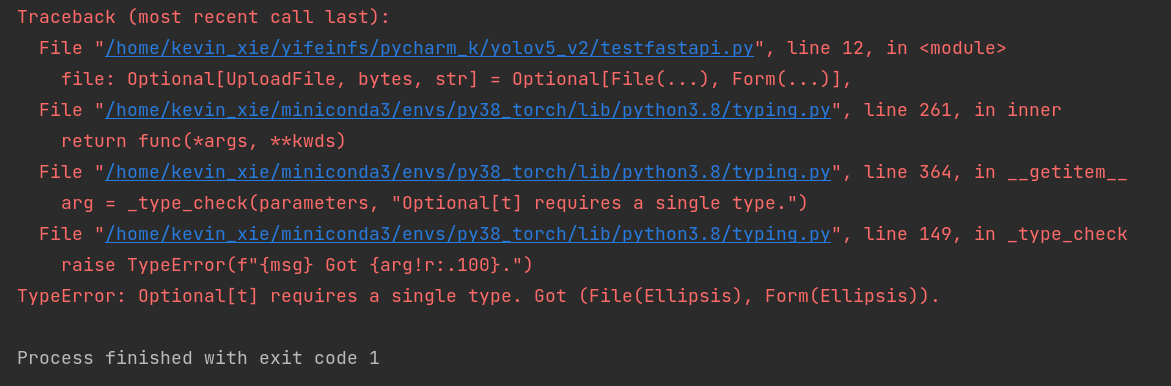
        file: Optional[UploadFile, bytes, str] = Optional[File(...), Form(...)],
):
    try:
        if file:
            return 1
    except:
        traceback.print_exc()
        return -1


if __name__ == '__main__':
    uvicorn.run('testfastapi:app', host='0.0.0.0', port=8001, reload=False, debug=False, workers=1)
Description
hello!
How can a parameter variable name support multiple types?
In the program,file: Optional[UploadFile, bytes, str] = Optional[File(...), Form(...)],this program is my imagination,I want file parameter can be anything that I need, isinstance() can be used to distinguish detail types.
I don't think it can succeed, but I want to know why.
thank you!
Operating System
Linux
Operating System Details
CentOS 7
FastAPI Version
0.68.0
Python Version
Additional Context