

-
First Check
Commit to Help
Example Codeimport fastapi
import pydantic
class NestedModel(pydantic.BaseModel):
x: pydantic.BaseModel
y: pydantic.BaseModel
def create_app():
for _ in range(100):
fastapi.routing.APIRoute(
"/test", endpoint=lambda: ..., response_model=NestedModel
)
# PROFILING
import yappi
yappi.set_clock_type("CPU")
with yappi.run():
create_app()
stats = yappi.get_func_stats()
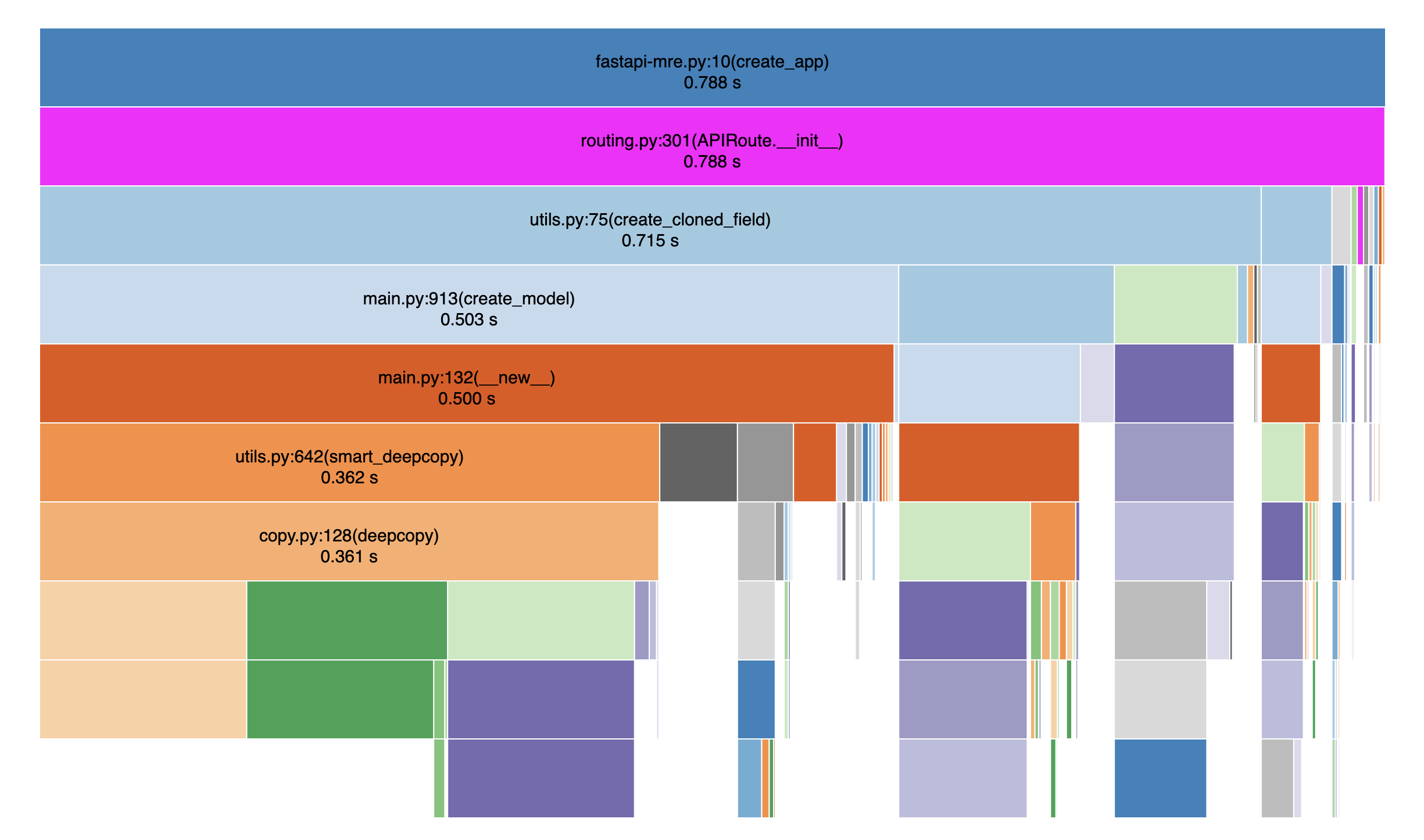
stats.save("fastapi.pprof", type="pstat")DescriptionWhen building a FastAPI application with nested Pydantic models, the For the trivial example, you can see that Note, timing is CPU time not WALL time
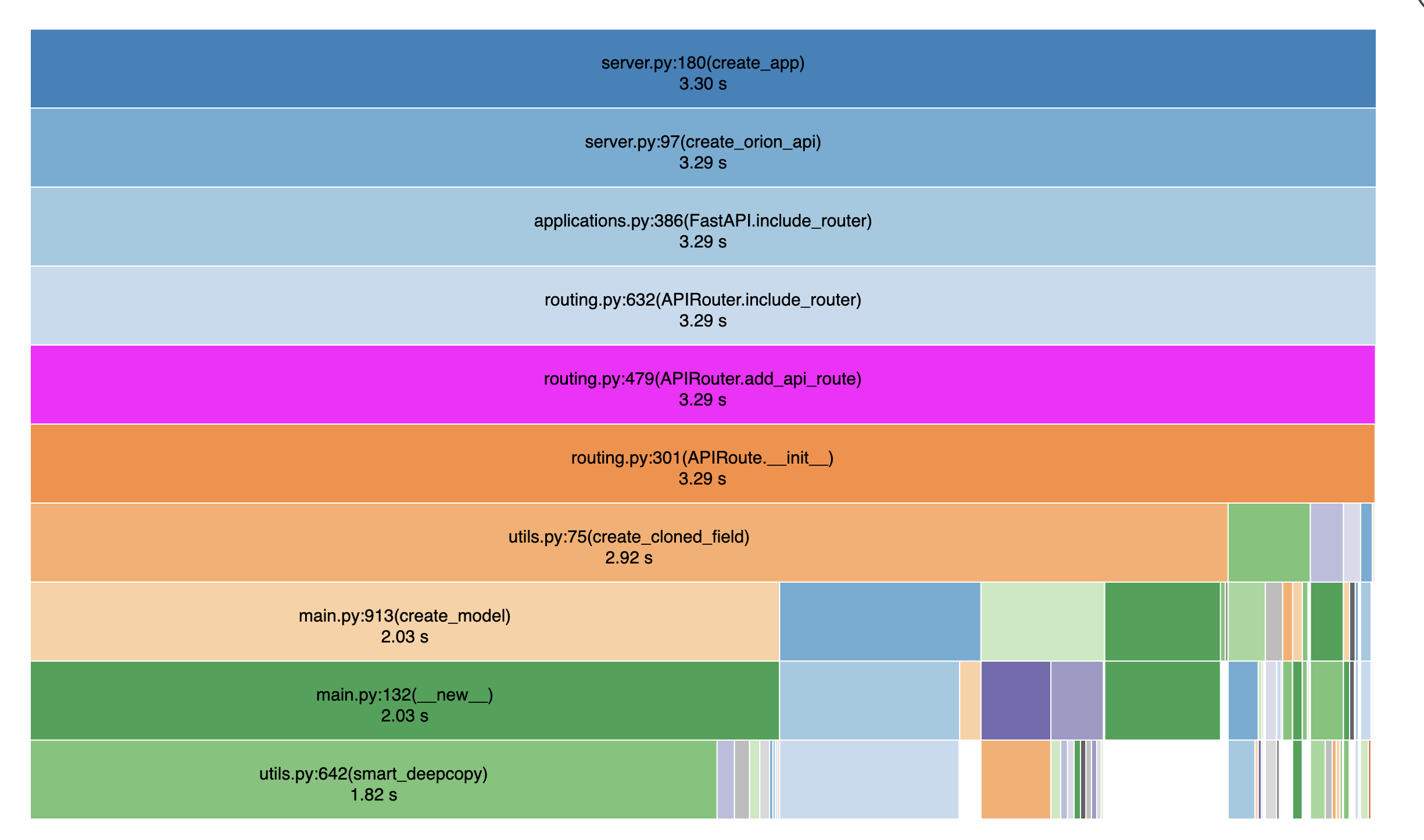
If we replace this trivial application with the one from Prefect,
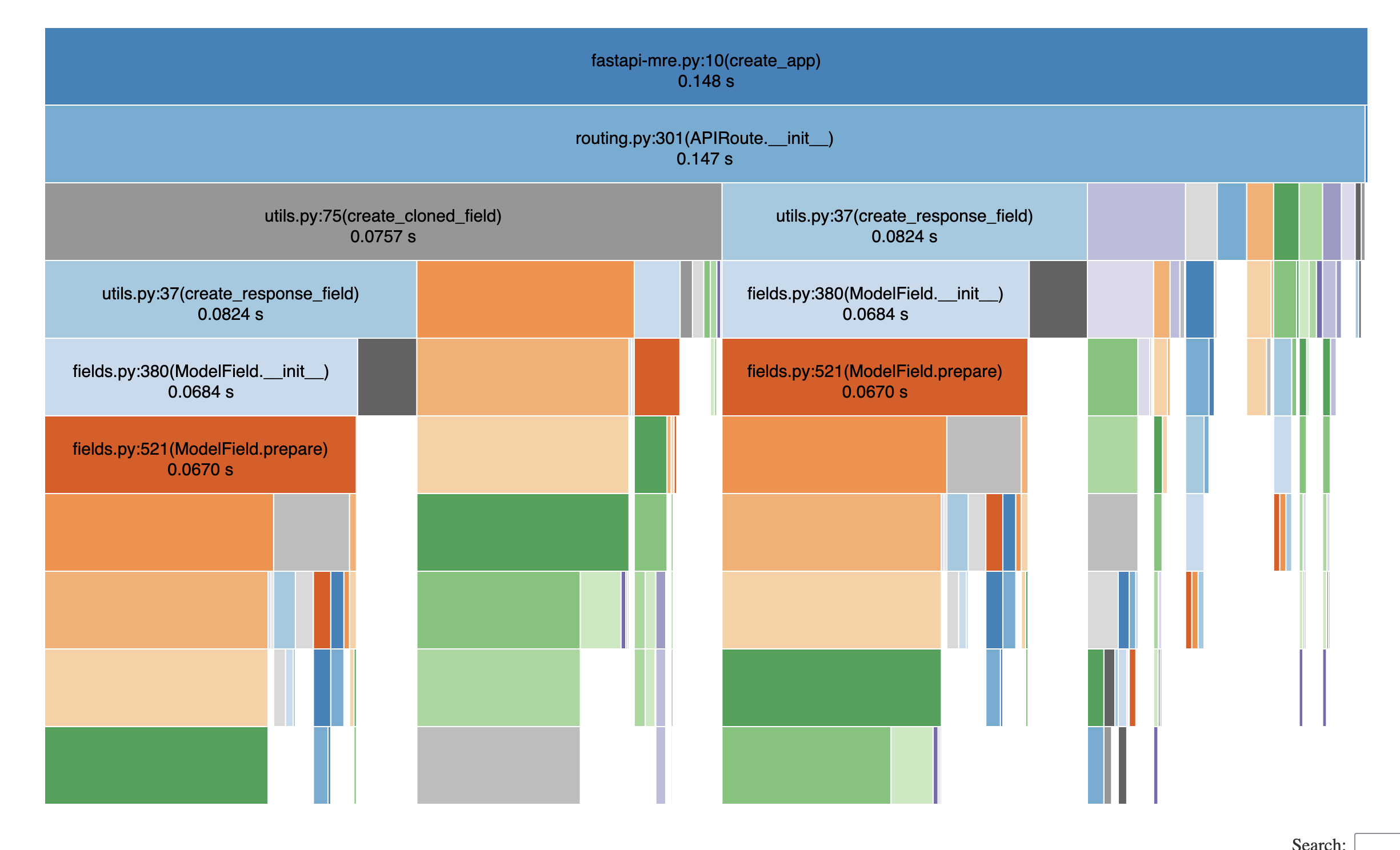
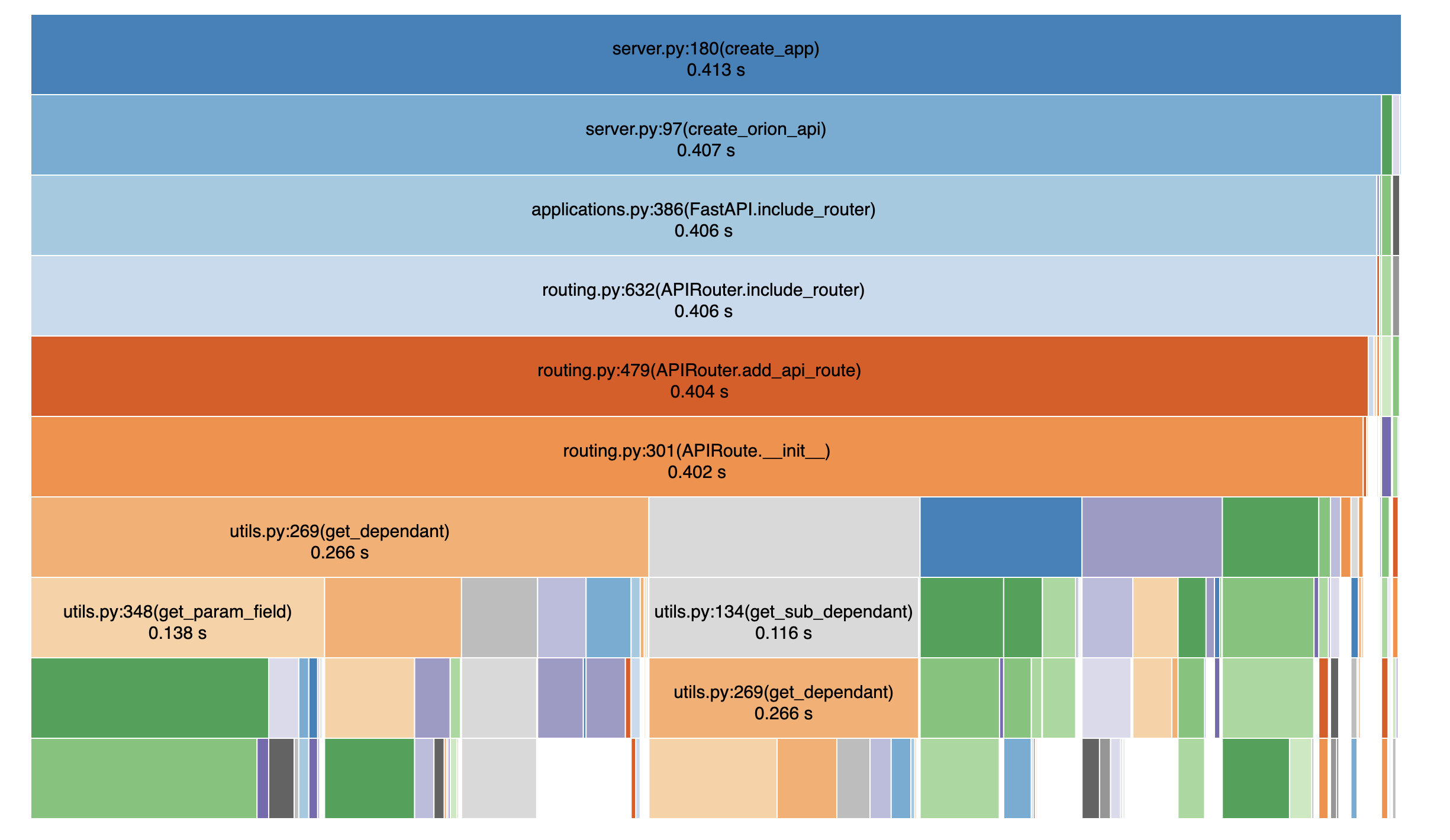
With a patch to retain the cache across calls to this function, we can get this down to 50% of the CPU time with a ~5x overall speedup.
This speedup persists and is even more significant in a real-world application with
Operating SystemmacOS Operating System DetailsNo response FastAPI Version0.74.0 Python Version3.8.12 Additional ContextThis may also be resolvable with pydantic/pydantic#1008 as mentioned in #894 (comment) |
Beta Was this translation helpful? Give feedback.
Replies: 22 comments 9 replies

-
|
We are currently having this issue in a bigger FastAPI project. The startup time did increase to a minute till several minutes over the last months - just to get the server running and on every code change while doing development. As a quick test we did just "remove" the So I would love to get this fixed. ;-) |
Beta Was this translation helpful? Give feedback.
-
|
Little update: I did use the patch provided in the pull request after all, but just reverted this on my local dev setup as it did produce problems when working with ForwardRef's. Those seem to be not resolved any more, possibly because an "old version" of the model is cached now. Have to dig into this - but the patch will introduce regression bugs for sure....so just you know. |
Beta Was this translation helpful? Give feedback.
-
|
Update again - this is a real issue: Thing is besides taking for basically ever to load without the patch and loading in about 30 seconds with the patch....also the RAM usage skyrockets....which the patch also fixes.
Again just FYI - we will need a good solution for that. |
Beta Was this translation helpful? Give feedback.
-
|
Thanks for giving this a test @ddanier ! Can you share an minimal complete example that uses forward refs and demonstrates how it breaks your routes? I can investigate adding handling for that case. |
Beta Was this translation helpful? Give feedback.
-
|
@madkinsz I will do that....sadly I did not have the time yet to really look into this. All details above are bits my colleagues gave me when trying to work on our own performance issue. The project we try to use this is pretty huge and even the ForwardRefs are no just plain normal ForwardRefs (they are part of dynamically generated pydantic model)...so I will need to setup a new project to get a simple example for this. What I can say for sure is that the problem occurred after we did try the patch and thus must be a direct result of this. Sorry if this takes some time, much to do currently. :) |
Beta Was this translation helpful? Give feedback.

-
|
Any update on this? |
Beta Was this translation helpful? Give feedback.

-
|
We are also heavily hit by this issue. But we added a hacky workaround for our tests which speeds up the test initialization hugely! It would be great to get the issue fixed. The hack is here for anyone hit by the same issue: FASTAPI_CLONED_TYPES_MEMO = {}
# Workaround for FastAPI initialization slowness causing slow test startup.
# https://github.com/tiangolo/fastapi/issues/4644
@pytest.fixture(scope="session")
def fix_slow_fastapi_issue(monkeypatch: MonkeyPatch) -> None:
import fastapi.routing
import fastapi.utils
orig = fastapi.utils.create_cloned_field
def patch(
field: ModelField, *, cloned_types: Optional[Dict[Type[BaseModel], Type[BaseModel]]] = None
) -> ModelField:
return orig(field, cloned_types=FASTAPI_CLONED_TYPES_MEMO if cloned_types is None else cloned_types)
patcher.setattr(fastapi.utils, "create_cloned_field", patch)
patcher.setattr(fastapi.routing, "create_cloned_field", patch)
@pytest.fixture(scope="session")
def http_app(fix_slow_fastapi_issue: None) -> FastAPI:
return create_test_app() # Does the FastAPI initializationProfiles via pytest-profiling After: cc @ddanier what issue are you seeing with the proposed fix do you have an example to give? We are also running a big FastAPI service but the patch seems to work for us. |
Beta Was this translation helpful? Give feedback.
-
|
We are currently using a monkey patched version of the normal # flake8: noqa
"""
This is a faster version of the main.py.
This version is faster by monkey patching the internals of FastAPI. It is
intended to NEVER be used in production. It is only for testing and
local development.
To can activate this file you may just create a `docker-compose.override.yml`
with the following contents:
---
version: "3.6"
services:
api:
command:
[
"poetry",
"run",
"uvicorn",
"something.fast_main:app",
"--host=0.0.0.0",
"--reload",
]
---
"""
from dataclasses import is_dataclass
from typing import Optional, cast
from weakref import WeakKeyDictionary
from pydantic import BaseModel, create_model
from pydantic.fields import ModelField
from pydantic.utils import lenient_issubclass
def patched_create_cloned_field(
field: ModelField,
*,
cloned_types: Optional[dict[type[BaseModel], type[BaseModel]]] = WeakKeyDictionary(),
) -> ModelField:
# _cloned_types has already cloned types, to support recursive models
if cloned_types is None:
cloned_types = WeakKeyDictionary()
original_type = field.type_
if is_dataclass(original_type) and hasattr(original_type, "__pydantic_model__"):
original_type = original_type.__pydantic_model__
use_type = original_type
if lenient_issubclass(original_type, BaseModel):
original_type = cast(type[BaseModel], original_type)
use_type = cloned_types.get(original_type)
if use_type is None:
use_type = create_model(original_type.__name__, __base__=original_type)
cloned_types[original_type] = use_type
for f in original_type.__fields__.values():
use_type.__fields__[f.name] = patched_create_cloned_field(
f, cloned_types=cloned_types,
)
new_field = fastapi.utils.create_response_field(name=field.name, type_=use_type)
new_field.has_alias = field.has_alias
new_field.alias = field.alias
new_field.class_validators = field.class_validators
new_field.default = field.default
new_field.required = field.required
new_field.model_config = field.model_config
new_field.field_info = field.field_info
new_field.allow_none = field.allow_none
new_field.validate_always = field.validate_always
if field.sub_fields:
new_field.sub_fields = [
patched_create_cloned_field(sub_field, cloned_types=cloned_types)
for sub_field in field.sub_fields
]
if field.key_field:
new_field.key_field = patched_create_cloned_field(
field.key_field, cloned_types=cloned_types,
)
new_field.validators = field.validators
new_field.pre_validators = field.pre_validators
new_field.post_validators = field.post_validators
new_field.parse_json = field.parse_json
new_field.shape = field.shape
new_field.populate_validators()
return new_field
import fastapi # noqa
fastapi.routing.create_cloned_field = patched_create_cloned_field
from something.main import app # noqaNote that the docs at the top only fit our own setup with running everything in docker and note that I did remove the app name (replaced by "something"). Anyways this seems to work for us now and we do not have any issues. I cannot reproduce the problems we had any more. RAM usage is still also down by a huge amount. Nice thing about this additional file + the monkey patch is that we still can just build a normal production version that does include this. |
Beta Was this translation helpful? Give feedback.

-
|
Thank you for the patch, @ddanier. I can attest that this is an issue with one of the larger services we have. Before patching: After patching: |
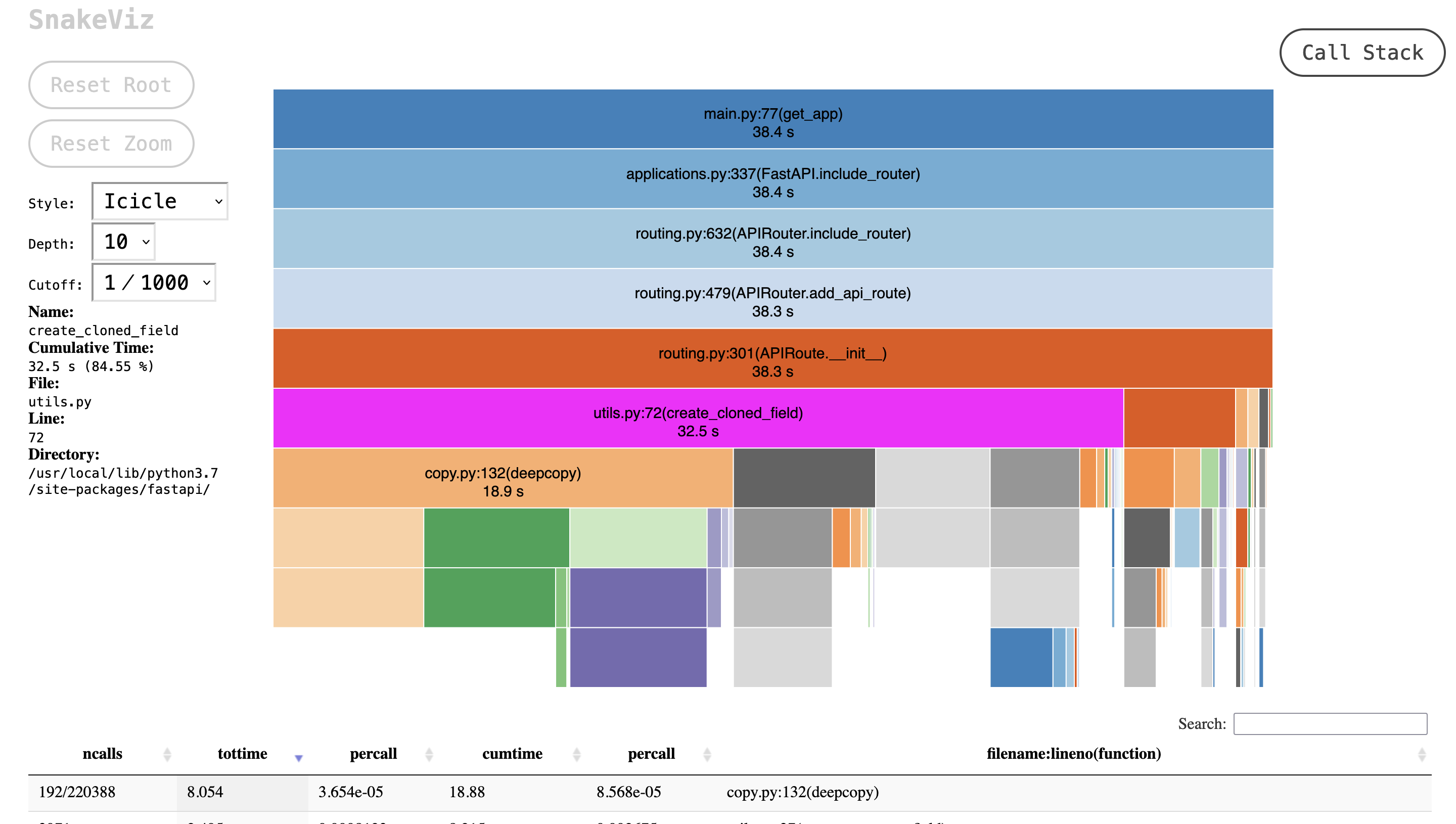
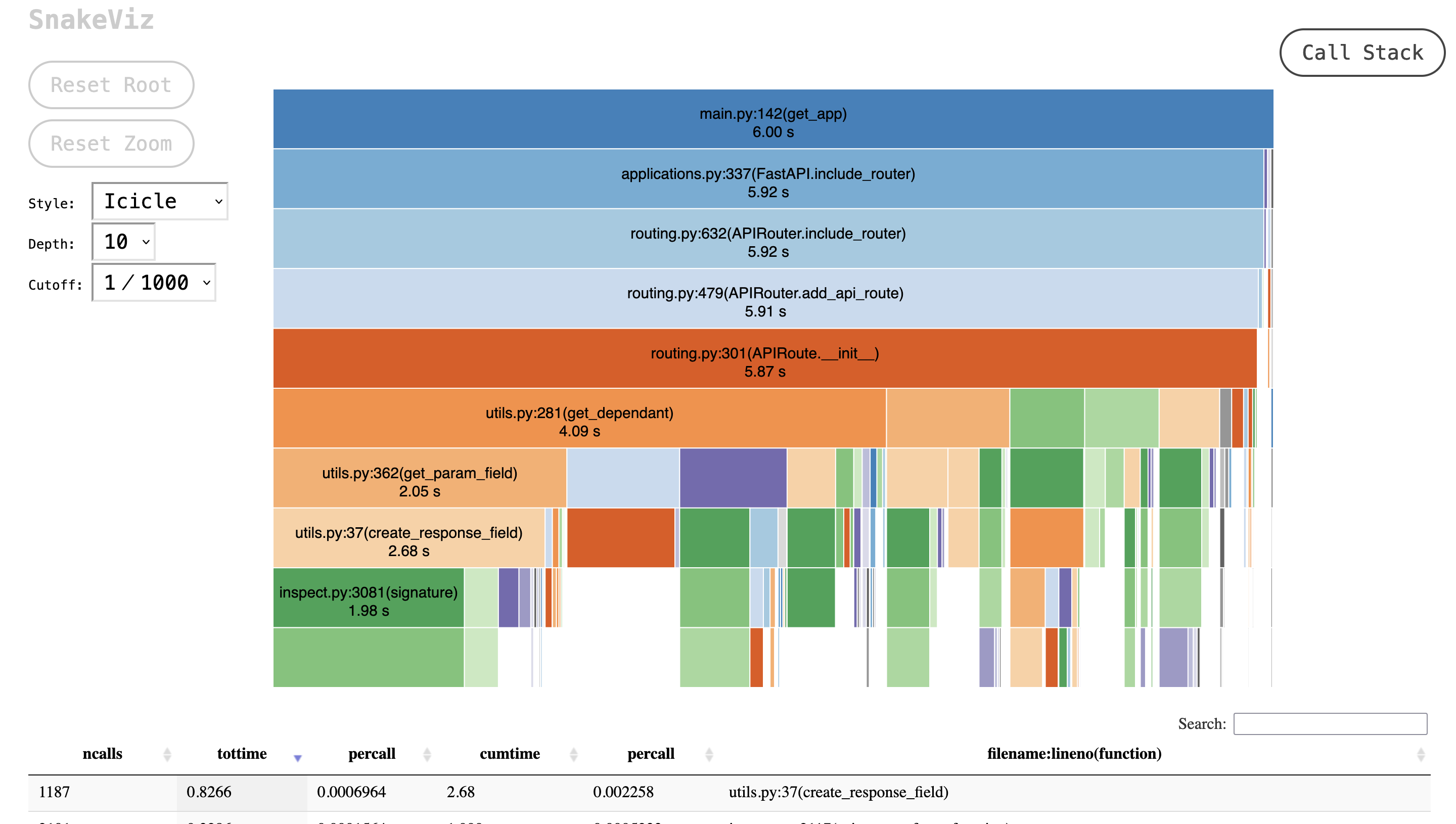
Beta Was this translation helpful? Give feedback.

-
|
Just leaving a note that I'll try the patch as well. When I start the app in itself, it's not so much of a problem per se but in my tests, this slowness is repeated for each test case and has rendered the tests very slow. |
Beta Was this translation helpful? Give feedback.

-
|
Glad I found this issue thread, my project was getting too slow to debug. maybe it will get some love at some point @tiangolo ? |
Beta Was this translation helpful? Give feedback.

-
|
Same here, especially annoying with |
Beta Was this translation helpful? Give feedback.

-
|
Although turning off(or caching here) response models will speed up startup a lot, it is still a problem with cold starts of Lambda. |
Beta Was this translation helpful? Give feedback.

-
|
My current startup time is around 3.5 minutes 😅 |
Beta Was this translation helpful? Give feedback.

-
|
I used the branch in #4645 and the time taken to register routers is quite literally 10x faster - from 8s to 0.8s. The PR has been waiting for review for a while... at least the author is kind enough to keep his branch (mostly) up to date with master, so thats what we're using |
Beta Was this translation helpful? Give feedback.
-
|
@tiangolo please let me know if there's anything I can do to get this migrated back to an issue since there's quite a bit of detail regarding the specifics of the problem here. |
Beta Was this translation helpful? Give feedback.

-
|
I too can confirm after encountering an existing FastAPI app that has 48 routers and 300 routes that this is a signifiant problem adversely affecting startup time in both testing/ development and production (we run fastapi on both AWS Lambda and ECS). For example, on my intel i9 16" MBP, the app takes 25-30secs to load with a 70% of that time accumulated in
Using a WeakKeyDictionary via @ddanier's patch and/ or #4645 drops that to a respectable 8 seconds. @tiangolo - what's the most helpful way to get the change tabled by @madkinsz reviewed and merged? |
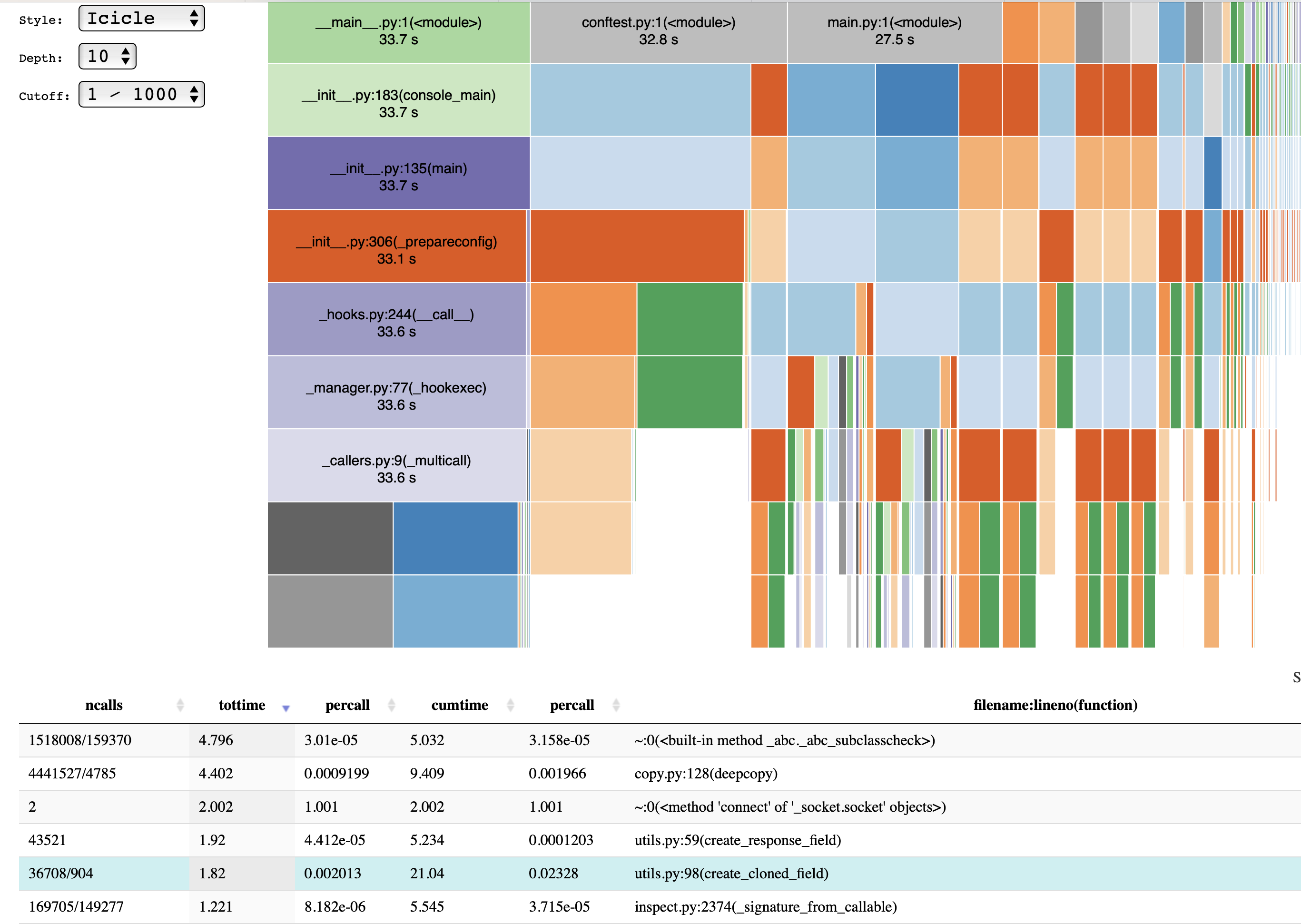
Beta Was this translation helpful? Give feedback.

-
|
We have the exact same situation as @followben. Impractically slow startup time when containers need to be spun up. @ddanier's patch works great for local development, but we're hesitant to implement this in production given how it alters the internals. What will it take to get this merged in @tiangolo ? |
Beta Was this translation helpful? Give feedback.

-
|
We noticed the exact same issue when running FastAPI application on AWS Lambda. Applying the above patch allowed us to get a significant speed-up during our cold starts (in our case we gained 1s) |
Beta Was this translation helpful? Give feedback.

-
We have the same issue with our FastAPI application on AWS Lambda. I'm going to test above workaround, but in the meantime I would like an official fix from the maintainer :) |
Beta Was this translation helpful? Give feedback.
-
|
We had to monkeypatch badly behaving class FixedFastAPI(FastAPI):
_create_cloned_field_patched = False
@staticmethod
def _fix_fastapi_routes_init_issue() -> None:
"""
Workaround for FastAPI initialization slowness causing slow startup and memory issues.
https://github.com/tiangolo/fastapi/discussions/8609
"""
import fastapi.utils
def patched_create_cloned_field(field: ModelField, **_kwargs: Any) -> ModelField:
# We dont need to use badly behaving create_cloned_field as we have ensured that the returned Pydantic
# instance and sub-fields match exactly the given model. We dont need to handle the derived class issues
# like in create_cloned_field.
return field
fastapi.utils.create_cloned_field = patched_create_cloned_field
fastapi.routing.create_cloned_field = patched_create_cloned_field
def __init__(self: AppType, **kwargs: Any) -> None:
if not FixedFastAPI._create_cloned_field_patched:
FixedFastAPI._fix_fastapi_routes_init_issue()
FixedFastAPI._create_cloned_field_patched = True
super().__init__(**kwargs)As a suggestion, could we have a way to override the class APIRoute(routing.Route):
def __init__(self, ...) -> None:
...
if self.response_model:
self.secure_cloned_response_field: Optional[
ModelField
] = self.create_secure_response_field(self.response_field)
@classmethod
def create_secure_response_field(cls, field: ModelField) -> ModelField:
# Applications can define what response securing means for them
return create_cloned_field(field)With the monkeypatch we got a big boost in startup time, it dropped from 40s to under 10s. Also the memory usage dropped by 3-4x!: 
|
Beta Was this translation helpful? Give feedback.

-
|
Thanks for the thorough report and for the discussion everyone! This should be fixed in #4645, in FastAPI 0.96.0, just released 🚀 Thanks @madkinsz for the fix! |
Beta Was this translation helpful? Give feedback.

-
|
I don't know about you guys, but after an upgrade to the very latest version of fastapi with pydantic v2 my coldstart times went up with factor 3. I had so many code changes that I am not 100% sure of the cause, but it seems similar to the issue we addressed here... |
Beta Was this translation helpful? Give feedback.

-
Beta Was this translation helpful? Give feedback.

-
|
@Kludex thanks! I will track that issue |
Beta Was this translation helpful? Give feedback.

-
|
I'm facing what appears to be the same issue (not sure). Run-time performance is good, but start up is really slow. I also noticed a huge increase in memory consumption. Using latest packages ... FastApi 0.103.1, pydantic 2.3.0, pydantic-core 2.6.3 Analyzing with cProfile gives this
|


Beta Was this translation helpful? Give feedback.

-
|
I figured it out. The issue is not directly related to pydantic, but it seems it is somehow related to rust and regular expressions. |
Beta Was this translation helpful? Give feedback.

-
|
There are also a number of performance issues with pydantic v2: pydantic/pydantic#7409 If you don't see your particular issue logged in pydantic, suggest you create a new one. They're trying to improve the performance of v2. |
Beta Was this translation helpful? Give feedback.

-
|
regex's are basically always secretly dangerous. |
Beta Was this translation helpful? Give feedback.

-
|
Hello, Is there a fast workaround, perhaps for local development purposes? Thank you. |
Beta Was this translation helpful? Give feedback.

-
|
Yes this was resolved in #4645 |
Beta Was this translation helpful? Give feedback.


Thanks for the thorough report and for the discussion everyone!
This should be fixed in #4645, in FastAPI 0.96.0, just released 🚀
Thanks @madkinsz for the fix!