
Replies: 1 comment

-
Overview of approachesSource: Ranatunga K et al. (2008) Review of soil water models and their applications in Australia. Environmental Modelling & Software 23: 1182–1206. DOI: 10.1016/j.envsoft.2008.02.003 Types of models Fig. 1. Schematic diagram for basic processes employed by each category of water balance models identified in review by Ranatunga K et al. (2008). RF, ET and RO refer to rainfall, evapotranspiration and runoff.
D’Odorico P& Porporato A (Eds.) (2006) Dryland ecohydrology. Dordrecht, The Netherlands: Springer. - Chapter 3 Table 1: A classification of soil moisture models on the basis of different approaches used in the representation of soil, evapotranspiration, vegetation canopies, infiltration, and precipitation. On single bucket models
Parton, W.L., M. Hartman, D., Ojima, and D. Schimel (1998). DAYCENT and its land surface submodel: description and testing, Global and Planetary Change, 19: 35-48. Guswa AJ et al. (2002) Models of soil moisture dynamics in ecohydrology: A comparative study. Water Resources Research 38: 5-1-5–15. DOI: 10.1029/2001WR000826
Figure 7 Traces of root zone saturation over the growing season for the average climate realization. The thick line is the result from the bucket model; the thin solid line is the result from the Richards model with f = 0.1; the dashed line is the result from the Richards model with f = 0.8. Transpiration is OK, but evidenly diverging a bit Figure 8 Traces of daily transpiration over the growing season for the average climate realization. The thick line is the result from the bucket model; the thin solid line is the result from the Richards model with f = 0.1; the dashed line is the result from the Richards model with f = 0.8. "Therefore the differences in the results can be attributed to the spatial variability in soil moisture and its effect on local losses due to evaporation and transpiration. The biggest differences in the predictions from the bucket and Richards models are in the relationship between evapotranspiration and average root zone saturation, the timing and intensity of transpiration, and the partitioning of uptake between evaporation and transpiration. Whether or not these differences are significant will depend on the objective of the modeling study." eSsenatil partsKey elements of what we want
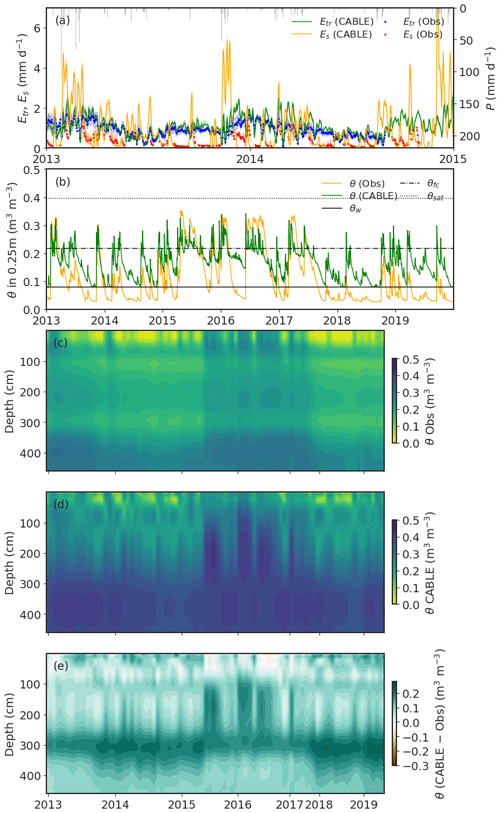
Glimpses at dataData suggests water availability at deeper levels more stable. Moist tropical forestBCI, Chitra-Tarak R et al. (2021) Hydraulically-vulnerable trees survive on deep-water access during droughts in a tropical forest. New Phytologist 231: 1798–1813. DOI: 10.1111/nph.17464 BCI has a strong wet-dry season. Rainfall at BCI is seasonal with a mean annual total of 2627 mm and a pronounced dry season from mid-December through April with < 100 mm of rainfall per month. Note top layer dries out much more. EucFace Western SydneyMu M et al. (2021) Evaluating a land surface model at a water-limited site: implications for land surface contributions to droughts and heatwaves. Hydrology and Earth System Sciences 25: 447–471. DOI: 10.5194/hess-25-447-2021
Semi-arid woodland (Ti-trees basin)Cleverly J et al. (2016) Soil moisture controls on phenology and productivity in a semi-arid critical zone. Science of The Total Environment 568: 1227–1237. DOI: 10.1016/j.scitotenv.2016.05.142
Fig. 3. Fluctuations of volumetric soil moisture content (θv) at 100 cm depth in hardpan (solid line) and unconsolidated loamy sand (dashed line). Soil porosity was 0.35 ± 0.006 (n = 95, horizontal dotted line). Grey bars represent weekly total precipitation.
Fig. 5. Soil moisture profiles measured in replicate arrays beneath bare soil (circles and dashed line) and Mulga (squares and solid line) (a) before (2–11 May 2013) and during (b) a small storm (12–21 May 2013); or (c) during a large storm (15–24 January 2014).
Fig. 6. Root density profile measured near the base of Mulga trees (squares and solid line), at the edge of the canopy (open circles and broken line), and in exposed hardpan (bare soil; triangles and dashed line), Symbols show mean ± standard error (N = 294).
"During the long, dry periods between storms, the presence of hydraulic lift to the shallow roots was inferred from daily fluctuations in θ above the hardpan, synchronisation of phenology amongst grasses and trees, and the absence of other discharge points (i.e., negligible drainage and evapotranspiration). We propose that through this mechanism, functioning of the shallow root system was maintained, which provided Mulga's roots and evergreen leaves with the capability of responding rapidly (i.e., if the conditions were favourable) to short, unpredictable, and large storms (i.e., with immediate moisture uptake through the roots to support immediate photosynthetic responses in the leaves). This resilience (i.e., physiological drought tolerance that does not diminish photosynthetic responses to subsequent wet periods) is the fundamental property that placed the Mulga lands of Australia in the heart of the 2011 global land carbon sink anomaly." Tarin T et al. (2020) Carbon and water fluxes in two adjacent Australian semi-arid ecosystems. Agricultural and Forest Meteorology 281: 107853. DOI: 10.1016/j.agrformet.2019.107853
Fig. 1. Climatic conditions of SWC, ET, EVI and carbon budget for 7 hydrological years in the Mulga woodland. Rainfall, carbon fluxes (GPP, ER, and NEP) and evapotranspiration are daily totals. Air temperature, VPD and SWC are daily averages. EVI values were interpolated to a daily time-step from 16-day MODIS data. Single layer modelA single layer model works a lot better! With variable inflow, It runs smoothly with timesteps as short as 0.1 The version below will need some slight adjustments to account for soil depth. Really we should be tracking total soil moisture not theta. But they're equivalent if depth = 1 (I think). Two layer modelWe'd use this if we wanted to incorporate the effect of a water table, either below or within the root zone. He et al 2021 present "A two-layer numerical model of soil moisture dynamics: Model development" https://www.sciencedirect.com/science/article/pii/S0022169421008477:
See also https://doi.org/10.1016/j.advwatres.2017.09.027 Model variantsRoss 2003 -- Kirchoff Transform fast solution to RERoss 2003 https://acsess.onlinelibrary.wiley.com/doi/pdf/10.2134/agronj2003.1352 " A fast method was developed for solution of the Richards equation for water transport. Brooks–Corey soil hydraulic property descriptions were used with water content as the dependent variable in unsaturated regions and pressure head in saturated regions. Central time weighting was used in unsaturated conditions to improve accuracy and fully implicit weighting in saturated conditions to improve stability. Water fluxes were calculated using matric flux potentials combined with a novel spatial weighting scheme for the gravitational component. Flow across soil property interfaces was calculated by equating fluxes to and from the interface"
So this may simplify the dynamics? Ross 2006 Fast solution of Richards’ equation for flexible soil hydraulic property descriptions. Science Report, 39(06).
Other modelsSoil Moisture Velocity Equation (SMVE)converted the one-dimensional Richards’ equation into a form that they call the Soil Moisture Velocity Equation (SMVE) that describes the speed of propagation of particular moisture contents within a homogeneous soil layer: Farthing & Ogden 2017
But still requires time steps possibly not different to what we have FATES-HYdroXu et al 2013:
Refers back to Christoffersen et al. (2016):
ED & ED2Moorcroft et al 2001
Medvigy et al 2009 -
Walko et al 2000 -
AWRA-L, Ozwald W3Albert et al 2013 - Global analysis of seasonal streamflow predictability using an ensemble prediction system and observations from 6192 small catchments worldwide https://doi.org/10.1002/wrcr.20251The modeling framework used in the experiment is the W3RA system and is based on the landscape hydrology component model of the AWRA system (AWRA-L version 1.0) [Van Dijk, 2010b; Van Dijk and Renzullo, 2011; Van Dijk et al., 2012a]. AWRA-L can be considered a hybrid between a simplified grid-based land surface model and a nonspatial (or so-called “lumped”) catchment model applied to individual grid cells. The model was designed to be parsimonious rather than detailed, to support its use where there are few on-ground observations to force and constrain it, as is typical for Australia. Where possible, process equations were selected from the literature and through comparison against observations. The meteorological inputs are gridded daily total precipitation, incoming short-wave radiation, and minimum and maximum temperature, which are converted to daytime effective values The configuration considers two hydrological response units (HRUs): deep-rooted tall vegetation (“forest”) and shallow-rooted short vegetation (“herbaceous”), each of which occupies a fraction of each grid cell.Vertical processes are described for each HRU individually:
|




Beta Was this translation helpful? Give feedback.

Uh oh!
There was an error while loading. Please reload this page.
-
Background and Aims
This report aims to implement and document soil water models in R, so that we can better better understand challenges we've had implementing this in the C++ model.
We encountered the issue that soil water model was running very slowly and erratically. Initially, we thought this might be due to some programming errors. However, it appears that it may be the equations themselves.
DF ran some checks, working off a branch in plant with only the soil water layer added, i.e no consumption of water by plants: becb153
Richards equation
I first investigated the possibility of programming errors. What i found was that it works fine if you set the rate of change in theta so a constant or a variable value, dpeending on depth and/or time (e.g.$\sin(t)/z$ , to make it interesting. Also it was very quick (as expected, e.g. with 100 soil layers for 300 years -> 1.84 sec), and the ODE system seems to be sized correctly. This is as expected and so suggests memory allocation etc is all fine.
speed
Note, We can get RE to run with time step of 1e-6.
Other models talk about using a 30min timestep. In years, 30min = 5.7e-5 (=1/(242365)), so not that different!
But a single RK step is actually 4 smaller steps,
Original multi-layer model based on Richards Equation.
To clarify issues with the model I implemented the same equations in R using
deSolvepackage.What we found was that the equations showed exactly the same pathologies as in the C++ version.
Works with small step size, 1e-5
Fails with larger step sizes, > 1e-5
Below are plots i captured in different runs. This was interesting, because we used the same timestpes as in plant and it failed at exactly the same spot
jpg")
It's a stiff system! Works when switching to different solver
However, changing the ode solving method fixes things (in the R version). Using lsoda instead of rk4 enables me to step with steps sizes of 0.1 out to 1 or more years.
It seems this set of equations is stiff! According to wikipedia:
It also works fine if we enforce a consistenly short
Looking back at the literature this seems to make sense
Richards' equation is a nonlinear, degenerate, parabolic-elliptic partial differential equation (PDE). The elliptic nature of the solution can arise when capillary head is the primary variable, which is common in simulations of layered soils because capillary head is the continuous variable while water content is discontinuous across layers [List and Radu, 2016]. Numerical solvers for parabolic PDEs are not appropriate for elliptic PDEs.
Ogden et al 2017:
Farthing & Ogden 2017: Richards’ equation is a nonlinear, degenerate elliptic- parabolic partial differential equation (List and Radu, 2016). The head-based forms of the equation, Eq. [3–5], transition from parabolic to elliptic as the solution domain nears saturation unless storage effects are included (Ss > 0), in which case Eq. [5] remains parabolic. The nonlinearity and transition of type in different portions of the problem domain make it very difficult to solve using traditional analytical techniques, and it is impossible to solve in closed form except for a small number of special cases (Miller et al., 1998). This difficulty is only exacerbated by the range of initial and boundary conditions encountered in practice as well as by the nature of common soil water constitutive relations that can lead to solutions with low regularity (Alt and Luckhaus, 1983). Specifically, the solution depends on two empirical, highly nonlinear soil water constitutive relations: the unsaturated hydraulic conductivity function K(θ) that can be constant or very near zero for non-positive values of the capillary head, and the capillary head function Psi(θ) that can take on arbitrary small values for relative saturations near 100%. These extremes lead to degeneracy in the solution of Richards’ equation
Of course, many approximate, empirical, or completely arbitrary methods have been developed over the years to simulate the flow of water through unsaturated soils because of the real or perceived difficulties posed by the numerical solution of Richards’ equation.
*Computational inefficiency and lack of robustness in Richards’ equation solvers used in practice most often manifest as poor linear and nonlinear solver convergence and/or poor performance of the time integrator. Our view is that a significant portion of this poor convergence and instability arises from under resolution in space of sharp fronts or other phenomena where highly nonlinear soil properties change drastically over neighboring elements or cells. *
Psi based form or RE
The implementation above is the mixed form, as it contains both$\psi$ and $theta$
The psi based form is recommended by Ireson et al
First we need a function for$K(\psi)$ . Combining the functions for $K(\theta)$ and $\Psi(\theta)$ gives
and
(I think, need to check.)
Checking new functions are consistent with previous
Looks good!
Same issue here, works with small time step or using lsoda solver
but not with larger time steps
So there's possibly no advantage in running the psi based model
Theta based model (incomplete)
We can also write a version of the RE fully based on$\theta$ . According to Bonan 2019: "The moisture-based, or $\theta$ -based, equation uses $\theta$ as the dependent variable with
in which$D(\theta) = K(\theta)/C(\psi)$ is referred to as the hydraulic diffusivity (m2 s–1). In this equation, the specific moisture capacity appears within the spatial derivative."
Below not finished. Needs review
Time delay model
I considered an option for stabilising the system, which was to use the running mean of infiltration and drainage. This didn't help.
For future reference, a running mean can easily be tracked using a Delay differential equation: https://en.m.wikipedia.org/wiki/Delay_differential_equation#Reduction_to_ODE.
if you have variable$x$ , then solve for running mean of x, $\bar{x}$ , by adding an extra ODE to track $$y = \bar{x}/k$$ , where $k$ is the decay rate (memory, higher values = shorter memory) and
$$\frac{dy}{dt} = x - k y$$
$$y = x/k.$$
with initial condition
Soil water code.zip
Possible ways forward
Need to find a solution that works with Runge Kutta ODE stepping
environemnts with strong wet-dry signal, we want to capture plants
Beta Was this translation helpful? Give feedback.
All reactions