

An experiment to make next.js routes usage safer.
Heavily inspired by my work on @swan-io/chicane
$ yarn add next-type-routes
# --- or ---
$ npm install --save next-type-routesFirst, you have to generate the typed routes functions. For that, I recommend using npm scripts:
"scripts": {
  "type-routes": "type-routes src/routes.ts",
  "dev": "yarn type-routes && next dev",
  "build": "yarn type-routes && next build",
When ran, this command parse your pages tree and generates a TS file (src/routes.ts) which looks like this:
import { createTypedFns } from "next-type-routes";

export const {
  createURL,
  getApiRequestParams,
  getServerSideParams,
  useRouterWithSSR,
  useRouterWithNoSSR,
} = createTypedFns([
  // Here will be all your project routes:
  "/",
  "/api/auth/login",
  "/api/projects/[projectId]",
  "/projects",
  "/projects/[projectId]",
  "/users",
  "/users/[userId]",
  "/users/[userId]/favorites/[[...rest]]",
  "/users/[userId]/repositories",
  "/users/[userId]/repositories/[repositoryId]",
]);import Link from "next/link";
import { createURL } from "path/to/routes";
export default function ExamplePage() {
return (
<>
<h1>Users</h1>
{/* URL params are type safe! */}
<Link href={createURL("/users/[userId]", { userId: "zoontek" })}>
zoontek
</Link>
</>
);
}import { useRouterWithSSR } from "path/to/routes";
export default function ExamplePage() {
const { params } = useRouterWithSSR("/users/[userId]"); // we can use useRouterWithSSR since getServerSideProps is used
const { userId } = params.route; // userId type is string
return <h1>{userId} profile</h1>;
}import { useRouterWithNoSSR } from "path/to/routes";
export default function ExamplePage() {
const { params } = useRouterWithNoSSR("/users/[userId]"); // we have to use useRouterWithNoSSR since getServerSideProps is not used
const { userId } = params.route; // userId type is string | undefined
if (userId == null) {
return <span>Loading…</span>;
}
return <h1>{userId} profile</h1>;
}import type { NextApiRequest, NextApiResponse } from "next";
import { getApiRequestParams } from "path/to/routes";
export default function handler(req: NextApiRequest, res: NextApiResponse) {
// we can access params in a safe way on API routes
const params = getApiRequestParams("/api/projects/[projectId]", req);
res.status(200).json({ handler: "project", params });
}import { GetServerSideProps } from "next";
import Link from "next/link";
import { getServerSideParams } from "path/to/routes";
export const getServerSideProps: GetServerSideProps = async (context) => {
const params = getServerSideParams("/users/[userId]", context);
// we can access params in a safe way on the server
console.log(params.route.userId);
return { props: {} };
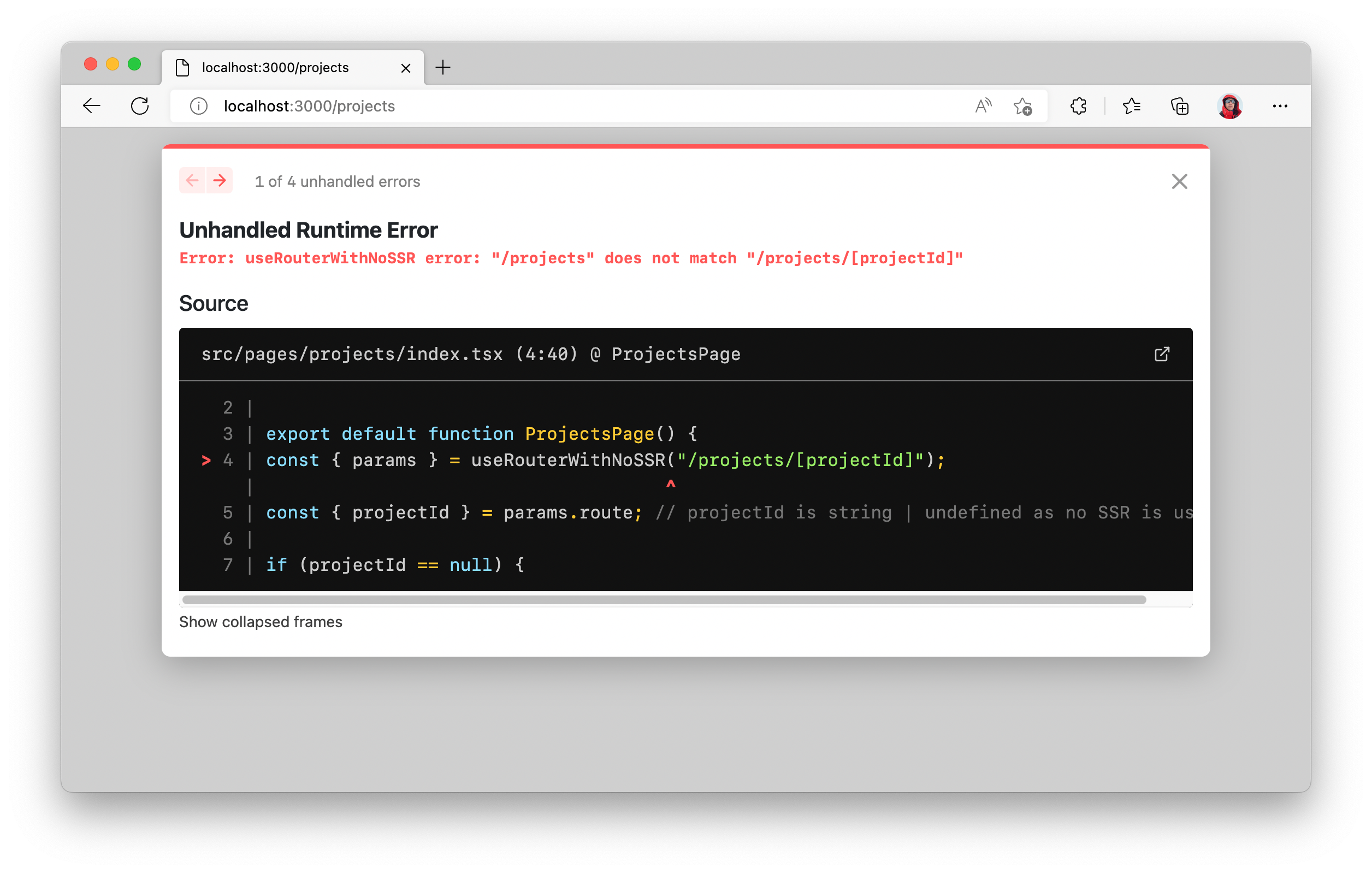
};What happen when I, let's say, use useRouterWithSSR("/users/[userId]") in page with /project/[projectId] path?
Well, it will throw an error 💥. That's why I highly recommend to create a 500.tsx page and wrap your app in an Error Boundary.