Project Page | Paper | Video | ICLR 2022
Mark Hamilton, Zhoutong Zhang, Bharath Hariharan, Noah Snavely, William T. Freeman
This is the official implementation of the project "Analysis of Unsupervised Learning Techniques for Cerebrovascular Image Segmentation ".
You can view the presentation slides here.
git clone https://github.com/00casio/STEGO
cd STEGOPlease visit the Anaconda install page if you do not already have conda installed.
Conda might be heavy to be installed on linux so an alternative is to install miniconda from Moniconda
To setup the environment you need to run the following commands:
conda env create -f environment.yml
conda activate stego
If it is the case where conda is not known as an internal command, it is better to access conda from its files where its installed as follows
~/miniconda3/bin/conda env create -f environment.yml
source ~/miniconda3/bin/activate stego1
if some of the dependencies were not installed correctly when creating the conda env, the user should install them manually after activating the environment with the right version found in environment.yml
cd src
python download_models.pyTo train STEGO from scratch, put the dataset in the dataset folder, name the dataset as potsdam and make sure that it has two folders, one named gt and one named imgs with 3 txt files, first one is all.txt having all the images names without their extensions, labelled_test.txt having the name of the testing (validation) images, labelled_train.txt having the training images, and unlabelled_train.txt this could be empty. If you encounter any errors, you need to check train_config.yml in configs, mainly the pytorch_data_dir where it should be replaced by the dataset folder
The labels can be changed to .mat with changing their gray scale 255 to 1 with the code fix_label_pixel.py.
Also for our vessels training, we implemented src/remove_black.py that changes black background pixels of brain images to random noise.
Note that gt and imgs should have the same names regardless of their extensions. The structure of the dataset should be as follows:
dataset
|
└──potsdam
      |
      └── imgs
      |   |──unique_img_name_1.png
      |   └──unique_img_name_2.png
      └── gt
      |   |──unique_img_name_1.mat
      |   └──unique_img_name_2.mat
      |
      └── all.txt
      |
      └── labelled_train.txt
      |
      └── labelled_test.txt
      |
      └── unlabelled_train.txt
We added a dataset directory having a demo dataset that one can follow its form, if the code is tested on the provided dataset it will output errors as its very small(3 images).
python crop_datasets.py
python precompute_knns.py
Then you can run the following in STEGO/src:
python train_segmentation.pyHyperparameters can be adjusted in STEGO/src/configs/train_config.yml
To monitor training with tensorboard run the following from STEGO directory:
tensorboard --logdir ../../output/logsafter training checkpoints will be saved in output/checkpoints.
This section details the Volume Reconstruction process using a pre-trained Stego model. The goal is to reconstruct 3D volumes and evaluate segmentation performance with metrics like Dice and clDice.
- Load the test dataset and its corresponding labels.
- Ensure the number of input files matches the number of label files.
- Apply necessary preprocessing steps like skull stripping and standardization.
- Initialize the Stego model with a checkpoint file "/path/to/checkpoint.ckpt"
For each volume:
- Load the volume and iterate over each slice.
- Extract patches from the slice and preprocess them:
- Use the Stego model to predict the segmentation for each patch:
- Apply any necessary post-processing steps, such as thresholding, to the predicted patches.
Reconstruct the entire volume from the predicted slices: Assemble the predicted slices into a 3D volume. Save the reconstructed volume for further analysis and visualization.
Compute evaluation metrics for the reconstructed volumes: Dice Score: Measures overlap between predicted and ground truth labels. clDice Score: Measures the similarity between the predicted and ground truth binary masks. The results are saved in a text file, typically named evaluation_results.txt, which contains metrics for each dataset configuration.
python volume_reconstruction.py --dataset_name <DATASET_NAME> --n_size <SIZE> --current_seed <SEED>Real-world images can be cluttered with multiple objects making classification feel arbitrary. Furthermore, objects in the real world don't always fit in bounding boxes. Semantic segmentation methods aim to avoid these challenges by assigning each pixel of an image its own class label. Conventional semantic segmentation methods are notoriously difficult to train due to their dependence on densely labeled images, which can take 100x longer to create than bounding boxes or class annotations. This makes it hard to gather sizable and diverse datasets impossible in domains where humans don't know the structure a-priori. We sidestep these challenges by learning an ontology of objects with pixel-level semantic segmentation through only self-supervision.
Self-supervised contrastive learning enables algorithms to learn intelligent representations for images without supervision. STEGO builds on this work by showing that representations from self-supervised visual transformers like Caron et. al.’s DINO are already aware of the relationships between objects. By computing the cosine similarity between image features, we can see that similar semantic regions such as grass, motorcycles, and sky are “linked” together by feature similarity.
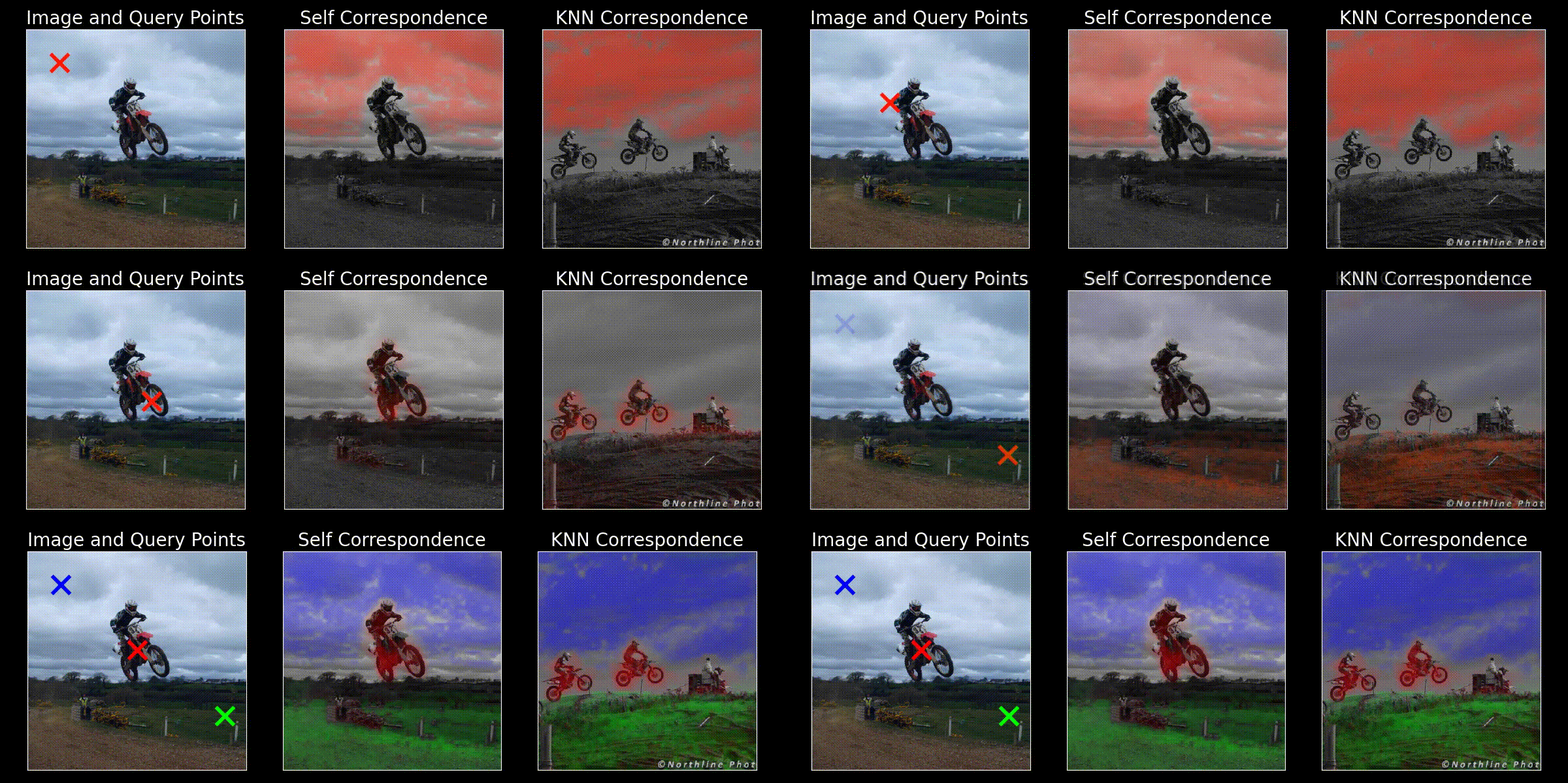
To visualise the correspondance in our study its found in
results/correspondence/attention_interp.mp4The STEGO unsupervised segmentation system learns by distilling correspondences between images into a set of class labels using a contrastive loss. In particular we aim to learn a segmentation that respects the induced correspondences between objects. To achieve this we train a shallow segmentation network on top of the DINO ViT backbone with three contrastive terms that distill connections between an image and itself, similar images, and random other images respectively. If two regions are strongly coupled by deep features we encourage them to share the same class.

We evaluate the STEGO algorithm on the CocoStuff, Cityscapes, and Potsdam semantic segmentation datasets. Because these methods see no labels, we use a Hungarian matching algorithm to find the best mapping between clusters and dataset classes. We find that STEGO is capable of segmenting complex and cluttered scenes with much higher spatial resolution and sensitivity than the prior art, PiCIE. This not only yields a substantial qualitative improvement, but also more than doubles the mean intersection over union (mIoU). For results on Cityscapes, and Potsdam see our paper.

@inproceedings{hamilton2022unsupervised,
	title={Unsupervised Semantic Segmentation by Distilling Feature Correspondences},
	author={Mark Hamilton and Zhoutong Zhang and Bharath Hariharan and Noah Snavely and William T. Freeman},
	booktitle={International Conference on Learning Representations},
	year={2022},
	url={https://openreview.net/forum?id=SaKO6z6Hl0c}
}
For feedback or questions, please contact jadalaou@eurecom.fr or driss@eurecom.fr