Repository navigation
Real Aircraft
ANet Relay targets small quadcopters with a Pixracer-class flight controller running PX4 or ArduPilot, behind an ESP8266 mavesp8266 Wi-Fi bridge, flown without an RC transmitter: all manual input is MAVLink stick emulation (MANUAL_CONTROL on PX4, RC override on ArduPilot).
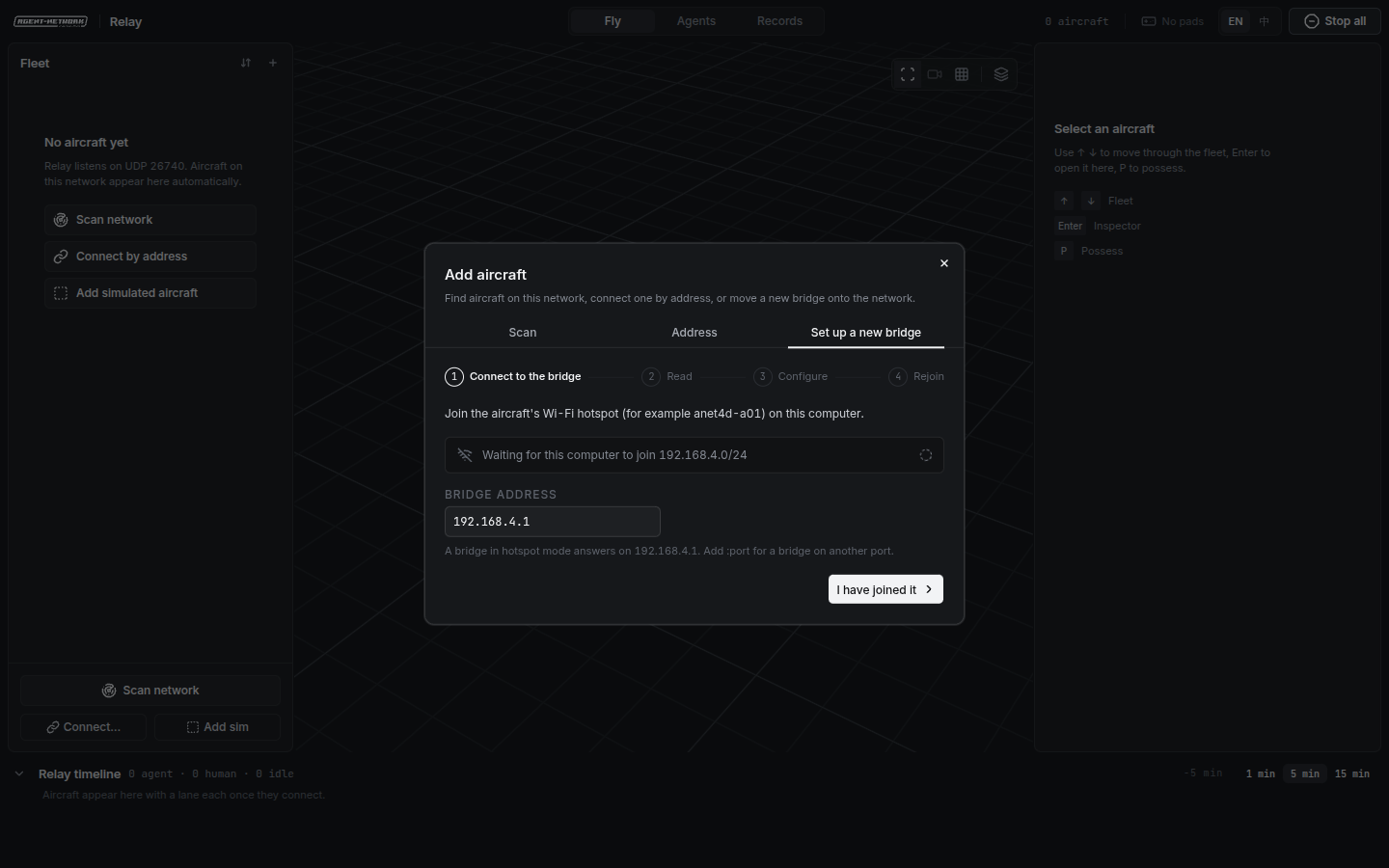
- A factory-fresh bridge starts as a hotspot. In Relay choose Connect… → Set up a new bridge. The four-step wizard joins the hotspot, writes your team network's name, password and ports through the bridge's own setup interface, reboots it and waits for the aircraft on the team network.
- Aircraft that send heartbeats to UDP 14550 appear in the fleet on their own. Scan network probes the local subnets; Connect… also accepts an address.
- USB serial. Connect… → USB serial lists the serial ports, flight controllers first, and detects the baud rate. An unplugged board goes offline and reconnects when it comes back. This link is also the one hardware in the loop needs.
- The hardware guide (Chinese) covers wiring, bridge parameters and flight-controller parameters.
Arming a real aircraft requires typing ARM. Preflight blocks it until the link, battery, prearm checks and the GCS input parameters are in order:
| Autopilot | Parameters Relay checks |
|---|---|
| ArduPilot |
MAV_GCS_SYSID (or SYSID_MYGCS), RC_OVERRIDE_TIME
|
| PX4 |
COM_RC_IN_MODE (1 to 3 allows MAVLink input) |
Relay also checks stick directions (do this with the propellers removed), propellers, mode, failsafe and position.
The most common cause of an unsteady hover is flying in STABILIZE, where throttle goes straight to the motors. Relay moves an aircraft it possesses on the ground from STABILIZE to altitude hold when it has a barometer. While hovering, watch Overview → Flight health in the inspector: attitude oscillation, hands-off lean, yaw drift, altitude hold, hover throttle, motor balance, vibration, battery sag, link and stick stream, each with a likely cause and fix. See the flight tuning guide (Chinese) and Bench Procedures.
Drift without a position sensor. In altitude hold the autopilot holds the height, not the position: an aircraft with a level error or a gyro bias leans and slides off even with centred sticks. Without optical flow, a rangefinder or another position source, cancel it with a timeline and its trim, tuned first on a simulator with the same kind of error.
Once an aircraft has reported its firmware, Overview → Firmware shows the family, version, git hash, board and the best-matching installed pack. Generate twin profile and Start twin turn it into a simulator that runs the same firmware with the same parameters, to rehearse a flight or a timeline before flying it for real. See Firmware Twins and HITL.
Agents use the same calls as on simulators. Real aircraft additionally need the operator's preflight steps and confirm: "ARM". Onboard programs run on a real aircraft only after the operator turns on Allow programs on this aircraft in the inspector (confirm word PROGRAM, reset on every connection). Copilot shows an approval card before every motion command and device write on a real aircraft. Real aircraft never join the arena, matches, dogfights or remote collisions.
A UVC capture device (for example an HDMI-to-USB card fed by the video receiver) shows picture-in-picture per aircraft.