Repository navigation
Service Scale Integration
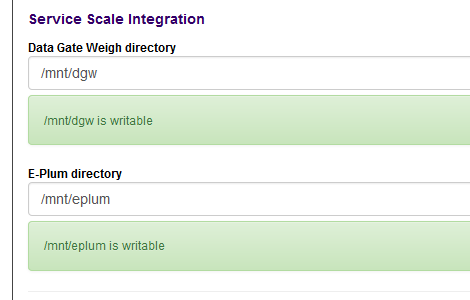
CORE has moderate capacity to integrate with service scales (i.e., scales that print a barcoded sticker with a price). Current integration supports the Hobart Quantum line. There is preliminary support for the Mettler Toledo bPro line but it has had less thorough production testing and use. Scale integration requires a scale server application. CORE does not interact with the scale directly but rather interacts with the scale server application. Currently supported options are Hobart's Data GateWeigh and Invatron's ePlum. Configuring these servers is not discussed here as the respective software makers may consider that information proprietary. CORE's side of the configuration requires a directory path where files can be left for Data GateWeigh and/or a directory path where files can be left for ePlum (you can theoretically run both simultaneously but this probably is not a good idea outside of development and testing). Windows file sharing / Samba is the easiest for Windows & Linux servers to share a directory path.
Next CORE needs a list of available scales.
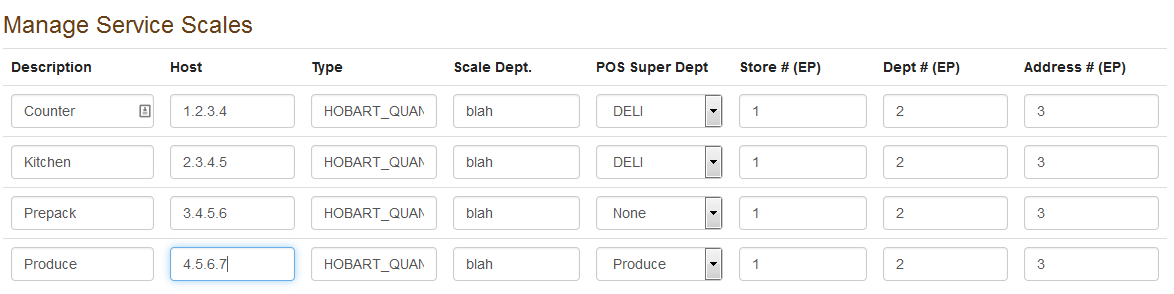
- Description is simply for user-friendliness
- Host is useful for both types of integration since it allows CORE to notify the user when a scale is not on the network but this field is technically only required with Data GateWeigh
- Type and Scale Dept. are Data GateWeigh fields. Refer to its documentation for appropriate values.
- Store #, Dept #, and Address # are ePlum fields. Refer to its documentation for appropriate values.
- POS Super Dept defines which items go to which scale(s) by default. This is only the default and can be overridden on a per-item basis.
CORE uses UPC-A barcodes for scale items with four digit PLUs. This the item's UPC is 2 followed by the scale PLU followed by six zeroes - e.g., 21234000000. Scale PLUs that are less than four digits must include leading zeroes - e.g., scale PLU 12 is UPC 20012000000. When editing scale items the scale PLU portion of the UPC is bolded. CORE supports the fields pictured for scale data plus price although scale price is automatically the same as POS price.
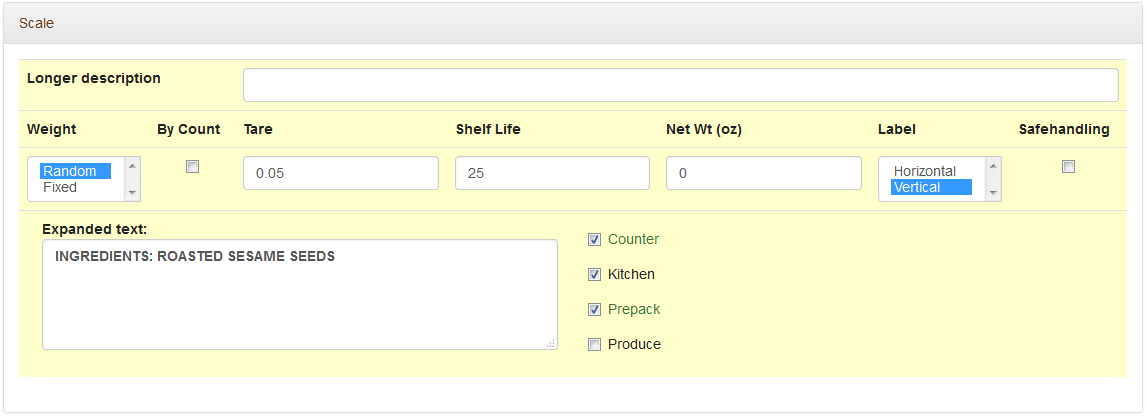
- Longer description is optional. If omitted, the item's normal description is sent to the scale instead. Some scales may allow for more than CORE's receipt-based 30 character limit.
- Weight and By Count are coupled fairly tightly. Fixed weight items will always be by count and random weight items will never be by count.
- Tare is entered as a decimal in hundreths of pounds
- Shelf life is entered as an integer in days
- Net Wt is entered as decimal ounces. How this number is interpreted may depend on configuration options on the scale itself.
- The label selection, random or fixed weight choice, and safe handling option will all influence which actual label format is used. Not all scales support horizontal and vertical variants.
- Expanded Text is just a large block of text. Common uses include ingredients, origin statements, and organic status information.
- The amount of text that will fit will vary from scale to scale and label format to label format.
- Some scales do not allow completely deleting existing text. The best option is to put a single, inconspicuous character in the expanded text such as a period.
- The checkboxes to the right of expanded text control which scale(s) the item is sent to.
Updates are not instantaneous. Depending on the scale application server's configuration an update may take anywhere from 1 to 15 minutes to take effect at the scales. Sending multiple items simultaneously is possible via Advanced Search however larger sets of changes will take even longer. Importantly, changes are strictly sequential. If you send an update to hundreds of items that will take hours to complete then all other changes requests will be stuck waiting until that batch completes. The user interface of the scale itself may be noticeably slower during large updates as the scales have relatively little computing power.