


From 98.8% Accuracy To 9.03% Accuracy with ε=0.3
This repository demonstrates the vulnerability of Convolutional Neural Networks to adversarial attacks using the Fast Gradient Sign Method (FGSM). What starts as a high-performing MNIST classifier quickly crumbles under carefully crafted perturbations.
"The ease with which we can switch between these two worlds is remarkable. In one world, the neural network is confident and accurate. In the other, the same network is confused and wrong." - Ian Goodfellow
Our CNN follows a simple yet effective design philosophy:
📥 Input Layer (28×28×1)
    ↓
🔍 Conv2D(1→8, 3×3) + ReLU
    ↓
📉 MaxPool2D(2×2)
    ↓
🔍 Conv2D(8→16, 3×3) + ReLU
    ↓
📉 MaxPool2D(2×2)
    ↓
🧠 Fully Connected(16×7×7 → 10)
    ↓
📤 Output (10 classes)
- Loss Function: Cross-Entropy Loss
- Optimizer: Adam
- Dataset: MNIST (28×28 grayscale images)
- Training Accuracy: 98.8% ✨
The Fast Gradient Sign Method is a white-box adversarial attack that generates perturbations by:
- Computing the gradient of the loss w.r.t. input image
- Taking the sign of the gradient
- Scaling by epsilon (ε) to control perturbation magnitude
Mathematical Formula:
x' = x + ε × sign(∇ₓ J(θ, x, y))
Where:
x'= adversarial examplex= original inputε= perturbation magnitudeJ= loss function
🔗 Explaining and Harnessing Adversarial Examples - Goodfellow et al., 2014
Even minimal perturbations can significantly alter model predictions while remaining nearly imperceptible to the human eye.
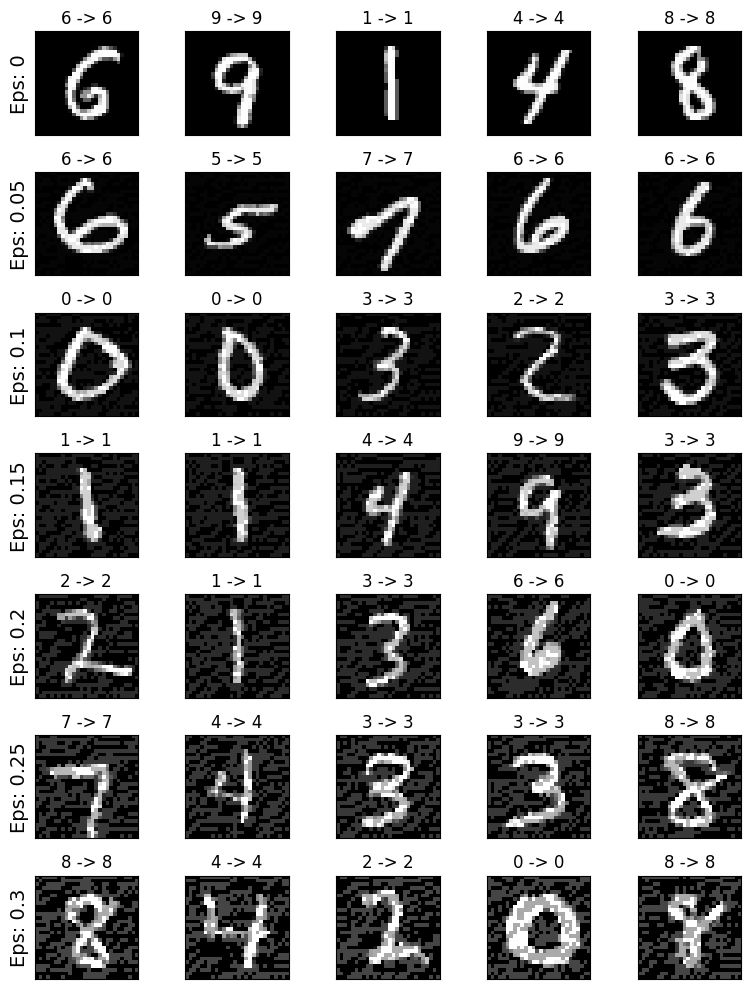
🧠 This visualization clearly illustrates how increasing epsilon (ε) gradually distorts the image, confusing the model.
The model's performance dramatically degrades as epsilon increases:
| Epsilon (ε) | Test Accuracy | Accuracy Drop | Status |
|---|---|---|---|
| 0.00 | 98.74% | - | 🟢 Pristine |
| 0.05 | 93.03% | ↓ 5.71% | 🟡 Slight Impact |
| 0.10 | 73.87% | ↓ 24.87% | 🟠 Moderate Impact |
| 0.15 | 45.32% | ↓ 53.42% | 🔴 Severe Impact |
| 0.20 | 25.22% | ↓ 73.52% | 🔴 Critical |
| 0.25 | 14.44% | ↓ 84.30% | 🔴 Near Failure |
| 0.30 | 9.03% | ↓ 89.71% | 🔴 Complete Failure |
🔍 Critical Finding: Even with ε = 0.1 (barely perceptible to human eye), the model accuracy drops from 98.8% to 73.9% - a catastrophic 24.9% decrease!
- Security Implications: Real-world AI systems are vulnerable
- Robustness: High accuracy ≠ robust model
- Adversarial Training: Need for defensive mechanisms
pip install torch torchvision numpy matplotlibgit clone https://github.com/Achintya47/Fast-Gradient-Sign-Attack
cd Fast-Gradient-Sign-Attack
jupyter notebook Training_and_Attacking.ipynbThis project is part of my summer research exploration implementing cutting-edge papers in PyTorch.
- Actor-Critic Algorithm from Scratch - Reinforcement Learning implementation
- More projects coming soon...


Let's discuss AI security and robustness!
- Goodfellow, I. J., Shlens, J., & Szegedy, C. (2014). Explaining and harnessing adversarial examples. arXiv preprint arXiv:1412.6572.
- LeCun, Y., Bottou, L., Bengio, Y., & Haffner, P. (1998). Gradient-based learning applied to document recognition. Proceedings of the IEEE.
⭐ Star this repo if you found it insightful!