Fix redirect handling to respect RFC and HTTP/1.1 RFC 7538 #263
Conversation


|
@AliSoftware Oliver can you peruse this and let me know if any changes are needed? Thanks! |

 AliSoftware
left a comment
AliSoftware
left a comment
AliSoftware
left a comment
There was a problem hiding this comment.
I haven't checked the RFC in full, but wondering if we should only keep the method for 307-308 or if there are any other 3xx status codes that would need to follow the same rule?
For example for 301/302 I read that the RFC had no intent originally for clients to change the method to GET when redirecting, even if most clients are doing so, making it become sort of a de-facto standard which wasn't intended (and making 307/308 come to be created to remove that ambiguity).
RFC 2616 (the updated version of 2068) clarifies that, explicitly stating that clients are not allowed to change the method on 301/302 redirections and that the 307 status code is somewhat a workaround to deal with non-compliant clients:
Note: RFC 1945 and RFC 2068 specify that the client is not allowed to change the method on the redirected request. However, most existing user agent implementations treat 302 as if it were a 303 response, performing a GET on the Location field-value regardless of the original request method. The status codes 303 and 307 have
been added for servers that wish to make unambiguously clear which kind of reaction is expected of the client.
I wonder what the native iOS behaviour (NSHTTPURLProtocol) , as well as Safari, do? Does it mishandle 301/302 like historically most other browsers and change the method to GET while the RFC didn't intent that, or does it properly keep the method like the RFC originally intended, making it behave the same for 301/302 and 307/308?
Speaking of which, I also wonder if there isn't some method out there to create the proper new NSURLRequest from a redirect response, like maybe asking NSHTTPURLProtocol or something, to avoid re-implementing those rules ourselves? Tbh I doubt that it's publicly available, but it's still probably worth looking into
CHANGELOG.md
Outdated
There was a problem hiding this comment.
Please add a period + 2 spaces (ending the line with 2 spaces allows the rendered markdown to insert a newline in the same paragraph to make the links be on their own line, see other entries)
There was a problem hiding this comment.
Also little nitpicking while I'm at it :P Just for readability I think 307/308 is more understandable than 307/8
There was a problem hiding this comment.
Fixing this too :)
OHHTTPStubs/Sources/OHHTTPStubs.m
Outdated
There was a problem hiding this comment.
Please use spaces for indentation (not because I want to start the tabs vs spaces war 😄 but because all the rest of the code uses spaces so we should be consistent)
There was a problem hiding this comment.
Yes, I keep forgetting that you do that. And my Xcode has auto tabs, so when I save the file, it gets done automatically. I'll fix that.
There was a problem hiding this comment.
I think you can override that per project (selecting the project in the left pane of Xcode then change the values of tab width + indent with on the right pane), maybe you should use that, so that whatever settings contributors like you have globally set in their Xcode, it will use spaces for that specific OHHTTPStubs project.

|
Ok, I've investigated a little bit
|
OHHTTPStubs/Sources/OHHTTPStubs.m
Outdated
There was a problem hiding this comment.
So, in light of the remarks I just did, maybe we should:
- Keep not only the
httpMethodbut also thebodyof the original request - Do that for all 301, 302, 307 and 308 (but not 303)
So in practice:
- Maybe we should be less broad in the test
>300 && < 400above and only handle specific codes - Do a
mutableCopyof the original request and alter itsurl(instead of allocating a newNS[Mutable]URLRequestfrom scratch) so it keeps all the other original properties like method & body?- If we do that, be sure that making a copy of a request which was potentially already consumed didn't make the body empty, as the body data is quickly turned into the
httpBodyStream: NSInputStreamproperty and if that stream has started being consumed maybe amutableCopyisn't enough to make it work & re-read from the beginning? So be sure to test that use case
- If we do that, be sure that making a copy of a request which was potentially already consumed didn't make the body empty, as the body data is quickly turned into the
There was a problem hiding this comment.
I kept the test for > 300 && < 400 but then applied special treatment for the special codes.
Instead of creating a new NSMutableRequest, I can (and should have created a mutable copy instead) NSMutableURLRequest* tempRedirectRequest = [self.request mutableCopy];
Just to be safe, I'll make sure to copy the body into the mutable copy as well.
There was a problem hiding this comment.
@AliSoftware As I'm re-reading your comments of making a mutable copy.
NSURLRequest *redirectRequest = (NSURLRequest*)[tempRedirectRequest copy];
How can we know if the HTTPBody was consumed?
quoting your comment, "... as the body data is quickly turned into the httpBodyStream: NSInputStream property and if that stream has started being consumed maybe a mutableCopy isn't enough to make it work & re-read from the beginning? So be sure to test that use case"
Need suggestions on how I test that use case?
Seems we'll have to return the NSMutableURLRequest instead of copying it back to immutable. I wonder if there would be any unintended side-effect from that. Would we cause upgrading users to hit a snag because of the type change?
There was a problem hiding this comment.
Just to be clear, when I said to make sure to copy the body, I didn't mean to make tempRedirectRequest.body = request.body explicitly, I rather meant that, by experience, once the request has been sent thru the iOS URL Loading System, as far as I understand, the content of the httpBody: NSData is converted into an NSInputStream which is then set to the httpBodyStream property of the request, and the httpBody property itself is then set back to nil
This is why we had to add the OHHTTPStubs_httpBody workaround-property for people wanting to do tests on their request body in their stubs, because at the time the stub is called the httpBody property was already turned into an inputStream then set to nil (so as a workaround we duplicate the httpBody: NSData when it's set so we can read it back later).
I don't know how that's gonna work in our current context of redirection, maybe the [request mutableCopy] will have everything already working for the body to be re-used — even it's already transformed into an httpBodyStream, if that stream isn't consumed yet there shouldn't be any problem, the copy will have the copy of the httpBodyStream too and it will work as expected), but given this oddity in how httpBody is auto-transformed into an NSStream by the OS automatically, it's worth checking using some tests that it still works as expected in practice.
There was a problem hiding this comment.
Whoops our comments were cross-posted 😉
To answer your question above, I think:
- It could be fine to return a mutable request, it will be exposed by the API as an
NSURLRequesteven if under the hood it's mutable, so the only side effect would be if the users were to cast it to mutable directly without making a mutableCopy first, which they are not supposed to do anyway (I mean if later they have a delegate method called, or their stub called, the type of the parameter will beNSURLRequesteven if the object itself was in practiceNSMutableURLRequest, but they are not supposed to do(NSMutableURLRequest*)requestto force-cast anyway - If the
httpBodyStreamis not consumed and is properly copied from the request to the mutableCopy, I don't see any reason why it wouldn't also be properly copied from the mutableCopy back to the immutableCopy we return, so in practice we should still return an immutable copy anyway.
So to be clear:
// We have the immutable "NSURLRequest* request" at that point // (1)
NSMutableURLRequest* mreq = [request mutableCopy]; // (2)
mreq.url = newLocation: // (3)
NSURLRequest* newReq = [mreq copy]; // (4)
- At point (1) we have the request, but I'm guessing the
httpBodyis already set tonilby the OS and has been turned into thehttpBodyStreaminstead. The big question is, has thathttpBodyStreamalready been consumed or not. Let's assume it hasn't (hyp A). - So at point (2), the
httpBodyStreamof the original request should, I guess (hyp B), be copied into the mutable request during thecopy - At point (4), the
httpBodyStreamof the mutable copy is copied into the immutable request duringcopy(hyp B)
And:
- I think the hypothesis B is very likely, after all when we ask for a (mutable)Copy there's no reason why it wouldn't make an exact copy of all fields, including the inputStream. But since it's a stream (like a file descriptor you have after some
fopenand so on), and thus having multiple copies of the same stream open at once could lead to side effects, it's worth checking - But the big question is hypothesis A, whether the stream has already been read by the filesystem or not, and if it has can it (and should it) be rewinded so that it's read from the start again for the new redirect request, etc
I know it's a little complex, and maybe after having said all that maybe I'm imagining problems that don't even exist and everything will work automatically as expected without us having to worry about hypothesis A & B, but given that we had that issue that made us create the OHHTTPStubs_httpBody workaround, better be safe and double-check than sorry and break things 😉
There was a problem hiding this comment.
I think the simplest way to check that is to:
-
Check if, as I guessed, by the time we are at that redirect stage,
httpBodyis already back toniland turned into anhttpBodyStreaminstead. If it's not yet turned into a stream, then all my worries go away as it's just copying the body's NSData, nothing special happens during the mutableCopy/copy then -
If it's indeed already turned into an
httpBodyStream, look a at thehttpBodyStream.streamStatus(see doc
- If it's
NotOpenfor example, then it's ok even if it's already turned into a stream it has never been read yet - If it's
NSStreamStatusAtEndorClosed, then we might have a problem as that means it has already been consumed (and idk if it can be rewinded to the start so that our request copy that we return for the redirect is able to re-consume the data?)
There was a problem hiding this comment.
Ok, I can add the code to test that and try it out in my own client.
But if it's the latter, NSStreamStatusAtEnd or Closed, then we've got to decide how best to handle that.
Now, I suppose all this only matters if the original request is of method=POST?
There was a problem hiding this comment.
I really hope everything will work magically (and if that's the case, sorry for the false alarm and complex explanations, maybe I'm worrying for nothing).
But if it's indeed the latter:
-
It's a good question about how we've to handle that. It seems we can't rewind on an
NSInputStreamother than a file stream (so not one build fromNSData), as far as I read in the docs. So we'll have to re-create it. But thehttpBodyis back to nil… So we'll have to rely on ourOHHTTPStubs_httpBodyworkaround which kept a copy of the body around? Gross… but not sure we have many more options. -
As for "only apply for
method=POST, I'm not sure what the RFC expects. In general,GETrequests don't usually have anyhttpBody— onlyPOSTrequest do — but I have no idea if it's officially valid/accepted forGETrequest to have anhttpBodyaccording to the RFC, and if it is, if that body should also be conserved when redirecting. But I guess the logical thing to do would then be to do the copy of the body for all requests, whatever the method.
Let's test first — if the body is already converted to a stream at that point and if the stream is already open or not — before relying on hypothesis and think of possible solutions (that we might not even have to use if the hypothesis isn't even true), we'll think about the solution depending on the result of the tests then 😉
|
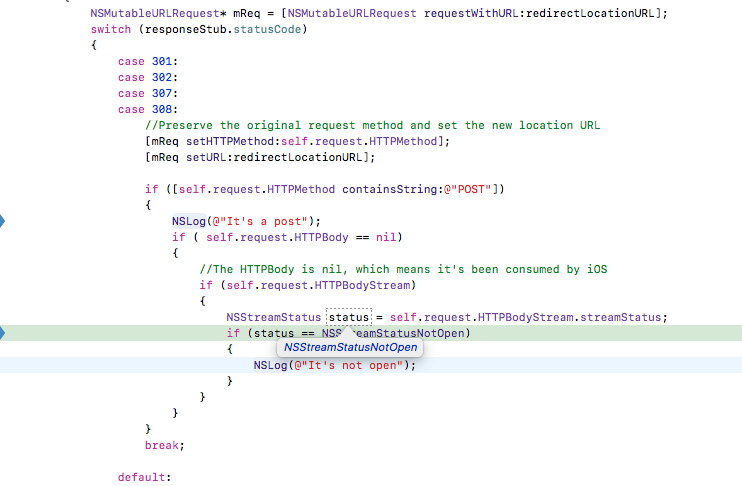
@AliSoftware This is what I observed in our own redirect tests. Does it amply answer your question? (Please note that this code a local test and isn't submitted here on Github at this time.)
|
|
@mikelupo This is a really good news, that means that everything should work magically, and I worried for nothing 😅 The Tbh I'm a bit (happily) surprisedly this result, as the request and all its body theoretically would have been sent to the real server at that stage, so that the server can return a 3xx redirect, so at that point, at least in real (not-stubbed) conditions, I guess the OS has already consumed the body (as it has sent the full request to the server). But in our case as we intercepted everything we never consumed it, so we should be totally good :-) It's actually easy to confirm now that we know it's Bottom line: I probably worried for nothing, sorry for all the alarms and complex explanations for nothing ^^ |
|
@AliSoftware, no need to apologize. This is the exact purpose of this forum. To discuss (sometimes in detail) the change that is being presented. We learned some good things from this exercise. So with that said, is this code ok as-is now? or do I need to make some more changes? Thanks! |
|
Well we still need to make the |
AliSoftware
left a comment
AliSoftware
left a comment
There was a problem hiding this comment.
This code means that 303 will not work anymore as the URL will not be replaced or changed in the case of 303
|
This would be nice to have unit tests for these redirect behaviors, especially to not forget cases like 303 and ensure we don't break those RFC implementations in the future. |
|
Good catch!
…Sent from my iPhone
On Oct 16, 2017, at 2:29 PM, AliSoftware ***@***.***> wrote:
@AliSoftware requested changes on this pull request.
This code means that 303 will not work anymore as the URL will not be replaced or changed in the case of 303
—
You are receiving this because you were mentioned.
Reply to this email directly, view it on GitHub, or mute the thread.
|
OHHTTPStubs/Sources/OHHTTPStubs.m
Outdated
There was a problem hiding this comment.
This isn't needed anymore as we do a mutableCopy on line 427 now so the HTTPMethod is already the same as the original
OHHTTPStubs/Sources/OHHTTPStubs.m
Outdated
There was a problem hiding this comment.
So in summary the behaviour we want to implement I think is:
- 301, 302, 307, 307: do the
mutableCopy+mReq.URL = redirectLocationURL+copydance like you already do here - default, especially for 303:
redirectRequest = [NSURLRequest requestWithURL:redirectLocationURL];— instead of the copy (as, according to the RFC, 303 exists to tells that "the original request has been accepted and processed by the server and we now need to go to a new location to continue", so we must forget the old request (and not copy anything from it) and create a brand new one
There was a problem hiding this comment.
Got it. I'll make that change. My code and your comment crossed on the wire.
AliSoftware
left a comment
AliSoftware
left a comment
There was a problem hiding this comment.
… and don't forget to add tests for all this, given the time we took to discuss it and check the expected behaviour, better not break it in the future 😉
OHHTTPStubs/Sources/OHHTTPStubs.m
Outdated
There was a problem hiding this comment.
303 shouldn't make a copy of the original request, as the intent according to RFC is to tell that the first request has been processed correctly and that we should now continue to a new request
OHHTTPStubs/Sources/OHHTTPStubs.m
Outdated
There was a problem hiding this comment.
This = nil; isn't needed as all path below will affect it a value anyway. (By not affecting it to nil, the compiler will warn us in case we later change the code and forget to affect a value in one of the code paths)
|
I almost didn't do that. I'll change it and resubmit.
A clever strategy...
Thanks,
Mike
-----Original Message-----
From: AliSoftware <notifications@github.com>
To: AliSoftware/OHHTTPStubs <OHHTTPStubs@noreply.github.com>
Cc: mikelupo <mikelupo@aol.com>; Mention <mention@noreply.github.com>
Sent: Mon, Oct 16, 2017 3:41 pm
Subject: Re: [AliSoftware/OHHTTPStubs] Fix redirect handling to respect RFC and HTTP/1.1 RFC 7538 (#263)
@AliSoftware commented on this pull request.
In OHHTTPStubs/Sources/OHHTTPStubs.m:
@@ -424,7 +424,28 @@ - (void)startLoading
// Notify if a redirection occurred
if (((responseStub.statusCode > 300) && (responseStub.statusCode < 400)) && redirectLocationURL)
{
- NSURLRequest* redirectRequest = [NSURLRequest requestWithURL:redirectLocationURL];
+ NSURLRequest *redirectRequest = nil;
+ NSMutableURLRequest *mReq = nil;
This = nil; isn't needed as all path below will affect it a value anyway. (By not affecting it to nil, the compiler will warn us in case we later change the code and forget to affect a value in one of the code paths)
—
You are receiving this because you were mentioned.
Reply to this email directly, view it on GitHub, or mute the thread.
|
|
Once we settle on this, Shall I squash the commits down into a single thing and resubmit?
-----Original Message-----
From: AliSoftware <notifications@github.com>
To: AliSoftware/OHHTTPStubs <OHHTTPStubs@noreply.github.com>
Cc: mikelupo <mikelupo@aol.com>; Mention <mention@noreply.github.com>
Sent: Mon, Oct 16, 2017 3:41 pm
Subject: Re: [AliSoftware/OHHTTPStubs] Fix redirect handling to respect RFC and HTTP/1.1 RFC 7538 (#263)
@AliSoftware commented on this pull request.
In OHHTTPStubs/Sources/OHHTTPStubs.m:
@@ -424,7 +424,28 @@ - (void)startLoading
// Notify if a redirection occurred
if (((responseStub.statusCode > 300) && (responseStub.statusCode < 400)) && redirectLocationURL)
{
- NSURLRequest* redirectRequest = [NSURLRequest requestWithURL:redirectLocationURL];
+ NSURLRequest *redirectRequest = nil;
+ NSMutableURLRequest *mReq = nil;
This = nil; isn't needed as all path below will affect it a value anyway. (By not affecting it to nil, the compiler will warn us in case we later change the code and forget to affect a value in one of the code paths)
—
You are receiving this because you were mentioned.
Reply to this email directly, view it on GitHub, or mute the thread.
|
|
I don't mind keeping the commit history. Don't hesitate if you need help implementing the unit tests 😉 |
|
I definitely need help writing the unit tests. Current unit tests seem to be only checking one status. A 301. |
|
I think basically you can generalise the unit test for 301 to:
|
|
Thanks @AliSoftware. I am actively working on it between other tasks so my submission may be delayed. |
|
@AliSoftware I have generalized the _test_redirect method and it's now accepting parameters. Where I'm lacking is the improvements that you mentioned,
Could use some help with that part. |
There was a problem hiding this comment.
Maybe here instead of returning an empty NSData, we could use a data for the redirect that is computed from the original httpBody (maybe not exactly the same data to be sure not to confuse them both, but maybe one derived from it) — And for those tests, don't use the json parameter then.
So make those stub be so that:
- for the original request (the stub on that line 123), we send a redirect response (with
httpStatusCode, being 301, 302, …) with the body derived from the request:stubbedRedirectResponse.httpBody = f(originalRequest.httpBody). - Then the second stub handling the redirect (below, line ~129), we make it so the stubbed final response has a body re-derived from the redirect body:
finalResponse.httpBody = g(redirectResponse.httpBody) = g(f(originalRequest.httpBody))
That way, once in the completion block at the call site, we can look at the resulting body and do some assertions there.
For example f can be so it returns a simple JSON representation of a dictionary like { "originalBody": originalBodyHere, "originalMethod": originalMethodHere }. Then g can be so it returns a JSON wrapping that first JSON, like { "redirectedBody": { "originalBody": originalBodyHere, "originalMethod": originalMethodHere }, "redirectedMethod": redirectedMethodHere }.
That would make the assertions in the actual tests below easy to ensure we didn't lose anything in the way.
There was a problem hiding this comment.
I had a comment here, but it became a bit irrelevant after taking a break. I've been looking at this code for too long now. ;) So I deleted it.
There was a problem hiding this comment.
Haha too late, I saw it in my email notifications 😂
(Thanks for telling me you deleted it though, as I would probably have gone crazy trying to find it on GitHub after receiving the email notification otherwise 😄)
There was a problem hiding this comment.
So do we need to follow redirects in the context of these tests? I would think so.
There was a problem hiding this comment.
ok, we have two "withStubResponse" methods here. One for the original redirect, one for the second response (from the redirected request) for the path, @"/elsewhere". In the first redirected response, I'm trying to hijack the data payload with my own JSON stuff to keep track of originating request stuff (I think this is what you were wanting me to do). Then put that hijacked data payload on the wire for the redirected request, and hence, when we finally get the 200 response, we should have our built up JSON. However, it seems that apple is ignoring my change in data. I'm getting the original data posted all the way through. This isn't bad behavior and it's preventing man-in-the-middle attacks. It seems I won't be able tweak the HTTPBody in the response.
Thoughts?
There was a problem hiding this comment.
I was actually thinking about it the other day. The way we implemented it is that when there is a redirect, we do redirect with the same body as the original. That's the whole point of your PR. That's what you implemented. When there's a 301, we redirect to the new URL but with the original request's body. So that's our implementation after all.
So it's logical, from that implementation we did, that, whatever body we return in the redirection response, our implementation redirects to the new URL with the original body after all 😉
More than that, I think in our reasoning for those tests we confused the request and the response. In the real world, when you post a request to the server with some http body B1, if the server returns a 301 response, that 301 response doesn't have any http body itself. It's the server's redirect response after all
So in our specific context:
- the first stub should just return an
OHHTTPStubsResponsewith status code 301 (and no http body whatsoever, that body would be ignored anyway, and we respect the RFC on that) - then the second stub is supposed to be the final response that the server would return, when queried on the redirected URL with that original body. So there we could make our fake response to be some JSON wrapping the original body in that case (like if we had a real server whose only role was to echo what we send to it, just wrapped inside a JSON)
There was a problem hiding this comment.
For the other response codes as well ...should we return nil for the body in the first stub or only in 301? Edit: We can't return nil for data as the stub won't allow returning a nil,
There was a problem hiding this comment.
I think all redirect responses are supposed to have an empty body
There was a problem hiding this comment.
Don't forget to remove that NSLog once you've done with experimenting on that test before we merge 😉
There was a problem hiding this comment.
It's already out in my code. 🥇
There was a problem hiding this comment.
So for example here if we tweak our test_redirect_NSURLSession… method so that it returns a response body derived from the dataToPost, we can now check if the jsonResponse — which should be derived from that g(f(dataToPost)) that we initially sent — matches what is expected.
If our redirect lost the httpBody during that redirect, that means that we would lose the response derived from it and the assertion would fail.
That's just a random idea, I'm on the train rn with little data so haven't had the leisure of looking into it in details, I hope you'll see the idea.
|
@mikelupo ping 😉 Any chance you'll find some time to continue working on it soon? |
|
Hi, I keep planning to work on it, but my daily job keeps getting in the way!
;P
I'll make a push to try and get this done before middle next week.
Feel free to ping me any time to cattle-prod me.
Mike
…-----Original Message-----
From: AliSoftware <notifications@github.com>
To: AliSoftware/OHHTTPStubs <OHHTTPStubs@noreply.github.com>
Cc: mikelupo <mikelupo@aol.com>; Mention <mention@noreply.github.com>
Sent: Thu, Oct 26, 2017 3:06 pm
Subject: Re: [AliSoftware/OHHTTPStubs] Fix redirect handling to respect RFC and HTTP/1.1 RFC 7538 (#263)
@mikelupo ping 😉
Any change you'll find some time to continue working on it soon?
I'd love to make a new release at some point and would like to include your PR in it 👍
—
You are receiving this because you were mentioned.
Reply to this email directly, view it on GitHub, or mute the thread.
|
|
👌 |
|
@AliSoftware I posted Unit Tests for review. I hope that I have correct thinking as far as this part of the PR goes. |
There was a problem hiding this comment.
Wait… now that I read your implementation, I realize that we can in fact do that test in a way simpler way: no need for that JSON dictionary with originalMethod & originalBody and all. What we just want to assert is that once we've replied with a redirect, the next request will have the same body as the original
So basically we can remove all that new code with your __block variables and the build JSON dict and just do something like (pseudo-code, as I'm in the train and live-typing that from the web interface):
__block NSData* request1Body = nil;
__block NSString* request1Method = nil;
// Reply with a redirect
[OHHTTPStubs stub path "" with : {
  // Memorize the body and method of the original request
  request1Body = request.ohhttpstubs_HTTPBody;
  request1Method  request.HTTPMethod

  // Then just reply with header "Location: …/elsewhere" and empty HTTPBody.
  // i.e. just as usual redirect, in fact what we previously did before that PR, no JSON dict to build or whatnot
  // A normal, official redirect in HTTP is just a 3xx header and no body anyway
  return OHHTTPStubsResponse(headers, 3xx code, empty body)
}

// Then also stub the final response done after the redirect
[OHHTTPStubs stub "/elsewhere" with: {
  // That's what we want to test:
  // that once OHHTTPStubs has handled the redirection,
  // the new request created to the new location has the same
  // HTTPBody (and potentially method) than the original request, so:
  XCTAssertEqual(request.ohhttpstubs_HTTPBody, originalRequestBody)
  XCTAssertEqual(request.ohhttpstubs_HTTPBody, originalRequestMethod)
  // then continue the code as it was before the PR
So basically, the easiest way to go there is to undo the changes you did to _test_redirect_NSURLSession (sorry for the misleading!) and instead just store the method+body when stubbing the original request, and assert they're the same in the redirected request on the second stub. The rest (especially the response those stubs return) should be unchanged (same as before the PR), the only change is to take advantage of the stub to additionally store the original request method/body (first stub) / additionally compare the new request's method/body to the stored one (second stub).
Hope that's more clear with this. No more temp JSON with "originalBody"/"originalMethod" keys, no change to the responses returned by the stubs, no need to pass an httpBody parameter to that _test_redirect_NSURLSession helper method, none of that.
Sorry again for the confusion, I think we both mixed everything up with all those requests and responses and all
There was a problem hiding this comment.
You can probably use our request.ohhttpstubs_HTTPBody extension there instead of reading the stream and then avoid this whole else block?
There was a problem hiding this comment.
Curious why you used NSJSONSerialization for going from Data to JSON on line 143 but used NSKeyedArchived (and not NSJSONSerialization dataFromJSONObject) to go the other way around?
Also, you might just use the base64 of the body instead of deserializing it (in case that original body is not actual JSON for example it would still work)
There was a problem hiding this comment.
Thanks for taking a hard look at the code. I'll address your interesting comments soon.
Recovering here from a bad storm and multi-day power outage.
There was a problem hiding this comment.
Checking in. I've not forgotten. I'm just busy on some other tasks that are directly work related.
There was a problem hiding this comment.
No problem. Just hope you saw I took a stab at it so it's implemented now… and so we've swapped roles then, as it'll be your turn to review 😁
Good luck with work

Before this change, a POST request redirected with status code
307 or 308 would become a request with GET method.
This check-in changes the behavior to retain the HTTP method
in the case of 307/308 redirect
 AliSoftware
force-pushed
the
fixRedirect307and308
branch
from
AliSoftware
force-pushed
the
fixRedirect307and308
branch
from
3203ab9 to
3d8aef8
Compare
|
@mikelupo I took the liberty to rebase and give a try at those tests. It's indeed easy to get lost and lose track between all those multiple requests & responses in all redirects when trying to figure how to write that… 😓 |

 Liquidsoul
left a comment
Liquidsoul
left a comment
Liquidsoul
left a comment
There was a problem hiding this comment.
LGTM
I've just a comment about some assert texts 🤓
| [self _test_redirect_NSURLSession:session httpMethod:method jsonBody:json delays:0.0 redirectStatusCode:301 | ||
| completion:^(NSString *redirectedRequestMethod, id redirectedRequestJSONBody, NSHTTPURLResponse *redirectHTTPResponse, id finalJSONResponse, NSError *errorResponse) | ||
| { | ||
| XCTAssertEqualObjects(redirectedRequestMethod, method, @"Expected the method to be the same as was sent"); |
There was a problem hiding this comment.
Maybe it's me but, I find the message of this assert not clear. Something more like "Expected the method to be unchanged"?
|
Seems like Travis-CI randomly fail 50% of the time on:
At first I thought it was just Travis being Travis (it has been quite unstable for some time) but even when restarting jobs, some pass and some continue failing with the same "No value" CocoaError, so maybe that's a real problem that we gonna have to investigate (likely a race condition between all the requests and redirects done simultaneously but the test only having one shared variable at some place in that test method?!) |
…ed delegate object for each test needing one
…iple scenarios in loops
|
@AliSoftware Thank you for taking this up in my absence! 👍 |


4 participants


Before this change, a POST request redirected with status code
307 or 308 would become a request with GET method.
This check-in changes the behavior to retain the HTTP method
in the case of 307/308 redirect
Checklist
Description
Motivation and Context
inadherence to RFC and HTTP specs.
Fixes #262
I ran existing NSURLSession tests. TODO: Create a test case to handle these cases.
Will require some help from @AliSoftware to do so
Thanks to my colleague @sashra for finding this!