A Java class containing methods for creating text files, and counting the number of lines in these files using different approaches:
- Sequentially
- Using threads
- Using a thread pool
Creates n text files, with names "name_i.txt", where i is the index of the file (starting from 1). Each file will contain a number of "Hello World" lines, generated randomly using the seed and bound values as follows:
- A random number x is generated between 0 (inclusive) and bound (exclusive) using java.util.Random
- x "Hello World" lines are written to the file
Counts the number of lines in the text files specified by the fileNames array, using a sequential approach.
Counts the number of lines in the text files specified by the fileNames array, using a multi-threaded approach. A separate CountLines thread is created for each file, and the threads are started using the run() method. The main thread then waits for all of the CountLines threads to finish using the join() method. Finally, the number of lines in each file is summed to get the total number of lines.
Counts the number of lines in the text files specified by the fileNames array, using a thread pool. A fixed size thread pool is created using java.util.concurrent.Executors, and a CountLinesPool task is submitted to the pool for each file. The main thread then waits for the tasks to complete and sums the number of lines in each file to get the total number of lines.
A Java thread class used by getNumOfLinesThreads(String[] fileNames) to count the number of lines in a single file.
A java.util.concurrent.Callable implementation used by getNumOfLinesThreadPool(String[] fileNames) to count the number of lines in a single file. Can be submitted to an java.util.concurrent.Executor or java.util.concurrent.ExecutorService for execution.

Each example runs 10,000 files that contains a random number x between 0 and 300.
In this run, the seed of each function is diffrent:
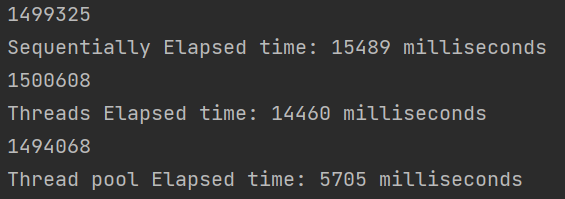
In this run, all the function share the same seed:

The CustomExecutor is designed to run tasks with different priorities. When a task is submitted to the executor, it is added to a PriorityBlockingQueue based on its priority. The PriorityBlockingQueue is a queue that sorts the tasks based on their priority, with the highest priority tasks at the front of the queue.
The CustomExecutor uses a pool of threads to run the tasks. When a thread becomes available, it takes the next highest priority task from the front of the queue and executes it. This ensures that tasks with higher priorities are completed before tasks with lower priorities.
The CustomExecutor extends the ThreadPoolExecutor class, which provides several methods for managing the pool of threads and the tasks being run.
- execute(Runnable command): adds the given Runnable task to the queue for execution by a thread in the pool submit(Callable task): adds the given Callable task to the queue and returns a PriorityFuture object that can be used to track the task's progress and retrieve the result when it is complete. The PriorityFuture object holds the taskType of the task
- shutdown(): begins the process of shutting down the executor, rejecting any new tasks that are submitted
- awaitTermination(long timeout, TimeUnit unit): blocks until all tasks have completed execution after a shutdown request, or the timeout occurs, whichever happens first.
The CustomExecutor also has a field holder_threads_count, which is an array of integers representing the number of threads currently running tasks with each TaskType. This can be used to track the number of tasks being run for each priority level and ensure that tasks are being distributed appropriately. Additionally, it returns a PriorityFuture object, when a task is submitted using submit method. The PriorityFuture object holds the taskType of the task.
The Task class implements the Callable interface and provides a call() method that is executed by a thread when the task is run. The call() method should contain the code for the task that needs to be performed.
The compareTo method of the Task class is used to compare the priority of two tasks. It compares the taskType values of the tasks, with the task having a higher priority being ranked higher. This is used by the PriorityBlockingQueue to sort the tasks based on their priority.
The Task class represents a unit of work that can be submitted to the CustomExecutor for execution. It implements the Callable interface, which allows it to be run by a thread and return a result. The Task class has the following fields and methods:
- taskType: an enum of type TaskType representing the priority of the task
- callable: a Callable object that contains the code for the task
- Task(Callable callable): constructs a new Task with OTHER as the taskType and the given callable
- Task(Callable callable, TaskType taskType): constructs a new Task with the given callable and taskType
- Task(TaskType taskType, Callable callable): constructs a new Task with the given taskType and callable
- static Task createTask(Callable callable, TaskType taskType): creates a new Task with the given callable and taskType
- static Task createTask(Task task): creates a new Task with the same callable and taskType as the given task
- T call() throws Exception: executes the task's callable and returns the result
- int compareTo(T other): compares the priority of this Task to the given other Task, returning a negative integer if this Task has a higher priority, a positive integer if it has a lower priority, or zero if the priorities are equal
The PriorityFuture class is a extension of the FutureTask which is a concrete implementation of the Future interface. It is designed to run a callable task, and also hold a priority field that can be used to compare tasks based on their priority.
- priority: an integer representing the priority of the task.
- PriorityFuture(Callable callable, int priority): constructor which takes a callable and priority as input
- static PriorityFuture createPriorityFuture(Task task): It creates an instance of PriorityFuture by taking task object as input and creates an object with callable of task and priority as taskType.priorityValue
- compareTo(Object other): it compares the priority of the current object and other object, if the priority of current object is less than other object it will return -1, if it's greater than other object it will return 1, if it's equal to other object it will return 0.
The PriorityFuture class is used to run a callable task and also to hold the priority of the task, so that it can be used to compare tasks based on their priority. It can be used in scenarios where you want to run tasks concurrently and sort them based on their priority.
The TaskType enum represents the priority of a Task. It has three values: COMPUTATIONAL, IO, and OTHER. Each TaskType has an integer value representing its priority, with COMPUTATIONAL having the highest priority and OTHER having the lowest.
The PriorityBlockingQueue is a queue that stores Task objects and orders them based on their priority. It is used by the CustomExecutor to store the submitted tasks and ensure that tasks with higher priorities are run before tasks with lower priorities. The PriorityBlockingQueue uses a Comparator to compare the tasks and determine their ordering
The Callable interface represents a task that can be executed by a thread and returns a result
The Executor interface provides a way to execute Runnable tasks
The ThreadPoolExecutor is an implementation of the Executor interface that manages a pool of threads to execute tasks. It has a queue to store the tasks and a set of rules for adding new tasks to the queue and starting new threads

