Logic tasks.
Roman numerals are represented by seven different symbols: I, V, X, L, C, D and M.
Symbol Value I 1 V 5 X 10 L 50 C 100 D 500 M 1000
For example, 2 is written as II in Roman numeral, just two ones added together. 12 is written as XII, which is simply X + II. The number 27 is written as XXVII, which is XX + V + II.
Roman numerals are usually written largest to smallest from left to right. However, the numeral for four is not IIII. Instead, the number four is written as IV. Because the one is before the five we subtract it making four. The same principle applies to the number nine, which is written as IX. There are six instances where subtraction is used:
I can be placed before V (5) and X (10) to make 4 and 9.
X can be placed before L (50) and C (100) to make 40 and 90.
C can be placed before D (500) and M (1000) to make 400 and 900.
Given a roman numeral, convert it to an integer.
Example 1:
Input: s = "III" Output: 3 Explanation: III = 3.
Example 2:
Input: s = "LVIII" Output: 58 Explanation: L = 50, V= 5, III = 3.
Example 3:
Input: s = "MCMXCIV" Output: 1994 Explanation: M = 1000, CM = 900, XC = 90 and IV = 4.
Constraints:
1 <= s.length <= 15
s contains only the characters ('I', 'V', 'X', 'L', 'C', 'D', 'M').
It is guaranteed that s is a valid roman numeral in the range [1, 3999].
Example: { 2, 1, 11, 8, 7 } target = 9 { 0, 4, 1, 3 }
Given a string s, find the length of the longest substring without repeating characters.
Example 1:
Input: s = "abcabcbb" Output: 3 Explanation: The answer is "abc", with the length of 3.
Example 2:
Input: s = "bbbbb" Output: 1 Explanation: The answer is "b", with the length of 1.
Example 3:
Input: s = "pwwkew" Output: 3 Explanation: The answer is "wke", with the length of 3. Notice that the answer must be a substring, "pwke" is a subsequence and not a substring.
Given an integer array nums, return the length of the longest strictly increasing subsequence. A subsequence is a sequence that can be derived from the given sequence by deleting some or no elements without changing the relative order of the remaining characters. For example, "cat" is a subsequence of "crabt".
Example 1:
Input: nums = [9,1,4,2,3,3,7] Output: 4 Explanation: The longest increasing subsequence is [1,2,3,7], which has a length of 4.
Example 2: Input: nums = [0,3,1,3,2,3] Output: 4
A string is called a palindrome string if the reverse of that string is the same as the original string.
Example 1:
Input: s = "babad" Output: "bab" Explanation: "aba" is also a valid answer.
Example 2:
Input: s = "cbbd" Output: "bb"
Implement the myAtoi(string s) function, which converts a string to a 32-bit signed integer (similar to C/C++'s atoi function).
The algorithm for myAtoi(string s) is as follows:
Read in and ignore any leading whitespace.
Check if the next character (if not already at the end of the string) is '-' or '+'. Read this character in if it is either. This determines if the final result is negative or positive respectively. Assume the result is positive if neither is present.
Read in next the characters until the next non-digit character or the end of the input is reached. The rest of the string is ignored.
Convert these digits into an integer (i.e. "123" -> 123, "0032" -> 32). If no digits were read, then the integer is 0. Change the sign as necessary (from step 2).
If the integer is out of the 32-bit signed integer range [-231, 231 - 1], then clamp the integer so that it remains in the range. Specifically, integers less than -231 should be clamped to -231, and integers greater than 231 - 1 should be clamped to 231 - 1.
Return the integer as the final result.
Note:
Only the space character ' ' is considered a whitespace character.
Do not ignore any characters other than the leading whitespace or the rest of the string after the digits.
Example 1:
Input: s = "42" Output: 42 Explanation: The underlined characters are what is read in, the caret is the current reader position. Step 1: "42" (no characters read because there is no leading whitespace) ^ Step 2: "42" (no characters read because there is neither a '-' nor '+') ^ Step 3: "42" ("42" is read in) ^ The parsed integer is 42. Since 42 is in the range [-231, 231 - 1], the final result is 42.
Example 2:
Input: s = " -42" Output: -42 Explanation: Step 1: " -42" (leading whitespace is read and ignored) ^ Step 2: " -42" ('-' is read, so the result should be negative) ^ Step 3: " -42" ("42" is read in) ^ The parsed integer is -42. Since -42 is in the range [-231, 231 - 1], the final result is -42.
Example 3:
Input: s = "4193 with words" Output: 4193 Explanation: Step 1: "4193 with words" (no characters read because there is no leading whitespace) ^ Step 2: "4193 with words" (no characters read because there is neither a '-' nor '+') ^ Step 3: "4193 with words" ("4193" is read in; reading stops because the next character is a non-digit) ^ The parsed integer is 4193. Since 4193 is in the range [-231, 231 - 1], the final result is 4193.
You are given an integer array height of length n. There are n vertical lines drawn such that the two endpoints of the ith line are (i, 0) and (i, height[i]).
Find two lines that together with the x-axis form a container, such that the container contains the most water.
Return the maximum amount of water a container can store.
Notice that you may not slant the container.
Example 1:
Input: height = [1,8,6,2,5,4,8,3,7] Output: 49 Explanation: The above vertical lines are represented by array [1,8,6,2,5,4,8,3,7]. In this case, the max area of water (blue section) the container can contain is 49.
Example 2:
Input: height = [1,1] Output: 1
Given an integer array nums, return all the triplets [nums[i], nums[j], nums[k]] such that i != j, i != k, and j != k, and nums[i] + nums[j] + nums[k] == 0.
Notice that the solution set must not contain duplicate triplets.
Example 1:
Input: nums = [-1,0,1,2,-1,-4] Output: [[-1,-1,2],[-1,0,1]] Explanation: nums[0] + nums[1] + nums[2] = (-1) + 0 + 1 = 0. nums[1] + nums[2] + nums[4] = 0 + 1 + (-1) = 0. nums[0] + nums[3] + nums[4] = (-1) + 2 + (-1) = 0. The distinct triplets are [-1,0,1] and [-1,-1,2]. Notice that the order of the output and the order of the triplets does not matter.
Example 2:
Input: nums = [0,1,1] Output: [] Explanation: The only possible triplet does not sum up to 0.
Example 3:
Input: nums = [0,0,0] Output: [[0,0,0]] Explanation: The only possible triplet sums up to 0.
Example 4:
There is a city composed of n x n blocks, where each block contains a single building shaped like a vertical square prism. You are given a 0-indexed n x n integer matrix grid where grid[r][c] represents the height of the building located in the block at row r and column c.
A city's skyline is the the outer contour formed by all the building when viewing the side of the city from a distance. The skyline from each cardinal direction north, east, south, and west may be different.
We are allowed to increase the height of any number of buildings by any amount (the amount can be different per building). The height of a 0-height building can also be increased. However, increasing the height of a building should not affect the city's skyline from any cardinal direction.
Return the maximum total sum that the height of the buildings can be increased by without changing the city's skyline from any cardinal direction.
Example:
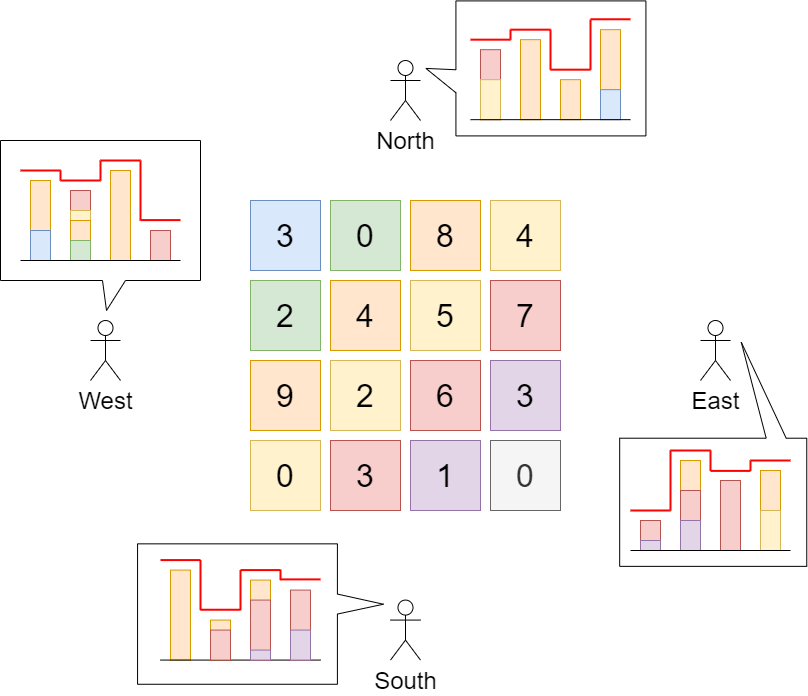
Input: grid = [[3,0,8,4],[2,4,5,7],[9,2,6,3],[0,3,1,0]] Output: 35 Explanation: The building heights are shown in the center of the above image. The skylines when viewed from each cardinal direction are drawn in red. The grid after increasing the height of buildings without affecting skylines is: gridNew = [ [8, 4, 8, 7], [7, 4, 7, 7], [9, 4, 8, 7], [3, 3, 3, 3] ]
Example 5: Squares of a Sorted Array
Given an integer array nums sorted in non-decreasing order, return an array of the squares of each number sorted in non-decreasing order.
Example 7:
Input: nums = [-4,-1,0,3,10] Output: [0,1,9,16,100] Explanation: After squaring, the array becomes [16,1,0,9,100]. After sorting, it becomes [0,1,9,16,100]. Example 2:
Input: nums = [-7,-3,2,3,11] Output: [4,9,9,49,121]
example 8
Operation backTrace Input: nums = [9, 3, 7] Target 13 Try operation addition and subtraction. Last number had to the result of this. Example 9 - 3 = 7
example 9
You are given an integer array nums. You are initially positioned at the array's first index, and each element in the array represents your maximum jump length at that position. Return true if you can reach the last index, or false otherwise.
Input: nums = [2,3,1,1,4] Output: true Explanation: Jump 1 step from index 0 to 1, then 3 steps to the last index.
Input: nums = [3,2,1,0,4] Output: false Explanation: You will always arrive at index 3 no matter what. Its maximum jump length is 0, which makes it impossible to reach the last index.
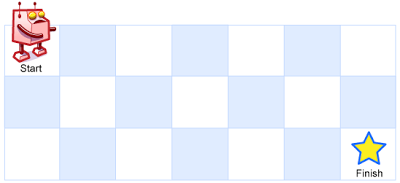
There is a robot on an m x n grid. The robot is initially located at the top-left corner (i.e., grid[0][0]). The robot tries to move to the bottom-right corner (i.e., grid[m - 1][n - 1]). The robot can only move either down or right at any point in time.
Given the two integers m and n, return the number of possible unique paths that the robot can take to reach the bottom-right corner.
The test cases are generated so that the answer will be less than or equal to 2 * 109.
You are given an integer array coins representing coins of different denominations and an integer amount representing a total amount of money.
Return the fewest number of coins that you need to make up that amount. If that amount of money cannot be made up by any combination of the coins, return -1.
You may assume that you have an infinite number of each kind of coin.
Input: coins = [1,2,5], amount = 11 Output: 3 Explanation: 11 = 5 + 5 + 1 Example 2:
Input: coins = [2], amount = 3 Output: -1 Example 3:
Input: coins = [1], amount = 0 Output: 0
Constraints:
1 <= coins.length <= 12 1 <= coins[i] <= 231 - 1 0 <= amount <= 104
You have full a full name as input and outputs the initials. Each word in the name should be represented by its first uppercase letter, followed by a dot (.). If a word contains a hyphen (-), the initials should include it.
John Doe -> J.D. Alice Bob Carol -> A.B.C. Jean-Claude Van Damme -> J-C.V.D. Mary Jane Watson-Parker -> M.J.W-P.
example 13 SnackBack. There are n items with weights text{weights} = [w_1, w_2, ..., w_n] and a backpack with a capacity of W.
The goal is to select the maximum number of items such that their total weight does not exceed W.
Problem Statement: Given a string s containing just the characters '(', ')', '{', '}', '[', and ']', determine if the input string is valid.
A string is valid if:
Open brackets must be closed by the same type of brackets. Open brackets must be closed in the correct order. Every close bracket has a corresponding open bracket of the same type. Examples:
Копировать
Редактировать
isValid("()") // true
isValid("()[]{}") // true
isValid("(]") // false
isValid("([)]") // false
isValid("{[]}") // true
Constraints:
1 <= s.length <= 10⁴ s consists only of '(){}[]'.
You are given the heads of two sorted linked lists list1 and list2. Merge the two lists into one sorted list. The list should be made by splicing together the nodes of the first two lists. Return the head of the merged linked list.
Example 1:
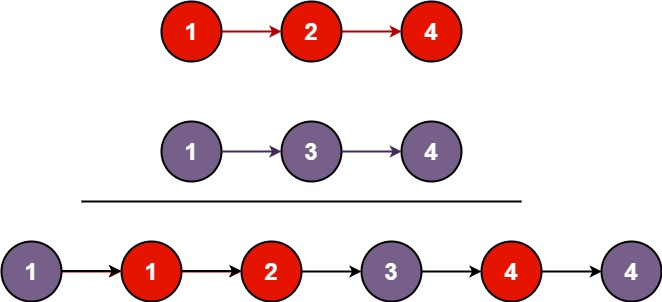
Input: list1 = [1,2,4], list2 = [1,3,4] Output: [1,1,2,3,4,4] Example 2: Input: list1 = [], list2 = [] Output: [] Example 3: Input: list1 = [], list2 = [0] Output: [0]
The encoding rule is: k[encoded_string], where the encoded_string inside the square brackets is being repeated exactly k times. Note that k is guaranteed to be a positive integer. You may assume that the input string is always valid; there are no extra white spaces, square brackets are well-formed, etc. Furthermore, you may assume that the original data does not contain any digits and that digits are only for those repeat numbers, k. For example, there will not be input like 3a or 2[4]. Example 1:
Input: s = "3[a]2[bc]" Output: "aaabcbc" Example 2:
Input: s = "3[a2[c]]" Output: "accaccacc" Example 3:
Input: s = "2[abc]3[cd]ef" Output: "abcabccdcdcdef"