





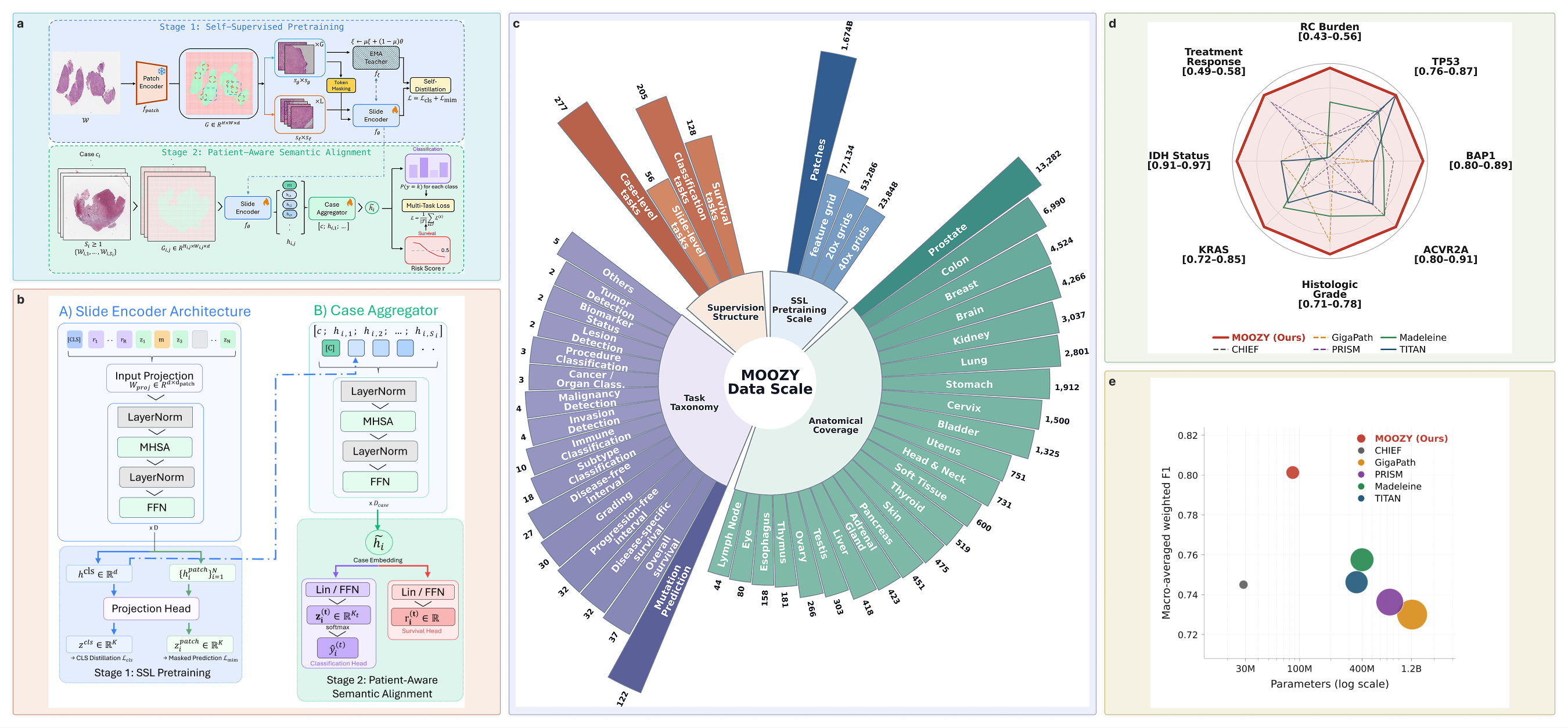
MOOZY is a foundation model for computational pathology that treats the patient case, not the individual slide, as the fundamental unit of representation. It encodes one or more whole-slide images (WSIs) into a single 768-dimensional case-level embedding that captures dependencies across all slides from the same patient. Trained entirely on public data with 85.8M parameters (14x smaller than GigaPath), MOOZY outperforms larger models on classification and survival prediction tasks across diverse organs and cancer types.
pip install moozyModel weights download automatically on first use. No access gates, no manual downloads, no HuggingFace approval.
# Encode a patient case from pre-extracted H5 feature files
moozy encode slide_1.h5 slide_2.h5 --output case_embedding.h5

# Encode directly from raw whole-slide images
moozy encode slide_1.svs slide_2.svs --output case_embedding.h5
Or use the Python API:
from moozy.encoding import run_encoding

run_encoding(
    slide_paths=["slide_1.h5", "slide_2.h5"],
    output_path="case_embedding.h5",
)
The output H5 file contains a 768-d case-level embedding ready for downstream tasks: classification, survival prediction, or retrieval.
All encoding arguments (data, runtime, raw WSI options, mixed precision) are documented in docs/encode.md.
conda create -n moozy python=3.12 -y
conda activate moozy
pip install moozy
venv
python -m venv moozy-env
source moozy-env/bin/activate
pip install moozy
uv
uv venv moozy-env
source moozy-env/bin/activate
uv pip install moozyThe output is a standard H5 file. Load it with h5py:
import h5py

with h5py.File("case_embedding.h5", "r") as f:
    embedding = f["features"][:]  # (768,) float32 case-level embedding

# Use the embedding for downstream tasks
# e.g., as input to a linear probe, k-NN, MLP probe, or clusteringMOOZY is a two-stage pipeline that first learns slide-level representations through self-supervised learning, then aligns them with clinical meaning through multi-task supervision.
Stage 1: Self-supervised slide encoder. A vision transformer learns context-aware spatial representations from 77,134 unlabeled public histopathology slides (~1.67 billion patches across 23 anatomical sites) using masked self-distillation. No labels are used. The slide encoder captures tissue morphology, spatial context, and inter-region relationships across the whole slide.
Stage 2: Patient-aware multi-task alignment. The pretrained slide encoder is fine-tuned end-to-end with a case transformer that models dependencies across all slides from the same patient. A learnable [CASE] token aggregates per-slide embeddings into a single case-level representation. Multi-task supervision across 333 tasks (205 classification, 128 survival) from 56 public datasets provides broad clinical grounding. All task heads are discarded after training, leaving a general-purpose patient encoder.
For detailed model specifications, see the model card.
Both training stages are fully open-source and reproducible using only public data. All training arguments (data, model, optimization, checkpointing, logging, runtime) are documented in the Stage 1 and Stage 2 training docs.
For local multi-GPU training, use the launch scripts in scripts/:
# Stage 1: Self-supervised pretraining
GPU_IDS=0,1,2,3,4,5,6,7 bash scripts/train_stage1.sh

# Stage 2: Multi-task alignment
GPU_IDS=0,1,2,3,4,5,6,7 bash scripts/train_stage2.sh
SLURM job templates are provided in slurm/ for cluster environments:
| Script | Description |
|---|---|
slurm/single_gpu.sh |
Single-GPU training |
slurm/multi_gpu.sh |
Multi-GPU training on one node |
slurm/multi_node.sh |
Multi-node distributed training |
slurm/inference.sh |
Patient encoding |
Frozen-feature MLP probe comparison against slide encoder baselines on eight held-out tasks. Bold indicates the best result per metric.
| Task | Metric | CHIEF | GigaPath | PRISM | Madeleine | TITAN | MOOZY |
|---|---|---|---|---|---|---|---|
| Residual Cancer Burden | F1 | 0.46 | 0.45 | 0.46 | 0.51 | 0.43 | 0.56 |
| AUC | 0.60 | 0.55 | 0.58 | 0.63 | 0.58 | 0.74 | |
| Bal Acc | 0.44 | 0.40 | 0.43 | 0.48 | 0.38 | 0.51 | |
| TP53 Mutation | F1 | 0.82 | 0.76 | 0.85 | 0.84 | 0.87 | 0.87 |
| AUC | 0.81 | 0.76 | 0.85 | 0.85 | 0.91 | 0.86 | |
| Bal Acc | 0.83 | 0.76 | 0.84 | 0.84 | 0.88 | 0.86 | |
| BAP1 Mutation | F1 | 0.86 | 0.84 | 0.80 | 0.85 | 0.84 | 0.89 |
| AUC | 0.75 | 0.63 | 0.71 | 0.78 | 0.82 | 0.79 | |
| Bal Acc | 0.75 | 0.66 | 0.66 | 0.75 | 0.75 | 0.78 | |
| ACVR2A Mutation | F1 | 0.89 | 0.80 | 0.85 | 0.89 | 0.87 | 0.91 |
| AUC | 0.80 | 0.74 | 0.83 | 0.76 | 0.79 | 0.91 | |
| Bal Acc | 0.80 | 0.65 | 0.81 | 0.81 | 0.76 | 0.90 | |
| Histologic Grade | F1 | 0.71 | 0.77 | 0.73 | 0.75 | 0.73 | 0.78 |
| AUC | 0.71 | 0.77 | 0.67 | 0.74 | 0.71 | 0.75 | |
| Bal Acc | 0.73 | 0.77 | 0.73 | 0.74 | 0.73 | 0.77 | |
| KRAS Mutation | F1 | 0.77 | 0.77 | 0.72 | 0.81 | 0.80 | 0.85 |
| AUC | 0.76 | 0.72 | 0.61 | 0.70 | 0.80 | 0.80 | |
| Bal Acc | 0.74 | 0.76 | 0.63 | 0.77 | 0.81 | 0.79 | |
| IDH Status | F1 | 0.92 | 0.94 | 0.91 | 0.92 | 0.94 | 0.97 |
| AUC | 0.96 | 0.97 | 0.95 | 0.96 | 0.97 | 0.99 | |
| Bal Acc | 0.92 | 0.94 | 0.91 | 0.91 | 0.94 | 0.97 | |
| Treatment Response | F1 | 0.53 | 0.51 | 0.57 | 0.49 | 0.49 | 0.58 |
| AUC | 0.70 | 0.68 | 0.69 | 0.59 | 0.60 | 0.68 | |
| Bal Acc | 0.48 | 0.40 | 0.51 | 0.35 | 0.37 | 0.48 |
Mean values from five-fold frozen-feature evaluation. Full results with confidence intervals are in the paper.
Across all eight tasks, MOOZY improves macro averages over TITAN by +7.4% weighted F1, +5.5% AUC, and +7.8% balanced accuracy, and over PRISM by +8.8% F1, +10.7% AUC, and +9.8% balanced accuracy, with 14x fewer parameters than GigaPath.
This work was supported by NSERC-DG RGPIN-2022-05378 [M.S.H], Amazon Research Award [M.S.H], and Gina Cody RIF [M.S.H], FRQNT scholarship [Y.K]. Computational resources were provided in part by Calcul Québec and the Digital Research Alliance of Canada.
If you find MOOZY useful, please cite:
@article{kotp2026moozy,
  title   = {MOOZY: A Patient-First Foundation Model for Computational Pathology},
  author  = {Kotp, Yousef and Trinh, Vincent Quoc-Huy and Pal, Christopher and Hosseini, Mahdi S.},
  journal = {arXiv preprint arXiv:XXXX.XXXXX},
  year    = {2026}
}This project is licensed under CC BY-NC-SA 4.0.