Repository navigation
Use cases
The problem is related to the identification of the Youngs modulus of concrete from experimental tests. It includes multiple levels
- Identification using the procedure from the standard - take the third loading cycle and chose a (random) reading before and after the loading (within the 20s) and compute the secant modulus (this is the Young's modulus)
- include the data during the loading phase as well
- include the uncertainty of the measurements (including both stress/strain or similarly load/displacements)
- estimate, how good the model is able to approximate the first and second loading cycle as well as the third one
- assume that for each sample (e.g. usually 3, but we usually have the compression data = first cycle for another 3) there is a different Young's modulus, compute the distribution of these Youngs moduli
- use an elastic model with the parameters identified from above in a constitutive formulation to predict the probability distribution of the mid-span displacement of a structure (e.g. 3-point bending test)
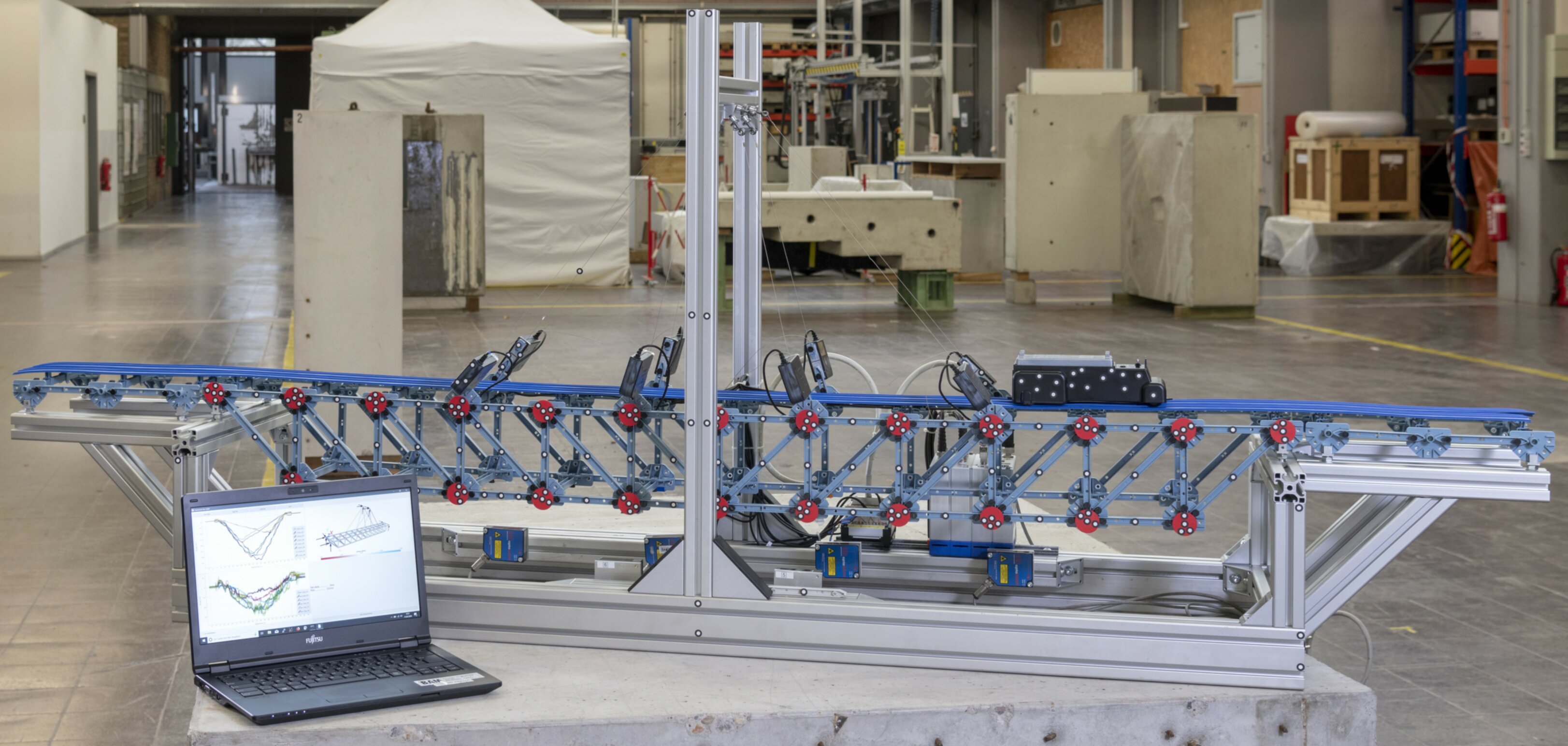
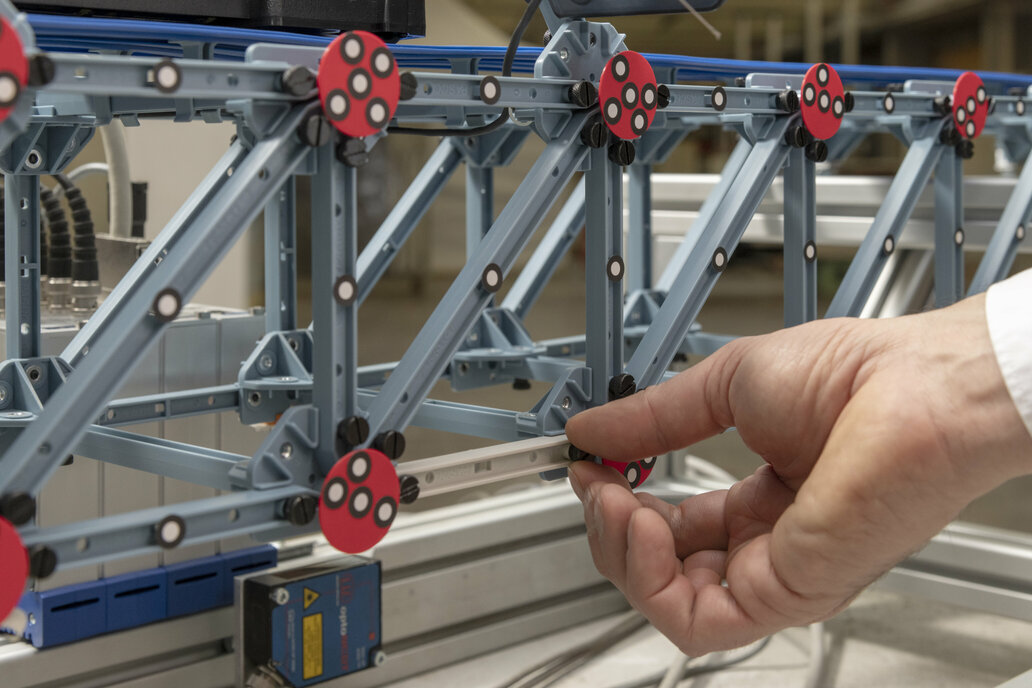
This problem deals with finding the probability distribution of a threshold value that cannot be measured directly. Assume you produce an explosive (say sticks of dynamite) and you want to know to know the critical height from which you can drop a stick of dynamite triggering its explosion. So you conduct several tests (each time with a new stick of dynamite) where you drop the sticks from different heights (usually one applies so-called staircase or up-and-down test schemes here, see https://en.wikipedia.org/wiki/Up-and-Down_Designs). The outcome of each test is either an explosion or no explosion. After the experiments you want to estimate the PDF of the critical height.
Let us assume that the unknown distribution of the critical height - let us call it - follows a normal distribution
. Hence, we want to infer the two parameters
and
. In order to formulate the likelihood function let us think about what each experiment tells us about
. First, let us assume that each stick of dynamite has its own "true" critical height. If we let it fall from a height lower than its true critical height, it will not explode and if we let it drop from a greater (or equal) elevation than its true critical height it will explode. So if an experiment results in an explosion, we infer that the critical height of that particular stick was smaller or equal to the tested elevation, however, we do not know the exact value. This can be interpreted as a left-censored data point. Conversely, if an experiment does not result in an explosion we can infer that the critical height of the corresponding stick was greater than the tested elevation - hence we have a right-censored data point. The corresponding likelihood function looks like this:
Here, is the parameter vector,
is the number of conducted tests,
and
are the tested and true critical height of dynamite stick
respectively, and
is defined as 1 if test
resulted in an explosion, and
if no explosion occurred in test
. If we replace the general terms
with the respective ones of the normal distribution, we obtain
where is the cumulative distribution function (CDF) of the standard normal distribution. Given some test data, one can now solve this problem in a frequentist manner by maximizing the likelihood, or via a Bayesian approach, if one additionally defines priors on
and
.
Latex modeling with hack for latex rendering
Here is some text related to likelihood and prior, forward model, data, ..
Here is some text related to the approach used to solve the problem (Gibbs, MCMC, special structures)