
 |
 |
| V1 | V2 |
 |
|
| 16CH ESP-EEG | |
High-precision 8-channel biosensing board designed for EEG, EMG, ECG, and Brain Computer Interface (BCI) research applications
www.cerelog.com and Product Page (Assembled Units Available): Here
Need Help or have a question? Discord Chat Community
Open Source Firmware, Software & Schematic included on this page
Contact: simon@cerelog.com
Need Help or have a question? Discord Chat Community
Product Page: Here
Product Usage Guide : Here and See Instructions file above for device usage
Video Product Overview: Here
3D Print your own case Here

Helpful troubleshooting guide
Compatable with OpenBCI Gui (Custom fork) via **Lab Streaming Layer (LSL) ** protocol (What is LSL?)

Setup instructions and LSL Custom Python connection script : Here
A modified OpenBCI Gui has been forked above so you can visualize data easily and stream to other platforms. This works with it's LSL streaming capability via a special python script (in link above)!
ESP-EEG’s Python client software can stream data via the standard neuroscience software communication protocol Lab Streaming Layer. This means you can stream directly to your favorite neuroscience software or Matlab running on your laptop or remote computers, record data streams, and integrate ESP-EEG's data with other data streams.

Instructions on how to collect data from device with Brainflow API custom instance: Here
and
Custom instance of Brainflow Repo: Here for collecting data with the device.
Note: Test script to quickly view plot and aquire data -> Run 'Shared_brainflow-cerelog/python_package/cerelog_tests/filtered_plot.py' from in above repo. (Must download and run with full Brainflow instance to use)
2 Quick Videos Using Cerelog ESP-EEG with Brainflow:
Make sure to read the above linked guide as it is very detailed. If you get stuck with setup, checkout these videos below:
General Product usage Overview Video
Link above links to youtube videos
A demonstration of using the EMG capability of the ESP-EEG bio-signal sensor to control a robotic hand.
(Click the image above to watch the demo on YouTube)

Github code for EMG robotic hand control
A demonstration of using the ESP-EEG bio-signal sensor to play Pong using SSVEP technology.
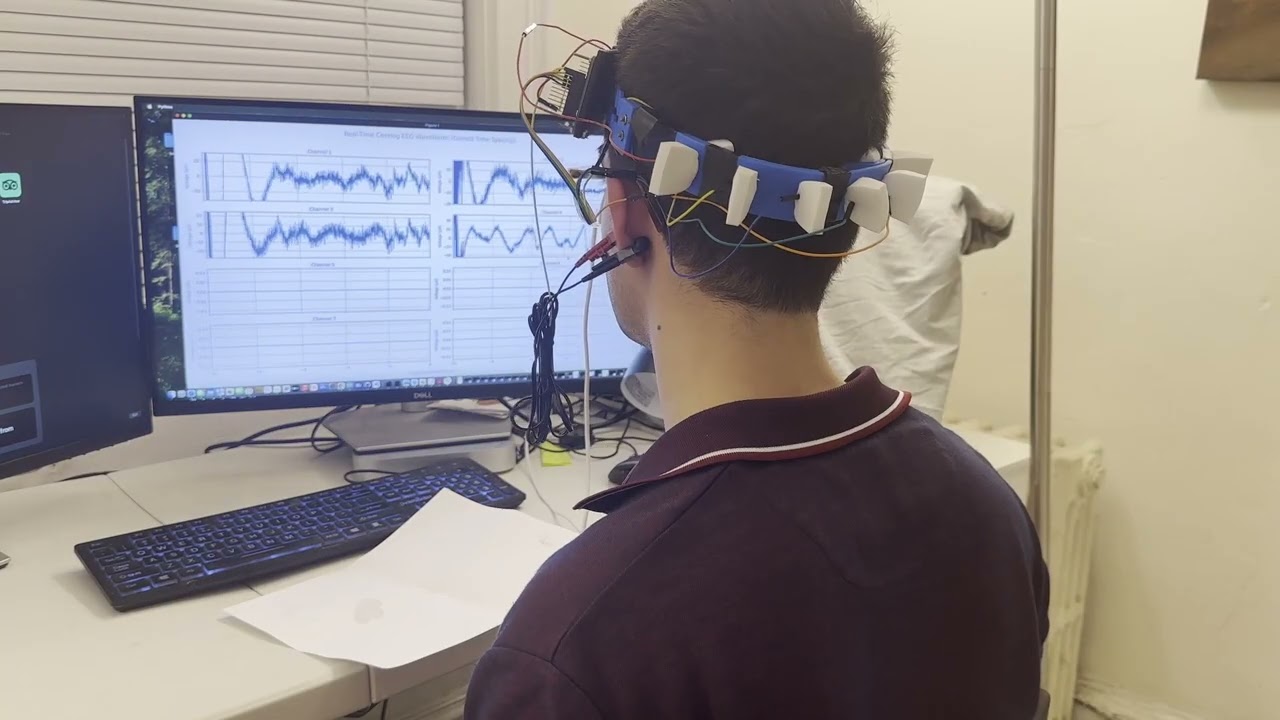
Instructables: Playing Pong With Your Mind – DIY Brain Computer Interface
A decoder is a small program — usually a machine-learning model — that looks at
those signals and guesses what the person was thinking or trying to do.
A community-built browser-based decoder playground. Stream live EEG data from your ESP-EEG, run an ML model on it, and see predicted vs. actual outputs side by side — no local install needed. Built by community member yelabbassi; third-party.
Learn more about PhantomLoop →


Unlike many consumer EEG devices that use "open-loop" or passive grounding strategies, the ESP EEG implements a True Closed-Loop Active Bias (Drive Right Leg).
- The Problem: Many competitors leave the bias feedback loop open, rendering the noise cancellation ineffective against movement artifacts and 50/60Hz hum. Their bias pin effectively becomes the average of the supply rails and acts as a ground on their device making the bias pin not function as effectively intended on the ADS1299 datasheet.
- Our Solution: We utilize the full capability of the ADS1299 to measure the common-mode signal, invert it, and actively drive it back into the body.
- The Result: A significantly lower noise floor and fewer artifacts, allowing for research-grade data capture even in non-shielded environments.
View hardware folder for device schematic
- Status LED (GPIO 17):
- 🟢 Solid On: Firmware loaded, ready to stream.
- ⚫ Off: Board not powered or boot failure.
- Battery LED:
- 🔴 Red: Charging.
- 🟢 Green: Fully Charged.
- Battery Connector: JST-PH 1.25mm (Red = +, Black = -). Supports 3.7V LiPo.
- Electrodes: Standard touch-proof headers. (Pins 1-8 = Signal, SRB1 = Reference).
| Feature | Specification |
|---|---|
| ADC | Texas Instruments ADS1299 (24-bit, Research Grade) |
| Channels | 8 Differential Channels + 1 Active Bias (Noise Cancellation) |
| Sample Rate | 250 SPS (Default) |
| Processor | ESP32-WROOM-DA (Dual Core, WiFi/BT capable) |
| Connectivity | USB-C (Data/Power) & WiFi/Bluetooth (Hardware Ready) |
| Montage | Referential (SRB1 = Ref) by default. Configurable to Sequential. See firmware folder for more information |
View firmware folder for firmware and modification instructions
NON-ISOLATED DEVICE: BATTERY OPERATION REQUIRED
This device does not contain galvanic isolation circuitry. To ensure user safety and prevent ground loops:
- ALWAYS use this device with a laptop running on BATTERY POWER.
- NEVER connect this device to a computer that is plugged into a wall outlet (Mains Power).
- NEVER use this device on a desktop computer.
Failure to follow these instructions introduces a risk of electric shock in the event of a mains surge and will significantly degrade signal quality due to ground noise.
This product is intended for research, engineering, and educational purposes only. It is not a medical device and has not been evaluated by the FDA. The product is not UL or FCC certified.
This evaluation board/kit is intended for use for ENGINEERING DEVELOPMENT, DEMONSTRATION, OR EVALUATION PURPOSES ONLY and is not considered by Cerelog Inc. to be a finished end-product fit for general consumer use.
We expressly disclaim any liability whatsoever for any direct, indirect, consequential, incidental or special damages, including, without limitation, lost revenues, lost profits, losses resulting from business interruption or loss of data, arising from the use of this product.
Only plug this device into a computer running off of battery power such as a Laptop running on its own battery supply or a raspberry pi powered by a portable battery bank. Do not connect to a mains powered device such as a PC because it is not isolated in the event of a power surge.
Cerelog Inc. assumes no liability for the performance, suitability, or use of any third-party products linked or recommended on this website.