Repository navigation
Socrates
Socrates is for the moments when you know something’s wrong with a passage but can’t say what, or when you don’t know what to ask next. It deals you good questions to start from, three at a time, fitted to what you’ve selected. Question the draft reads your writing for the places that most need a question. And five short walks, from Examine a claim to Competing explanations, take you through a method a step at a time.
Socrates isn’t AI. It’s a deck of 475 question stems, written for researchers working alone, built into Anabasis, and a set of patterns for reading a draft. Nothing leaves your computer.
- The owl beside + Question in the Research tab.
- Mark → Ask Socrates… in the toolbar, or S after Ctrl+Alt+G, with a passage selected.
- Questions to start from (the owl) at the foot of the new-question window.
-
Examine a claim from the Oracle: say
examine:followed by the claim. See The Oracle.
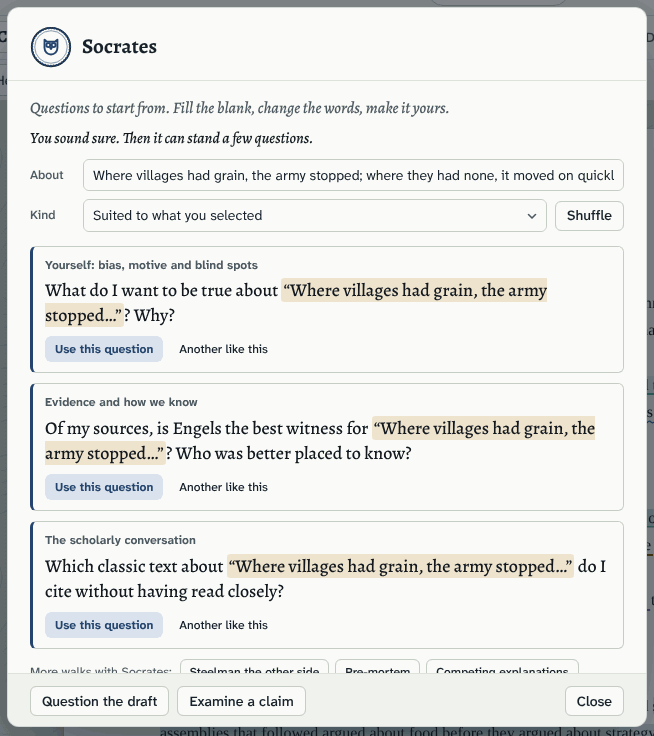
Select a word, a claim, a name, a number or a source before you open Socrates, and the questions are about it, with it filled into each one. Or type something into About. Leave it empty for questions about the piece as a whole.
Socrates works out what kind of thing you selected and deals questions that suit it:
- a term, such as logistics or hoplite: questions about meaning and definition;
- a claim, a sentence that asserts something: questions about evidence, assumptions and alternatives;
- a person or group: questions about motive, perspective and what we really know of them;
- a place or event: questions about causes, chronology and what might have happened otherwise;
- a number: questions about where it came from, what it measures and what it’s compared with;
- a source: questions about provenance, purpose and reliability.
Some questions name parts of your own project when it has them: one of your sources’ authors (one who writes about the selection, if any does), the chapter you’re in, or a thread the passage belongs to. “Would Waterfield use the word mercenary the way I do?” is more use than a question about “your sources”.
Choose a Kind to draw from just one, or leave it on any:
- Clarifying meaning and terms
- Evidence and how we know
- Assumptions
- Alternatives and competing explanations
- Implications and consequences
- Perspectives, actors and stakeholders
- Sources and provenance
- Causation
- Time, chronology and change
- Numbers, data and measurement
- Comparison, analogy and context
- Counterfactuals and contingency
- Intelligence analysis: hypotheses, indicators, deception, confidence
- Journalism and investigation: money, power, people
- Argument and the shape of the piece
- The reader
- Yourself: bias, motive and blind spots
- Questions about the question
- When you are stuck
- Ethics, harm and responsibility
- Method and research design
- Policy and recommendations
- The scholarly conversation
- Scene, character and story
The kind of writing you’re doing leans the choice: an intelligence brief draws more on intelligence-analysis and policy questions, a white paper on policy, literary journalism on journalism, perspectives and scene, an investigation on ethics, a thesis on causation, sources, method and the scholarly conversation. So do the kinds you use. Socrates keeps a count of which kinds you pick, in this browser’s settings, and deals those a little more often. It keeps nothing about what you selected or asked.
- Shuffle deals three more.
- Another like this swaps one card for another of the same kind.
-
Use this question makes it an open research question, linked to the passage you selected, ready to edit into your own words. It then shows in the Research tab, in the Plan and in the journal’s research design. Some questions have a second blank (
___) for you to fill.
The questions are a place to start, not a quiz. Rewrite them freely. A question you’ve turned into your own words is the one you’ll actually answer.
Question the draft, at the foot of the Socrates window, reads the document you’re in (or, with Read: Every chapter, the whole book) for places worth a question:
| Finding | What it looks for | The question it leads to |
|---|---|---|
| Claim of cause | led to, caused, resulted in, because of, drove | What’s the mechanism, and what else could explain it? |
| Sweeping word | always, never, everyone, nothing, entirely | Is it true of every case? |
| Sure of itself | clearly, obviously, undoubtedly, proves | Would a reader who doubts you be persuaded? |
| Unnamed authority | some historians say, studies show, experts agree | Who, exactly? Can you name and cite them? |
| Fact without a source | a date, figure or superlative in a paragraph with no citation | Where does this come from? |
| Hedged claim | it could be argued that, arguably, it seems that | Say it plainly, or not at all? |
| Round number | 10,000, thousands of, 50 percent | Who counted, how, and compared with what? |
Each sentence is listed once, under its most telling finding, with any others noted. The sentences are shaded in the page while the list is open. For each one:
- Questions about it deals three questions of the kind that suits the finding, about that sentence, ready to link to it.
- Examine it starts Examine a claim with that sentence.
- Go to it selects the sentence in the draft.
It’s a pattern, not a verdict. “Hunger led to the mutiny” may be exactly right; the point is that a careful reader will ask how.
Examine a claim walks you through the Socratic method in five short steps. It’s for a claim you’re about to build on, and want to be sure of first.
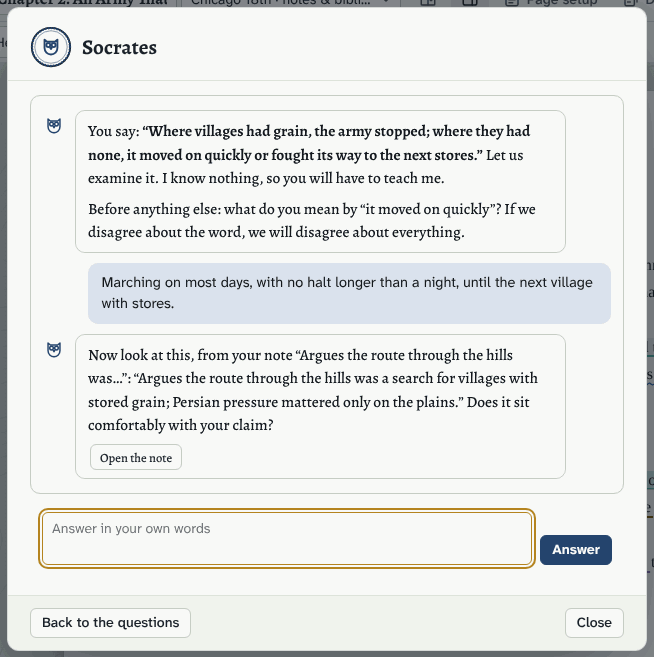
Start it from Examine a claim at the foot of the Socrates window. If you’ve selected a claim (or typed one into About), it begins with that; otherwise Socrates asks for one.
- What do you mean? Socrates picks out the claim’s key phrase and asks what you mean by it. “The march was decided by supply“: supply of what, to whom, and how would you know it was lacking? Answer in a sentence or two.
- What pushes against it? Socrates searches your own notes and paragraphs for a passage close to the claim that turns against it: a “but”, a “however”, a “fewer than”. It quotes the sentence and asks how your claim survives it, with a button to open the note or go to the paragraph. If nothing in the project pushes back, it says so and asks you to name the strongest objection yourself.
- Mend the claim. If the claim needs it, write the better version: narrower, hedged, or with its condition stated. Say “same” if it stands as it was.
- One last question. Socrates asks one more question about the mended claim, about its evidence, implications, alternatives or assumptions.
- Before and after. The summary sets out the claim as it was, what you mean by its key phrase, the passage it was tested against, and the claim as it is now.
From the summary:
- Save to the journal adds the whole exchange to today’s log, tagged socrates and linked to the note it was tested against. See The research journal.
- Copy the claim copies the mended claim, to paste into the draft.
- Examine another starts again.
- Back to the questions returns to the deck.
Press Enter to answer; Shift+Enter starts a new line.
The steps are the old ones: define the terms, find the counterexample, revise. What makes them useful in Anabasis is step two. The counterexample comes from your own research, so it’s the objection a reader who knows your sources would raise. Claims usually survive the exercise, but they come out narrower and better defended, and the journal keeps a record of why you worded them the way you did.
Under the questions, More walks with Socrates offers four other methods, each a short dialogue that ends with a summary you can save to the journal. Each starts from what’s in About if it fits.
The opposite of a straw man. Socrates asks for your position, who disagrees with it most seriously, and then for their case at its strongest, in their terms. It shows you a passage from your own project that bears on it, asks what you concede, and asks you to answer the strong version and restate your position. Keep their case as a note files it, tagged counterargument, for the chapter where you answer it.
Imagine the piece failed: the editor passed, readers weren’t convinced, a critic took it apart. Socrates asks for the most likely reason, the one you’d rather not think about, and one from outside the writing. Then it lists the warnings your project already shows (claims without sources, contested claims, TKs, an editor’s unanswered queries, sources rated D or below, falling behind your word target), and asks what you can prevent and what you’ll do first. Add the first step to next steps puts it in the journal.
The intelligence analyst’s method (Richards Heuer’s analysis of competing hypotheses). Name the question, then every explanation, including ones you don’t believe, then the evidence. Socrates suggests notes that might bear on it. Mark each piece of evidence against each explanation as consistent, inconsistent or neither, and Weigh them: the explanation that survives is the one with the least evidence against it. Evidence that fits every explanation is pointed out, because it proves less than it seems. The walk ends with what evidence would tell the leading explanations apart. Make them hypotheses in the journal adds each one to the research journal to track.
Name the word your argument rests on, define it in a sentence, give an example that counts and one that looks like it but doesn’t. Socrates then finds how you already use the word in your drafts and notes, and asks whether every use means what you just said. Keep the definition as a note files the result.
When you take a question with Use this question, it’s kept with the project, linked to the research question it became. Socrates won’t deal it again. When you open Socrates with nothing selected, an old question that’s still open comes back under From before: Answer it opens it on the research desk, Examine it starts Examine a claim, and Not now puts it off for three days. The foot of the window counts how many you’ve taken and how many are answered, and the Oracle mentions an old open one in its check-in.
There’s no model behind Socrates, only a list and some care in dealing from it:
- Each stem is tagged with the kinds of selection it suits. Questions meant for a person aren’t dealt for a number, and claim questions need a claim.
- A stem that names part of your project (an author, a chapter, a thread) is used only when the project has one.
- Long claims are shortened, so the question stays readable.
- A question isn’t dealt again until you’ve seen the rest of its kind.
- About one deal in three includes a question that names part of your project, when there’s one to ask.
The stems are in data/socrates.txt in the source code, in a simple format documented at the top of the file, if you want to see them all or suggest more.
A question written for one word can read badly around another. Socrates now fills the blank the way a careful writer would: the verb agrees with a plural (“Are the Ten Thousand one group, or several?”, “Where do mercenary armies begin and end?”), “a” becomes “an” before a vowel sound (“an FBI file”, but “a unit”), a question that opens with the blank starts with a capital, a possessive after a name ending in s is just an apostrophe, and a quotation inside quotation marks gets single ones.
- Select less, not more. A single term or one sentence gets sharper questions than a paragraph.
- Use “Yourself” and “When you are stuck” when the trouble isn’t the evidence but the writing.
- Examine the thesis. Run your thesis through Examine a claim before you build a draft on it, and again after.
- Keep the questions you use. A question made with Use this question stays linked to the passage until you mark it answered.