Repository navigation

Replies: 2 comments

|
In the OpenCitySense data model, the Thing of the Device is connected to the Thing of the Connector using the ControllingConnector / ControlledDevices relation. The Decoder that is used can also be found from the Device-Thing, through the DeviceModel. Of course this doesn't cover all aspects of ownership and provenance, since that goes further. Ownership and provenance are definitely topics that could be standardised. |
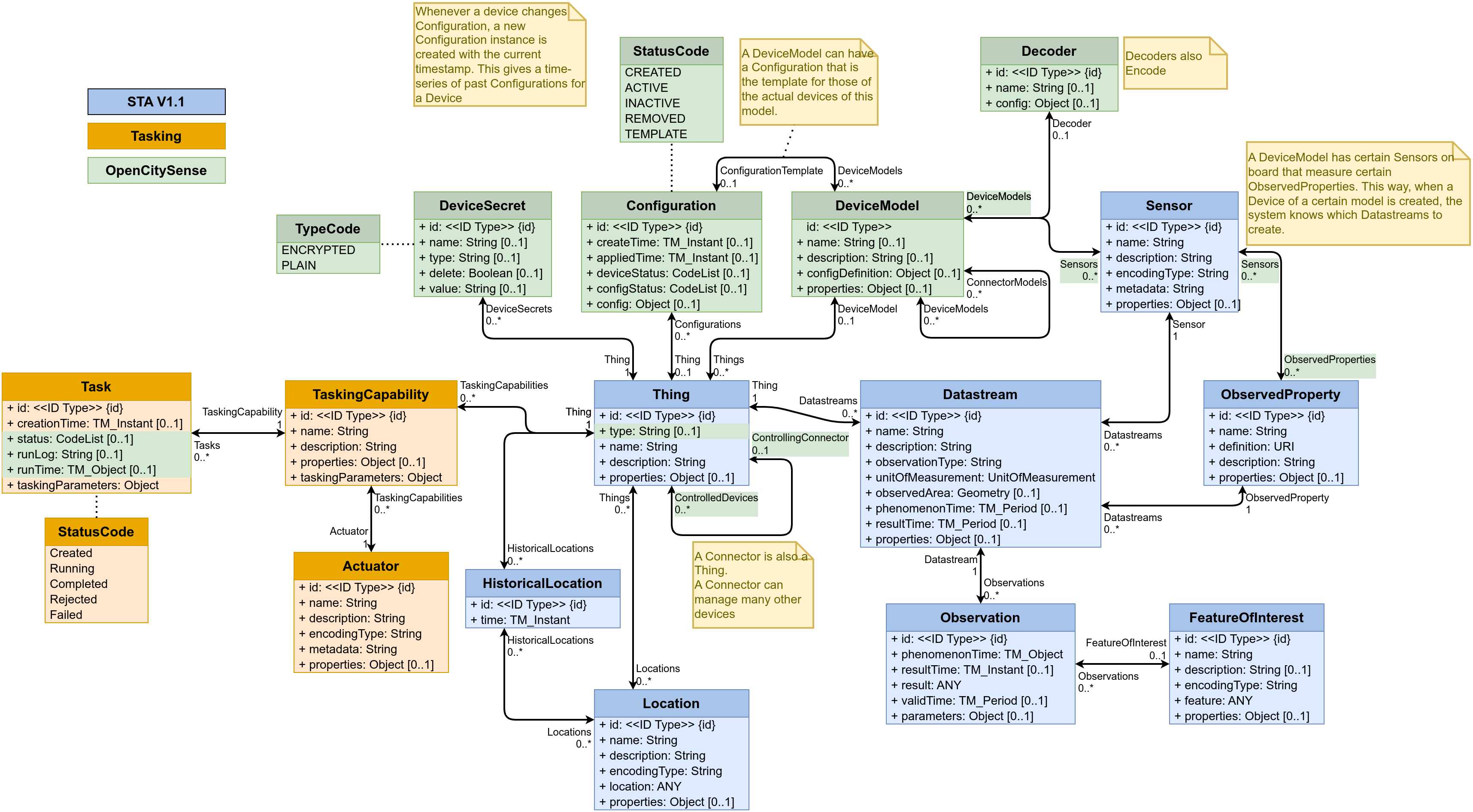

|
I've been thinking about this question for a while :) For now, I only have a strong opinion on the Traceability and Operations part. Regarding traceability, I believe it is best to keep a As for caching and duplicates, I agree it is important - in my implementation before creating any STA entity the system checks for "object existence". Perhaps it is more important to define what equivalence and identity in the STA context. |


Uh oh!
There was an error while loading. Please reload this page.
Uh oh!
There was an error while loading. Please reload this page.
Hi all,
Thanks to @justinschembri's work, we're now ingesting a healthy volume of Observations into the server.
What we're missing: given a Datastream or Observation, there's no reliable way to tell which connector produced it. In OGC SensorThings a "connector" isn't a concept at all (it's just a Thing) so at the protocol level nothing marks a Thing as a connector, nor links a Datastream back to the connector that writes to it. (We do have a small type extension on Thing today, but it's optional, not enforced, and doesn't bind the datastreams to it.)
Why I think this is worth solving:
Traceability: answering "where did this data come from?" end to end.
Ownership & transformation: which connector wrote a stream, and therefore which decoding/transformation was applied.
Operations: catching orphaned or duplicate data and attributing issues to the right source.
A few questions for the group:
Keen to hear how you all look at this.
Current datastreams (in screenshot all from @justinschembri)

All reactions