Repository navigation
Home
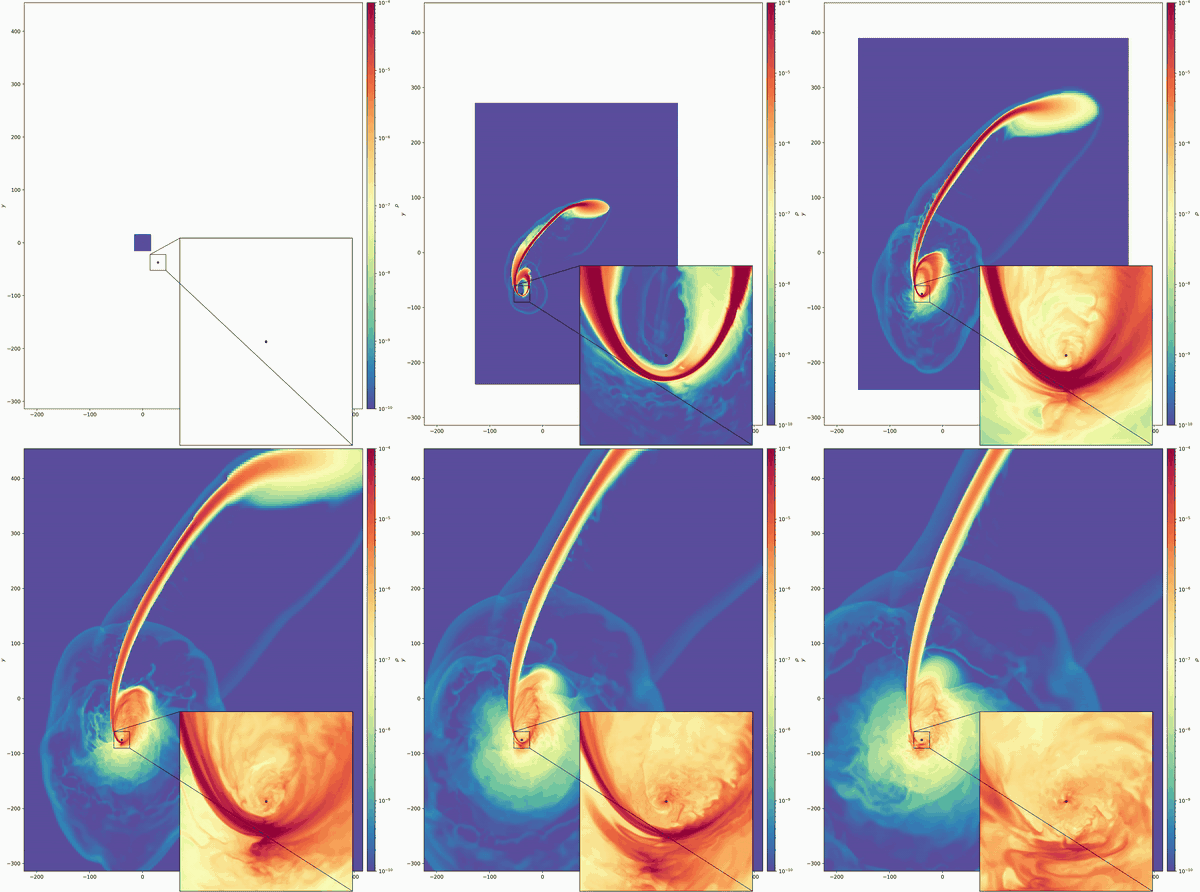
Fiducial (FID) tidal disruption run: gas density in the orbital plane over 7 Pmb.
YouTube ·
original-resolution MP4
An extended version of AthenaK for GPU simulations of self-gravitating, radiation-pressure-dominated astrophysical flows, with tools that turn the output into synthetic observables. Tidal disruption events are the first fully validated application (Jiang et al., An End-to-End Numerical Framework for Tidal Disruption Events with AthenaK, ApJS, arXiv:2609.37859); the components are not specific to TDEs. The code is in the repository; these pages mirror its documentation.
- End-to-end simulations on GPUs: tabulated H/He EOS with radiation pressure, multigrid self-gravity, dual energy, localized adaptive time stepping (LAT), conservative remapping and frame conversion, sink particles, and the TDE problem generator.
-
athenak_rt: synthetic observables from AthenaK snapshots (uniform or AMR): multifrequency H/He continuum transfer and grey reference modes, for any hydrodynamic snapshot written with the tabulated LTE EOS. Its radiative transfer follows the photospheric method of Yang et al. (2026, ApJ, 998, 118); publications that use it should cite Yang et al. (2026) and Jiang et al. (2026). See athenak_rt.
For general use of AthenaK, see the official AthenaK documentation and the upstream repository.
- Build with
-D PROBLEM=tde_external(see TDE User Guide). - Build the equation of state table with
./get_eos_table.shin the top-level directory. - Run the five-step example chain (TDE Example Inputs).
Synthetic observables: athenak_rt
- athenak_rt: overview
- athenak_rt: user guide (modes, options, tables, outputs, examples)
TDE workflow
Components
- Tabulated EOS, EOS Tables, Chabrier EOS Data
- Multigrid Self-Gravity
- Dual Energy
- Local Adaptive Time Stepping
- Remapping, Remap Usage
Hong-Xuan Jiang (masterjoe2000@outlook.com)