Visual MCP server manager for Claude Code. Toggle, configure, and manage your MCP servers from a browser UI instead of editing JSON files by hand.
Runs entirely on your machine. MCP Man is a local web server that reads and writes your local Claude Code config files. No data leaves your computer.
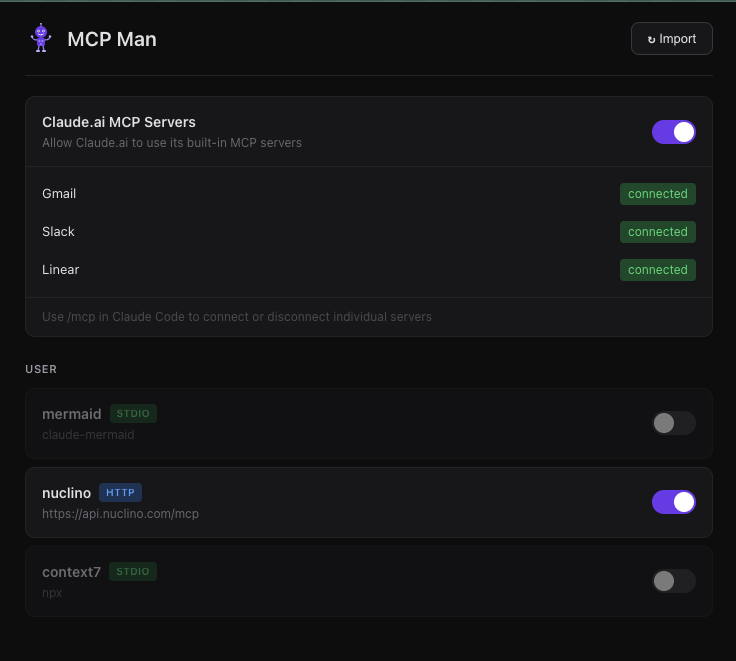
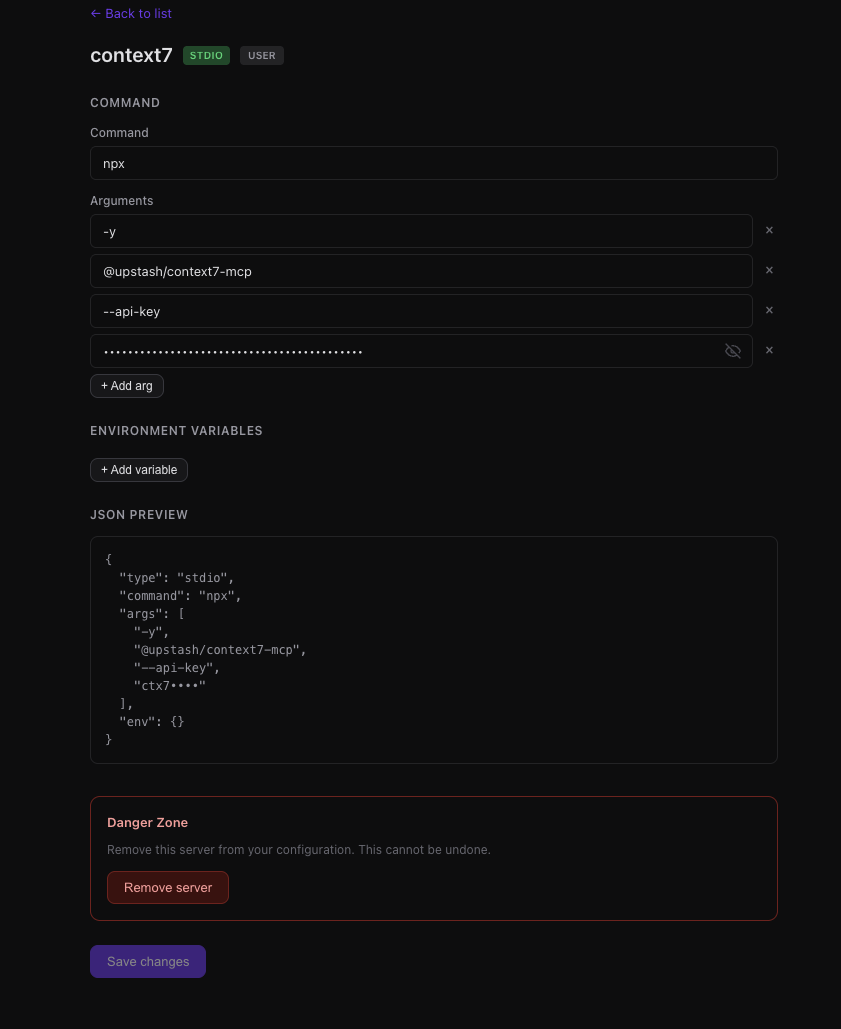
npx @isurur/mcp-manThis opens a local web UI where you can manage all your MCP servers. On first run, it automatically installs portless for a clean URL: http://mcp-man.localhost:1355
- Toggle servers on/off — enable or disable MCP servers with a single click, changes save instantly
- Edit server config — modify commands, args, env vars, headers, and URLs from the detail view
- Secret masking — API keys, tokens, and sensitive values are masked by default with reveal toggles
- Claude.ai MCP overview — see which Claude.ai servers (Gmail, Slack, Linear, etc.) are connected
- Multi-scope support — manage both user-level (
~/.claude.json) and project-level (.mcp.json) servers - Restart reminder — a banner reminds you to restart Claude after saving config changes
- Single instance — only one mcp-man runs at a time; re-running opens the existing session
- Portless integration — automatically uses
mcp-man.localhostinstead of a random port
npx @isurur/mcp-man [options]

Options:
  --project <path>   Add a project directory to manage (can be repeated)
  --no-portless      Skip portless integration, use localhost with port
  --help, -h         Show help
# Basic usage
npx @isurur/mcp-man

# Manage project-specific MCP servers
npx @isurur/mcp-man --project /path/to/my-project

# Multiple projects
npx @isurur/mcp-man --project ./project-a --project ./project-b

# Without portless
npx @isurur/mcp-man --no-portlessMCP Man reads and writes the same config files Claude Code uses:
- User servers —
~/.claude.json→mcpServers - Project servers —
.mcp.jsonin project directories - Claude.ai toggle —
~/.claude/settings.json→ENABLE_CLAUDEAI_MCP_SERVERS
Changes are written directly to these files, so they take effect on the next Claude Code restart.
MIT